The Central Board of Indirect Taxes and Customs (CBIC) has released a comprehensive consolidated document containing the latestGST rates on goods, effective from 22nd September 2025. This step has been taken to provide greater clarity to taxpayers, traders, and businesses by compiling all recent notifications and amendments into a single updated list.
The GST Council, in its recent meeting, announced major changes in GST rates across multiple categories of goods. These changes, effective from 22.09.2025, are aimed at rationalizing tax slabs, reducing consumer burden on essential items, and boosting demand in sectors like FMCG, automobiles, and consumer durables.
How to Access the Official List
The consolidated list has been published on the official CBIC GST portal and can be downloaded in PDF format. Stakeholders are advised to check the latest rates before issuing invoices post 22.09.2025.
The Central Board of Direct Taxes (CBDT) has released a circular (13/2025) wherein certain benefit has been given to those who claimed Section 87A tax rebate for special rate income like short term capital gains (STCG) on sale of equities and got a tax notice with demand.
According to this circular, if you had claimed Section 87A tax rebate on special rate income like STCG on equities and this claimed was accepted also, then you can get a tax demand notice. However, if you pay this tax demand by December 31, 2025 then any penal interest if levied will be waived. If you don’t pay the tax demand by December 31, 2025 for such Section 87A tax rebate cases then the interest will be levied.
Expert said to ET Wealth Online: “This circular provides indication to those taxpayers who could have claimed Section 87A tax rebate on STCG income prior to July 5, 2024. These taxpayers will get a tax notice for claiming Section 87A tax rebate. After judgment of Bombay High Court for restricting 87A claim in ITR and several lower court judgments allowing 87A, relief was expected from income tax department. However, by issuing this circular department, it is clear that litigation on 87A is likely to increase. Circular give marginal relief that even if tax payer doesn’t pay demand within 30 days of receiving this tax notice, interest at 1% per month will not be payable. This present circular (13/2025) has waived off the interest, if the taxpayer pays the tax demand on or before December 31, 2025.”
What did CBDT say in the circular?
CBDT in the circular (13/2025) dated September 19, 2025 said the following:
The provisions of Section 115BAC(1A) of the Income-tax Act, 1961 are subject to the other provisions of Chapter XII. Therefore, incomes chargeable to tax at special rates specified under various provisions of Chapter XII are not included while determining the chargeability to tax under Section 115BAC(1A). Further, the clause (b) of proviso to Section 87A is applicable to incomes chargeable to tax under Section 115BAC(1A).
It is noticed that in certain cases, the returns had already been processed and rebate was allowed under Section 87A on incomes chargeable to tax at special rates. In such cases, rectifications have to be carried out to disallow such Section 87A tax rebate, which has been incorrectly allowed. Such rectifications will result in demands getting raised. If the payments of such demands raised are delayed then the same are liable for charging of interest under Section 220 (2).
In order to mitigate the genuine hardship arising to such taxpayers on account of interest payable under Section 220 (2), the CBDT in exercise of its powers conferred under Section 119, directs that the interest payable under Section 220(2) shall be waived in such cases where the payment of the tax demands raised, is made on or before December 31, 2025.
In such cases, if a taxpayer fails to pay the tax demand raised as a result of rectification order passed by the CPC on or before December 31, 2025, the interest shall be charged under Section 220(2) from the day immediately following the end of the period mentioned in sub-section (1) of Section 220.
Circular 13/2025
Also read: Father sold family land for daughter’s marriage; first son alleged father was alcoholic and filed a case but lost in Supreme Court due to this reason
What is the issue that is causing such problems regarding claiming of 87A tax rebate
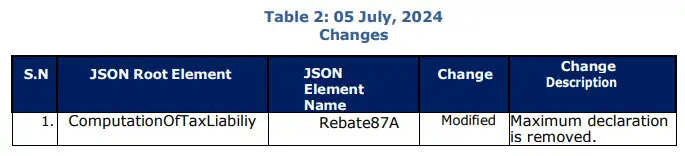
According to an earlier Economic Times report dated July 21, 2024, the ITR filing utilities stopped allowing tax rebate under section 87A for various special rate incomes including short-term capital gains on equity shares or equity-oriented mutual funds taxable at 15% under Section 111A.
ITR-2 Schema
“Earlier the Income Tax Utility Software allowed filing of ITRs with rebate, but after July 5, 2024, a whole controversy arose due to change of schema of utility software by the income tax department. Pursuant to those ITRs which were filed with tax rebate are now getting intimation notices for tax demand equivalent to amount to rebate availed. Recently, more than 500 demand notices were received by members of Chartered Accountants Association Surat. Where there was a refund due, the amount of rebate was deducted from it after processing of the ITR,” said Expert
Once the rebate facility was stopped, taxpayers could not claim 87A rebate in conjunction with the special tax rate like STCG. Many people were previously allowed to make this claim, and now they are receiving tax demand notices as a result. “Those taxpayers who have claimed rebate, using old utility or adjusting 87A rebate amount, are now getting a tax notice wherein tax demand is raised with reduced amount of rebate,” said Expert
As companies worldwide unveil their Q3 2025 earnings, traders and investors are getting a clearer picture of the global economy’s momentum — and its weak spots.
From tech giants to retailers, every sector is revealing something about consumer strength, inflation impact, and investor confidence.
Key Takeaway
Quarter three results are shaping global market sentiment. Strong tech earnings are boosting optimism, while consumer and retail sectors show growing caution.
For traders, even one comment in an earnings call can send shockwaves through markets — making this season a critical moment to stay alert.
Tech Takes the Lead
Technology firms are once again driving global optimism. AI, semiconductor, and cloud companies have delivered solid results, reassuring investors that last year’s growth wasn’t just a one-time surge.
And it’s not just Wall Street reacting — European and Asian markets are following suit, proving that tech continues to anchor global sentiment.
Retail Feels the Pressure
Retailers, however, are facing mounting challenges. Rising tariffs, inflation, and changing consumer habits are eating into margins. Even companies showing higher revenues are struggling with shrinking profits.
The question remains: can consumer demand hold through the final quarter of 2025?
Financials and Real Estate: A Mixed Bag
Higher interest rates have helped banks with better margins but slowed loan growth. Real estate firms are still adjusting to new demand dynamics, especially in major cities.
This mix makes financials tricky — one strong result can mask underlying weakness elsewhere. Traders using flexible tools like CFDs can adapt quickly, hedging against risk while seizing short-term opportunities.
Interest Rates: Central bank signals can easily overshadow even strong results.
Currency Moves: Exchange rate fluctuations remain a key factor in cross-border earnings.
Geopolitics: Supply chain shifts and policy uncertainty keep volatility alive.
Sector Snapshot
Sector
Trend
Outlook
Tech
Strong rebound
Continued momentum
Retail
Margin pressure
Depends on consumer demand
Financials
Mixed
Sensitive to rate decisions
Energy
Volatile
Benefiting from price swings
Traders Should Ask:
Can tech maintain its growth pace into Q4?
Will consumers keep spending through higher costs?
Could higher rates hurt credit growth?
Are commodities still a safe hedge against volatility?
Setting the Tone for the Year-End
Q3 2025 earnings are setting the stage for how markets will close out the year. Tech’s strength brings confidence, but consumer caution and sectoral divergence keep uncertainty high.
For traders, adaptability is the key — those watching closely and reacting quickly could find opportunity amid volatility.
The Government of India, Ministry of Finance, has issued Notification No. 15/2025 – Central Tax, dated 17th September 2025 under the Central Goods and Services Tax Act, 2017. This notification provides significant relief to small taxpayers regarding the filing of annual returns under GST.
Key Highlights of the Notification
Legal Basis
Issued under the powers conferred by the first proviso to Section 44(1) of the CGST Act, 2017. Based on the recommendations of the GST Council.
Applicability
Effective for the Financial Year 2024–25 onwards. Applies to registered persons whose aggregate turnover in a financial year is up to ₹2 Crore.
Exemption Granted
Such taxpayers are exempted from filing the annual return (Form GSTR-9) for the said financial year.
Practical Impact
Ease of Compliance
Small taxpayers (with turnover ≤ ₹2 Crore) no longer need to prepare and file an annual return, reducing compliance burden.
Automatic Exemption
The exemption is automatic – eligible taxpayers are not required to submit any separate request or application.
Applicable from FY 2024–25
The exemption covers annual returns due in FY 2025–26 (for the financial year 2024–25) and onwards.
Who Still Needs to File GSTR-9?
Taxpayers with aggregate turnover above ₹2 Crore in any financial year.
The Central Board of Indirect Taxes and Customs (CBIC) on Friday issued a fresh clarification on how secondary or post-sale discounts should be treated under GST, addressing doubts for manufacturers, dealers, and distributors. The move is aimed at bringing uniformity in implementation across tax authorities and reducing disputes.
Full ITC allowed despite post-sale discounts
The circular clarified that when a supplier gives a discount after the sale through a financial or commercial credit note (instead of a GST credit note), the buyer does not have to worry about reversing Input Tax Credit (ITC).
CBIC said that a financial or a commercial credit note only adjusts the payment between the supplier and the buyer — it does not change the taxable value or GST amount charged in the original invoice. Since the GST liability on that invoice remains the same, the buyer’s entitlement to ITC also stays the same.
For instance lets say a manufacturer sells goods worth ₹1,00,000 + ₹18,000 GST to a dealer. Later, the manufacturer gives a ₹10,000 discount via a financial credit note. Here the GST remains ₹18,000 and the dealer can still claim full ITC, even though he paid only ₹1,08,000 (₹90,000 + ₹18,000).
Discounts between dealers and manufacturers
When manufacturers give discounts to dealers to help them offer competitive pricing, these are treated as price reductions and not as payments for services. Such discounts, given on a principal-to-principal basis, are not part of “consideration” under GST. Simply put, dealers don’t need to treat these discounts as taxable income for services.
Lets say a dealer buys shoes at ₹1,000 + GST from a manufacturer. Later, the manufacturer gives ₹50 discount per pair to push sales. Here the sale price reduction will not impact the total GST.
Discounts linked to agreements
The circular draws a distinction in cases where a manufacturer has an agreement with the end customer to supply goods at a lower price. If the manufacturer issues a credit note to the dealer to ensure the final customer gets the discounted rate, such a discount will be considered part of the overall “consideration” for supply.
For example, if the manufacturer signs an agreement with a corporate buyer that the shoes must be sold to employees at ₹900, the manufacturer issues credit notes to the dealer to cover the discount. In this case, the discount is linked to the end sale and becomes part of consideration—GST impact may arise.
Separate GST liability for promotional activities
CBIC stated that if dealers merely use the discount to push sales, no extra GST applies. However, if they undertake specific promotional activities like advertising, co-branding, exhibitions, or customer support on behalf of the manufacturer under a clear agreement, then GST will apply on those services separately.
Vivek Baj, partner, Economic Laws Practice called this is a welcome step because earlier, he said. many such discounts were being questioned by tax authorities as hidden payments for promotional services, which created a lot of disputes.
“The clarification, along with the GST Council’s recent proposal to remove the requirement of proving discounts through agreements, will go a long way in reducing unnecessary litigation. Since the clarification is clarificatory in nature, it will also help resolve ongoing cases from the past,” Bajaj added.
The Central Board of Indirect Taxes and Customs (CBIC) has released a series of Central Tax (Rate) Notifications on 17th September 2025 to implement the decisions of the 56th GST Council meeting. These notifications primarily deal with GST rate changes and amendments to earlier notifications. All changes are effective from 22nd September 2025.
Download Links:
Number
Date
Subject
Download
17/2025-Central Tax (Rate)
17-Sep-2025
Seeks to amend Notification No. 3/2017- Central Tax (Rate) dated 28.06.2017.
09/2025 & 10/2025: Supersede the original 2017 rate and exemption notifications, thereby consolidating all GST rates under the new GST 2.0 regime.
11/2025 & 17/2025: Amendments to Notification 3/2017 (concessional rate supplies for exploration and production).
12/2025 & 16/2025: Amendments to Notification 12/2017 (service exemptions).
15/2025: Amends Notification 11/2017 relating to GST rates for services.
13/2025 & 12/2025: Amendments to notifications relating to concessional GST on handicraft items and earlier changes to service rates.
14/2025: Notifies revised GST rate for bricks, in line with the Council’s decision (sand lime bricks reduced to 5%).
GST 2.0. Central Tax (Rate) Notifications
Earlier Notification No. & Date of Issue
Subject
New Notification No.
Date
21/2018-Central Tax (Rate), dt. 26-07-2018
Seeks to prescribe concessional CGST rate on specified handicraft items, to give effect to the recommendations of the GST Council in its 28th meeting held on 21.07.2018
Amended by 13/2025-Central Tax (Rate)
17.09.2025
08/2018-Central Tax (Rate), dt. 25-01-2018
Seeks to amend Notification No.1/2017-CGST (Rate)
Amended by 12/2025-Central Tax (Rate)
17.09.2025
12/2017-Central Tax (Rate), dt. 28-06-2017
To notify the exemptions on supply of services under CGST Act
Amended by 16/2025-Central Tax (Rate)
17.09.2025
11/2017-Central Tax (Rate), dt. 28-06-2017
To notify the rates for supply of services under CGST Act
Amended by 15/2025-Central Tax (Rate)
17.09.2025
03/2017-Central Tax (Rate), dt. 28-06-2017
2.5% concessional CGST rate for supplies to Exploration and Production notified under section 11(1)
Amended by 11/2025-Central Tax (Rate) & 17/2025-Central Tax (Rate)
17.09.2025
02/2017-Central Tax (Rate), dt. 28-06-2017
CGST exempt goods notified under section 11(1)
Superseded by 10/2025-Central Tax (Rate)
17.09.2025
01/2017-Central Tax (Rate), dt. 28-06-2017
CGST Rate Schedule notified under section 9(1)
Superseded by 09/2025-Central Tax (Rate)
17.09.2025
Conclusion
These notifications mark the implementation of GST 2.0, simplifying rate structures and clarifying exemptions. Businesses must now:
Update billing and ERP systems with revised rates effective 22nd September 2025.
Review service contracts and supply chains impacted by amended exemption/rate notifications.
Pay close attention to transitional compliance, especially for goods like bricks, handicraft items, pharma products, and services under concessional/exempt categories.
Together, these changes give legal effect to the recommendations of the 56th GST Council and begin a new phase of GST compliance in India.
The 56th GST Council meeting held on 3rd September 2025 introduced a landmark set of changes that are being popularly referred to as GST 2.0.
To implement these decisions, the Central Government issued a series of Gazette Notifications on 17th September 2025, which come into force from 22nd September 2025. The most important of these are:
The GST Council, in its 56th meeting held on 3rd September 2025, along with subsequent circulars and clarifications, has brought several important changes impacting businesses, service providers, and consumers. The National Pharmaceutical Pricing Authority (NPPA) and the GST Council have issued detailed guidelines on GST rates, exemptions, and compliance procedures. Below is a simplified breakdown of the key points.
1. Medicines & Medical Devices – Revised MRP Implementation
All drug manufacturers/marketers must revise the Maximum Retail Price (MRP) of medicines and devices to reflect revised GST rates.
A revised/supplementary price list (Form V/VI) must be issued to dealers, retailers, State Drug Controllers, and the Government.
Re-labelling or recalling old stock (before 22nd Sept 2025) is not mandatory, provided compliance is ensured at the retailer level.
2. GST on Drones
Previously, drones attracted different GST rates depending on usage (5%, 18%, or 28%).
Now, a uniform 5% GST applies to all drones, irrespective of type or use.
3. GST on Bricks
Under the Special Composition Scheme (from April 2022):
Bricks attract 6% GST without ITC or 12% with ITC (threshold ₹20 lakhs).
No major change in Sept 2025, except:
Sand lime bricks – GST rate reduced from 12% to 5%.
4. Life & Health Insurance Services
Individual life and health insurance policies (including for family) are exempt from GST.
Reinsurance services for such policies are also exempted.
Other inputs (like brokerage/commission) – ITC to be reversed since output is exempt.
5. Hotel Accommodation Services
For rooms costing ≤ ₹7,500/day:
GST is 5% without ITC (mandatory).
Hotels cannot opt for 18% with ITC on such rooms.
6. Beauty & Wellness Services
Attract 5% GST without ITC (mandatory).
Service providers cannot opt for 18% with ITC.
7. Input Tax Credit (ITC) Rules for 5% without ITC Supplies
ITC cannot be taken for goods/services exclusively used for such supplies.
For mixed-use inputs, proportionate ITC reversal is required under Section 17(2) of CGST Act.
8. Job Work Services
Bus body building – 18% with ITC.
Bricks job work – 5% with ITC (where output bricks attract 5%).
9. Multimodal Transportation of Goods
Without air transport: 5% GST with restricted ITC (limited to 5% of value of transport input services).
With air transport involved: 18% GST with full ITC.
10. Local Delivery Services via E-Commerce Operators (ECOs)
Covered under Section 9(5) CGST Act.
GST @18% applicable:
If supplied by unregistered person via ECO → ECO pays GST.
If supplied by registered person via ECO → Supplier pays GST.
ECO-provided delivery services are not treated as GTA (Goods Transport Agency).
11. Leasing & Renting Services
Without operator → taxed at same rate as supply of like goods.
On 12th September 2025, the Central Board of Indirect Taxes and Customs (CBIC) issued Circular No. 251/08/2025-GSTto address long-standing doubts on the GST treatment of secondary or post-sale discounts. The clarification aims to bring uniformity in practice across taxpayers, dealers, and field formations.
Many suppliers issue financial or commercial credit notes after sales, reducing the amount payable by the buyer.
Earlier, there was confusion if the recipient should reverse ITC in such cases.
Clarification:
Supplier issuing a financial/ commercial credit note cannot reduce their original tax liability.
Since the tax charged originally remains unchanged, recipient is not required to reverse ITC.
Example: If goods worth ₹1,00,000 + GST ₹18,000 were sold, and later supplier issues a ₹10,000 commercial credit note, the GST still applies on ₹1,00,000. Buyer keeps full ITC of ₹18,000.
2. Post-Sale Discounts & Consideration
Question: If a manufacturer gives a discount to a dealer, can it be treated as “consideration” for the dealer’s sale to the end customer?
Clarification:
Normally, the manufacturer sells to the dealer, and the dealer sells to the customer — these are two independent principal-to-principal transactions.
A discount given by the manufacturer simply reduces the dealer’s purchase price, helping competitive pricing. It is not an inducement and hence not “consideration”.
Exception: If the manufacturer has a direct agreement with the end customer to sell at a discounted price, and instructs the dealer accordingly, then such a discount is treated as part of the consideration (since it influences the supply to the end consumer).
3. Post-Sale Discounts vs. Promotional Services
Dealers sometimes undertake promotional activities after receiving discounts.
Clarification:
If these activities are incidental (e.g., boosting their own sales), the discount is simply a reduction in sale price, not payment for services.
However, if there is a specific agreement where the dealer provides services like:
Advertising campaigns
Co-branding
Special sales drives
Customer support
Exhibitions or events
Customization/branding services
then these are independent supplies of service and GST will apply on the consideration received for such services.
Practical Impact of This Circular
For Dealers/Distributors
Can continue to avail full ITC even when receiving post-sale discounts via financial/ commercial credit notes.
No ITC reversal required unless linked with a formal agreement involving promotional services.
For Manufacturers
Discounts given for competitive pricing will not attract GST as “consideration”.
But if discount is tied to a specific end-customer agreement or services rendered by dealer, GST may apply.
For Auditors & Tax Professionals
Important to check agreements carefully — whether a discount is just commercial in nature or tied to service obligations.
This distinction affects GST liability significantly.
Conclusion
The new Circular No. 251/08/2025-GST clears a long-pending ambiguity around post-sale discounts.
Normal trade discounts = No GST impact, no ITC reversal.


 Background
 How to Access the Official List




 Key Highlights of Notifications
 Key Issues Addressed in the Circular
 Conclusion