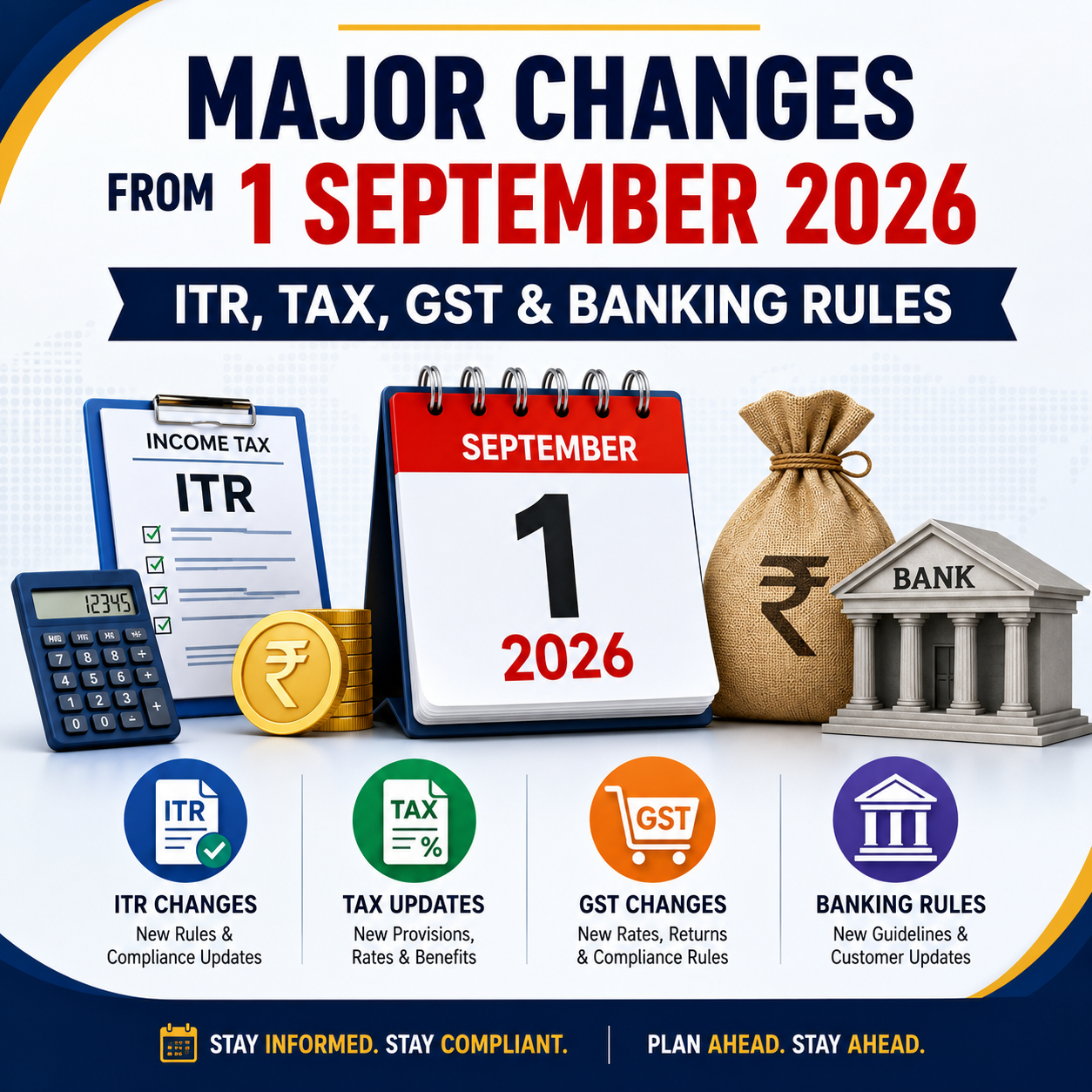
New Rules from 1 September 2026: Key Updates on ITR, Tax, GST and Banking

From 1 September 2026, several important developments will affect taxpayers, bank customers, and businesses. However, it would not be technically correct to say that every change is a “new law effective from 1 September.” Some are consequences arising after the 31 August deadline, while others are important regulatory developments scheduled during September. Certain banking-related changes may also vary from one bank to another.

Therefore, this article explains the key changes and developments that taxpayers, businesses, and bank customers should be aware of from 1 September 2026 onwards, particularly:

  • ITR filing after 31 August
  • Filing of Belated ITR
  • New timeline for Revised ITR
  • 57th GST Council Meeting
  • ATM withdrawal charges
  • Possible changes in bank-specific charges
  • New security features and alphanumeric codes in cheque books
  • Important tax compliance deadlines in September

ITR Filing: 31 August Deadline Has Ended

One of the most significant developments concerns Income Tax Return filing.

For AY 2026-27, the applicable due date for non-audit taxpayers to file their ITR was 31 August 2026. Therefore, after 31 August, the normal deadline for filing an original return under Section 139(1) has expired.

The Income Tax Department has also clarified that 31 August 2026 was the applicable due date for non-audit taxpayers for AY 2026-27.

Accordingly, if an eligible taxpayer files an ITR on or after 1 September 2026, it will generally be treated as a Belated Return.


Which ITR Can Be Filed After 1 September?

Missing the 31 August deadline does not mean that taxpayers can no longer file their ITR.

Taxpayers who failed to submit their original return by 31 August can still file a Belated Return, subject to the applicable provisions.

For AY 2026-27:

Last Date for Filing Belated ITR: 31 December 2026

As per the Income Tax Department, a belated return for AY 2026-27 can be filed up to 31 December 2026, subject to the earlier completion of assessment.

However, filing a belated return may attract the applicable late filing fee:

  • Total income up to ₹5 lakh → ₹1,000
  • Total income above ₹5 lakh → ₹5,000

In addition, interest on outstanding tax liability may also apply wherever applicable.

Therefore, the key takeaway from 1 September is:

ITR filing does not stop after 31 August. However, returns filed after the deadline will generally be treated as Belated Returns, and applicable late filing fees may be payable.

Major Change in the Revised ITR Filing Timeline

There is an important change regarding Revised Income Tax Returns for AY 2026-27.

If you have already filed your ITR within the prescribed time and later discover any issue, such as:

  • Income was not reported;
  • An incorrect deduction was claimed;
  • Bank interest was missed;
  • There was an error in reporting capital gains;
  • A TDS mismatch was noticed;
  • Incorrect information was entered;

you can generally file a Revised Return to correct the details.

The timeline for filing a revised return has also been extended compared with the earlier framework.

New Last Dates for Revised ITR

31 December 2026

If the Revised ITR is filed on or before 31 December 2026, the return can be filed within this extended timeline without the additional fee prescribed under Section 234I.

31 March 2027

A Revised ITR can also be filed between 1 January 2027 and 31 March 2027. However, in such cases, the additional fee prescribed under Section 234I will apply.

The Income Tax Department’s current FAQs specifically confirm that for AY 2026-27, a revised return can be filed up to 31 March 2027, subject to completion of assessment. A revised return filed after 31 December 2026 will attract the applicable Section 234I fee.

In Simple Terms:

Type of ITR Last Date Consequence
Original ITR – Non-Audit 31 Aug 2026 Normal due date has expired
Belated ITR 31 Dec 2026 Late filing fee + applicable interest
Revised ITR 31 Dec 2026 No Section 234I additional fee
Revised ITR after 31 Dec 31 Mar 2027 Section 234I additional fee applicable

Therefore, if you have already filed your ITR but later realize that there is an error or omission, filing the revised return before 31 December 2026 may be financially more beneficial.


Important Difference Between Belated and Revised ITR

Taxpayers should clearly understand the difference between these two types of returns.

Belated Return

If the original ITR was not filed within the applicable due date:

31 August deadline missed → Belated ITR

Revised Return

If the ITR has already been filed and an error is discovered later:

ITR already filed → Revised ITR

Therefore, a taxpayer who did not file the ITR by 31 August 2026 will generally need to file a Belated Return.

On the other hand, a taxpayer who filed the ITR on or before 31 August 2026 but later discovers an error can generally file a Revised Return to correct it.

57th GST Council Meeting: Major Meeting Scheduled for 12 September

September brings an important development for GST taxpayers and businesses.

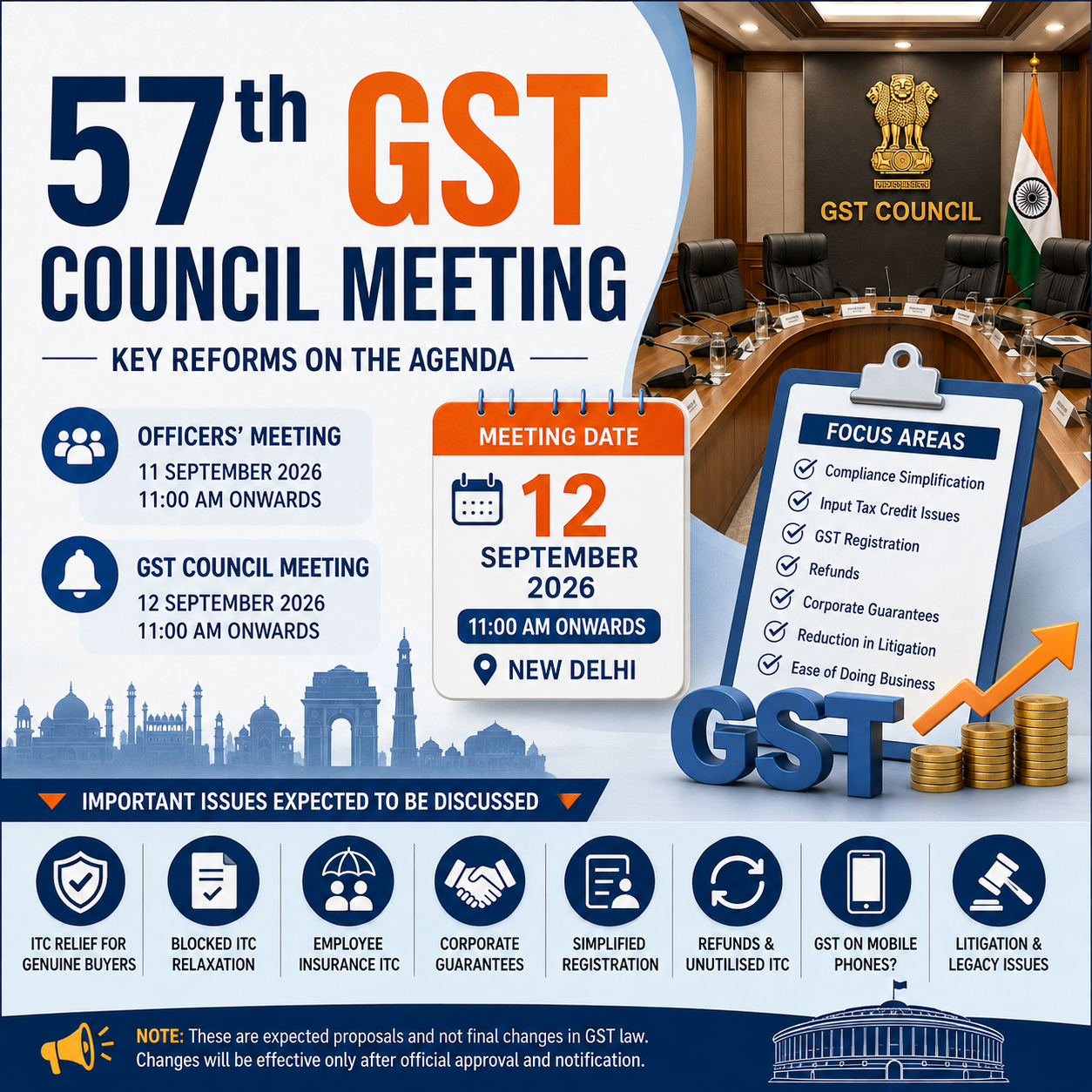
The 57th GST Council Meeting is scheduled to take place in New Delhi on 12 September 2026.

According to the official memorandum issued by the GST Council Secretariat:

57th GST Council Meeting

Date: 12 September 2026
Time: 11:00 AM onwards

A meeting of GST officers will also be held one day earlier:

Officers’ Meeting

Date: 11 September 2026
Time: 11:00 AM onwards

This GST Council meeting is being held after a gap of more than a year since the previous Council meeting.


ATM Cash Withdrawal Charges

Now let us look at an important development concerning the banking sector.

Under the RBI’s existing framework, customers are entitled to a certain number of free ATM transactions every month.

At the customer’s own bank’s ATM, the general framework provides for:

5 Free Transactions

At another bank’s ATM:

Metro Cities — 3 Free Transactions

Non-Metro Cities — 5 Free Transactions

Once the free transaction limit is exhausted, banks may charge up to ₹23 per transaction, along with applicable taxes.


Are All Banks Increasing ATM Charges from 1 September?

No.

This distinction is very important.

The RBI specifies the maximum permissible charges, while individual banks determine their actual applicable fee structure within the regulatory framework.

Therefore:

ATM charges can differ depending on the bank and the type of account.

For example, certain banks may have separate charges for:

  • Additional ATM transactions;
  • Non-financial ATM transactions;
  • Cash withdrawals;
  • Balance enquiries.

Customers should therefore check their bank’s latest Schedule of Charges to understand the applicable fees during September.

Important Point

It would be incorrect to assume that ₹23 is a fixed charge for every ATM transaction.

The ₹23 amount relates to the applicable maximum customer charge after the prescribed free transaction limit has been exceeded, subject to the RBI framework.


ATM Transaction Failed but Money Was Debited?

This is another important protection available to bank customers.

If an ATM transaction fails and:

  • Money is debited from the bank account; but
  • Cash is not dispensed by the ATM,

the bank is required to reverse the amount within the prescribed timeline.

Under the RBI framework, failed ATM transactions have an outer reversal timeline of T+5 calendar days.

If the amount is not reversed beyond this prescribed period, a compensation of ₹100 per day is applicable.

Therefore, if an ATM transaction fails, customers should not simply wait for the refund.

Keep records such as:

Bank statement + ATM receipt + Complaint Number

New Alpha-Numeric Security Code May Be Introduced in Cheque Books

Cheque users may also see an important development going forward from September.

Several banks are introducing additional security features in cheque leaves to strengthen cheque security and reduce the risk of cheque fraud.

One such feature is the Alpha-Numeric Code.

An alpha-numeric code means that, instead of using numbers alone, a combination of letters and numbers may be printed on the cheque leaf.

The primary objective is to strengthen cheque authentication and help prevent fraudulent cheque transactions.

For example, policy documents of Bank of India mention the Alphanumeric Code as an enhanced security feature, and the bank has introduced it in its new-series cheque books.


Will All Old Cheque Books Become Invalid After 31 December 2026?

Customers should be cautious about such claims circulating on social media.

Some banks have issued communications asking customers to adopt new-series cheque books with enhanced security features.

However, it would be incorrect to claim that:

“The RBI has made all old cheque books across India automatically invalid after 31 December 2026.”

Requirements for replacing an existing cheque book may depend on the specific instructions issued by the respective bank.

Therefore, if your bank asks you to:

  • Obtain a new cheque book;
  • Replace your existing cheque series;
  • Use a newly introduced alphanumeric security code;

you should follow the bank’s instructions.

Customers who frequently use cheques for high-value transactions should especially verify the validity of their cheque book and any applicable security requirements.

The RBI’s Cheque Truncation System (CTS) framework has also continued to focus on cheque security, standardisation, and prevention of cheque-related fraud.


Second Advance Tax Instalment Due in September

September is important not only for banking and ITR matters but also for Income Tax compliance.

For taxpayers covered by the advance tax provisions, 15 September 2026 is an important due date for the second instalment of Advance Tax.

Generally, cumulative advance tax payments are scheduled as follows:

15 June → 15%

15 September → 45%

15 December → 75%

15 March → 100%

These percentages are subject to the applicable provisions and taxpayer circumstances.

Therefore, taxpayers who are liable to pay advance tax should review their estimated income, tax liability, and payments already made before the September deadline.


GST Compliance Also Remains Important in September

September is also an important month for GST taxpayers because of various regular compliance deadlines.

Monthly filers should keep track of the applicable due dates for August 2026 transactions, including returns and tax payments.

Important GST compliances may include:

  • GSTR-1
  • GSTR-3B
  • GSTR-7
  • GSTR-8
  • GSTR-5
  • GSTR-6
  • QRMP-related payments

Taxpayers should verify the applicable due dates based on their registration type and filing frequency.

Moreover, the 12 September GST Council Meeting makes September 2026 particularly significant from the perspective of GST policy developments.


Another Important Income Tax Deadline in September

September is also significant for taxpayers covered by tax audit requirements.

For applicable tax audit cases for AY 2026-27, the Tax Audit Report is due by 30 September 2026, while the corresponding ITR filing deadline may fall later depending on the applicable category.

The Income Tax Department has also clarified the tax audit report timeline for AY 2026-27.

Therefore, audit taxpayers should not assume:

“The ITR due date is in October, so there is no compliance required in September.”

The Tax Audit Report must be submitted first, within the prescribed timeline.


MCA DIR-3 KYC: No Longer an Annual Requirement

The MCA has provided an important compliance relief for company directors.

Earlier, DIN holders generally had to complete DIR-3 KYC compliance every year.

However, the MCA has amended the Companies (Appointment and Qualification of Directors) Rules and changed the annual KYC requirement.

DIR-3 KYC Is No Longer Required Every Year

Under the revised system, DIR-3 KYC Web is required once in every three consecutive financial years.

This change became effective from 31 March 2026.

Therefore, directors should understand an important point in September 2026:

DIR-3 KYC is no longer an annual compliance requirement.

However, There Is an Important Condition

If there is any change in the Director’s:

  • Mobile Number
  • Email Address
  • Residential Address

the updated details must be reported through DIR-3 KYC Web within 30 days, along with the applicable fee.

Therefore, directors should ensure that their contact and residential details remain updated in the MCA records.

Therefore, do not assume that no MCA KYC update is required for the next three years.

Example

Suppose a director was allotted a DIN during FY 2025-26.

In that case, the director’s three-year KYC cycle will begin from that financial year, and the applicable DIR-3 KYC Web filing will be required in the third consecutive financial year.

For directors who had already completed their KYC by FY 2025-26, the MCA indicates that their next KYC filing cycle would generally be due by 30 June 2028.

Another Important Point

If there is any change in the director’s:

Mobile Number / Email Address / Residential Address

there is no need to wait for the three-year KYC cycle.

Such changes must be updated within the prescribed period as applicable.

Therefore, in September 2026, directors should review their:

DIN + KYC Status + Mobile Number + Email Address + Residential Address

to ensure that all details are accurate and up to date.


Companies Compliance Facilitation Scheme 2026

According to the recent update, the window for the Companies Compliance Facilitation Scheme, 2026 (CCFS-2026) has been extended up to 15 September 2026.

The scheme provides eligible companies with an opportunity to regularise pending statutory filings, subject to the applicable terms and conditions.

This can be particularly useful for companies that have outstanding or delayed MCA filings.

September MCA Compliance Checklist

For Directors:

  • Check the DIR-3 KYC cycle
  • Update any changes in mobile number, email address, or residential address

For Companies:

  • Review pending MCA forms
  • Check eligibility under CCFS-2026
  • Ensure the 15 September deadline is not missed, wherever applicable

Major Opportunity for Small Taxpayers with Foreign Assets — FAST-DS 2026

The Government has introduced the Foreign Assets of Small Taxpayers – Disclosure Scheme, 2026 (FAST-DS).

It is a one-time voluntary disclosure opportunity that allows eligible taxpayers to declare specified foreign assets or foreign income that may not have been disclosed earlier, subject to the prescribed conditions.

Most importantly:

On 1 September 2026, the Income Tax Department enabled FAST-DS Form 1 for online filing.

This makes FAST-DS an important Income Tax development associated with 1 September 2026.


Who May Benefit from FAST-DS?

The scheme may be relevant for eligible taxpayers who hold certain specified foreign assets or foreign income that were not properly disclosed earlier.

Some examples include:

1. Foreign Bank Account

An individual may have opened a bank account abroad while studying or working overseas and later returned to India, but the account was not properly disclosed.

2. Foreign Shares / ESOP / RSU

An employee may have received:

  • ESOPs
  • RSUs
  • Shares
  • Other securities

from a foreign company, but the required foreign asset disclosure may have been missed.

3. Foreign Insurance

A person may hold a foreign insurance policy or a cash-value insurance contract that was omitted from the required disclosure.

4. Foreign Property

A taxpayer may own property or another specified asset outside India that was not disclosed as required.

5. Foreign Income

Income earned from a foreign source may not have been appropriately reported for Indian tax purposes.

The Income Tax Department’s FAQs specifically refer to situations such as MNC employees holding foreign ESOPs/RSUs, former students with dormant overseas bank accounts, and returning non-residents as examples of potentially relevant cases.


What Is the Value Limit Under FAST-DS?

An important distinction needs to be understood here.

Broadly, the scheme provides for two categories.

Category A

Where the combined value of specified undisclosed foreign income/assets is up to ₹1 crore, the prescribed scheme mechanism may apply.

Under this category, the prescribed amount is calculated at 60% of the relevant value, subject to the applicable provisions.

Category B

For certain specified foreign assets or income having a value of up to ₹5 crore, a separate mechanism applies. Subject to the prescribed conditions, there is a provision for a ₹1 lakh fee.


FAST-DS Last Date

This is one of the most important dates to remember:

31 December 2026

The last date for submitting a declaration under the scheme is 31 December 2026.

Therefore, eligible taxpayers have a limited window beginning in September 2026 to evaluate their position and take appropriate action.

What Should Foreign Asset Holders Do?

If you have any of the following:

  • Foreign Bank Account
  • Foreign Shares
  • ESOPs / RSUs
  • Foreign Property
  • Foreign Insurance
  • Foreign Investments
  • Foreign Income

and believe that a previous disclosure may have been missed or incomplete, the matter should not be ignored.

The first step should be to determine:

Am I eligible for FAST-DS?

If you are eligible, then carefully evaluate:

Value + Source + Applicable Category + Tax/Fee + Supporting Documentation

before making the disclosure.


Important: A Foreign Asset Is Not Limited to a Foreign Bank Account

A foreign asset does not simply mean a bank account maintained outside India.

Foreign shares, securities, ESOPs, RSUs, insurance policies, overseas property, investments, and other specified foreign assets may also be relevant depending on the applicable disclosure requirements.

Therefore, taxpayers should review their complete overseas asset and income position rather than checking only for foreign bank accounts.

Taxpayers often assume:

“I do not have a foreign bank account, so I do not need to worry about Schedule FA.”

However, this assumption may not always be correct.

Depending on the circumstances, foreign assets may include:

  • Foreign bank accounts
  • Foreign custodial accounts
  • Foreign equity or debt interests
  • Foreign financial interests
  • Immovable property located outside India
  • Foreign insurance or cash-value policies
  • Interests in foreign trusts
  • Foreign accounts for which the taxpayer has signing authority
  • Other specified foreign assets

The Income Tax Department also covers several categories within the scope of foreign asset disclosure.


FAST-DS and Foreign Asset Disclosure in ITR — Understand Both Separately

This distinction is also important for taxpayers.

FAST-DS is a special one-time disclosure scheme.

On the other hand, under the regular ITR filing framework, eligible resident taxpayers are required to disclose applicable foreign assets and foreign income through the prescribed schedules.

According to the Income Tax Department, Schedule FA, Schedule FSI, and Schedule TR are associated with the disclosure of foreign assets and foreign income. These schedules are not available in ITR-1 and ITR-4.

Therefore, taxpayers holding foreign assets should not consider only:

“Is my income taxable?”

They should also ask:

“Do I have any foreign assets or foreign income, and am I required to disclose them?”


🚨 1 September 2026 — Major Tax Update

The Foreign Assets of Small Taxpayers Disclosure Scheme (FAST-DS) 2026 – Form 1 has become available for filing through the Income Tax e-Filing Portal.

Eligible taxpayers can disclose specified undisclosed foreign assets or income subject to the prescribed conditions.

Last Date: 31 December 2026


Important SFT Reporting Thresholds

The following transactions may be reportable under the Statement of Financial Transactions (SFT) framework once the specified thresholds are reached:

S. No. Transaction SFT Reporting Threshold
1 Cash payment for purchasing a bank draft, pay order, or banker’s cheque ₹10 lakh or more in a financial year (with PAN); ₹5 lakh or more (without PAN)
2 Cash deposits in savings or other accounts, excluding current accounts and time deposits ₹10 lakh or more in a financial year (with PAN); ₹5 lakh or more (without PAN)
3 Time deposits, excluding renewal of another time deposit ₹10 lakh or more in a financial year
4 Credit card bill payments ₹1 lakh or more in cash OR ₹10 lakh or more through other modes in a financial year
5 Purchase of bonds or debentures ₹10 lakh or more in a financial year
6 Purchase of shares or payment towards share application money ₹10 lakh or more in a financial year
7 Buy-back of shares, other than purchases through the open market ₹10 lakh or more in a financial year
8 Sale or purchase of foreign currency, forex cards, etc. ₹10 lakh or more with PAN; ₹5 lakh or more without PAN
9 Purchase, sale, gift, or Joint Development Agreement (JDA) involving immovable property ₹45 lakh or more, or stamp duty value of ₹45 lakh or more
10 Purchase of stamp paper ₹2 lakh or more in a single transaction with PAN; ₹1 lakh or more without PAN
11 Payment of insurance premiums ₹5 lakh or more in a financial year with PAN; ₹2.5 lakh or more without PAN
12 Cash receipts from the sale of goods or services by a specified person liable to tax audit More than ₹2 lakh

Disclaimer

The proposed or expected changes discussed in relation to the GST Council should not be treated as final GST law unless officially notified. Before taking any action relating to tax, GST, or banking transactions, taxpayers and businesses should verify the relevant official notification, circular, and applicable instructions issued by their bank.
When Will the 57th GST Council Meeting Be Held? Date Announced

The 57th GST Council Meeting is scheduled to take place on 12 September 2026 in New Delhi. The meeting is likely to address several significant GST-related matters, including GST compliance, Input Tax Credit (ITC), GST registration, refunds, corporate guarantees, and other concerns raised by various industries.

As per the official notice issued by the GST Council Secretariat, the 57th GST Council Meeting will be held on Saturday, 12 September 2026, from 11:00 AM onwards. Prior to this meeting, an Officers’ Meeting is scheduled to be held on 11 September 2026 from 11:00 AM onwards.

The detailed agenda for the meeting has not yet been officially announced. Therefore, the topics mentioned in this article are based on issues that are reportedly being considered, industry representations, and recent developments. These should not be considered final GST changes unless they are formally approved by the GST Council and subsequently implemented through the necessary notification, rule amendment, or other legal procedure.

57th GST Council Meeting: Key Dates

Particulars Details
GST Council Meeting 57th GST Council Meeting
Date 12 September 2026
Time 11:00 AM onwards
Venue New Delhi
Officers’ Meeting 11 September 2026
Officers’ Meeting Time 11:00 AM onwards

The previous 56th GST Council Meeting was held on 3 and 4 September 2025.

Since there has been a considerable gap between the 56th and 57th meetings, the upcoming GST Council Meeting is expected to be particularly important for businesses, tax professionals and GST taxpayers.


Why Is the 57th GST Council Meeting Significant?

The 56th GST Council Meeting led to major GST rate rationalisation and several significant reforms.

The upcoming phase of GST reforms is expected to concentrate on areas such as:

  • Simplifying GST compliance requirements
  • Reducing GST-related litigation
  • Resolving Input Tax Credit (ITC) issues
  • Improving the GST registration process
  • Strengthening the refund mechanism
  • Promoting ease of doing business
  • Providing clarity on complex GST provisions
  • Addressing transitional issues resulting from previous GST changes

Several matters have remained pending before the GST authorities, while industry stakeholders have also submitted representations seeking clarification and relief.

Therefore, the 57th GST Council Meeting may result in important developments affecting businesses and taxpayers.


1. Possible Relief for Genuine Buyers When Suppliers Fail to Pay GST

One of the key issues that may be considered relates to Input Tax Credit (ITC) in cases where a supplier collects GST from the buyer but subsequently fails to deposit the tax with the Government.

What Is the Existing Issue?

Consider the following example:

A purchases goods worth ₹10 lakh from B.

B issues a valid GST invoice and charges the applicable GST.

A:

  • receives the goods;
  • pays B for the purchase;
  • records the transaction in its books of accounts;
  • receives the invoice details through the GST system; and
  • claims eligible ITC.

However, B later fails to deposit the GST collected from A with the Government.

In such situations, A may face ITC reversal or a GST demand, despite having entered into a genuine transaction and fulfilled all the compliance requirements that were within its control.

This has remained a significant and long-standing concern under the GST system.

What Relief Could Be Considered?

A proposal is reportedly under consideration to provide greater protection to genuine and bona fide purchasers.

Under the proposed approach, a buyer may receive protection where it can demonstrate that:

  • the transaction was genuine;
  • the goods or services were actually received;
  • payment was made to the supplier;
  • the GST amount was paid to the supplier; and
  • proper supporting documents and evidence are available.

The objective could be to place the primary responsibility for tax recovery on the defaulting supplier, especially in cases where the buyer has not engaged in fraud, collusion or any fake transaction.

Important

This is currently an expected or proposed reform and should not be treated as a final amendment to GST law.

If such a proposal is approved, the final rules, conditions, documentation requirements and safeguards will be crucial.


2. Possible Changes in Blocked ITC Under Section 17(5)

Another important matter that may receive attention is blocked Input Tax Credit under Section 17(5) of the CGST Act.

Currently, ITC is restricted on various categories of goods and services, subject to certain specified exceptions.

Some of these categories include:

  • Motor vehicles
  • Food and beverages
  • Outdoor catering services
  • Beauty treatment
  • Health-related services
  • Club memberships
  • Certain travel-related benefits
  • Works contract services and construction-related expenses in specified cases

Businesses have been seeking relaxation of some of these restrictions, particularly in situations where the expenditure has a direct connection with business operations.

The GST Council may consider whether certain existing ITC restrictions should be reviewed or rationalised.

However, taxpayers should not claim ITC that is currently blocked merely because changes are expected.

The existing legal provisions will continue to apply unless and until any amendment is formally introduced and becomes legally effective.


3. ITC on Health and Life Insurance Provided to Employees

Employee-related insurance may also be among the issues considered by the GST Council.

Many companies provide their employees with benefits such as:

  • Group health insurance
  • Group medical insurance
  • Group life insurance
  • Other employee welfare-related benefits

The availability of ITC on such expenses depends on the nature of the expenditure and the relevant provisions of Section 17(5), including any applicable exceptions.

Industry stakeholders have been seeking greater clarity and, in certain cases, relaxation from ITC restrictions relating to employee insurance.

If the Council approves any changes in this area, it could provide significant benefits to organisations with a large workforce and substantial employee insurance expenditure.

However, as with other expected reforms, the final conditions and legal provisions will be important.

4. Corporate Guarantees: Possible Simplification of GST Provisions

The GST treatment of corporate guarantees provided between related parties has become an important area of concern for many companies.

Under the current GST framework, specific valuation rules apply where a corporate guarantee is provided to a banking company or financial institution on behalf of a related party.

The prescribed deemed valuation mechanism has led to significant debate and, in some cases, GST litigation.

For instance, the existing provisions may result in GST liability even when a corporate guarantee is provided without charging any separate consideration.

What Changes Could Be Expected?

Industry stakeholders have been seeking:

  • Simplified valuation rules;
  • Reduced compliance requirements;
  • Greater certainty regarding the taxable value;
  • Lower unnecessary working-capital burden;
  • Clearer treatment of intra-group transactions.

The 57th GST Council Meeting may consider providing further clarification or simplifying the existing rules relating to corporate guarantees.

Any such development could be particularly important for large corporate groups with parent companies, subsidiaries and other related entities.


5. Possible Simplification of GST Registration

GST registration is another key area where further reforms may be considered.

Although the GST registration system has become increasingly technology-based, businesses may still face challenges due to:

  • Additional verification procedures;
  • Extensive documentation requirements;
  • Physical verification in certain cases;
  • Differences in registration practices;
  • Queries raised by tax authorities; and
  • Delays in obtaining registration approval.

There are reports that the GST Council may consider introducing greater standardisation in the GST registration process.

One of the matters reportedly under consideration involves improving uniformity in the registration process between Central and State tax authorities, particularly for businesses with higher monthly output tax liability.

The overall objective would be to make the GST registration process:

Faster + More Predictable + More Standardised + Less Dependent on Manual Intervention


6. Simplified Multi-State GST Registration for Small Businesses

Businesses that expand their operations across multiple States often face significant GST compliance challenges.

Depending on the nature and structure of their operations, such businesses may be required to obtain and maintain separate GST registrations in different States.

This can result in:

  • Multiple GST return filings;
  • Multiple reconciliations;
  • Separate GST electronic ledgers;
  • Separate compliance obligations;
  • Multiple notices and assessments; and
  • Higher professional and administrative expenses.

A simplified mechanism for small businesses operating across multiple States has reportedly been under consideration.

Such a mechanism, if introduced, could help reduce the overall compliance burden for small businesses while making it easier for them to expand their operations across different States.

If such a reform is introduced, it could substantially reduce the compliance burden for small businesses that are expanding their operations across different geographical locations.

However, the final eligibility conditions and the legal framework of any such scheme will be crucial.


7. Possible Automation of GST Registration Cancellation

Another administrative reform that may be considered is the automation of GST registration cancellation.

Currently, the cancellation process may involve manual intervention, and the procedure can vary depending on the facts and circumstances of each case.

A more automated system could potentially offer:

  • Uniform cancellation procedures;
  • System-driven processing;
  • Faster disposal of cancellation applications;
  • Reduced manual intervention; and
  • Clearer communication with taxpayers.

The GST Council may consider measures to simplify and streamline the existing cancellation process.

For taxpayers who have discontinued their business or are no longer required to remain registered under GST, a simpler and faster cancellation mechanism could help reduce unnecessary compliance requirements.


8. Unutilised ITC Refund and Inverted Duty Structure

The refund of accumulated and unutilised Input Tax Credit (ITC) is another significant issue affecting many businesses.

An inverted duty structure arises when the GST rate applicable to inputs is higher than the GST rate charged on outward supplies.

As a result, businesses may accumulate excess ITC, leading to a blockage of working capital.

Various industries have been seeking improvements and greater clarity in the refund mechanism, particularly regarding:

  • Input services;
  • Accumulated ITC;
  • Refund calculation procedures;
  • Transfer of accumulated credit;
  • Utilisation of unutilised ITC; and
  • Issues arising from an inverted duty structure.

If reforms are introduced in this area, they could provide significant working-capital relief to businesses facing the accumulation of unused ITC.


9. Compensation Cess Credit and Transitional Concerns

Changes in GST rates and the movement away from the earlier compensation cess framework have created several practical and transitional concerns for businesses.

One important issue relates to accumulated compensation cess credit, especially in industries such as the automobile sector.

Businesses holding inventory on which compensation cess had already been paid before changes in the tax structure may face uncertainty regarding the future treatment and utilisation of the accumulated credit.

Industry stakeholders have raised concerns about the possible blockage of substantial amounts of such credit.

The GST Council may therefore examine transitional matters relating to:

  • Existing inventory;
  • Accumulated compensation cess credit;
  • Credit already available in the electronic ledger;
  • Treatment of credit following GST rate changes; and
  • The resulting impact on working capital.

Any clarification or relief in this area could be particularly beneficial for industries significantly affected by these transitional issues.


10. Mobile Phones: Could GST Be Reduced From 18% to 5%?

One of the more widely discussed issues ahead of the GST Council Meeting concerns the GST rate applicable to mobile phones.

Currently, mobile phones are subject to 18% GST.

There have been reports suggesting that the GST Council may consider reducing the GST rate on certain categories of mobile phones.

Some reports have specifically referred to a possible proposal for 5% GST on mobile phones priced up to ₹25,000.

If such a proposal is approved, it could potentially benefit consumers and provide support to the smartphone and electronics industry.

Has 5% GST on Mobile Phones Been Confirmed?

No.

At present, this remains only a reported proposal or possibility and has not been confirmed as a final decision.

Therefore, consumers and taxpayers should not assume that:

“Mobile phones priced up to ₹25,000 now attract only 5% GST.”

The existing GST rate will remain applicable unless and until an official decision is taken and the required notification is issued.

Any final decision would also need to clarify:

  • The applicable price threshold;
  • Product classification;
  • Effective date of the revised rate;
  • Treatment of existing inventory; and
  • Related Input Tax Credit implications.

11. Will There Be Another Reduction in GST Rates?

Following the major GST rate rationalisation carried out during the 56th GST Council Meeting, there is considerable interest in whether the 57th meeting will introduce another round of GST rate cuts.

At present, there is no officially confirmed list of GST rate reductions for the 57th GST Council Meeting.

Therefore, claims on social media regarding specific products becoming cheaper should be viewed with caution.

The 56th GST Council Meeting had already introduced significant changes to the GST rate structure, including a broad 5% and 18% rate framework along with a special higher rate for specified goods.

As a result, the 57th meeting may focus more on areas such as:

  • Input Tax Credit;
  • GST compliance;
  • Registration;
  • Refund mechanisms;
  • Litigation;
  • Administrative reforms and simplification.

Therefore, the meeting may focus more on improving the GST system rather than introducing another broad-based restructuring of GST rates.


12. GST Litigation and Pending Legacy Issues

GST-related litigation continues to be a major challenge for businesses and taxpayers.

Disputes can arise because of:

  • Different interpretations of GST provisions;
  • Procedural and compliance-related issues;
  • Defaults by suppliers;
  • Input Tax Credit disputes;
  • Transitional matters;
  • Valuation-related disagreements; and
  • Classification disputes.

The GST Council may consider steps to reduce avoidable litigation and provide greater clarity and certainty to taxpayers.

A simpler GST framework, supported by clear rules and practical guidance, can help reduce disputes and lower the overall compliance cost for businesses.

13. GST Treatment of App-Based Passenger Transport Services

Another area that may require additional clarification is the GST treatment of app-based passenger transportation services.

With the increasing use of digital platforms and the emergence of different business models, several GST-related questions may arise, including:

  • Who is responsible for paying GST?
  • Whether the provisions of Section 9(5) are applicable;
  • Whether the GST liability falls on the platform or the actual service provider;
  • Registration requirements; and
  • Various compliance obligations.

Further clarification from the GST authorities could help provide greater certainty to both technology-based platforms and passenger transport service providers.


14. Petroleum Products Under GST — Will Petrol and Diesel Be Included?

Petroleum products currently remain outside the main GST framework.

From time to time, discussions have taken place regarding the possible inclusion of certain petroleum products under GST, including:

  • Petrol;
  • Diesel;
  • Aviation Turbine Fuel (ATF); and
  • Natural Gas.

However, there is currently no officially confirmed decision that petrol or diesel will be brought under GST from September 2026.

Any decision to include these products under GST would require extensive discussions, particularly because State Governments receive substantial revenue from taxes on petroleum products.

Therefore, claims suggesting that petrol and diesel will definitely be brought under GST during the upcoming GST Council Meeting should not be considered confirmed.


Conclusion

The 57th GST Council Meeting scheduled for 12 September 2026 could be an important step in the next phase of GST reforms.

While the previous GST Council Meeting focused significantly on GST rate rationalisation, the upcoming meeting is expected to give considerable attention to simplifying GST compliance, resolving Input Tax Credit issues, improving GST registration, streamlining refunds, clarifying corporate guarantee provisions and reducing litigation.

Some of the key issues to watch include:

  • Protection of ITC for genuine buyers
  • Possible relaxation of blocked ITC under Section 17(5)
  • ITC relating to employee insurance
  • GST treatment of corporate guarantees
  • Simplification of GST registration
  • Multi-State GST registration for businesses
  • Automation of GST registration cancellation
  • Refund of accumulated and unutilised ITC
  • Transitional issues relating to compensation cess
  • Possible reduction in GST on mobile phones
  • GST litigation and pending legacy issues

However, taxpayers should keep in mind that reported or expected proposals do not become law unless they are formally approved and legally implemented.

The final GST position can be determined only after the GST Council makes its decisions and the required notification, circular, rule amendment or statutory amendment is issued.

Until any changes are officially implemented, businesses and taxpayers should continue to comply with the existing GST provisions.

This article will be updated once the official agenda is released and again after the 57th GST Council Meeting to cover the final decisions, applicable effective dates and their practical impact on taxpayers.

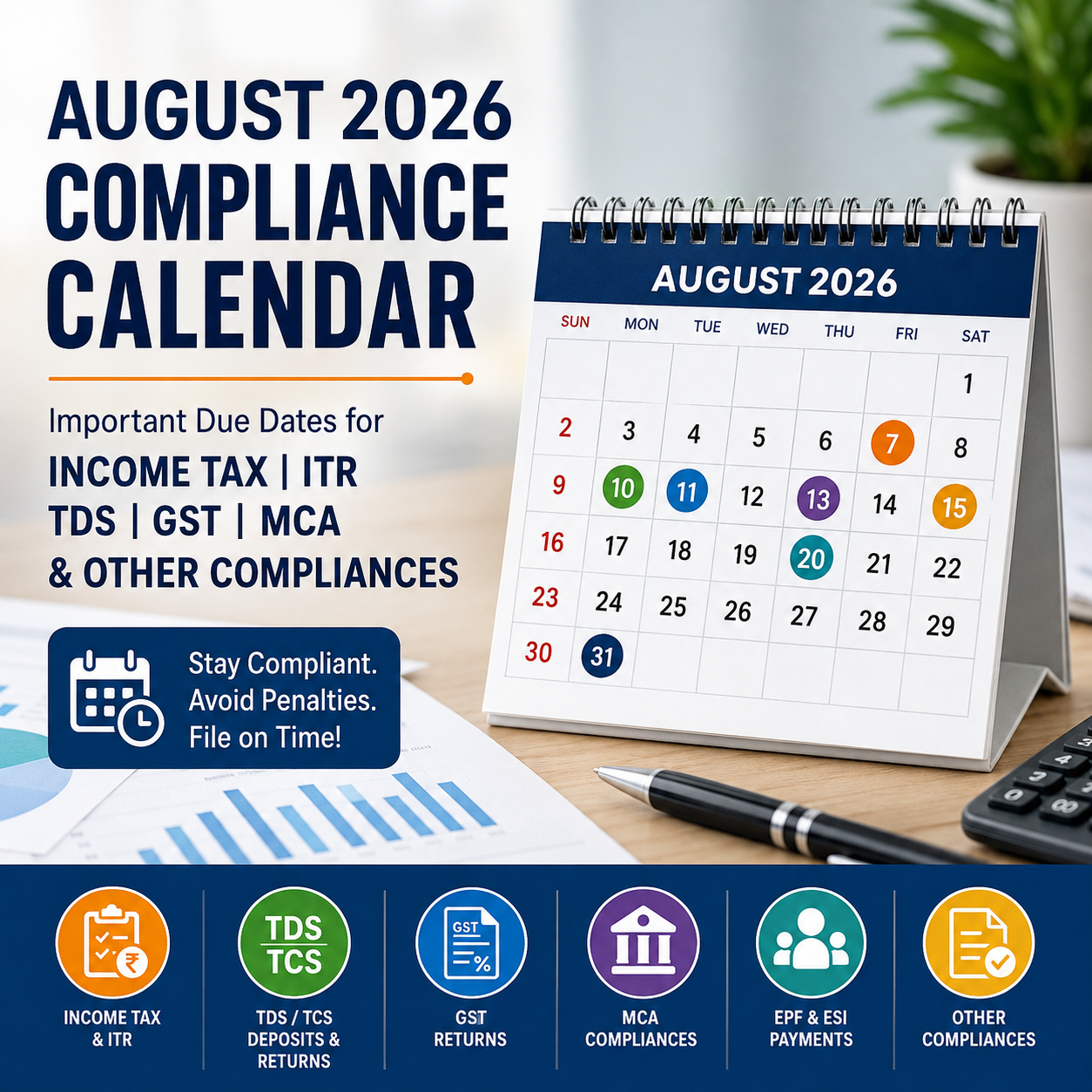
Mark Your Calendar: August 2026 Compliance Due Dates for GST, ITR, TDS & MCA

August 2026 Compliance Calendar: Major Income Tax, ITR, TDS, GST & MCA Deadlines

August 2026 is a crucial month for tax compliance, with several important statutory deadlines applicable to taxpayers, businesses, professionals, companies, and tax deductors. After the busy filing season in July, various obligations under the Income-tax Act, GST laws, MCA regulations, and labour legislations become due during August.

Failure to comply with these deadlines may lead to late filing fees, interest liabilities, penalties, delays in processing returns, or even the loss of certain tax benefits.

Below is a detailed compliance calendar highlighting the key due dates for August 2026.

Income Tax Compliance

7 August 2026 – Due Date for Deposit of TDS/TCS

Tax Deducted at Source (TDS) and Tax Collected at Source (TCS) deducted or collected during July 2026 should generally be deposited with the Central Government on or before 7 August 2026, unless a different timeline applies under the law.

This requirement generally applies to:

  • Employers
  • Companies
  • Partnership firms
  • Proprietorship businesses
  • Government deductors and other entities responsible for TDS/TCS compliance

31 August 2026 – Last Date to File ITR-3 & ITR-4

The revised Income-tax framework prescribes a separate filing deadline for certain non-audit business taxpayers.

Accordingly, 31 August 2026 is the due date for filing:

  • ITR-3 (for eligible taxpayers not subject to tax audit)
  • ITR-4 (Sugam)
  • Eligible working partners covered under the prescribed provisions

Taxpayers should carefully determine the due date applicable to their category rather than assuming that every return was due on 31 July.

Belated Return for ITR-1 & ITR-2

The original due date for filing ITR-1 and ITR-2 was 31 July 2026, and that deadline has already passed.

Those who could not file within the due date may still submit a Belated Return within the time permitted under the Income-tax Act. However, such filing may attract late filing fees, interest, and other statutory consequences wherever applicable.

Before submitting a belated return, taxpayers should reconcile and verify:

  • Annual Information Statement (AIS)
  • Form 26AS
  • Taxpayer Information Summary (TIS)
  • Any outstanding tax demand
  • Bank account validation status

Updated Return (ITR-U)

Eligible taxpayers also have the option of filing an Updated Return (ITR-U), provided they satisfy the conditions specified under the Income-tax Act.

The amended provisions now allow updated returns to be filed for a longer period than earlier, subject to payment of the prescribed additional tax and compliance with other statutory requirements.

TDS/TCS Compliance

Quarter 1 TDS/TCS Statements

The due date for filing Quarter 1 TDS/TCS statements for FY 2026-27 was 31 July 2026.

If the statement has not yet been filed, deductors should complete the filing without further delay.

Delayed filing may result in:

  • Late filing fee under Section 234E
  • Interest, where applicable
  • Additional penalties or other legal consequences in eligible cases

Important TRACES Portal Update

The TRACES Portal has introduced revised TDS certificate formats, including Form 131, for Tax Year 2026–27.

Deductors should use the updated portal functionality to download and issue the applicable TDS certificates wherever required.

GST Compliance

For GST-registered businesses, August 2026 is another important month with multiple return filing deadlines that must be monitored carefully.

10 August 2026

Due date for filing:

  • GSTR-7
  • GSTR-8

11 August 2026

Last date to file:

  • Monthly GSTR-1 (for taxpayers filing returns on a monthly basis)

13 August 2026

Due date for:

  • GSTR-5
  • GSTR-6

20 August 2026

Due date for filing:

  • Monthly GSTR-3B
  • GSTR-5A (where applicable)

GST Update: E-Way Bill System Changes Postponed

GSTN has deferred the implementation of the proposed enhancements to the E-Way Bill system.

As a result, businesses are not required to make immediate changes to their ERP software or existing operational processes. The revised rollout timeline will be communicated separately by GSTN.

MCA (Ministry of Corporate Affairs)

Company Compliance Facilitation Scheme (CCFS) 2026

A significant MCA compliance opportunity continues to be available through the Company Compliance Facilitation Scheme (CCFS), 2026, which remains open until 31 August 2026.

The scheme allows eligible companies to regularize pending ROC filings and obtain the benefits offered under the scheme, subject to the prescribed conditions.

Companies with outstanding ROC compliances should complete the necessary filings before the scheme expires to avoid missing this one-time compliance opportunity.

Regular ROC Compliances

Apart from the special compliance schemes, companies should also ensure that all routine ROC filings are completed within the prescribed timelines under the Companies Act.

Depending on the nature of the transaction, the commonly applicable ROC forms include:

  • DIR-12
  • MGT-14
  • INC-22
  • SH-7

Companies should review their statutory obligations and file the relevant forms on time to avoid additional fees and regulatory non-compliance.

EPF & ESI Compliance

15 August 2026

Employers covered under the respective labour laws should ensure timely remittance of:

  • EPF (Employees’ Provident Fund) contributions
  • ESI (Employees’ State Insurance) contributions

Timely payment helps employers remain compliant and prevents interest and penalty liabilities.

Checklist Before Filing Your Income Tax Return

Whether filing your original Income Tax Return or submitting a belated return, it is advisable to verify the following documents and records before filing:

  • ✅ Annual Information Statement (AIS)
  • ✅ Form 26AS
  • ✅ Taxpayer Information Summary (TIS)
  • ✅ Form 16 or Form 16A (where applicable)
  • ✅ Capital Gains Statement
  • ✅ Interest Certificates
  • ✅ Validated Bank Account Details

Cross-checking these documents helps ensure accurate reporting of income and reduces the chances of receiving tax notices or processing delays.

Important Due Dates – August 2026

Due Date Compliance
7 August 2026 Deposit of TDS/TCS deducted or collected during July 2026
10 August 2026 Filing of GSTR-7 and GSTR-8
11 August 2026 Monthly GSTR-1 return
13 August 2026 Filing of GSTR-5 and GSTR-6
15 August 2026 Payment of EPF and ESI contributions
20 August 2026 Monthly GSTR-3B and GSTR-5A (where applicable)
31 August 2026 Due date for filing ITR-3 and ITR-4 for eligible non-audit taxpayers
31 August 2026 Last date to avail benefits under the Company Compliance Facilitation Scheme (CCFS) 2026

Conclusion

August 2026 is a significant month for meeting tax, GST, and corporate compliance obligations. Eligible taxpayers should ensure that ITR-3 and ITR-4 are filed by 31 August 2026, while businesses must also comply with GST return filing schedules, TDS/TCS payment requirements, EPF and ESI contributions, and applicable ROC filings.

Companies with pending ROC compliances should make full use of the Company Compliance Facilitation Scheme (CCFS) 2026 before the scheme concludes on 31 August 2026. Completing these compliances within the prescribed timelines can help avoid late fees, interest, penalties, and other legal consequences while ensuring smooth regulatory compliance.