FY 2025-26: What Is the Late Fee for Delayed Tax Audit—₹75,000 or ₹1,50,000?

Tax Audit Late Fee FY 2025-26: Will It Be ₹75,000 or ₹1,50,000?

There is significant confusion among taxpayers, businesses and tax professionals about the penalty or fee applicable when the Tax Audit Report for FY 2025-26 (AY 2026-27) is filed after the prescribed due date.

The confusion mainly stems from the introduction of the Income-tax Act, 2025, which became effective from 1 April 2026. The new law introduces a different fee mechanism for failure to complete the required tax audit and submit the audit report.

Under the new provisions, the prescribed amounts are:

  • ₹75,000 where the delay is up to one month; and
  • ₹1,50,000 where the delay exceeds one month.

This raises an important question:

If the tax audit report relating to FY 2025-26 is submitted late, will the taxpayer be liable to pay ₹75,000 or ₹1,50,000?

The answer is No — the new ₹75,000 / ₹1,50,000 fee does not apply to FY 2025-26

The reason is that FY 2025-26 corresponds to AY 2026-27, and this year continues to be governed by the Income-tax Act, 1961.

The fact that the audit report may actually be submitted after 1 April 2026 does not by itself shift the audit to the new law.

The new fee provisions apply to Tax Year 2026-27 and later tax years.

Therefore, it is essential to distinguish between FY 2025-26 / AY 2026-27 and Tax Year 2026-27.


1. Understanding the Transition Between the Two Laws

The primary source of confusion is the transition from the Income-tax Act, 1961 to the Income-tax Act, 2025.

FY 2025-26

FY 2025-26 covers income earned from:

1 April 2025 to 31 March 2026

This financial year corresponds to:

AY 2026-27

It continues to be governed by:

Income-tax Act, 1961

Accordingly, the tax audit requirement remains covered by:

Section 44AB

The applicable tax audit forms continue to be:

Form 3CA / Form 3CB along with Form 3CD, wherever applicable.


Tax Year 2026-27

The new tax year covers income earned from:

1 April 2026 to 31 March 2027

This period falls under:

Income-tax Act, 2025

The corresponding tax audit provision is:

Section 63

The tax audit report under the new framework is:

Form No. 26

The new audit provisions and the revised fee mechanism therefore need to be considered separately for Tax Year 2026-27.


2. What Is the New Tax Audit Fee?

Under the Income-tax Act, 2025, the new fee provision is contained in Section 428.

Where a person fails to have the accounts audited and furnish the required audit report in accordance with Section 63, the prescribed fee is:

Delay of up to one month

₹75,000

Delay of more than one month

₹1,50,000

Thus, the new law provides a two-level fee structure depending on the period of delay.

It is also important not to confuse these amounts with the earlier penalty provisions. The new framework treats this amount as a fee, whereas the earlier law provided for a penalty.


3. Is the ₹75,000 Fee Applicable to FY 2025-26?

No.

This is the key point taxpayers need to understand.

Consider a taxpayer who is required to undergo tax audit for:

FY 2025-26 / AY 2026-27

Even if the tax audit report is submitted after 1 April 2026, the new Section 428 fee of ₹75,000 or ₹1,50,000 does not automatically become applicable.

The reason is that the audit relates to FY 2025-26, a year covered by the earlier Income-tax Act.

The transitional provisions ensure that the relevant provisions of the old law continue to apply to such years.


4. What Is the Income Tax Department’s Position?

The Income Tax Department has clarified the treatment of tax audit reports during the transition between the two Acts.

For FY 2025-26, the Tax Audit Report:

  • relates to AY 2026-27;
  • continues to fall under the Income-tax Act, 1961;
  • is required to be furnished using Form 3CA / Form 3CB / Form 3CD, as applicable; and
  • remains governed by the provisions of the old Act even where the report is uploaded after 1 April 2026.

Therefore, the applicable law is not determined simply by looking at the date on which the audit report is actually uploaded.

The crucial factor is the financial year or tax year to which the audit relates.


5. What Happens If the FY 2025-26 Tax Audit Is Delayed?

For FY 2025-26, the consequences of failure to comply with the tax audit requirement continue to be examined under the Income-tax Act, 1961.

The relevant provision is:

Section 271B

Section 271B provides for a penalty where a taxpayer fails to get the accounts audited or fails to furnish the audit report as required under Section 44AB.

The penalty may be calculated as the lower of:

0.5% of total sales, turnover or gross receipts

or

₹1,50,000

Accordingly, the maximum penalty under the old provision is:

₹1,50,000

However, this should not be confused with the new ₹75,000 / ₹1,50,000 fee structure introduced under the Income-tax Act, 2025.

The two provisions operate under different laws and apply to different tax years.

6. Penalty under Section 271B is NOT the same as the new late fee

This distinction is extremely important.

Old Act — FY 2025-26

The consequence is:

Penalty under Section 271B

It is not an automatic fixed late fee of ₹75,000.

The Assessing Officer may impose the penalty subject to the provisions of the Act.

The maximum is generally:

0.5% of turnover/gross receipts or ₹1.50 lakh, whichever is lower.

There is also an important protection under:

Section 273B

Section 273B provides that penalty under certain provisions, including Section 271B, may not be imposed where the taxpayer proves that there was reasonable cause for the failure.

Therefore, for FY 2025-26, the taxpayer should not mechanically calculate:

“Tax audit late by one month = ₹75,000.”

That is not the correct position.


7. What changes from Tax Year 2026-27?

Now consider a tax audit relating to:

Tax Year 2026-27

This period starts on:

1 April 2026

and ends on:

31 March 2027

This is governed by the:

Income-tax Act, 2025

The tax audit requirement is under:

Section 63

and the new tax audit report is:

Form No. 26

For failure to get the accounts audited and furnish the report within the prescribed time, the new fee under Section 428 applies.

Therefore:

Particulars Tax Year 2026-27 onwards
Delay up to one month ₹75,000
Delay beyond one month ₹1,50,000

This is the new regime.


8. Is ₹75,000 charged every month?

No.

This is another important point.

The provision does not say:

₹75,000 per month.

It provides:

Up to one month of delay

₹75,000

Thereafter

₹1,50,000

So it is not a recurring ₹75,000 every month.

For example, if the tax audit report is delayed by:

  • 10 days → ₹75,000
  • 20 days → ₹75,000
  • 30 days → ₹75,000
  • More than one month → ₹1,50,000

The provision should therefore not be interpreted as a monthly late fee.


9. Example — Tax Year 2026-27

Suppose a taxpayer is required to furnish the tax audit report by:

30 September 2027

Case 1 — Report filed on 10 October 2027

Delay = 10 days

Applicable fee:

₹75,000


Case 2 — Report filed on 25 October 2027

Delay = 25 days

Applicable fee:

₹75,000


Case 3 — Report filed on 5 November 2027

Delay exceeds one month.

Applicable fee:

₹1,50,000

Therefore, once the delay crosses the one-month threshold, the higher fee becomes applicable.

10. Example for FY 2025-26

Let us consider a practical example for the current tax-audit cycle.

Assume the taxpayer has:

Financial Year: FY 2025-26

Tax Audit Report Due Date: 30 September 2026

Now suppose the audit report is submitted on:

15 October 2026

The taxpayer should not conclude:

“The report is delayed by 15 days, so I must pay ₹75,000.”

That conclusion would be incorrect.

The Section 428(c) fee introduced under the new Income-tax Act, 2025 does not become applicable to the FY 2025-26 audit simply because the report is uploaded after 1 April 2026.

The audit for FY 2025-26 continues to be governed by the provisions of the Income-tax Act, 1961.

Accordingly, the relevant consequence is considered under the Section 271B penalty framework, subject to applicable provisions, including the reasonable-cause protection available under Section 273B.


11. Why Is There Confusion About the Tax Audit Late Fee?

The confusion surrounding the ₹75,000 and ₹1,50,000 amounts can mainly be attributed to three factors.

Reason 1 — The New Income-tax Act Became Effective From 1 April 2026

The Income-tax Act, 2025 came into effect from 1 April 2026.

As a result, many taxpayers assume that every tax compliance action performed after this date must automatically be governed by the new law.

However, this interpretation is not correct.

The transition provisions determine which law applies to a particular tax year.


Reason 2 — Section 428 Introduces a ₹75,000 Fee

Section 428 of the new Act specifies amounts of:

₹75,000

and

₹1,50,000

for the applicable tax-audit default.

Because these figures are clearly mentioned in the new law, several articles and social-media discussions have described the situation simply as:

“The tax audit late fee is now ₹75,000.”

However, that statement does not provide the complete picture.

The more accurate position is:

The ₹75,000 / ₹1,50,000 tax-audit fee mechanism under the new Act applies to Tax Year 2026-27 and subsequent tax years. It does not become applicable to the FY 2025-26 tax audit merely because the report is filed after 1 April 2026.


Reason 3 — FY 2025-26 and Tax Year 2026-27 Are Being Mixed Up

A major source of misunderstanding is the failure to distinguish between the two periods.

FY 2025-26

1 April 2025 to 31 March 2026

Corresponding assessment year:

AY 2026-27

Applicable law:

Income-tax Act, 1961


Tax Year 2026-27

1 April 2026 to 31 March 2027

Applicable law:

Income-tax Act, 2025

The new provisions, including the revised tax-audit fee mechanism, apply to this new tax year.

Therefore, identifying the year to which the audit relates is essential before determining the applicable late-compliance provisions.


12. Old Tax Audit Rules vs New Tax Audit Rules

The key differences can be summarized as follows:

Particulars FY 2025-26 / AY 2026-27 Tax Year 2026-27 onwards
Applicable Law Income-tax Act, 1961 Income-tax Act, 2025
Tax Audit Provision Section 44AB Section 63
Audit Report Form 3CA / 3CB + Form 3CD Form 26
Consequence of Default Penalty under Section 271B Fee under Section 428
First Amount Not prescribed as a fixed ₹75,000 fee ₹75,000
Higher Amount Maximum penalty can reach ₹1.50 lakh ₹1,50,000
Reasonable Cause Section 273B applies to Section 271B penalty New fee mechanism operates differently
Mandatory ₹75,000 Fee Not applicable Applicable
₹1,50,000 Fee After One Month Not applicable as a Section 428 fee Applicable

The table highlights an important point: although the figure of ₹1.50 lakh appears under both frameworks, the nature and manner of its application are different.


13. Is ₹1.50 Lakh Automatically Payable Under Section 271B?

No.

This is another important point that taxpayers should understand.

Under the old law, Section 271B provides for a penalty calculated as:

0.5% of total sales, turnover or gross receipts

or

₹1.50 lakh, whichever is lower.

Therefore, ₹1.50 lakh represents the maximum statutory limit, and it is not automatically imposed in every case of delayed tax audit.

Example 1 — Turnover of ₹50 lakh

Suppose the taxpayer has turnover of:

₹50 lakh

The calculation would be:

0.5% × ₹50 lakh = ₹25,000

Therefore, based on the statutory formula, the penalty would be capped at the lower applicable amount rather than automatically becoming ₹1.50 lakh.

Example 2 — Turnover of ₹10 crore

Suppose turnover is:

₹10 crore

Then:

0.5% × ₹10 crore = ₹5 lakh

Since Section 271B provides a maximum limit of ₹1.50 lakh, the statutory ceiling would be:

₹1.50 lakh

Thus, under Section 271B, ₹1.50 lakh is the maximum limit and not an automatic penalty amount.

14. New Act Introduces a Different Fee Structure

The mechanism under the new Section 428 is substantially different from the earlier penalty system.

Under the new provision, the prescribed fee is:

₹75,000

where the delay is up to one month,

and:

₹1,50,000

where the delay extends beyond one month.

Unlike the earlier Section 271B framework, this amount is not determined by applying a percentage to turnover.

This represents an important change for taxpayers.

For instance, consider a small business having turnover of only ₹20 lakh. If the business is required to undergo tax audit under the new Act and the audit report is delayed beyond one month, the applicable statutory fee can still be:

₹1,50,000

This is because the new fee is prescribed as a fixed amount and is not linked to the taxpayer’s turnover.


15. Can Reasonable Cause Avoid the New Fee?

Taxpayers and professionals should carefully distinguish between the old and new provisions on this issue.

Under the earlier Section 271B framework, the levy is in the nature of a penalty. Section 273B provides relief where the taxpayer is able to establish a reasonable cause for the failure.

The new Section 428 mechanism, however, is expressly framed as a fee.

Therefore, it should not be assumed that the new ₹75,000 / ₹1,50,000 fee will automatically receive the same treatment as a penalty imposed under Section 271B.

The nature of the levy itself has changed.

Accordingly, for Tax Year 2026-27 onwards, taxpayers should carefully consider the requirements of Section 428 instead of assuming that the earlier reasonable-cause provisions will operate in exactly the same way.


16. What Rules Apply During the Current Tax Audit Season?

For the present tax-audit cycle, the relevant period is:

FY 2025-26 / AY 2026-27

The currently applicable due date for the tax audit report is:

30 September 2026

The Income Tax Department has clarified that the tax audit relating to FY 2025-26 continues to be governed by the Income-tax Act, 1961.

Accordingly, the applicable forms continue to include:

  • Form 3CA, wherever applicable;
  • Form 3CB, wherever applicable; and
  • Form 3CD.

Therefore, the following statement would be incorrect:

“Since the new Act came into force on 1 April 2026, every late tax audit from FY 2025-26 will attract a ₹75,000 fee.”

The applicability of the new fee cannot be determined merely by looking at the date on which the audit report is uploaded.


17. What If CBDT Extends the Tax Audit Due Date?

Another practical consideration is whether the prescribed due date is subsequently extended.

If the CBDT officially extends the FY 2025-26 tax-audit deadline, the compliance position would have to be determined by taking the officially extended due date into account.

Until such an extension is formally notified, taxpayers should follow the applicable statutory deadline.

For the current FY 2025-26 tax-audit cycle, the applicable due date is presently:

30 September 2026


18. Easy Way to Understand the Two Regimes

The entire transition can be remembered using the following comparison:

FY 2025-26

Income-tax Act, 1961

Section 44AB

Form 3CA / 3CB + Form 3CD

Section 271B penalty


Tax Year 2026-27 onwards

Income-tax Act, 2025

Section 63

Form 26

Section 428 fee

The new fee structure is:

Up to one month of delay → ₹75,000

Beyond one month → ₹1,50,000

This distinction is important because the new fee mechanism should not be applied retrospectively to the FY 2025-26 tax audit.


19. Frequently Asked Questions

Q1. Will a ₹75,000 late fee apply to FY 2025-26 tax audit?

No.

The ₹75,000 fee under Section 428 does not apply to the FY 2025-26 tax audit simply because the report is submitted after 1 April 2026.


Q2. Is the amount ₹15,000 or ₹1,50,000 under the new provision?

The applicable higher amount is:

₹1,50,000

It is not ₹15,000.


Q3. From when does the ₹75,000 fee apply?

The ₹75,000 fee is part of the new regime applicable to Tax Year 2026-27 onwards, where the delay in furnishing the tax audit report is up to one month.


Q4. What happens when the delay is more than one month?

Under the new Section 428 mechanism, the prescribed fee becomes:

₹1,50,000


Q5. Is ₹75,000 payable for every month of delay?

No.

The provision does not impose ₹75,000 separately for every month.

The structure provides for ₹75,000 for delay up to one month and ₹1,50,000 thereafter.


Q6. Which provision applies to FY 2025-26?

For FY 2025-26 / AY 2026-27, the Income-tax Act, 1961 continues to govern the tax audit.

The consequences of non-compliance are therefore considered under Section 271B, subject to the applicable provisions of the old Act, including Section 273B.


Q7. Which audit forms are required for FY 2025-26?

For FY 2025-26, the applicable forms remain:

Form 3CA / Form 3CB along with Form 3CD, as applicable.


Q8. What form applies under the new tax-audit regime?

For Tax Year 2026-27 onwards, the new tax-audit report is:

Form No. 26

The new Form 26 replaces the earlier tax-audit reporting structure under the new framework.

Will the Tax Audit Due Date for FY 2025-26 Be Extended to 31 October 2026?

Tax Audit Due Date FY 2025-26 | AY 2026-27 | Latest Extension Update | Form 3CA/3CB/3CD

The tax audit compliance period for FY 2025-26 (AY 2026-27) is currently in progress. Taxpayers, businesses, tax professionals and Chartered Accountants are closely watching the deadline and one question is being discussed widely:

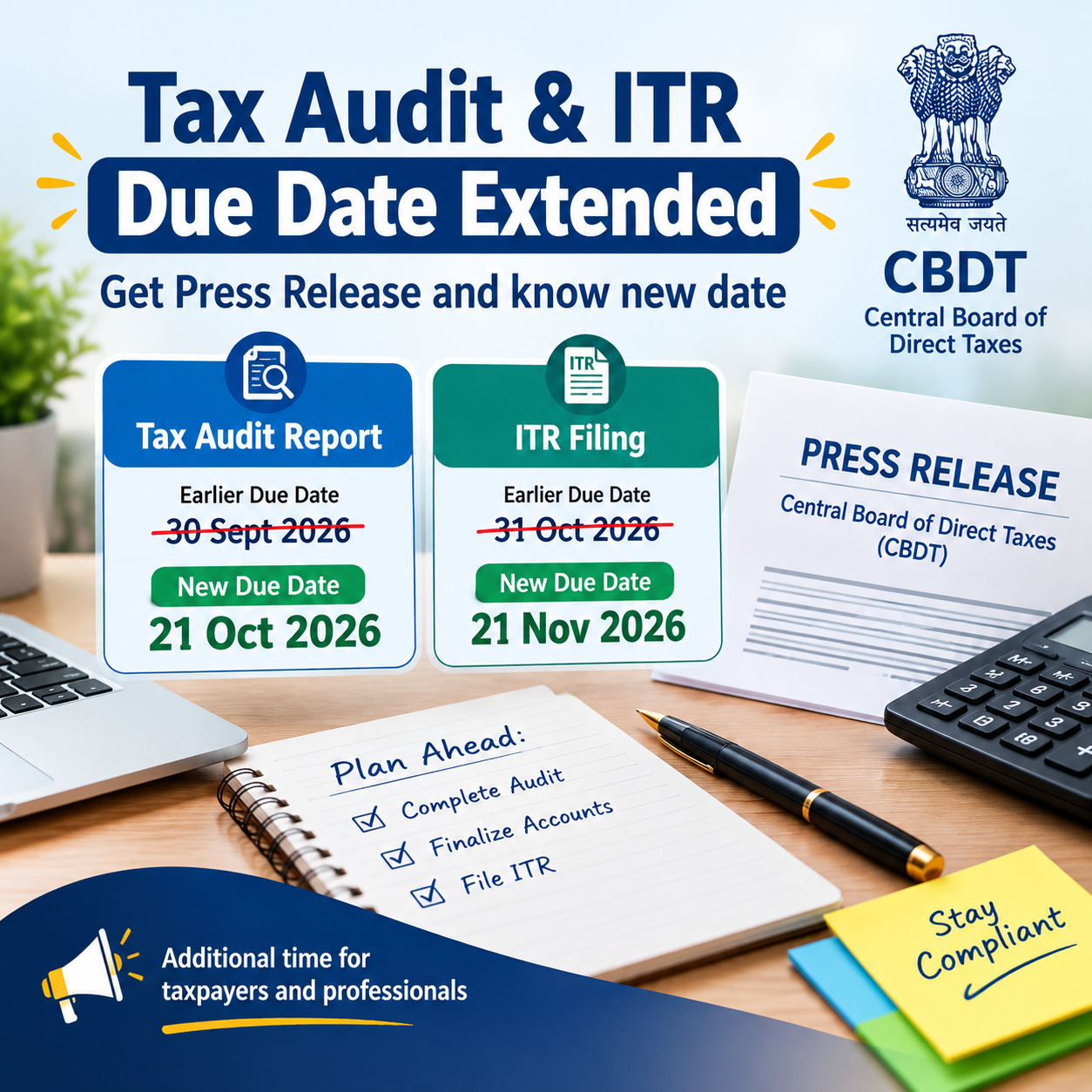
Will the Tax Audit Report due date be extended from 30 September 2026 to 31 October 2026?

As of 13 September 2026, the CBDT has not issued any official notification confirming an extension of the tax audit report filing deadline.

Accordingly, taxpayers and professionals should continue preparing their audit compliance on the basis of the existing 30 September 2026 deadline, unless the CBDT announces a formal extension.


1. What is the Tax Audit Due Date for FY 2025-26?

For FY 2025-26 (AY 2026-27), taxpayers covered under the tax audit provisions are currently required to furnish their tax audit report by:

30 September 2026

The tax audit report is submitted electronically by the Chartered Accountant. After the CA uploads the report, the taxpayer is required to log in to the Income Tax e-filing portal and approve or accept the report.

Current Important Compliance Dates

Compliance Particulars Due Date – FY 2025-26 / AY 2026-27
Non-audit ITR – applicable cases 31 August 2026
Tax Audit Report 30 September 2026
ITR for taxpayers covered by tax audit 31 October 2026
Tax audit with transfer pricing cases 31 October 2026
ITR for transfer pricing cases 30 November 2026

For AY 2026-27, the tax audit report continues to follow the applicable provisions of the existing Income-tax Act framework. The audit report deadline is generally one month before the due date applicable to taxpayers whose accounts are subject to audit.


2. Is the Tax Audit Due Date Extended?

No official extension has been announced so far.

This is an important distinction for taxpayers and professionals.

Various professional organisations, Chartered Accountants and other stakeholders may submit requests or representations seeking additional time. However, simply submitting a representation does not change the statutory deadline.

The due date can be changed only after the competent authority, generally the Central Board of Direct Taxes (CBDT), issues an official notification, order or other legally applicable announcement.

In simple terms:

Representation for Extension ≠ Extension Granted

Therefore, as of 13 September 2026, the 30 September 2026 deadline should continue to be considered the applicable due date for furnishing the Tax Audit Report.

Taxpayers and professionals should not assume that the deadline has been extended to 31 October 2026 unless an official CBDT announcement confirms it.

3. Why are taxpayers and professionals seeking an extension?

Several professional organisations have expressed concerns about the existing tax compliance schedule and the limited time available for completing tax audit-related work.

A key concern is the short interval between the non-audit ITR filing deadline and the tax audit report deadline.

For AY 2026-27, the due date for applicable non-audit business ITRs was 31 August 2026. The current deadline for submitting the tax audit report is 30 September 2026, leaving only one month between the two important compliance dates.

Professional bodies believe that this limited window may not provide sufficient time to complete the extensive audit procedures, reconciliations, verification and reporting requirements involved in tax audits.

For instance, the Chartered Accountants Association, Jalandhar, has requested that the tax audit report filing deadline be moved to 31 October 2026.

In another representation dated 11 September 2026, the Punjab Accountants Association also requested that the existing deadline of 30 September 2026 be extended by one month to 31 October 2026.


4. Delayed availability of ITR Forms and Utilities

The late and phased release of ITR forms and related filing utilities is another important reason cited in requests for an extension.

In its recent representation, the Chartered Accountants Association, Jalandhar pointed out that various ITR forms and utilities required for audit-related taxpayers were made available relatively late during the filing season.

The representation specifically referred to the availability of forms such as:

  • ITR-3
  • ITR-5
  • ITR-6
  • ITR-7

According to the professional body, the delayed availability of these forms and utilities effectively reduced the time available to taxpayers and professionals to prepare and complete audit-related compliances.

This becomes particularly significant for audit cases, where extensive data verification, reconciliation, financial review and tax-related reporting are generally required before the tax audit report can be completed and submitted.


5. Increased Reporting and Disclosure Requirements

Professional associations have also highlighted the growing reporting, disclosure and financial-statement requirements, particularly for non-corporate taxpayers.

The additional requirements mean that taxpayers and Chartered Accountants may need to spend more time gathering and processing detailed financial and tax information.

The information often needs to be:

  • Collected
  • Compiled
  • Reconciled
  • Verified
  • Audited
  • Reported and disclosed
  • Authenticated

As the volume and complexity of reporting increases, the overall workload during the tax audit season also rises for both taxpayers and Chartered Accountants.

These factors are among the key reasons professional bodies are requesting additional time for completing and filing the FY 2025-26 tax audit report.

6. What deadline extension is being sought?

The primary request from professional bodies is to provide additional time for completing the tax audit compliance.

Current deadline

30 September 2026

Proposed extended deadline

31 October 2026

Some representations have also asked for related extensions covering:

  • Form 10B
  • Form 10BB
  • Other audit-related reports
  • ITR filing deadlines applicable to audit cases

The Chartered Accountants Association, Jalandhar, has proposed two alternatives:

Option 1: Extend the Tax Audit Report filing deadline to 31 October 2026.

Option 2: Align the Tax Audit Report deadline with the audit-case ITR deadline, making both deadlines 31 October 2026.


7. Does the New Income Tax Act affect tax audits for FY 2025-26?

This is an important issue because FY 2025-26 represents a transition period between the existing and new income-tax law frameworks.

There has been some confusion regarding whether tax audits for this year should be carried out under Section 44AB of the Income-tax Act, 1961 or the corresponding provision under the new law, Section 63.

Position for FY 2025-26

For FY 2025-26 (AY 2026-27), tax audits continue to be governed by the:

Income-tax Act, 1961

Accordingly, the applicable tax audit report continues to be furnished through:

  • Form 3CA along with Form 3CD, or
  • Form 3CB along with Form 3CD

depending on the nature and circumstances of the taxpayer.

Therefore, taxpayers and professionals preparing tax audits for FY 2025-26 should continue using the applicable 3CA/3CB and 3CD forms under the existing law.


8. Section 44AB vs Section 63 – Which provision applies?

For FY 2025-26 / AY 2026-27, the relevant tax audit provision continues to be:

Section 44AB of the Income-tax Act, 1961

The new Income-tax Act, 2025 contains the corresponding tax audit provisions under Section 63, but the new framework applies to the tax years covered by that legislation.

The distinction can be summarised as follows:

Financial Year / Tax Year Applicable Provision Tax Audit Form
FY 2025-26 / AY 2026-27 Section 44AB – Income-tax Act, 1961 Form 3CA/3CB + Form 3CD
Tax Year 2026-27 onwards Section 63 – Income-tax Act, 2025 Form 26

Therefore, anyone completing a tax audit for FY 2025-26 should not confuse it with the new tax audit reporting framework applicable under the new law.


9. What is the tax audit deadline for audit cases?

For regular taxpayers who are subject to tax audit, the applicable timelines are currently:

Tax Audit Report

30 September 2026

Income Tax Return

31 October 2026

The difference between these two dates is significant. The tax audit report must generally be completed and furnished before the taxpayer proceeds with filing the corresponding audit-case ITR.

If the tax audit deadline is extended, the corresponding ITR deadline may also become a subject of discussion, depending on the nature of the extension announced by the authorities.


10. What is the timeline for Transfer Pricing cases?

Taxpayers who are required to furnish a report under Section 92E follow a different compliance schedule.

Tax Audit / Applicable Audit Report

31 October 2026

Income Tax Return

30 November 2026

Thus, the 30 September 2026 deadline should not be treated as a universal deadline for every taxpayer subject to audit.

Transfer pricing cases have a separate timeline because of the additional reporting requirements applicable to such taxpayers.


11. Who is generally liable for Tax Audit?

For FY 2025-26, tax audit applicability continues to be determined under Section 44AB of the Income-tax Act, 1961.

Broadly, tax audit provisions may apply in the following situations:

Business

Tax audit is generally applicable when the business turnover or gross receipts exceed:

₹1 crore

The threshold can increase to:

₹10 crore

where the prescribed conditions relating to cash receipts and cash payments are satisfied, including the applicable 5% limit.

Profession

For professionals, tax audit generally becomes applicable when gross receipts exceed:

₹50 lakh

Tax audit requirements may also arise in certain situations involving presumptive taxation, particularly where income is declared below the prescribed limits or the relevant conditions of the presumptive taxation provisions are not met.

Therefore, taxpayers should examine their individual facts and applicable provisions before determining whether a tax audit is required.

The Income Tax Department has also indicated that the fundamental turnover and receipt limits applicable to businesses and professionals continue under the relevant tax framework.


12. What are the consequences of filing the Tax Audit Report late?

Not furnishing the Tax Audit Report within the prescribed time may result in a penalty under the applicable provisions of the Income-tax Act.

For FY 2025-26, the relevant penalty provision is Section 271B of the Income-tax Act, 1961.

The penalty may generally be calculated at:

0.5% of sales, turnover or gross receipts

However, the maximum penalty cannot exceed:

₹1,50,000

It is important to note that the penalty provision is subject to the specific facts of each case.

If a taxpayer is able to demonstrate a reasonable cause for the failure, relief from penalty may be available under Section 273B, depending on the circumstances.

Therefore, taxpayers should not assume that a possible future extension or a potential reasonable-cause defence automatically removes the need to comply with the prescribed deadline.


13. Should you wait before completing the tax audit?

No. Taxpayers should not wait for a possible extension.

The safest approach is to continue working on the basis that 30 September 2026 is the applicable tax audit deadline.

Taxpayers and professionals should avoid delaying their audit merely because there is speculation that the government may extend the date.

The assumption that:

“The deadline will definitely be extended.”

can create unnecessary compliance risks.

There is a precedent from the previous assessment year. For AY 2025-26, the CBDT extended the specified tax audit report deadline from 30 September 2025 to 31 October 2025.

However, that earlier decision should not be interpreted as confirmation that the FY 2025-26 tax audit deadline has already been extended.

A previous extension does not automatically result in an extension for the current year.


14. Is there still a possibility of a CBDT extension?

Yes, an extension is still possible.

The CBDT has the authority to extend specified statutory compliance deadlines when circumstances warrant such action.

Therefore, the government may announce a revised tax audit deadline in the future.

However, taxpayers should rely only on an official CBDT notification or order.

Until such an announcement is made:

30 September 2026 should continue to be treated as the applicable Tax Audit Report due date.


15. Extension request vs official extension – What is the difference?

Taxpayers should clearly understand the difference between a request for an extension and an extension that has actually been granted.

Step 1 – Representation is submitted

Professional organisations, Chartered Accountants, tax practitioners or other stakeholders submit requests to the CBDT or Ministry of Finance seeking additional time.

⬇️

Step 2 – Government reviews the request

The authorities examine the representations along with technical, administrative and compliance-related issues.

⬇️

Step 3 – Official decision is issued

If the CBDT approves an extension, it issues an official notification, order or formal announcement specifying the revised deadline.

⬇️

Step 4 – Revised deadline becomes effective

Only after the official announcement can taxpayers rely on the extended due date.

Therefore:

“Professional bodies have requested an extension”

does not mean:

“The Tax Audit deadline has been extended.”

The two situations are completely different.


16. Tax Audit Due Date Status as of 13 September 2026

The current position can be summarised below:

Particulars Current Position
Financial Year FY 2025-26
Assessment Year AY 2026-27
Applicable Tax Audit Provision Section 44AB
Tax Audit Forms Form 3CA/3CB + Form 3CD
Existing Tax Audit Due Date 30 September 2026
Extension to 31 October 2026 Not officially announced as of 13 September 2026
Extension requests Yes
Professional bodies seeking extension Yes
Date requested by representations 31 October 2026
Audit-case ITR due date 31 October 2026
Transfer Pricing audit/report deadline 31 October 2026
Transfer Pricing ITR deadline 30 November 2026

Thus, based on the position stated above, taxpayers should continue to consider 30 September 2026 as the operative tax audit deadline unless the CBDT formally announces a change.


17. What action should taxpayers take now?

The practical approach is simple:

Do not wait for an extension announcement.

If your tax audit is still pending, start completing the required work immediately.

A typical preparation process may include:

Finalise books of accounts → Reconcile bank statements → Reconcile GST data → Verify TDS → Check AIS/26AS → Reconcile debtors and creditors → Review fixed assets → Verify loans and liabilities → Check expenses → Complete tax computation → Compile Form 3CD information → Finalise audit report → Obtain taxpayer approval → File the ITR

The objective should be to have the audit report ready for submission by 30 September 2026.

If the CBDT later grants an extension, taxpayers who have already completed their work will simply have additional time available.

On the other hand, if no extension is announced, delaying the audit until the last few days may result in avoidable compliance pressure, errors and filing risks.

Key takeaway

Plan your compliance based on the existing 30 September 2026 deadline. Any later extension should be treated as additional time, not as the deadline you are depending upon.

Final Conclusion

Tax Audit Due Date FY 2025-26: Current Status and Extension Update

As of 13 September 2026, the CBDT has not issued any official notification extending the tax audit deadline for FY 2025-26 (AY 2026-27).

Therefore, the existing tax audit deadline continues to be:

30 September 2026

At the same time, several professional organisations have approached the CBDT and Ministry of Finance seeking additional time and have proposed extending the deadline to:

31 October 2026

The requests for additional time are based on various compliance-related concerns, including the limited time available between important filing deadlines, the phased availability of ITR forms and utilities, and the increased level of audit and reporting work.

For now, taxpayers and tax professionals should follow the existing deadline rather than relying on a possible future extension.

The safest approach is to complete and submit the Tax Audit Report by 30 September 2026. Do not postpone compliance in anticipation of an extension.

If the CBDT subsequently issues an official order extending the deadline, taxpayers can follow the revised date specified in that announcement.

Quick Summary

  • Has an extension been officially announced?No
  • 📅 Current Tax Audit Due Date30 September 2026
  • 📢 Is an extension being requested?Yes
  • 🎯 Deadline requested by professional bodies31 October 2026
  • ⚠️ Should taxpayers wait for the extension?No

Current Official Position

The Income Tax Department’s current information indicates 30 September 2026 as the applicable tax audit deadline for FY 2025-26. The existing Forms 3CA/3CB along with Form 3CD continue to apply for the relevant AY 2026-27 tax audits.

Taxpayers should therefore rely on official notifications issued by the Income Tax Department or CBDT for any subsequent change in the deadline.


Disclaimer

This article is intended solely for general informational and educational purposes. It should not be treated as professional tax, legal or financial advice. Taxpayers should independently verify the applicable provisions of the Income-tax Act, rules, circulars, notifications and other official government communications before taking any compliance or financial decision.