May 2026 Statutory Compliance Calendar – GST, Income Tax, MCA, PF & ESI

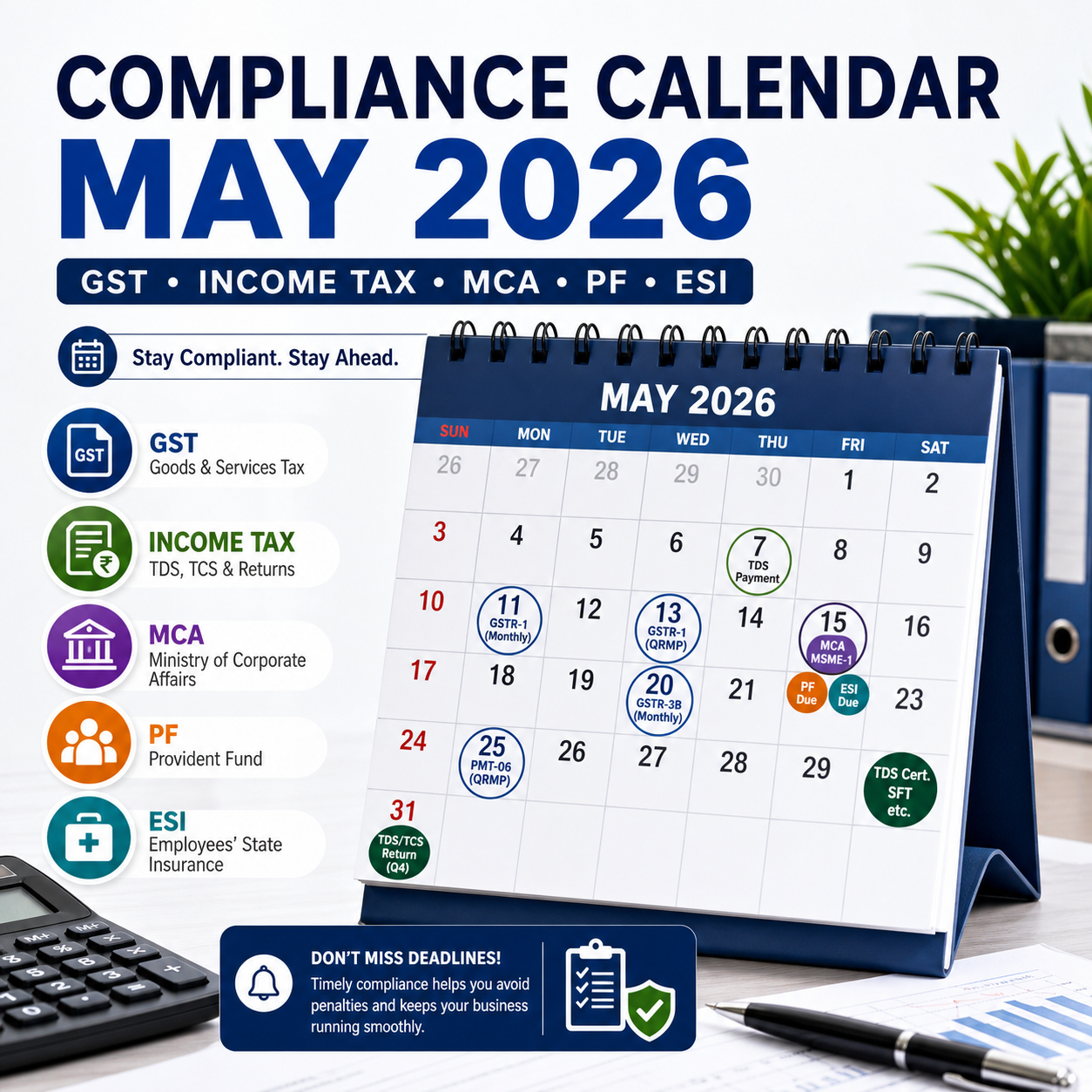
Compliance Calendar – May 2026 (GST, Income Tax, MCA, PF & ESI)

May 2026 is a crucial compliance month as it primarily covers filings related to April 2026, along with significant quarterly Income Tax obligations. Keeping track of due dates is essential to avoid interest charges, late fees, and penalties. Below is a structured overview of all major compliances.


Income Tax Compliance – May 2026

This month includes both monthly TDS deposit requirements and quarterly TDS return filings.

📊 Key Income Tax Due Dates

Due Date Compliance Particulars
7 May 2026 TDS Payment Deposit of TDS deducted for April 2026
31 May 2026 TDS Return (Q4) Filing of TDS returns for Jan–Mar 2026
31 May 2026 Form 16A Issuance Issue of TDS certificates (non-salary cases)

💡 Important Points

  • Delay in TDS deposit attracts interest at 1% / 1.5% per month
  • From this period, TDS compliance follows provisions of the Income Tax Act, 2025 (new sections applicable)
  • Late filing of TDS returns results in a penalty of ₹200 per day

🔷 GST Compliance – May 2026

📊 GST Due Dates (for April 2026 period)

Due Date Return Applicability
10 May 2026 GSTR-7 GST TDS filers
10 May 2026 GSTR-8 E-commerce operators (TCS)
11 May 2026 GSTR-1 Monthly return for outward supplies
13 May 2026 GSTR-6 Input Service Distributors (ISD)
20 May 2026 GSTR-3B Regular monthly taxpayers
20 May 2026 GSTR-5 Non-resident taxable persons
20 May 2026 GSTR-5A OIDAR service providers

🔶 QRMP Scheme

Taxpayers under the QRMP scheme are not required to file GSTR-3B for April in May.

Due Date Compliance
25 May 2026 PMT-06

PF & ESI Compliance – May 2026

Employers are required to fulfill monthly labour law compliances within prescribed timelines.

📊 PF & ESI Due Dates

Due Date Compliance Particulars
15 May 2026 PF Payment EPF contribution for April 2026
15 May 2026 ESI Payment ESI contribution for April 2026

💡 Important Points

  • Contributions include both employer and employee shares
  • Delay results in interest and penalties (damages)
  • PF return (ECR) must be filed along with the payment

MCA (ROC) Compliance – May 2026

MCA compliances are event-based rather than periodic.

📊 Key MCA Filings

Event Form Timeline
Allotment of Shares PAS-3 Within 30 days
Board Resolution Filing MGT-14 Within 30 days
Director Appointment/Resignation DIR-12 Within 30 days
Incorporation Filings Various Forms As applicable

💡 Important Points

  • No fixed monthly deadlines
  • Non-compliance can lead to significant penalties for both the company and its directors
  • Annual filings (AOC-4, MGT-7) are separate and not part of May compliance

Practical Compliance Focus – May 2026

May also plays a key role in financial year transition and reconciliation activities:

  • ✅ Reconciliation of GST data with books (impact of April opening balances)
  • ✅ Q4 TDS reconciliation prior to return filing
  • ✅ Salary and payroll verification, including PF & ESI alignment
  • ✅ Preparation for the upcoming Income Tax Return (ITR) filing season
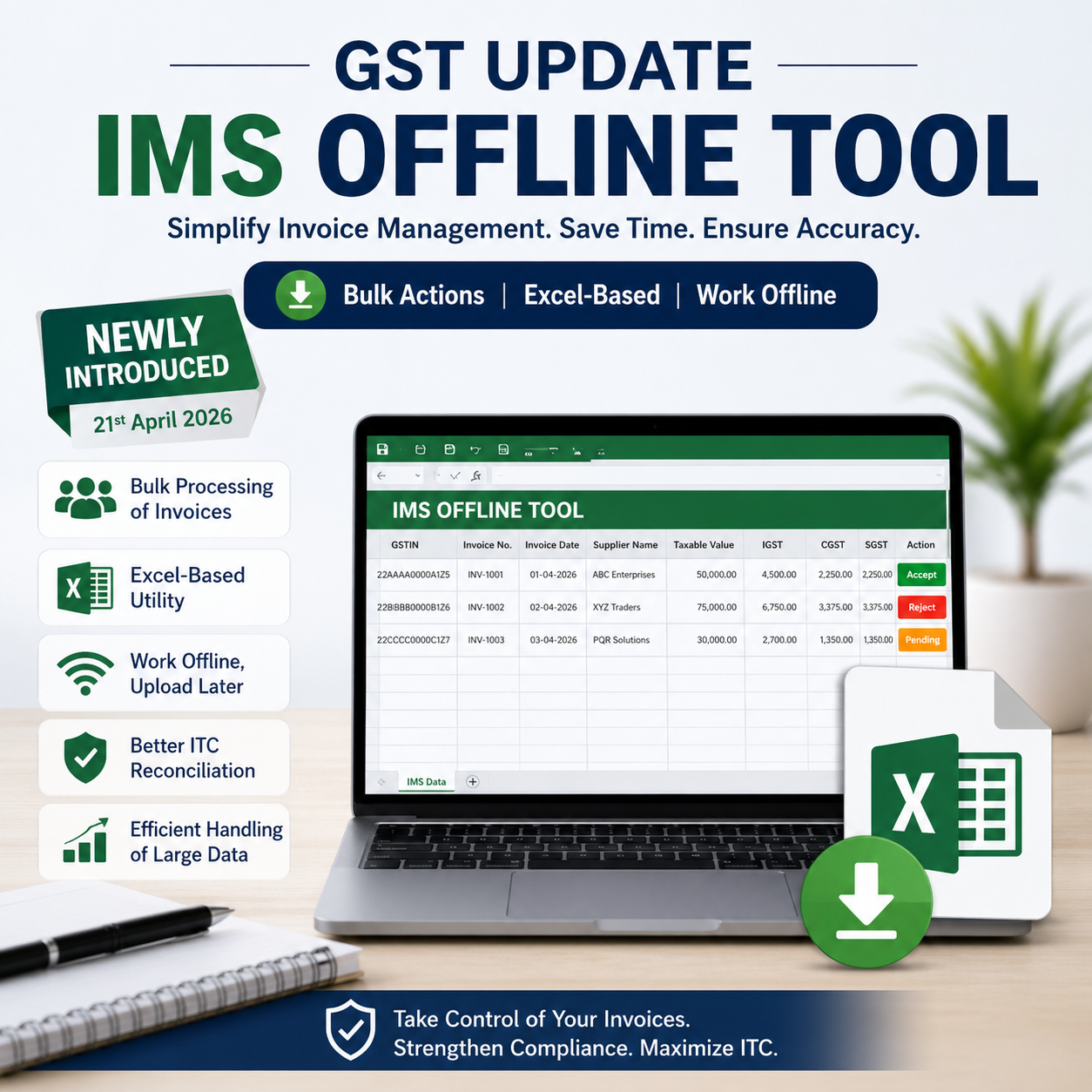
GST Latest Update: IMS Offline Tool Comes into Effect

In a major move to enhance GST compliance efficiency, the GST Network (GSTN) rolled out the IMS (Invoice Management System) Offline Tool on 21st April 2026. This initiative is designed to simplify invoice-level activities for taxpayers and improve the reconciliation process.

Background – What is IMS?

The Invoice Management System (IMS) was introduced on the GST portal starting from the October 2024 tax period. Its key objective is to provide taxpayers with greater control over their inward supplies (purchase invoices) reflected in the system.

Under IMS, taxpayers can review and take appropriate action on invoices uploaded by suppliers through:

  • GSTR-1
  • GSTR-1A
  • IFF (Invoice Furnishing Facility)

Available Actions in IMS include:
✔️ Accept invoice
❌ Reject invoice
⏳ Keep invoice pending

This system plays a vital role in Input Tax Credit (ITC) reconciliation by ensuring that ITC is claimed only on valid and verified invoices, thereby improving overall compliance accuracy.

What’s New? – IMS Offline Tool

To enhance usability and address practical challenges faced by taxpayers, the GST Network (GSTN) has introduced the IMS Offline Tool.

📌 Key Highlight:
👉 Excel-based utility (MS Excel format)
👉 Designed for ease of use and bulk processing


🎯 Key Features of IMS Offline Tool

1️⃣ Bulk Processing of Invoices

Previously, taxpayers were required to take action on invoices individually through the GST portal.

Now:
👉 Download invoice data
👉 Take action in bulk (Accept / Reject / Pending)
👉 Upload the updated file back to the portal

📌 This is a significant time-saving feature, especially for:

  • Large businesses
  • Professionals managing multiple clients

2️⃣ Excel-Based Utility (User-Friendly)

The tool is built on MS Excel, making it:

  • Easy to understand
  • Familiar for accountants and tax professionals
  • Usable without advanced technical knowledge

3️⃣ Offline Working Capability

👉 No need for continuous internet access

You can:

  • Work offline
  • Review invoices carefully
  • Upload once the process is complete

📌 This helps reduce:

  • Dependency on the GST portal
  • Last-minute filing stress

4️⃣ Improved ITC Reconciliation

While IMS already supports ITC validation, the offline tool further enhances the process.

👉 Reconciliation becomes:

  • Faster
  • More accurate
  • Less prone to errors

5️⃣ Efficient Handling of Large Data

For taxpayers dealing with high volumes of invoices:

👉 The tool ensures:

  • Smooth data handling
  • Reduced issues related to portal lag

⚠️ Important Points to Note

  • The IMS Offline Tool is optional but highly recommended
  • Final upload must be completed on the GST portal
  • Careful review before uploading is essential
  • Incorrect actions may impact ITC eligibility
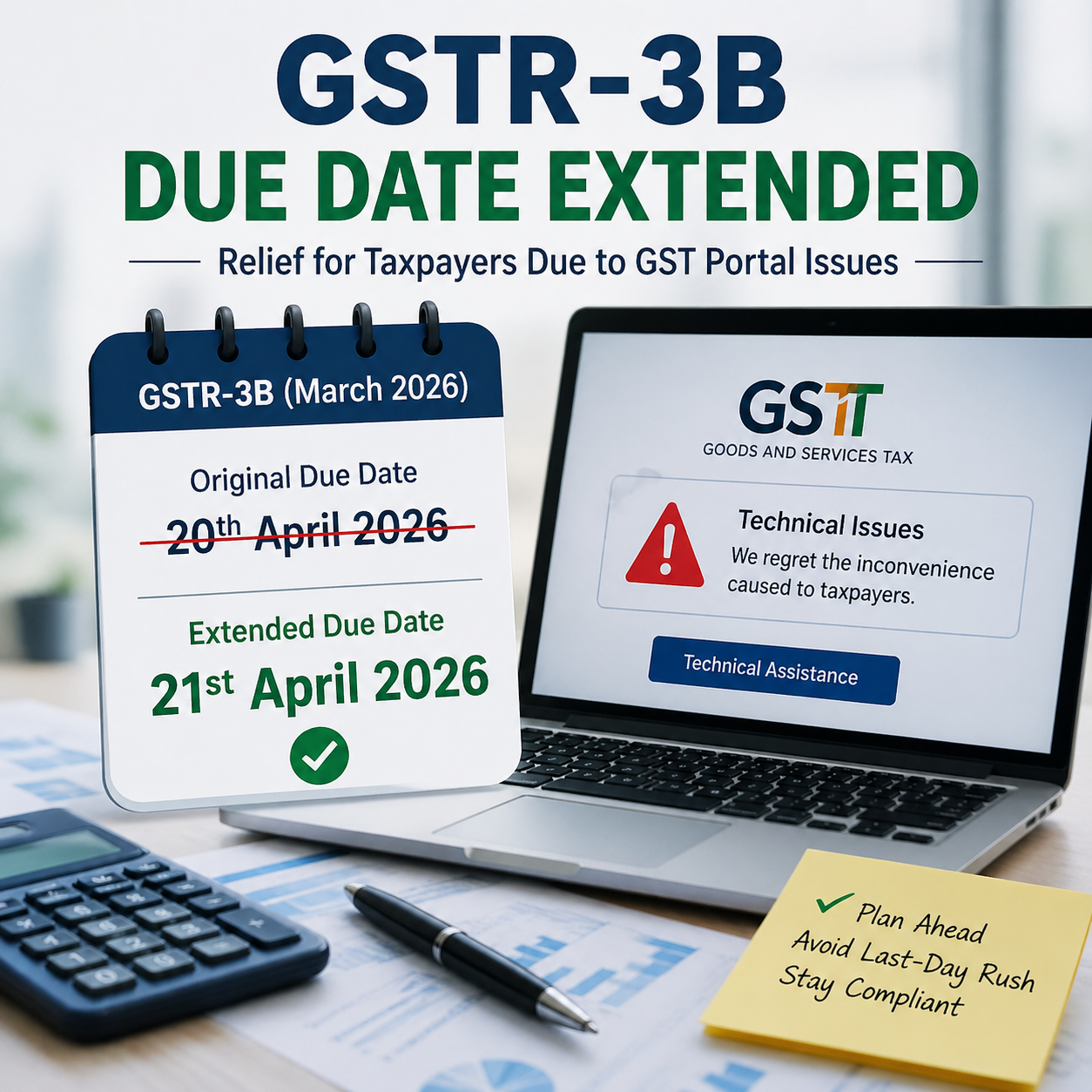
GSTR-3B Filing Gets Extension – Know the Updated Due Date

The GST Network (GSTN) has recently acknowledged the technical glitches encountered by taxpayers on the GST portal during the final day of GSTR-3B filing for March 2026, along with providing technical support.

📌 Background of the Issue

As per the regular GST compliance schedule, the due date for filing GSTR-3B (monthly return) for March 2026 was 20th April 2026.

However, on the due date, a significant number of taxpayers and professionals experienced serious technical difficulties on the GST portal, such as:

  • Inability to log in to the portal
  • Errors while saving or submitting returns
  • Payment failures
  • Portal slowdown or complete downtime
  • Delay in receiving OTPs

These disruptions created genuine challenges in timely compliance, especially considering that filing volume peaks on the last day.


⚠️ GSTN Response

In response to the widespread issues, the GST Network (GSTN) acknowledged the technical glitches and expressed regret for the inconvenience caused to taxpayers.

This is not the first instance—GSTN has previously issued advisories and provided interim solutions whenever system-related issues impacted return filing.


✅ Due Date Extended

Considering the genuine hardship faced by taxpayers, the authorities extended the due date for filing GSTR-3B:

  • Original Due Date: 20th April 2026
  • Extended Due Date: 21st April 2026

This extension provided taxpayers with an additional day to complete their filing without incurring late fees or interest.


📊 Practical Impact for Taxpayers

1. Relief from Late Fees & Interest
Late filing of GSTR-3B attracts:

  • Late fees
  • Interest at 18% per annum on tax liability

The extension ensured taxpayers could comply without additional financial burden.

2. Recognition of System-Based Challenges
The decision reflects the government’s acknowledgment of real-time portal issues, reinforcing trust in the GST compliance framework.

3. Reminder on Last-Day Filing Risks
This situation highlights an important compliance lesson:

  • Avoid last-day filing
  • Maintain buffer time for unexpected technical issues

📌 Important Professional Insight

  • Extensions are case-specific and not automatic
  • They apply only when technical issues are officially acknowledged by GSTN
  • Taxpayers should not assume similar relief in future periods

🧾 Conclusion

The extension of the GSTR-3B due date to 21st April 2026 provided much-needed relief to taxpayers affected by portal-related issues.

At the same time, it serves as a practical reminder to:
✔ Plan compliance activities in advance
✔ Avoid last-day filing rush
✔ Stay updated with GSTN advisories and updates

GST Update: Issue of Wrong Interest Calculation in GSTR-3B Returns

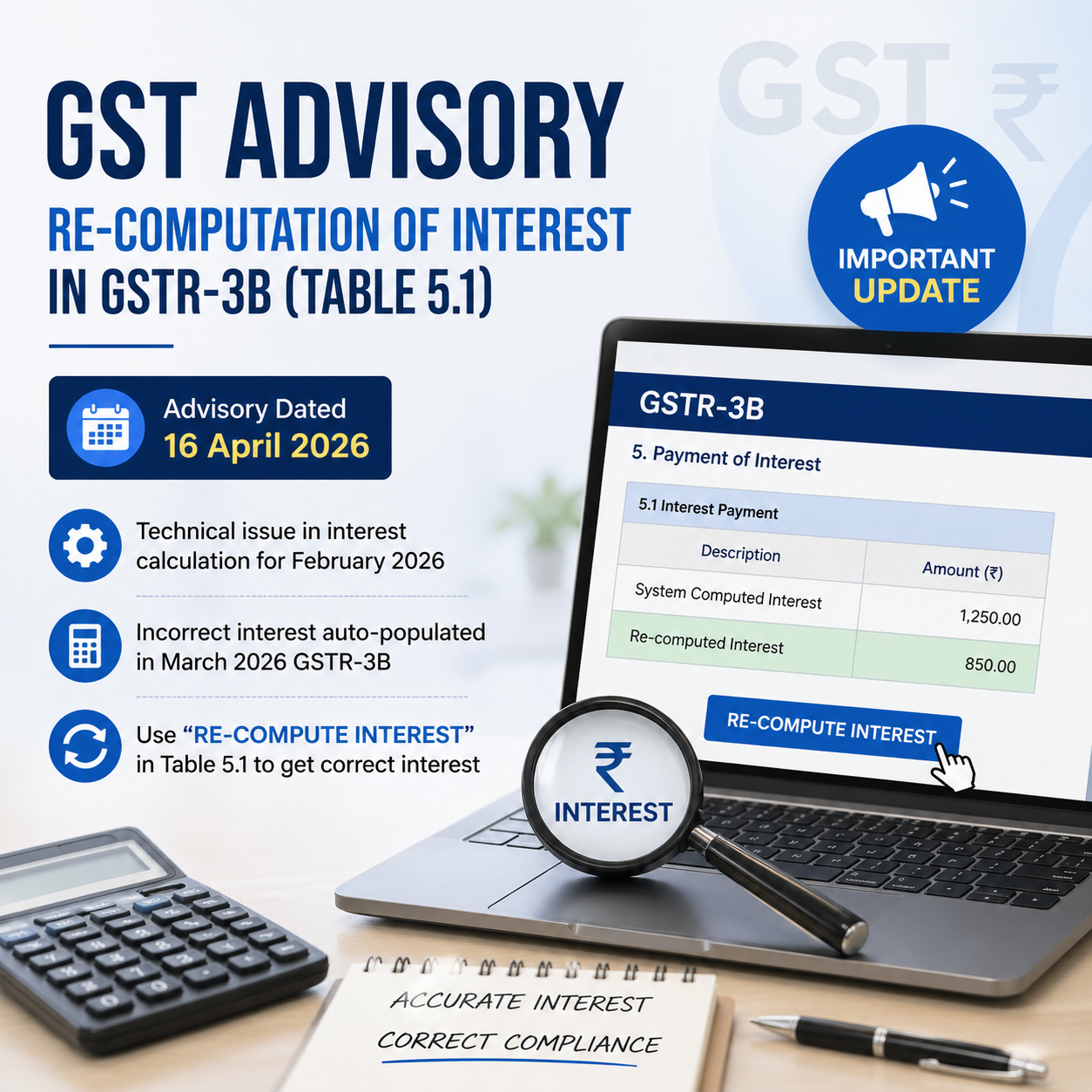
The GSTN has released a significant advisory dated 16 April 2026 regarding the recalculation of interest under Table 5.1 of GSTR-3B. The advisory highlights a technical issue where the system-generated interest for February 2026 was incorrectly computed and subsequently auto-populated in the March 2026 GSTR-3B for certain taxpayers.

This update is important for taxpayers to ensure accurate self-assessment of interest liability and to avoid excess payments or potential future disputes.

👉 Click here to download the advisory


🔍 System-Generated Interest – Working Mechanism

As a facilitation feature, the GST portal provides an automated system to compute interest on delayed filing of GSTR-3B. The system:

  • Calculates interest based on:
    • Tax liability discharged
    • Details reported in the “Tax Liability Breakup, As Applicable” table
  • The computed interest is:
    • Auto-populated in Table 5.1
    • Collected in the subsequent GSTR-3B return period

👉 This mechanism is similar to late fee computation, which is also calculated after filing and reflected in the next return cycle.


📄 Where to Verify Interest Calculation

Taxpayers can review the detailed interest computation through the System Generated GSTR-3B PDF.

🔎 Navigation Path:
Login → Return Dashboard → Select Return Period → GSTR-3B → Prepare Online → System Generated GSTR-3B PDF

This document provides a complete breakup of the interest calculation and should always be checked before filing.


⚠️ Issue Identified for February 2026

GSTN has identified that, due to a technical glitch:

  • Interest for February 2026
  • Reflected in March 2026 GSTR-3B (Table 5.1)

👉 May have been incorrectly computed for certain taxpayers.


❗ Root Cause

The issue arose because the system did not consider the benefit of the minimum balance available in the Electronic Cash Ledger, as required under:

👉 Rule 88B(1) proviso of the CGST Rules, 2017


🛠️ GSTN Solution – Recompute Interest

To address this issue, the GST portal has introduced a functionality to recompute interest.

👉 Steps to follow:

  • Navigate to Table 5.1 of GSTR-3B
  • Click on the “RE-COMPUTE INTEREST” button

The system will:

  • Recalculate interest using updated parameters
  • Consider the correct Electronic Cash Ledger balance

The revised interest amount will be reflected in the updated System Generated GSTR-3B PDF.

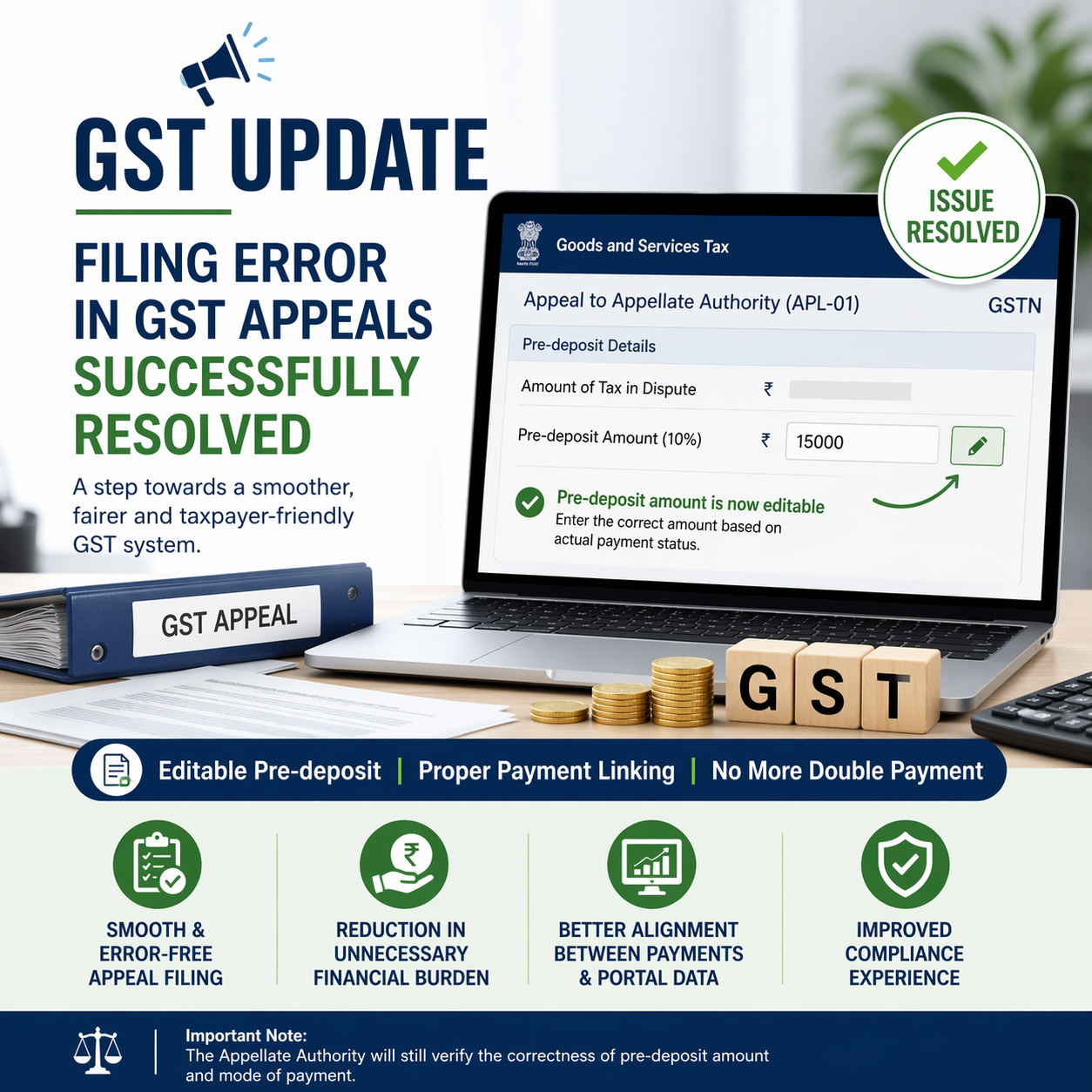
GST Update: Filing Error in GST Appeals Successfully Resolved

GST Update: Relief in Pre-Deposit Requirement While Filing Appeals

A key and practical update has been introduced on the GST portal concerning the pre-deposit requirement for filing appeals. This change directly benefits taxpayers filing appeals in Form APL-01 and resolves several long-standing practical issues.


🔍 Background – Pre-deposit under GST

As per CGST Act, 2017, Section 107(6), any taxpayer filing an appeal before the Appellate Authority must make a mandatory pre-deposit comprising:

✅ Full payment of admitted tax liability
✅ 10% of the disputed tax amount (subject to prescribed limits)

This payment is a prerequisite for the admission of an appeal.


⚠️ Earlier Issue on GST Portal

Previously, while filing Form APL-01, the GST portal:

  • Automatically calculated the 10% pre-deposit
  • ❌ Did not allow editing of this field

This led to several practical difficulties for taxpayers.

Common Challenges Faced

  • Pre-deposit already paid through DRC-03 or other modes
  • Incorrect classification of demand under wrong tax heads
  • Partial payments not considered by the system
  • Cases involving only interest or penalty disputes
  • Differences in interpretation of disputed tax amount

👉 As a result, taxpayers often faced duplication of payments or incorrect calculations.


Latest Update (Effective 6 April 2026)

The GSTN has now provided significant relief:

🔹 Key Change

👉 The pre-deposit percentage field is now editable in Form APL-01


🎯 Impact on Taxpayers

With this update, taxpayers can now:

✔️ Adjust pre-deposit based on actual liability
✔️ Consider payments already made
✔️ Avoid excess or duplicate payments
✔️ Accurately compute disputed tax amounts
✔️ File appeals aligned with actual case facts


🧾 Practical Situations Where This Helps

1. Pre-deposit Already Paid
Taxpayers can reduce the payable amount in APL-01 if already paid via DRC-03

2. Incorrect Demand Reflection
System-generated demand can now be corrected

3. Appeals for Interest/Penalty Only
No need to apply 10% on the entire demand

4. Partial Appeals / Multiple Orders
Pre-deposit can be calculated proportionately


⚖️ Important Safeguard

👉 This flexibility is subject to verification by the Appellate Authority, including:

  • Accuracy of the pre-deposit amount
  • Mode of payment
  • Compliance with Section 107(6)

⚠️ Incorrect adjustments may result in:

  • Rejection of appeal
  • Issuance of deficiency memo
  • Additional tax demand

📌 Key Takeaways for Professionals

🔹 Ensure correct computation of disputed tax
🔹 Maintain proper documentation of prior payments
🔹 Reconcile:

  • Order amount
  • Amount already paid
  • Required pre-deposit

💡 Professional Tip

Before editing the pre-deposit field, prepare a detailed working sheet including:

  • Total demand
  • Admitted liability
  • Disputed portion
  • Pre-deposit calculation
  • Payments already made

This helps minimize litigation risks at the appellate stage.


🚀 Conclusion

This update is a practical and taxpayer-friendly move by GSTN. It removes earlier system restrictions and aligns the portal with real-world scenarios.

👉 However, greater flexibility also means greater responsibility—accurate calculations and proper justification are now essential.

Compliance Due Dates & Key Filings for April 2026

With the start of the new financial year FY 2026–27, April emerges as a critical month for compliance from both Income Tax and GST perspectives. Businesses, professionals, and tax practitioners must stay on top of key deadlines to avoid interest, penalties, and potential notices.

🗓️ Compliance Timeline & Important Dates for April 2026

April sets the tone for the entire financial year, making it essential to ensure:

  • Timely GST return filings (GSTR-1, GSTR-3B, etc.)
  • Deposit of TDS/TCS within due dates
  • Proper documentation and reconciliation of transactions
  • Early planning for advance tax and regulatory compliances

    Compliance Calendar – April 2026 (Complete Guide)

    https://images.openai.com/static-rsc-4/zXx9R0Y3W9RUTZri8CNntnZVqNTyeeWaYbeqWgVw8F3TLlO_GHcXgBncfAoWH43AbADbv78IYLSabfRTGA9fEgD-xO0n-SJ3D6ULQMaUmt4QAKQlI0x8r-T4EFtzBNkVQV9FQ990xijfmRpgavEmqr80sNwaY-tQpvQMyDo1IvpjIfJY1aPprLDmTkDx0iKO?purpose=fullsize
    https://images.openai.com/static-rsc-4/5Sl9naNGQCWstT78h1FiYaDiANVfxgH0JlReCDdri6QF_oznPgLttDBFsDWUKCdZ53Rw6iAQF_k0eyedImpjMj0rjF15RFuL9EfaBfihQWI8g96gBjTn-bpgu96QURONSAX5wr3geZ6kK6ZgsqZsYyG7xIw1nFSZrQ232_O57aODHG0DQDQKnhyfhCnVUVdf?purpose=fullsize
    https://images.openai.com/static-rsc-4/KxcvggfFVwOL7SNUbELL82f31HbUhT3sQMB5m-hL8Z0rezQvAeLhdUBz6tyoJMGYoATEIlnMM8yXx-5qDe5tvUjV4_e3B4HVdqNjEu--W1S8D32OwNPXc_dR3A5tvh_NOAUeZBL4x-nHqvQ90ged6okgq9RU9YU2wVFUBaUiKfwojG8kYJNQkLP2JOaABOeO?purpose=fullsize
    5

    This article provides a comprehensive compliance calendar for April 2026, covering GST, Income Tax (TDS/TCS), PF, ESI, MCA, and other key regulatory requirements.


    🔰 Important Update from 1 April 2026

    With the beginning of FY 2026–27, several critical changes come into effect:

    • Reset of aggregate turnover under GST
    • Adoption of a new invoice series
    • Applicability of provisions under the Income Tax Act, 2025
    • Revised TDS/TCS rates (where applicable)
    • Start of a fresh compliance cycle for all taxpayers

    💰 Income Tax Compliance (TDS/TCS)

    📌 7 April 2026

    • Deposit of TCS for March 2026
    • Submission of declarations (Form 27C)

    📌 14 April 2026

    • Issue of TDS certificates:
      • Form 16B (property)
      • Form 16C (rent)
      • Other applicable certificates

    📌 30 April 2026

    • Deposit of TDS for March (non-government deductors)
    • Filing of:
      • Form 26QB (property transactions)
      • Form 26QC (rent payments)
      • Form 26QD (specified payments)

    📊 GST Compliance

    April is a high-volume GST compliance month due to both monthly and quarterly filings:

    📌 10 April 2026

    • GSTR-7 (TDS under GST)
    • GSTR-8 (E-commerce operators)

    📌 11 April 2026

    • GSTR-1 (Monthly – March 2026)

    📌 13 April 2026

    • GSTR-1 (QRMP – Jan–Mar quarter)
    • GSTR-5 (Non-resident taxable persons)
    • GSTR-6 (Input Service Distributor)

    📌 18 April 2026

    • CMP-08 (Composition scheme)

    📌 20 April 2026

    • GSTR-3B (Monthly filers)

    📌 22 & 24 April 2026

    • GSTR-3B (QRMP scheme)

    📌 25 April 2026

    • ITC-04 (Job work return)

    📌 28 April 2026

    • GSTR-11 (UIN holders)

    📌 30 April 2026

    • GSTR-4 (Annual return for composition dealers – FY 2025–26)

    👨‍💼 PF & ESI Compliance

    📌 15 April 2026

    • Deposit of Provident Fund (PF)
    • Filing of ECR (Electronic Challan-cum-Return)
    • Deposit of ESI contributions

    🏢 MCA / Companies Act Compliance

    While April has no major fixed ROC due dates, it remains important for:

    • Planning annual compliance strategy
    • Conducting the first Board Meeting (if applicable)
    • Reviewing statutory registers and disclosures

    🌍 Other Key Compliance

    📌 7 April 2026

    • Filing of ECB-2 Return (foreign borrowings under FEMA)

    📌 15 April 2026

    • Submission of Form 15CC (foreign remittance compliance)

    ✅ Final Takeaway

    April is not just the start of a new financial year—it’s a foundation month for compliance discipline. Staying updated with deadlines across GST, Income Tax, and other laws helps:

    • Avoid penalties and interest
    • Ensure smooth operations
    • Build a strong compliance track record for the year ahead
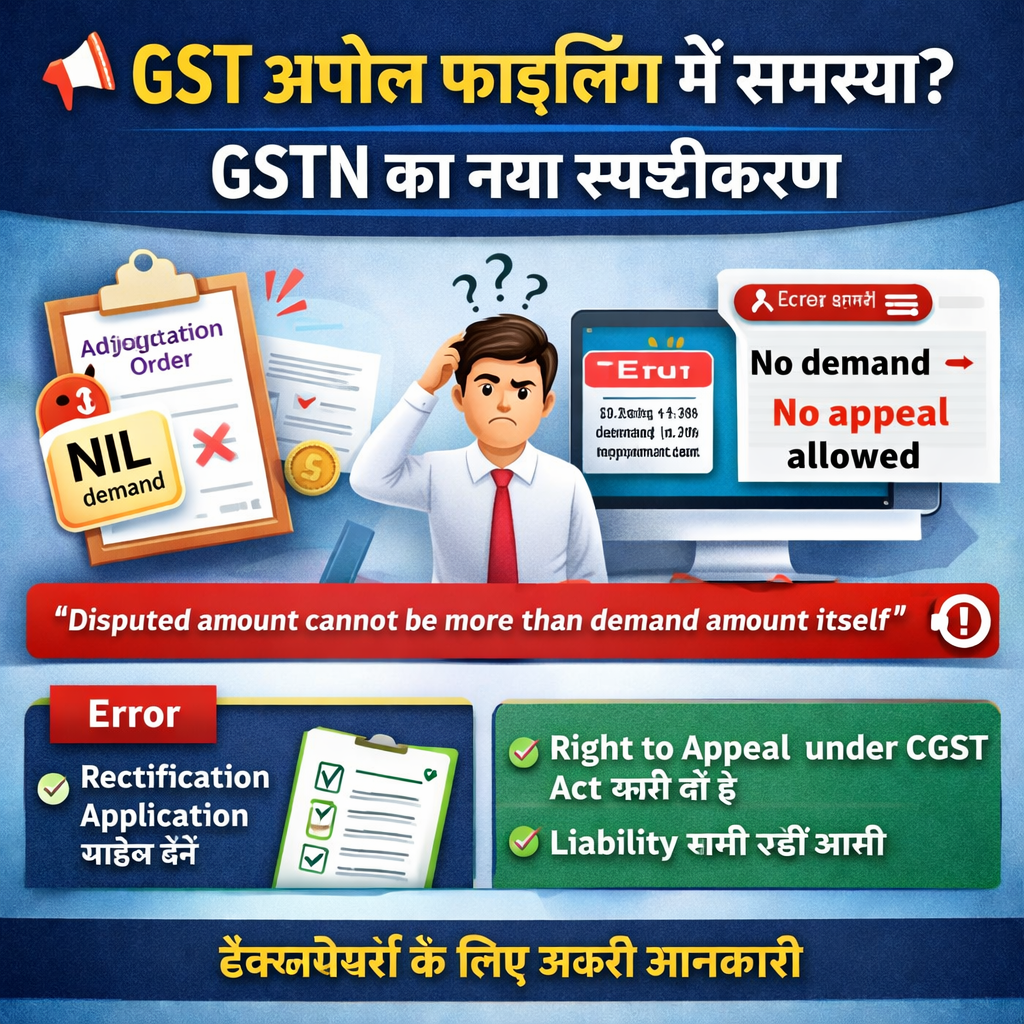
GST अपील प्रक्रिया में समस्या? GSTN ने जारी की गाइडलाइन

📢 GST अपील फाइलिंग में समस्या? जानें पूरा मामला और समाधान

GSTN ने हाल ही में एक महत्वपूर्ण समस्या पर ध्यान दिलाया है, जिसका सामना कई टैक्सपेयर्स GST पोर्टल पर अपील फाइल करते समय कर रहे हैं।


⚠️ समस्या क्या है?

कुछ मामलों में टैक्सपेयर्स adjudication order के खिलाफ appeal (APL-01) फाइल नहीं कर पा रहे हैं क्योंकि:

👉 ऑर्डर में Demand = NIL दिख रहा है
👉 जबकि वास्तव में टैक्स liability पर विवाद अभी भी मौजूद है


🔍 यह स्थिति कब उत्पन्न होती है?

यह समस्या आमतौर पर तब होती है जब:

  • टैक्सपेयर SCN (Show Cause Notice) स्टेज पर पेमेंट कर देता है
  • लेकिन यह पेमेंट liability स्वीकार किए बिना किया गया होता है
  • फिर भी अधिकारी इसे final discharge मान लेते हैं
  • और ऑर्डर में NIL demand दिखा देते हैं

⚙️ GST पोर्टल पर सिस्टम व्यवहार (DCR Mechanism)

जब भी demand order पास होता है:

  • एक Demand ID जनरेट होती है
  • यह Demand and Collection Register (DCR) में रिकॉर्ड होती है

👉 अगर demand NIL है:

  • सिस्टम इसे zero liability मान लेता है

🚫 असली समस्या (Appeal Filing Error)

जब आप Form APL-01 से अपील फाइल करते हैं:

👉 पोर्टल एरर देता है:
“Disputed amount cannot be more than demand amount itself”

📌 कारण:

  • Demand = NIL
  • इसलिए सिस्टम अपील ब्लॉक कर देता है

👉 सरल शब्दों में:
No demand = No appeal (technical issue)


⚖️ कानूनी स्थिति (बहुत महत्वपूर्ण)

GST Network (GSTN) ने स्पष्ट किया है:

✔ SCN स्टेज पर पेमेंट = liability स्वीकार करना नहीं है
✔ टैक्सपेयर को अपील का पूरा अधिकार है

👉 लागू कानून:
Section 107 of CGST Act, 2017

📌 महत्वपूर्ण बात:

  • पेमेंट कई बार pressure / compliance / litigation avoid करने के लिए किया जाता है
  • यह अपील का अधिकार खत्म नहीं करता

🛠️ GSTN द्वारा सुझाया गया समाधान

इस समस्या को हल करने के लिए GSTN ने एक स्पष्ट प्रक्रिया बताई है:

✅ Step-by-Step Solution

1. Rectification Application फाइल करें

  • GST पोर्टल पर rectification का विकल्प इस्तेमाल करें

2. Adjudicating Authority से संपर्क करें

  • स्पष्ट करें कि:
    • liability स्वीकार नहीं की गई थी
    • demand सही तरीके से निर्धारित की जाए

3. Rectification Order प्राप्त करें

  • संशोधित ऑर्डर में सही demand दिखनी चाहिए

4. फिर Appeal (APL-01) फाइल करें

  • demand अपडेट होने के बाद
  • निर्धारित समय सीमा के अंदर
1 अप्रैल 2026 से टैक्स सिस्टम में परिवर्तन | जानें प्रमुख बदलाव

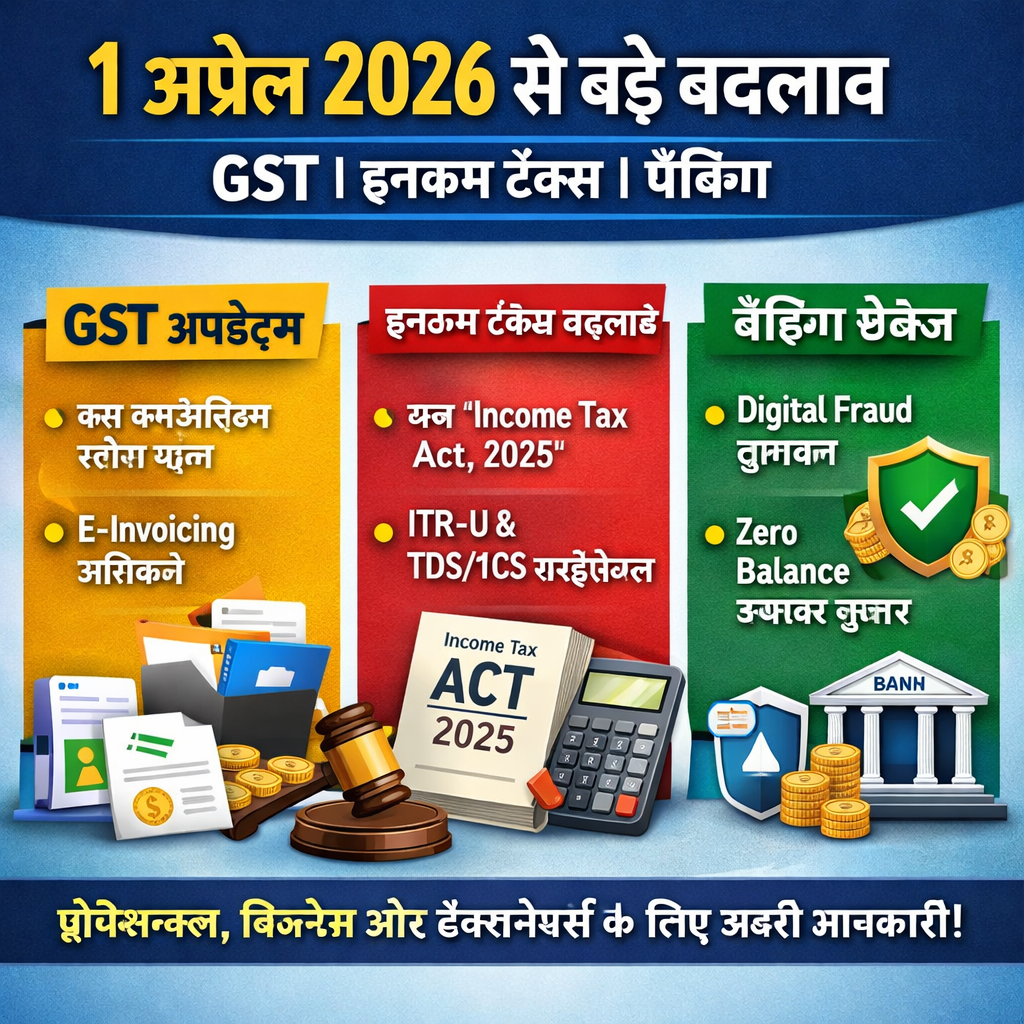
1 अप्रैल 2026 से लागू बड़े बदलाव | GST और इनकम टैक्स अपडेट

यह आर्टिकल 1 अप्रैल 2026 से लागू होने वाले सभी महत्वपूर्ण बदलावों को कवर करता है — प्रोफेशनल्स, बिज़नेस और टैक्सपेयर्स के लिए एक कम्प्लीट गाइड।


🟡 PART 1: GST में 1 अप्रैल 2026 से बदलाव

🔸 1. कंपोज़िशन स्कीम की डेडलाइन खत्म

31 मार्च 2026 अंतिम तिथि थी।
👉 1 अप्रैल के बाद:

  • नया ऑप्शन अब उपलब्ध नहीं
  • अगला मौका अगले वित्त वर्ष में ही मिलेगा

🔸 2. LUT (Letter of Undertaking) जरूरी

FY 2026-27 के लिए नया LUT फाइल करना अनिवार्य
👉 अगर फाइल नहीं किया:

  • एक्सपोर्ट टैक्सेबल माना जाएगा
  • GST देना पड़ेगा

⚠️ सलाह: वर्किंग कैपिटल ब्लॉक होने से बचने के लिए तुरंत LUT फाइल करें


🔸 3. GTA फॉरवर्ड चार्ज ऑप्शन बंद

31 मार्च 2026 तक ही विकल्प उपलब्ध था
👉 1 अप्रैल से:

  • डिफॉल्ट = Reverse Charge लागू

🔸 4. Rule 14A में राहत

👉 1 अप्रैल 2026 के बाद DRC-32 फाइल करने पर:

  • सिर्फ 1 महीने का GST रिटर्न देना होगा
  • पहले की तुलना में बड़ी राहत

🔸 5. नया इनवॉइस सीरीज़ अनिवार्य

नए वित्त वर्ष के साथ:

  • नई इनवॉइस नंबरिंग शुरू करें
  • GST और ऑडिट के लिए जरूरी

🔸 6. E-Invoicing लागू

👉 अगर टर्नओवर ₹5 करोड़ से अधिक है:

  • 1 अप्रैल 2026 से E-invoicing अनिवार्य

🔸 7. बुक्स ऑफ अकाउंट्स क्लोजर

31 मार्च 2026 तक:

  • बुक्स क्लोज करें
  • बैकडेट एंट्री से बचें
  • ऑडिट ट्रेल बनाए रखें

🔸 8. टर्नओवर की सही गणना

महत्वपूर्ण उपयोग:

  • E-invoicing
  • ऑडिट
  • कंपोज़िशन स्कीम

👉 ध्यान रखें:

  • सभी GSTIN का PAN आधारित टर्नओवर शामिल करें

🔸 9. GST रेट वेरिफिकेशन

  • हाल के बदलाव वाले प्रोडक्ट्स पर खास ध्यान दें
  • सही रेट लागू करें

🔸 10. MRP आधारित वैल्यूएशन (तंबाकू)

1 फरवरी 2026 से लागू
👉 जांचें:

  • क्या MRP बेस्ड वैल्यूएशन लागू है
  • सभी कंप्लायंस पूरे हैं या नहीं

🔸 11. ITC रीकंसिलिएशन जरूरी

मिलान करें:

  • बुक्स vs GSTR-2B
  • वेंडर फाइलिंग

👉 इससे नोटिस से बचा जा सकता है


🔸 12. ITC रिवर्सल और रिक्लेम ट्रैकिंग

  • पोर्टल पर नए स्टेटमेंट उपलब्ध
    👉 सुनिश्चित करें:
  • सही रिवर्सल
  • योग्य रिक्लेम लिया गया

🔸 13. अन्य महत्वपूर्ण GST पॉइंट्स

✅ HSN कोड अपडेट करें
✅ RCM लायबिलिटी चेक करें
✅ GSTR-9 / 9C की तैयारी शुरू करें
✅ E-Way Bill नियमों की जांच करें


🔵 PART 2: INCOME TAX में 1 अप्रैल 2026 से बदलाव

🔸 1. नया Income Tax Act, 2025 लागू

👉 1 अप्रैल 2026 से:

  • पुराना कानून रिप्लेस
  • नया टैक्स फ्रेमवर्क लागू

🔸 2. नए ITR फॉर्म और नियम

👉 नए बदलाव:

  • अपडेटेड रिपोर्टिंग फॉर्मेट
  • अतिरिक्त डिस्क्लोज़र आवश्यक
  • पोर्टल पर नए फॉर्म उपलब्ध

    🔸 3. नया चालान सिस्टम लागू

    टैक्स भुगतान के लिए नई संरचना लागू की गई है

    🔸 3. सही चालान का उपयोग अनिवार्य

    टैक्स पेमेंट करते समय अब सही चालान चुनना बेहद जरूरी है

    👉 उपयोग करें:

    • Advance Tax के लिए अलग चालान
    • Self-Assessment Tax के लिए अलग चालान

    ⚠️ गलत चालान चयन करने पर:

    • पेमेंट mismatch हो सकता है
    • नोटिस या एडजस्टमेंट की समस्या आ सकती है

    🔸 4. Income Tax Portal अपडेट

    इनकम टैक्स पोर्टल में बड़े बदलाव किए गए हैं

    👉 नए फीचर्स:

    • नया User Interface (UI)
    • आसान Navigation System

    👉 इसमें शामिल:

    • नया फॉर्म चयन सिस्टम
    • अपडेटेड फाइलिंग वर्कफ्लो

    📌 असर:
    रिटर्न फाइलिंग अब अधिक streamlined और user-friendly हो गई है


    🔸 5. Updated Return (ITR-U) पर रोक

    👉 FY 2020-21 के लिए:
    ❌ अब Updated Return फाइल नहीं कर सकते

    📌 1 अप्रैल 2026 से:

    • यह वर्ष पूरी तरह time-barred हो गया है

    🔸 6. TDS/TCS Correction Statements पर प्रतिबंध

    Section 397(3)(f) के अनुसार:

    👉 निम्न वर्षों के लिए correction अब संभव नहीं:

    • FY 2018-19 (Q4)
    • FY 2019-20 से 2022-23 (Q1–Q4)
    • FY 2023-24 (Q1–Q3)

    👉 1 अप्रैल 2026 से:
    ❌ कोई correction allowed नहीं


    🔸 7. अन्य महत्वपूर्ण Income Tax पॉइंट्स

    AIS / TIS Reconciliation

    • AIS/TIS को books से मैच करना जरूरी

    Advance Tax Planning

    • नए एक्ट के अनुसार calculation में बदलाव संभव

    Carry Forward Loss Check

    • losses सही तरीके से report किए गए हों

    Capital Gains Adjustments

    • नए नियमों के अनुसार verify करें

    🏦 PART 3: RBI & BANKING CHANGES (2026 से महत्वपूर्ण)

    🔸 1. Digital Fraud Compensation (बड़ी राहत)

    Reserve Bank of India ने नया customer protection framework लागू किया है

    👉 यदि आप डिजिटल फ्रॉड का शिकार होते हैं:

    • मुआवजा = 85% नुकसान या ₹25,000 (जो कम हो)
    • लागू: ₹50,000 तक के छोटे फ्रॉड पर
    • जीवन में केवल 1 बार

    ⚠️ शर्तें:

    • 5 दिनों के भीतर रिपोर्ट करना जरूरी
    • रिपोर्ट करें:
      • बैंक
      • Cyber Crime Portal

    👉 बैंक की जिम्मेदारी:

    • 5 दिनों के भीतर राशि क्रेडिट करना

    📌 प्रभाव:

    • पहली बार मजबूत कस्टमर सुरक्षा
    • डिजिटल पेमेंट्स पर भरोसा बढ़ेगा

    🔸 2. UPI और ATM लिमिट – स्पष्टता

    👉 महत्वपूर्ण बात:

    • UPI ट्रांजैक्शन ATM लिमिट में शामिल नहीं होते
    • ATM लिमिट केवल ATM withdrawals पर लागू होती है

    🔸 3. Zero Balance Accounts (BSBDA) में सुधार

    BSBDA खातों के लिए RBI ने सुविधाएं बढ़ाई हैं

    कोई Minimum Balance नहीं

    • पहले की तरह जारी

    ATM / Debit Card सुविधा

    • अब ज्यादा व्यापक रूप से उपलब्ध

    फ्री ट्रांजैक्शन लिमिट

    • कम से कम 4 फ्री withdrawal प्रति माह

    UPI और डिजिटल एक्सेस

    • UPI, Mobile Banking, AEPS पूरी तरह उपलब्ध

    बेसिक सर्विसेज पर कोई चार्ज नहीं

    • डिपॉजिट
    • बेसिक withdrawal
    • अकाउंट मेंटेनेंस

    फ्री पासबुक / स्टेटमेंट

    ओवरड्राफ्ट सुविधा

    • बैंक की शर्तों के अनुसार उपलब्ध

      📌 निष्कर्ष

      1 अप्रैल 2026 से GST, Income Tax और Banking तीनों क्षेत्रों में बड़े बदलाव लागू हो चुके हैं।
      समय पर इन अपडेट्स को समझकर और लागू करके आप compliance risk, penalties और financial losses से बच सकते हैं।

GSTR-3B Changes from Feb 2026: New GST ITC Rules Bring Relief to Taxpayers

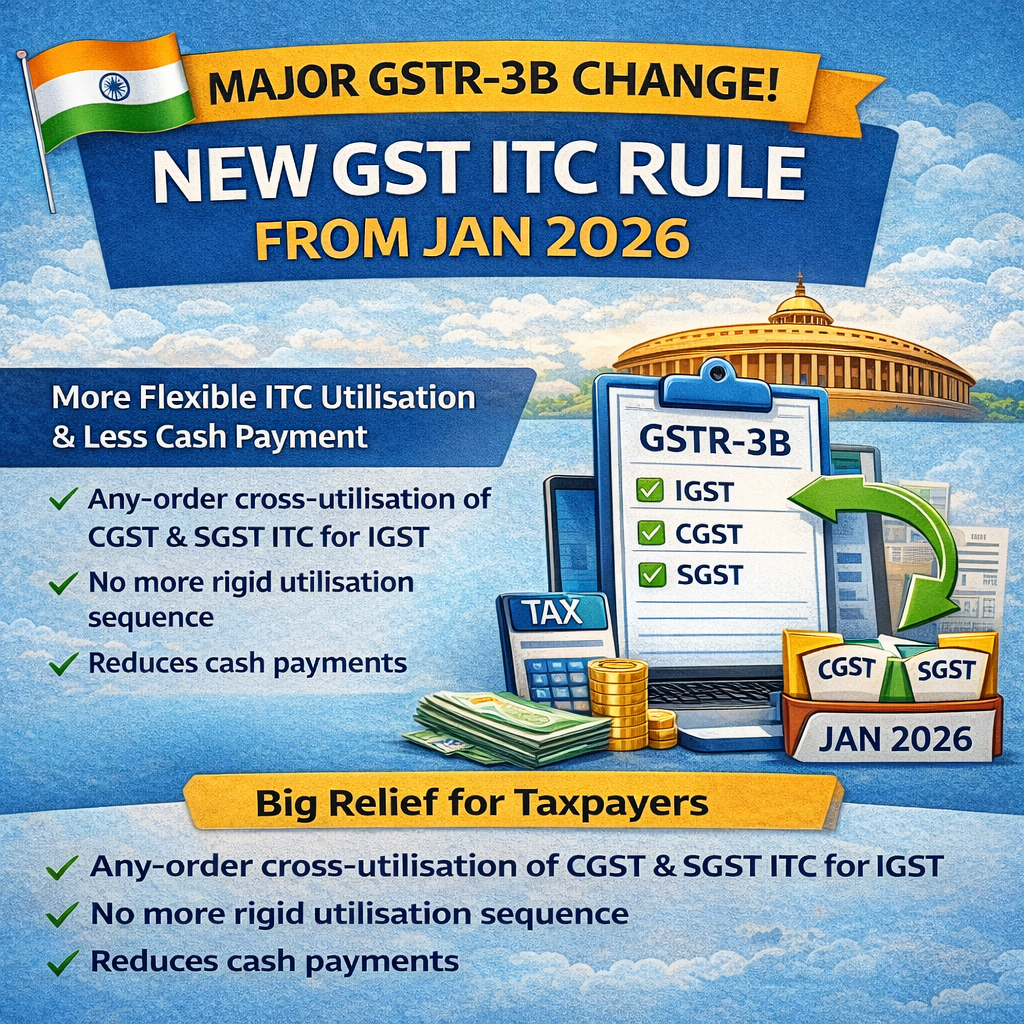
To reduce taxpayer hardship, the GST Portal will roll out a major change in ITC utilisation from the January 2026 return period, relaxing the rigid utilisation sequence followed earlier.

1. Earlier ITC Set-Off Rule – Compliance Challenge

Statutory Position (Earlier Framework)

Under the earlier GST law and portal system, Input Tax Credit utilisation was subject to a strict and compulsory sequence:

  • IGST ITC was required to be utilised first:

    • Against IGST liability

    • Then against CGST liability

    • Then against SGST liability

  • CGST ITC could be utilised only:

    • Against CGST liability

    • Then against IGST liability

  • SGST ITC could be utilised only:

    • Against SGST liability

    • Then against IGST liability

Direct cross-utilisation between CGST and SGST was not permitted.

Practical Difficulty for Taxpayers

Because of this rigid utilisation order, taxpayers often had to make cash payments, even when sufficient ITC was available under a different tax head. This resulted in blocked credits and avoidable cash outflow.

Illustration – Earlier Rule (Before January 2026)

Output Tax Liability

  • IGST: ₹1,00,000

  • CGST: ₹40,000

  • SGST: ₹40,000

Available ITC

  • IGST ITC: ₹1,00,000

  • CGST ITC: ₹50,000

  • SGST ITC: ₹50,000

Utilisation as per Earlier Rules

  • IGST ITC of ₹1,00,000 adjusted fully against IGST liability

  • CGST liability of ₹40,000 paid using CGST ITC

  • SGST liability of ₹40,000 paid using SGST ITC

✔ In this scenario, no hardship arose.

Problem Scenario Under Earlier Rules

  • Output IGST Liability: ₹80,000

  • Available ITC:

    • CGST ITC: ₹60,000

    • SGST ITC: ₹20,000

Under the old system:

  • CGST ITC could not be used to pay SGST

  • SGST ITC could not be used to pay CGST

Result:
Despite total ITC being sufficient, cash payment became unavoidable due to utilisation restrictions. This was a common and recurring compliance issue.


2. New ITC Utilisation Rule – Effective from January 2026

What Has Changed?

🔹 System-level modification in Table 6.1 of GSTR-3B

From the January 2026 tax period onwards, once IGST ITC is fully exhausted, the GST Portal will allow utilisation of CGST and SGST ITC for payment of IGST liability in any sequence.

📌 This flexibility is enabled through the GST Portal system, without changing the basic statutory framework.


3. Salient Features of the New Rule

  • Applicable only after full utilisation of IGST ITC

  • CGST and SGST ITC can be used in any order

  • Cross-utilisation permitted only for IGST liability

  • Implemented through automated portal logic in GSTR-3B

  • Reduces cash outflow and accumulation of idle ITC


4. Illustration – New Rule (From January 2026)

Output IGST Liability: ₹80,000

Available ITC

  • IGST ITC: Nil

  • CGST ITC: ₹60,000

  • SGST ITC: ₹20,000

Utilisation under New Rule

  • CGST ITC utilised: ₹60,000

  • SGST ITC utilised: ₹20,000

IGST liability fully discharged through ITC, with no cash payment

✔ Earlier: Cash payment was mandatory
✔ Now: Entire liability settled via ITC


5. Practical Impact on Taxpayers

✅ Significant Relief

  • Eliminates unnecessary cash payments

  • Prevents ITC pile-up under a single tax head

  • Improves liquidity and working capital efficiency

✅ Easier Compliance

  • System-driven utilisation suggestions

  • Reduced chances of manual errors

  • More logical and business-friendly ITC usage


6. Important Points to Remember

  • Direct cross-utilisation between CGST and SGST is still not allowed

  • Flexibility is permitted only for IGST liability

  • Applicable prospectively from January 2026

  • Taxpayers should analyse ITC balances before filing GSTR-3B

Budget 2026 Updates: Major Changes in GST Law

GST Changes Announced in Budget 2026 – Key Amendments Explained

The Finance Bill, 2026 proposes several significant amendments to the Central Goods and Services Tax Act, 2017 (CGST Act) with the intent of simplifying GST compliance, reducing litigation, and strengthening refund and appellate mechanisms.

Unless specifically stated otherwise, these amendments will become effective from a date to be notified, simultaneously with corresponding amendments by the States and Union Territories.


1. Amendment to Section 15(3): Post-Sale Discounts

Earlier Position

Post-sale discounts were allowed to be excluded from the value of supply only if:

  • The discount was agreed upon before or at the time of supply, and

  • The recipient reversed proportionate Input Tax Credit (ITC).

This condition led to frequent disputes where commercial discounts were offered after supply without explicit prior agreements.

Amendment Proposed (Finance Bill, 2026 – Clause 137)

  • The requirement of linking discounts to a pre-existing agreement has been removed.

  • Section 15(3) now allows exclusion of discounts based on issuance of a credit note under Section 34, subject to reversal of corresponding ITC by the recipient.

Impact

✔ Greater commercial flexibility
✔ Reduced valuation-related litigation
✔ Better alignment with real-world business practices


2. Amendment to Section 34: Credit Notes

Earlier Position

Section 34 did not explicitly link credit note provisions with valuation rules under Section 15, resulting in interpretational challenges.

Amendment Proposed (Clause 138)

  • Section 34 is amended to expressly reference Section 15.

Impact

✔ Clear legal linkage between valuation and credit notes
✔ Strengthens validity of post-sale discount adjustments
✔ Reduces objections during audits and assessments


3. Amendment to Section 54(6): Provisional Refund for Inverted Duty Structure

Earlier Position

Provisional refund of 90% was primarily available for zero-rated supplies, while refunds arising from Inverted Duty Structure (IDS) were excluded.

Amendment Proposed (Clause 139)

  • Provisional refund provisions are extended to IDS-related refunds.

Impact

✔ Improved cash flow for manufacturers
✔ Reduced working capital blockage
✔ Major relief for sectors with higher input tax rates


4. Amendment to Section 54(14): Removal of Refund Threshold Limit

Earlier Position

A threshold limit applied for sanctioning refunds, leading to procedural delays—especially for small exporters.

Amendment Proposed (Clause 139)

  • Threshold limit removed for refund claims relating to export of goods with payment of tax.

Impact

✔ Uniform refund processing
✔ Faster refunds for small exporters
✔ Reduced administrative discretion


5. Insertion of Section 101A(1A): Interim National Appellate Mechanism

Earlier Position

Conflicting Advance Ruling decisions were appealable to the National Appellate Authority (NAA), which was never constituted—leaving taxpayers without remedy.

Amendment Proposed (Clause 140)

  • New Section 101A(1A) empowers the Government to notify an existing authority or tribunal to hear such appeals until NAA is constituted.

  • Sub-sections (2) to (13) of Section 101A will not apply in such cases.

  • Explanation clarifies that “existing authority” includes a tribunal.

📌 Effective Date: 1 April 2026

Impact

✔ Resolves long-standing appellate vacuum
✔ Provides certainty in advance ruling disputes
✔ Strengthens GST dispute resolution framework


6. IGST Act Amendment: Place of Supply for Intermediary Services

Earlier Provision

Under Section 13(8)(b) of the IGST Act, intermediary services were deemed supplied at the location of the service provider, making overseas services taxable in India.

Amendment Proposed (Clause 141)

  • Section 13(8)(b) is omitted.

  • Place of supply will now be determined as per Section 13(2)—i.e., location of the recipient.

Impact

✔ Intermediary services to foreign clients qualify as export of services (subject to conditions)
✔ GST generally not applicable on such transactions
✔ Major relief for service exporters and consultants
✔ Long-pending litigation expected to subside


Conclusion

The GST amendments proposed in the Finance Bill, 2026 mark a decisive move toward taxpayer-friendly, litigation-free, and business-aligned GST administration. Key reforms in valuation, refunds, appellate remedies, and cross-border services are expected to significantly improve compliance efficiency and certainty.

Businesses and professionals should closely evaluate these changes and prepare for implementation once notified.