
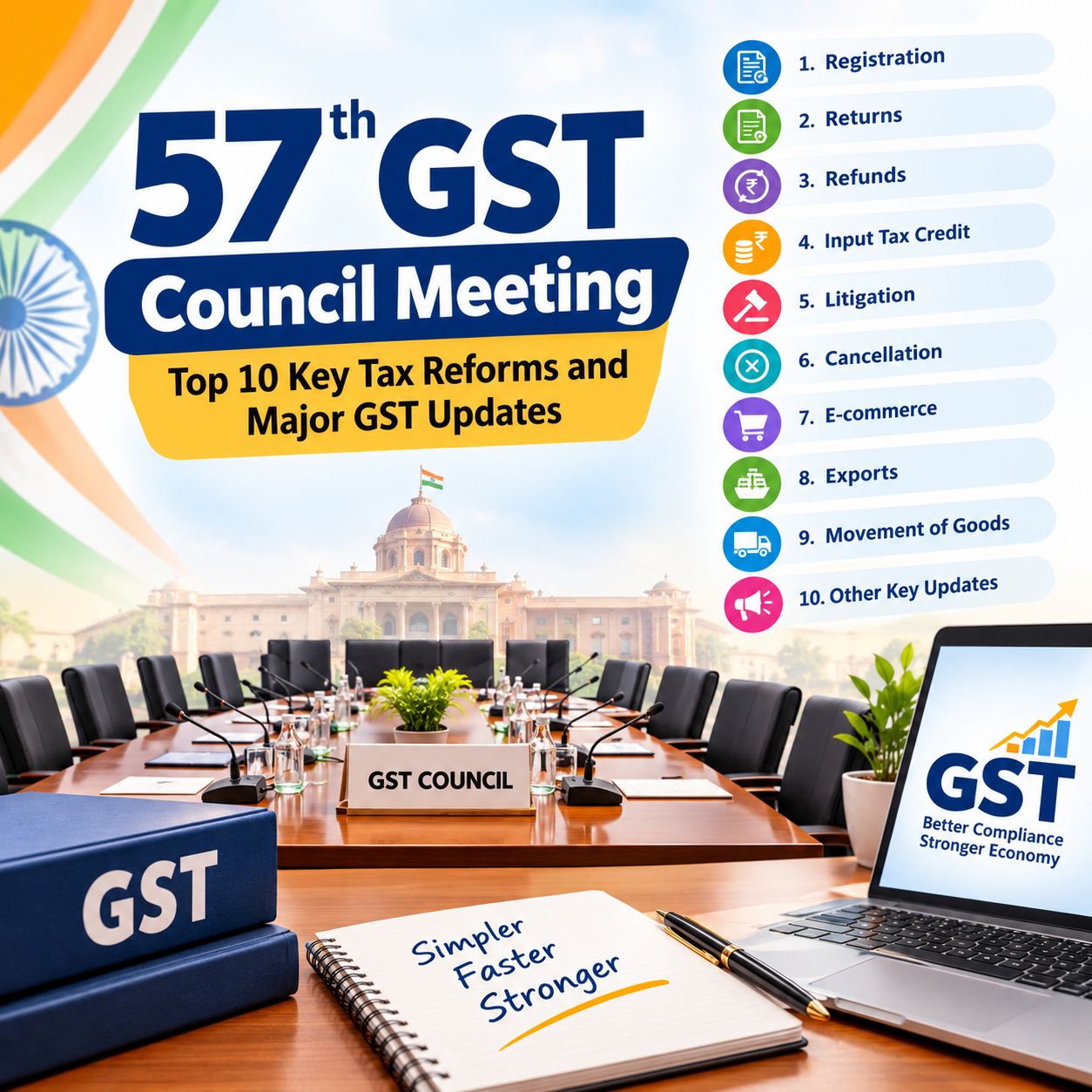

57th GST Council Meeting: 10 Major Tax Reforms and Important GST Announcements
57th GST Council Meeting: 10 Major GST Decisions and Key Compliance Reforms
The 57th GST Council Meeting, conducted in New Delhi on 8 October 2026, primarily focused on simplifying GST administration, improving processing speed, and expanding the use of technology in tax compliance. Rather than introducing changes to GST rates, the Council concentrated on procedural and administrative reforms relating to registration, return filing, refunds, Input Tax Credit (ITC), litigation, registration cancellation, e-commerce, exports, and transportation of goods. According to the meeting’s outcome note, no GST rate revisions were announced. The Council also decided that rate-related issues would be considered annually at a separate meeting dedicated exclusively to GST rates.
The reforms follow a year of implementation of the two-rate structure. During this period, taxable supplies and GST collections increased, while the effective tax rate on domestic supplies declined. The Council reported that monthly taxable supplies rose from ₹40.19 lakh crore to ₹50.58 lakh crore, while supplies reported to consumers increased from ₹5.98 lakh crore to ₹7.58 lakh crore. Gross tax liability also recorded growth, whereas the effective tax rate on domestic supplies decreased from 14.55% to 13.13%. The overall observation was that tax rates declined while the tax base expanded.
1. GST Registration Process to Become Simpler and More Automated
A key area of reform is the GST registration system. Currently, applications identified as low-risk, along with applications where output tax on supplies to registered persons does not exceed ₹2.5 lakh per month, can receive system-based registration within three working days without direct intervention by a tax officer. The Council stated that approximately 61% of GST registrations are already processed through this automated mechanism, while the remaining applications are examined by officers.
Under the proposed improvements, the registration portal will become more intuitive and applicant-friendly. It will display only the fields relevant to the applicant and identify the documents required for each specific purpose.
The Council has also approved automatic processing of selected registration amendment applications. Between November 2025 and September 2026, approximately 16.73 lakh amendment applications were submitted, of which 65.45% concerned changes such as trade names, directors’ or partners’ details, and addresses of additional places of business. These specified categories will now be eligible for automatic acceptance.
These changes are intended to reduce manual verification, simplify applications, and speed up routine registration-related procedures.
2. GST Return Filing to Improve Buyer-Seller Data Matching
The Council has proposed further integration between supplier-reported transactions and the Input Tax Credit claimed by buyers. It observed that approximately 95,000 system-generated notices are issued annually because of differences between GST returns. However, the recovery against these notices represents only around 0.08% of the amount involved, suggesting that many discrepancies arise from reporting or data-entry errors.
Under the proposed mechanism, adjustments made by a supplier to previously reported sales will be communicated through the sales statement, enabling the corresponding buyer to account for the change in the original transaction. Taxpayers will also be allowed to correct certain details relating to earlier periods, including an incorrectly entered buyer GST registration number.
The Invoice Management System (IMS) will play an important role in reconciling these transactions. The buyer’s accepted position will flow into the relevant return, helping align supplier reporting with the buyer’s ITC records.
The proposed framework represents a move towards invoice-level reconciliation, reducing avoidable mismatches and improving coordination between buyers and suppliers.
3. GST Refunds to Be Processed More Quickly Through Automation
Improving the refund mechanism is another significant objective of the Council’s recommendations. The time permitted for issuing an acknowledgement of a refund application is proposed to be reduced from 15 days to 10 days. If neither an acknowledgement nor a deficiency memo is issued within this period, the application will be treated as acknowledged.
The Council has also proposed a risk-based refund system under which 90% of the claimed refund amount may be sanctioned through automated processing, subject to the prescribed risk assessment. The refund order is proposed to be issued within three working days of acknowledgement, compared with the existing seven-day period referred to in the outcome note.
Additionally, refunds relating to excess balances in the Electronic Cash Ledger are proposed to be processed automatically without requiring officer intervention.
The proposed system will also reduce repetitive data entry. Relevant shipping details will be obtained from Customs records, while payment information will be sourced from banking systems. This integration is expected to simplify refund applications and reduce administrative delays.
4. Important Proposed Changes in Input Tax Credit
The 57th GST Council Meeting has recommended several changes concerning Input Tax Credit. The proposals include allowing ITC on health and life insurance policies taken for employees, as well as on telecommunication towers and pipelines installed outside factory premises.
Credit is also proposed to be allowed on free samples and on stock written off due to the expiry of its shelf life where the applicable law requires the goods to be destroyed.
Another important proposal concerns services that are purchased and resupplied within the same business line. The Council has indicated that such transactions should not result in the same service being taxed twice because the credit chain is interrupted.
Examples discussed include hotel accommodation costing up to ₹7,500 per night booked through an agent, restaurant and catering services, and passenger transportation. In certain cases, these services were taxed at 5% without ITC, which restricted the flow of credit between businesses.
The proposed changes aim to restore the credit chain in eligible transactions and reduce tax-related distortions in service industries.
5. Inverted Duty Structure Refunds to Include Input Services and Plant & Machinery
The Council has proposed expanding the refund mechanism applicable to an inverted duty structure. Under the earlier framework described in the outcome note, refunds were restricted to tax attributable to input goods.
The proposed amendment will allow refunds relating to tax paid on input services under the inverted duty structure for ITC availed on or after 1 November 2026.
The restriction relating to tax paid on plant and machinery is also proposed to be removed. In such cases, the eligible refund would be calculated at one-sixtieth of the relevant credit for each month, reflecting the working life of the asset. This provision is proposed to apply to ITC availed on or after 1 April 2027.
These measures could help businesses manage accumulated credits and improve working capital availability, particularly in industries such as pharmaceuticals and fast-moving consumer goods (FMCG).
6. GST Litigation Procedures to Follow a Standardised Framework
The Council has proposed a more uniform approach to GST litigation and adjudication. The standard framework is expected to cover the issuance and service of notices, pre-notice communications, the grounds for alleging fraud, hearing procedures, and the preparation of adjudication orders.
Another important proposal is the introduction of a monetary threshold for issuing notices. Under the recommendation, no notice would be issued where the tax amount involved is below ₹10,000.
The objective is to reduce unnecessary disputes and avoid spending disproportionate administrative resources on matters involving relatively small amounts.
Standardised procedures could also improve consistency in the handling of GST disputes across different jurisdictions.
7. Proposed Relief in GST Arrest, Prosecution, and General Penalties
The Council’s outcome note contains important recommendations concerning GST enforcement and penalties. It states that the power of arrest under GST is proposed to be removed.
The prosecution threshold is also proposed to increase from ₹1 crore to ₹5 crore. In addition, the minimum punishment is proposed to be removed, allowing the court to determine whether a fine, imprisonment, or both would be appropriate in an individual case.
The general penalty applicable when no specific penalty is prescribed is proposed to be reduced from ₹25,000 to ₹10,000.
The Council has emphasised a more proportionate approach to compliance failures. Delayed return filing, reporting mistakes, or payment defaults would continue to attract the applicable recovery provisions, interest, and proportionate penalties, rather than additional punitive consequences beyond the relevant legal framework.
The broader objective is to use technology and invoice-level information to identify mismatches and potentially fraudulent ITC claims. The Council’s approach places greater emphasis on detecting irregularities through data analysis rather than relying primarily on deterrent enforcement measures.
8. E-Way Bill Checks and Physical Inspection of Goods in Transit
The Council has proposed changes to the procedure for physically inspecting goods transported under the GST framework.
Under the proposed system, a vehicle may be stopped for inspection only when specific intelligence is available. Prior authorisation from an officer holding a rank not below Joint Commissioner would also be required.
The proposal further restricts inspection powers to the originating State and the destination State. States through which the goods merely transit would not be permitted to stop the vehicle for inspection under the proposed framework.
For instance, if a consignment travels through five States before reaching its destination, physical verification would generally be limited to the State from which the goods originate and the State where they are delivered, rather than permitting routine checks in every intervening State.
E-Way Bills and other prescribed documents would continue to be required, and their details would remain subject to system-based verification. The principal change is that physical inspection would be linked to specific information or intelligence rather than conducted routinely without such a basis.
9. Simplified GST Registration Cancellation and a Proposed Scheme for Small Businesses
The Council has recommended an automated and phased approach to GST registration cancellation and business closure, beginning with smaller taxpayers.
Under the proposed framework, filing the final return would become part of the registration closure application instead of being treated as a separate subsequent step.
Where a GST registration has been suspended or cancelled because of a pending return or missing bank account details, the system is proposed to restore the registration once the taxpayer fulfils the outstanding requirement.
The Council has also granted in-principle approval for an optional compliance scheme for small taxpayers with turnover of up to ₹5 crore who make supplies exclusively to consumers. Under the proposed arrangement, eligible taxpayers would file returns annually while paying tax quarterly.
However, the detailed framework and the necessary legal amendments are expected to be presented at the next Council meeting. Therefore, this proposal should be understood as an in-principle decision rather than an operational filing facility currently available to taxpayers.
10. Key Reforms for Service Exports and E-Commerce Businesses
The meeting also addressed GST-related issues affecting exporters of services and sellers operating through e-commerce platforms.
Changes concerning export of services
An Indian business providing services to a foreign customer through its own overseas branch is proposed to become eligible for export benefits, subject to the applicable conditions and the removal of the restriction identified in the outcome note.
This proposal may be relevant to analytics companies, design businesses, engineering consultants, and Indian offices of international organisations.
The Council has also proposed treating services performed in India on goods belonging to a foreign customer as exports of services, even when the goods do not physically leave India. Examples include testing, repairs, certification, research, and processing activities.
The objective is to improve the tax treatment of these transactions and make India more competitive as a destination for contract processing and specialised services.
Changes concerning e-commerce sellers
Small sellers using e-commerce platforms may receive greater flexibility in managing GST registrations across States.
Under the proposal, a seller could declare an electronic commerce operator’s warehouse located in another State as the seller’s Principal Place of Business in that State, subject to the operator’s consent. This consent is proposed to be obtained automatically through the system.
The seller would still need to maintain a physical presence in at least one State, and the registration in the additional State would be restricted to supplies made through the relevant platforms.
The Council has also proposed a consistent tax treatment for similar services offered through different platform business models. Differences in contractual arrangements have led to varying interpretations of the same provisions. Under the proposed approach, the tax treatment would be determined by the actual service supplied, ensuring that comparable services receive comparable tax treatment regardless of how a platform structures the transaction.
No GST Rate Revision in the 57th GST Council Meeting
A key takeaway from the meeting is that no GST rate changes were announced at the 57th GST Council Meeting.
Instead, the discussions focused on resolving operational difficulties, removing inconsistencies, and addressing ambiguities that remained after the previous year’s rate-related changes.
The Council has decided to consider GST rate matters once a year at a dedicated meeting. This approach is intended to separate rate-related decisions from discussions concerning GST administration and compliance procedures.
Consequently, businesses should distinguish between the procedural reforms proposed at this meeting and changes to the tax rates applicable to goods and services. The emphasis was on improving how the GST system functions in practice, including registration, return filing, refunds, ITC claims, business closure, transportation, exports, and dispute resolution.
How Will the 57th GST Council Meeting Affect Taxpayers?
The recommendations indicate a move towards a more automated, technology-enabled, and risk-based GST compliance framework.
The principal implications for businesses include:
- Registration: Greater automation and faster processing of eligible applications.
- Return filing: Improved coordination between supplier declarations and buyer ITC claims.
- Refunds: Shorter acknowledgement timelines and increased system-based processing.
- Input Tax Credit: Proposed changes affecting selected insurance, infrastructure, sample, stock, and service transactions.
- Litigation: More standardised procedures and a proposed monetary threshold for notices.
- Enforcement: Proposed changes to arrest, prosecution, and general penalty provisions.
- Transportation: Greater reliance on specific intelligence before conducting physical inspections.
- Business closure: A more integrated registration cancellation process.
- Small taxpayers: A proposed optional annual return scheme with quarterly tax payments for eligible businesses.
- Exports and e-commerce: Proposed clarifications intended to simplify selected cross-border service and platform-based transactions.
For businesses, the key message is that GST compliance is gradually moving away from repetitive manual procedures towards data matching, risk-based assessments, and automated decision-making.
However, taxpayers should carefully distinguish between recommendations announced by the Council and provisions that have become legally effective. Some proposals require detailed rules, system modifications, notifications, or legislative amendments before they can be implemented.
In conclusion, the 57th GST Council Meeting represents a significant step towards GST process reform rather than another round of rate revisions. Its broader objective is to make compliance more convenient for businesses while strengthening the tax administration’s ability to identify discrepancies through technology and invoice-level information.
The proposed measures aim to address the remaining inconsistencies and ambiguities in GST administration and advance the principles underlying GST 2.0, with a greater emphasis on simplification, transparency, automation, and proportionate enforcement.