New Income Tax Slab Rates in Budget 2026: FY 2026-27 (AY 2027-28), ITR Deadlines & TDS/TCS Rules

Key Income Tax & ITR Updates – Budget 2026

  • No change in income tax slab rates under either tax regime.

  • Simplified ITR forms will be introduced shortly to ease compliance.

📅 Revised ITR Due Dates (Non-Audit Cases)

  • Business & Trust cases: Due date extended from 31 July to 31 August

  • Other non-audit cases: Due date continues to be 31 July

🔁 Revised Return – Section 139(5)

  • Time limit to file a revised return extended from 31 December to 31 March of the relevant assessment year.

🔄 TDS & TCS Updates

  • TDS and TCS rates rationalised to reduce complexity and mismatches.

🏠 Property Purchase from NRI – Key Relief

  • TAN requirement removed for buyers of property from an NRI.

  • A PAN-based challan system has been introduced for payment of TDS, simplifying the compliance process.

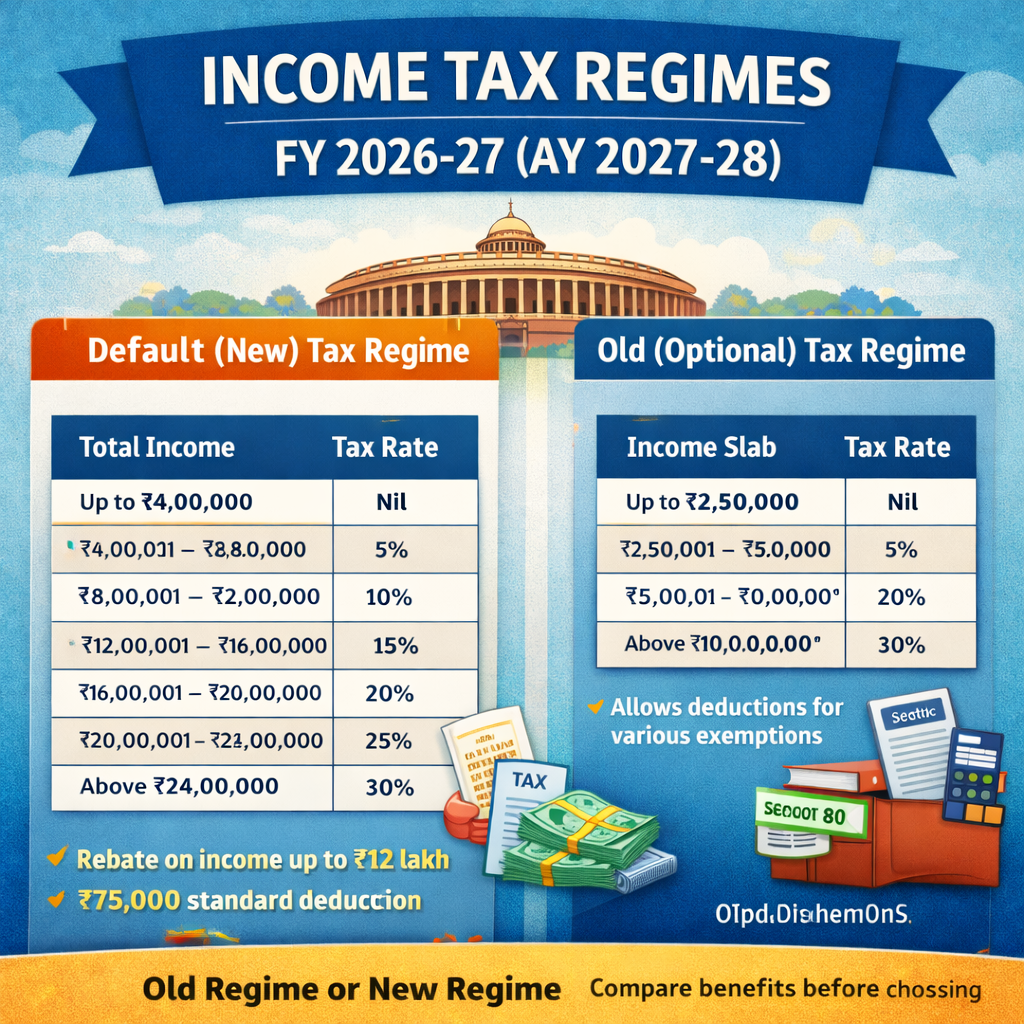
    Income Tax Slab Rates – Default (New) Tax Regime

    The following income tax slab rates will apply to individuals opting for the default new tax regime for FY 2026-27 (AY 2027-28):

    Total Income Tax Rate
    Up to ₹4,00,000 Nil
    ₹4,00,001 – ₹8,00,000 5%
    ₹8,00,001 – ₹12,00,000 10%
    ₹12,00,001 – ₹16,00,000 15%
    ₹16,00,001 – ₹20,00,000 20%
    ₹20,00,001 – ₹24,00,000 25%
    Above ₹24,00,000 30%

    These slab rates apply uniformly to all individuals, including salaried taxpayers, with no age-based differentiation.


    Key Features of the New Tax Regime

    1️⃣ Rebate under Section 87A

    Budget 2026 has enhanced tax relief through Section 87A:

    • Individuals with net taxable income up to ₹12,00,000 are eligible for a 100% tax rebate.

    • Consequently, the total tax liability becomes NIL for such taxpayers under the default regime.

    • This change significantly improves affordability for middle-income earners.

    2️⃣ Standard Deduction for Salaried Taxpayers

    • Salaried individuals can claim a standard deduction of ₹75,000 under the new tax regime.

    • Because of this deduction, effective tax-free income can extend up to ₹12.75 lakh.

    • This makes the default regime even more beneficial for salaried employees.


    Old Tax Regime (Optional)

    The old tax regime continues as an optional choice and follows a different slab structure. It allows various deductions and exemptions, such as HRA, Section 80C, Section 80D, and others.

    Income Tax Slabs under the Old Regime

    Income Slab Tax Rate
    Up to ₹2,50,000 Nil
    ₹2,50,001 – ₹5,00,000 5%
    ₹5,00,001 – ₹10,00,000 20%
    Above ₹10,00,000 30%

    While deductions are permitted under the old regime, it does not provide the higher rebate threshold available under the new tax regime. As a result, it may be less beneficial for taxpayers with limited deductions.


    Which Tax Regime Is Better for You?

    • Taxpayers with minimal deductions or exemptions may benefit more from the new default tax regime due to lower slab rates, higher rebate, and standard deduction.

    • Taxpayers who claim substantial deductions, such as housing loan interest, insurance premiums, and eligible investments, may still find the old regime more suitable.

    • It is advisable to perform a comparative tax calculation before choosing the appropriate regime.

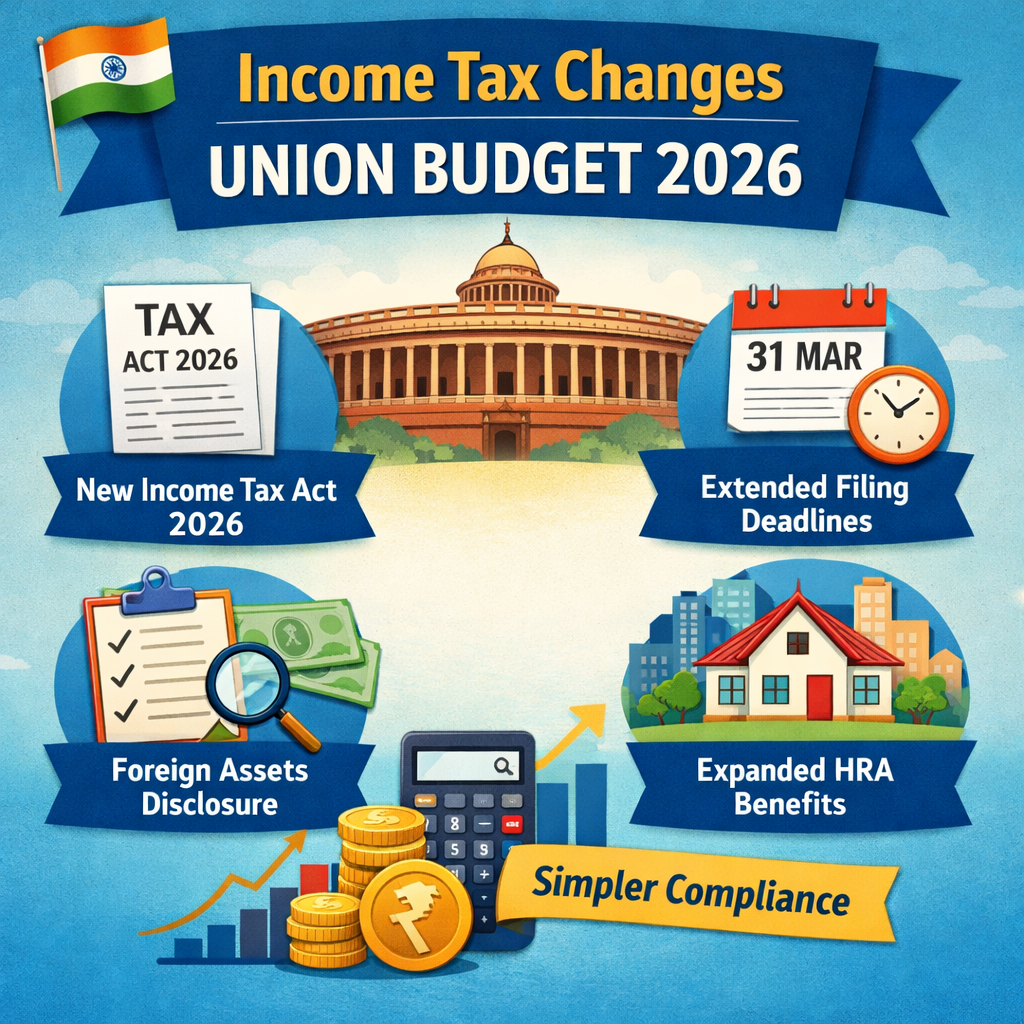
Income Tax Changes Announced in Union Budget 2026

Direct Tax Proposals in Budget 2026 – Key Highlights

In Union Budget 2026, the Government has announced a wide-ranging and future-oriented set of Direct Tax reforms aimed at simplifying tax laws, reducing disputes, improving compliance, and enhancing India’s appeal as a global investment destination. These measures signal a decisive shift from a complex, enforcement-driven regime to a trust-based, technology-enabled, and taxpayer-friendly tax system, aligned with the vision of Viksit Bharat.


1. New Income-tax Act, 2025 – A Structural Overhaul

One of the most significant announcements in Budget 2026 is the replacement of the Income-tax Act, 1961 with the Income-tax Act, 2025, effective from 1 April 2026.

The new legislation is designed to:

  • Be substantially shorter and simpler, with fewer sections and chapters

  • Use clear and unambiguous language to minimise interpretational disputes

  • Be easier for taxpayers and tax authorities to understand and implement

Simplified Income-tax Rules and redesigned return forms will be notified shortly, enabling individuals to comply without professional assistance.


2. Taxpayer Relief & Ease of Living Measures

The Budget introduces multiple measures to address long-standing taxpayer concerns:

MACT Interest Exemption

  • Interest awarded by the Motor Accident Claims Tribunal (MACT) to individuals will be fully exempt from tax.

  • No TDS will apply, irrespective of the amount received.

Rationalisation of TCS under LRS

  • TCS on overseas tour packages reduced to 2% (from 5% / 20%), without any threshold.

  • TCS on education and medical remittances under LRS reduced from 5% to 2%.

Clarity on TDS for Manpower Supply

  • Manpower supply services classified as contractor payments.

  • TDS rate capped at 1% / 2%, eliminating ambiguity and litigation.

Automated Lower / Nil TDS Certificates

  • Eligible small taxpayers can obtain lower or nil TDS certificates through an automated, rule-based system without Assessing Officer interaction.

Simplification of Form 15G / 15H

  • Depositories authorised to accept declarations centrally and share them with multiple companies, reducing repetitive filings.


3. Rationalised Return Filing Timelines

To ease compliance pressure:

  • Belated and revised returns can now be filed up to 31 March (earlier 31 December) on payment of a nominal fee.

  • Staggered ITR due dates introduced:

    • ITR-1 & ITR-2 (Individuals): 31 July

    • Non-audit cases and trusts: 31 August


4. Relief for Property Transactions Involving NRIs

For purchase of immovable property from a non-resident:

  • Resident buyers are no longer required to obtain a TAN.

  • TDS can be deposited using a PAN-based challan, similar to resident transactions.


5. One-Time Foreign Asset Disclosure Scheme (FAST-DS, 2026)

A special 6-month disclosure window has been introduced for genuine hardship cases involving small taxpayers.

Category A

  • Undisclosed foreign income / assets up to ₹1 crore

  • Payment of:

    • 30% tax

    • 30% additional tax (in lieu of penalty)

  • Immunity from prosecution granted

Category B

  • Foreign assets up to ₹5 crore

  • One-time fee of ₹1 lakh

  • Full immunity from penalty and prosecution

Immunity from prosecution is also retrospectively extended for non-immovable foreign assets up to ₹20 lakh.


6. Rationalisation of Penalty & Prosecution Regime

Key reforms include:

  • Assessment and penalty proceedings to be concluded through a single consolidated order

  • No interest on penalty amounts during pendency of first appeal

  • Pre-deposit for appeal reduced from 20% to 10%, limited to core tax demand

Updated Returns Post Reassessment

  • Taxpayers can file updated returns even after reassessment initiation by paying an additional 10% tax.

Penalty to Fee Conversion

  • Certain technical defaults (audit, TP report, SFT) converted into fee-based non-criminal defaults.

Decriminalisation Measures

  • Minor offences punishable only with fines

  • Maximum imprisonment reduced to two years

  • Penalties graded based on tax evasion quantum


7. Targeted Tax Relief for Cooperatives

  • Deduction extended to supply of cattle feed and cotton seed by primary cooperatives

  • Inter-cooperative dividend income allowed as deduction under the new tax regime

  • Three-year dividend exemption for notified national cooperative federations, subject to redistribution


8. IT Sector Boost & Transfer Pricing Certainty

  • IT and IT-enabled services consolidated under “Information Technology Services”

  • Uniform safe harbour margin of 15.5%

  • Threshold enhanced from ₹300 crore to ₹2,000 crore

  • Automated safe harbour approvals valid for 5 years

  • Fast-track unilateral APA with targeted 2-year resolution


9. Measures to Attract Global Business & Talent

  • Tax holiday till 2047 for foreign cloud service providers using Indian data centres

  • 15% safe harbour margin for data-centre support entities

  • 5-year tax exemption for non-residents supplying capital goods to bonded zone manufacturers

  • Exemption of global income for foreign experts residing in India up to 5 years

  • MAT exemption for non-residents taxed on presumptive basis


10. Tax Administration Reforms

  • ICDS to be merged with Ind-AS from FY 2027-28

  • Definition of “accountant” rationalised to support global expansion of Indian advisory firms


11. Other Key Direct Tax Measures

  • Buyback taxation shifted to capital gains for all shareholders

  • Additional tax for promoters to prevent arbitrage

  • TCS on liquor, scrap and minerals reduced to 2%; tendu leaves from 5% to 2%

  • STT increased on futures and options

  • MAT to become final tax from 1 April 2026, rate reduced to 14%, with limited MAT credit set-off


Conclusion

The Direct Tax proposals in Budget 2026 mark a bold move towards simplicity, certainty, and trust-based taxation. With a new Income-tax Act, substantial compliance relief, rationalised penalties, and strong incentives for investment and global integration, the reforms aim to strike a balance between revenue mobilisation and taxpayer confidence, supporting long-term economic growth.

January 2026: Complete Compliance & Filing Schedule for Businesses

January marks more than just the start of a new calendar year—it is also one of the busiest compliance months for businesses, professionals, and employers. A tight cluster of statutory obligations such as GST returns, TDS filings, PF-ESI contributions, and MCA compliances leaves little room for error. Missing even one due date can trigger late fees, interest, penalties, or system-generated notices.

As we enter January 2026, the compliance environment continues to become more stringent, backed by tighter deadlines, automated checks, and enhanced portal validations. To help businesses, taxpayers, and professionals stay on track, this article provides a comprehensive, date-wise compliance calendar for January 2026, covering GST, Income Tax, TDS/TCS, PF, ESI, and MCA requirements—all consolidated in one place.


GST Compliance

Due Date | Return/Form | Period | Applicability
7 January 2026 | GSTR-7 | December 2025 | GST TDS deductors
7 January 2026 | GSTR-8 | December 2025 | E-commerce operators
11 January 2026 | GSTR-1 | December 2025 | Monthly outward supply filers
20 January 2026 | GSTR-3B | December 2025 | Monthly GST return
22/24 January 2026 | GSTR-3B (QRMP) | Oct–Dec 2025 | Based on state category
20 January 2026 | GSTR-5A | December 2025 | OIDAR service providers

GST Composition Scheme
18 January 2026 | CMP-08 | Oct–Dec 2025


TDS/TCS & Income-Tax Compliances

Monthly TDS/TCS Payment
7 January 2026 – Deposit of TDS/TCS for December 2025
(Generally payable by the 7th of the following month)

Quarterly TDS/TCS Returns
15 January 2026 | Form 27EQ (TCS) | Oct–Dec 2025
31 January 2026 | Forms 24Q, 26Q, 27Q | Oct–Dec 2025

Income-Tax Update
As per CBDT indications, new ITR forms and procedures under the simplified Income-tax framework are expected to be notified by January 2026, ahead of implementation from 1 April 2026.


PF & ESI Compliance

15 January 2026
• EPF contribution payment & return – December 2025
• ESI contribution payment & return – December 2025

(PF and ESI dues are generally payable by the 15th of the subsequent month.)


MCA / ROC Filings

31 January 2026
• Filing of Annual Returns and Financial Statements for FY 2024-25
• Ensure timely submission of AOC-4 and MGT-7 within the extended timeline

LLPs should also verify due dates for Form 11 and other applicable ROC filings based on entity-specific requirements.


Other Important Statutory Compliances

Professional Tax (PT)
Generally payable by 31 January 2026 for December 2025 salary deductions (state-specific rules apply).

Advance Tax
No advance tax installment is due in January; the next installment falls in March 2026.


Consequences of Delayed Compliance – Quick Snapshot

GST: Late fees and interest on net tax liability
TDS/TCS: Interest and penalties for late payment or return filing
PF/ESI: Interest and statutory damages under respective laws


In today’s technology-driven compliance framework, delays rarely go unnoticed. GST filings, TDS payments, PF-ESI contributions, and MCA submissions are closely monitored through integrated systems. Timely compliance is no longer optional—it is essential.

Use this January 2026 Compliance Calendar as a ready reference, plan your filings in advance, and complete all obligations well before due dates. Staying proactive today helps avoid financial exposure, legal complications, and unnecessary stress in the future.

New Regulations for TDS Return Rectification Applicable from 01-04-2026

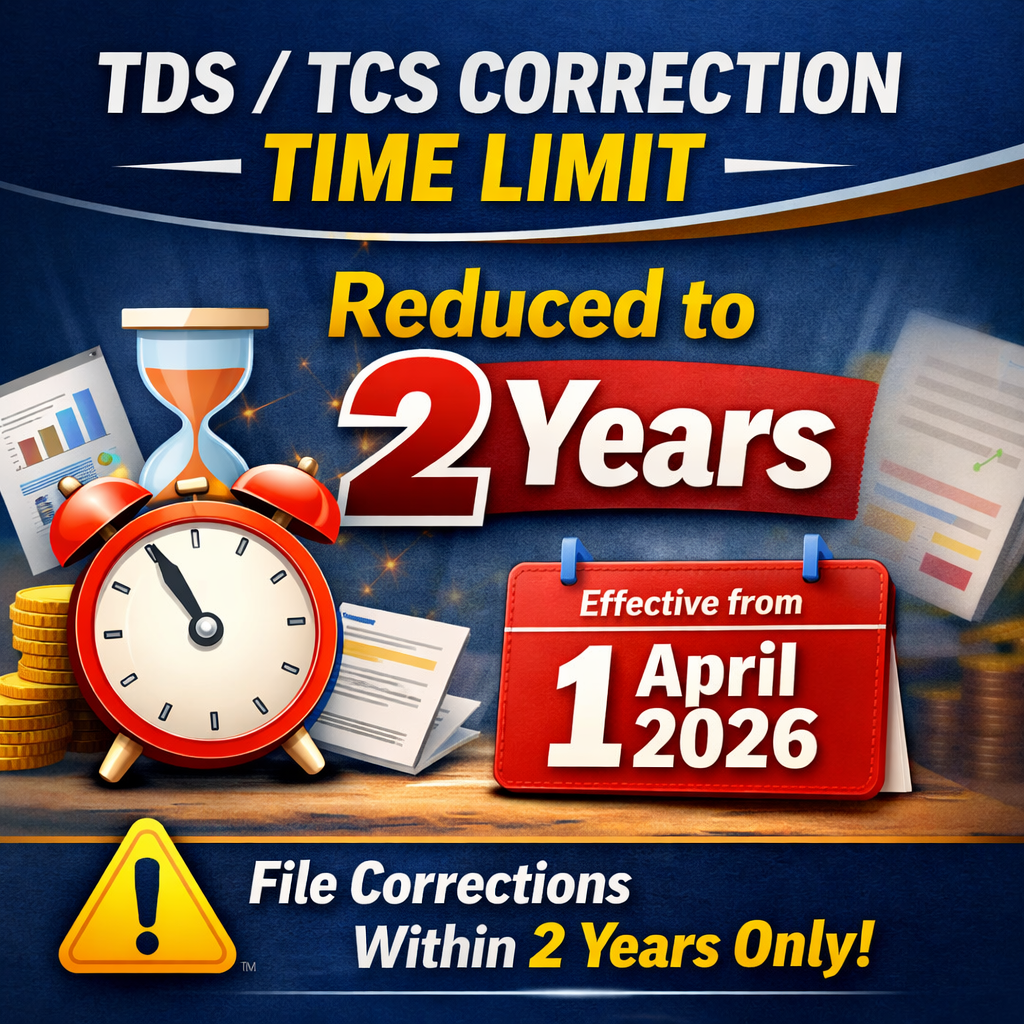
TDS / TCS Correction Statements: Time Limit Cut Down to 2 Years (Effective 01 April 2026)

🔔 What’s the Latest Change?

The Income Tax Department has introduced a major compliance reform by reducing the time limit for filing TDS and TCS correction statements to just 2 years, applicable from 1 April 2026.

Until now, deductors had the flexibility to revise old TDS/TCS returns even after many years. This long-standing practice will no longer be permitted.


⏳ Key Change Explained: Old Rule vs New Rule

🔙 Earlier Position (Before 01.04.2026)

  • No strict statutory deadline for filing correction statements

  • Corrections were practically allowed up to 7 years or more

  • Deductors commonly rectified:

    • Incorrect PAN details

    • Challan mapping errors

    • Short or excess deduction

    • Late reporting issues

  • Corrections were accepted even after several years

🔜 New Rule (From 01.04.2026)

  • Correction statements allowed only within 2 years

  • The 2-year period will be calculated from:

    • End of the relevant financial year

  • No correction will be permitted beyond this period

  • This is a strict and absolute deadline, not extendable in any case


📅 Last Opportunity for Old TDS/TCS Periods

Correction statements for the following quarters will be allowed only up to 31 March 2026:

  • Q4 of FY 2018–19

  • Q1 to Q4 of FY 2019–20 to FY 2022–23

  • Q1 to Q3 of FY 2023–24

⚠️ From 1 April 2026 onwards, the TRACES portal will permanently block corrections for these periods.


❌ Impact of Missing the 2-Year Deadline

Failure to file corrections within the prescribed time may result in:

  • ❌ Permanent denial of correction facility

  • ❌ Loss of TDS/TCS credit for deductees in Form 26AS / AIS

  • ❌ Disputes with employees, vendors, or contractors

  • ❌ Penalties ranging from ₹10,000 to ₹1,00,000

  • ❌ Higher compliance and audit risks

  • ❌ Interest liability and possible disallowance of expenses


✅ Reason Behind This Amendment

The department aims to promote:

  • Timely reconciliation of data

  • Faster and accurate credit to deductees

  • Reduced backlog of old corrections

  • Lower litigation and disputes

  • A shift towards real-time, technology-driven compliance

This change reflects a move towards strict timelines and disciplined reporting.


🧾 Best Practices Suggested by the Department

  • Regularly use TRACES utilities and validation tools

  • Track defaults and mismatches frequently

  • File correction statements immediately upon detecting errors

  • Train staff on the revised timelines

  • Adopt a preventive compliance approach


📌 Action Checklist for Deductors & Tax Professionals

✔ Review all pending TDS/TCS correction requirements
✔ Resolve old mismatches before 31 March 2026
✔ Strengthen internal review and control systems
✔ Inform clients and staff about the 2-year non-negotiable limit

Understanding TCS: Tax Collected at Source and Its Applicability

What is TCS?

TCS stands for Tax Collected at Source. It is a tax levied by the Indian government on certain specified transactions. Under the TCS provisions, the seller collects a specified percentage of the transaction value as tax from the buyer at the time of sale. The collected tax is then deposited with the government.

When is TCS Applicable?

TCS is applicable in various scenarios, including:

  • Sale of goods: TCS is applicable when a seller sells goods worth a certain threshold amount to a buyer.
  • Providing services: TCS is applicable when a seller provides specific services, such as hotel accommodation, tour packages, or event management services.
  • Remittance of money abroad: TCS is applicable when a person remits money outside India under the Liberalized Remittance Scheme.
  • Sale of scrap: TCS is applicable when a seller sells scrap, including scrap of any machinery or equipment.
  • Lottery and gambling: TCS is applicable on the sale of lottery tickets, horse race betting, or any other form of gambling.

Who is Responsible for TCS?

The responsibility for collecting and depositing TCS lies with the seller or the person receiving the payment. They are required to collect the tax from the buyer and deposit it with the government within the specified time frame.

However, there are certain exceptions where the buyer may be responsible for TCS. For example, in the case of remittance of money abroad, the buyer is required to deduct and deposit TCS if the seller does not have a Permanent Account Number (PAN) or Tax Deduction and Collection Account Number (TAN).

It is important for both the buyer and the seller to be aware of their responsibilities regarding TCS to ensure compliance with the tax laws.

In conclusion, TCS is a tax collected by sellers on specified transactions. It is applicable in various scenarios such as the sale of goods, provision of services, remittance of money abroad, sale of scrap, and lottery or gambling. The responsibility for collecting and depositing TCS lies with the seller, although there are exceptions where the buyer may be responsible. It is crucial for both parties to understand and fulfill their obligations to avoid any penalties or legal issues.