2026-27 TDS/TCS Section Codes: Full Updated List

The Income-tax Act, 2025 has introduced new section numbers and corresponding TDS/TCS codes. These revised section codes are applicable for Tax Year 2026-27 onwards and must be used while filing TDS/TCS returns under the new law.

To ensure accurate return filing, deductors and collectors should refer to the updated TDS/TCS section codes provided below.

TDS Section Codes for Tax Year 2026-27

The following table contains the revised TDS section codes prescribed under the Income-tax Act, 2025. These codes are applicable while filing TDS returns for Tax Year 2026-27 onwards.

Nature of Payment Relevant Section Section Code for TDS Return
Salary paid to State Government or other Government employees (excluding Union Government employees) 392 1001
Salary paid to employees other than Government employees 392 1002
Salary paid to Union Government employees (applicable for statements from FY 2013-14 onwards) 392 1003
Tax deduction in the case of specified senior citizens (applicable from FY 2021-22 onwards) 393(1) [Table: Sl. No. 8(iii)] 1032
Payment of accumulated balance due to an employee 392(7) 1004
Insurance commission or brokerage 393(1) [Table: Sl. No. 1(i)] 1005
Commission or brokerage (other than insurance) 393(1) [Table: Sl. No. 1(ii)] 1006
Rent for plant, machinery, or equipment paid to a specified person 393(1) [Table: Sl. No. 2(ii).D(a)] 1008
Rent for land, building, furniture, or fittings paid to a specified person 393(1) [Table: Sl. No. 2(ii).D(b)] 1009
Payment of consideration (other than consideration in kind) under an agreement referred to in Section 67(14) 393(1) [Table: Sl. No. 3(ii)] 1011
Compensation paid for acquisition of certain immovable property 393(1) [Table: Sl. No. 3(iii)] 1012
Income payable to a resident from units of a specified mutual fund, specified undertaking, or specified company 393(1) [Table: Sl. No. 4(i)] 1013
Interest income distributed by a business trust to a resident unit holder 393(1) [Table: Sl. No. 4(ii)] 1014
Dividend income distributed by a business trust to a resident unit holder 393(1) [Table: Sl. No. 4(ii)] 1015
Income (excluding the exempt portion under Schedule V) from units of an investment fund payable to a unit holder 393(1) [Table: Sl. No. 4(iii)] 1017

Income payable to an investor from an investment in a securitisation trust referred to in Section 221 393(1) [Table: Sl. No. 4(iv)] 1018
Interest income arising from securities 393(1) [Table: Sl. No. 5(i)] 1019
Interest income (other than interest on securities) payable to a senior citizen 393(1) [Table: Sl. No. 5(ii).D(a)] 1020
Interest income (other than interest on securities) payable to a person other than a senior citizen 393(1) [Table: Sl. No. 5(ii).D(b)] 1021
Interest income other than interest on securities 393(1) [Table: Sl. No. 5(iii)] 1022
Payment under a contract for carrying out any work, including labour supply, where the contractor is an Individual or HUF 393(1) [Table: Sl. No. 6(i).D(a)] 1023
Payment under a contract for carrying out any work, including labour supply, where the contractor is a person other than an Individual or HUF 393(1) [Table: Sl. No. 6(i).D(b)] 1024
Fees for technical services (excluding professional services), royalty relating to cinematographic films, or payments to call centre operators 393(1) [Table: Sl. No. 6(iii).D(a)] 1026
Fees for professional services or payments covered under Section 26(2)(h) 393(1) [Table: Sl. No. 6(iii).D(b)] 1027
Director’s remuneration, commission, fees, or similar payments (other than salary covered under Section 392) 393(1) [Table: Sl. No. 6(iii).D(b)] 1028
Dividend payments, including dividends on preference shares 393(1) [Table: Sl. No. 7] 1029
Amount received under a life insurance policy, including bonus, excluding amounts exempt under Schedule II 393(1) [Table: Sl. No. 8(i)] 1030
Payment made towards the purchase of goods 393(1) [Table: Sl. No. 8(ii)] 1031
Benefit or perquisite arising from business or profession provided to a resident 393(1) [Table: Sl. No. 8(iv)] 1033
Business or professional benefits/perquisites provided wholly or partly in kind where tax is deposited before release 393(1) [Table: Sl. No. 8(iv)] Note 6 1034
Sale of goods or services through an e-commerce operator’s digital platform 393(1) [Table: Sl. No. 8(v)] 1035
Consideration for transfer of a Virtual Digital Asset (VDA) where the transferor is not an Individual or HUF 393(1) [Table: Sl. No. 8(vi)] 1037
Consideration, whether in cash, kind, or both, for transfer of a Virtual Digital Asset 393(1) [Table: Sl. No. 8(vi)] Note 6 1038
Winnings from lotteries, crossword puzzles, card games, gambling, betting, or similar games (excluding online games) 393(3) [Table: Sl. No. 1] 1058
Winnings from lotteries, betting, gambling, crossword puzzles, card games, etc., where winnings are wholly/partly in kind and tax is paid before release 393(3) [Table: Sl. No. 1] Note 2 1059
Income from winnings in online games 393(3) [Table: Sl. No. 2] 1060
Online game winnings paid in kind or partly in kind where tax is deposited before release 393(3) [Table: Sl. No. 2] Note 2 1061
Income from horse race winnings 393(3) [Table: Sl. No. 3] 1062
Commission, remuneration, or prize paid to persons engaged in stocking, distributing, purchasing, or selling lottery tickets 393(3) [Table: Sl. No. 4] 1063
Cash payments by a bank, post office, or co-operative society to a co-operative society 393(3) [Table: Sl. No. 5.D(a)] 1064
Cash payments by a bank, post office, or co-operative society to persons other than co-operative societies 393(3) [Table: Sl. No. 5.D(b)] 1065
Amount referred to under Section 80CCA(2)(a) of the Income-tax Act, 1961 393(3) [Table: Sl. No. 6] 1066
Salary, remuneration, commission, bonus, or interest paid or credited to a partner of a firm, including the capital account 393(3) [Table: Sl. No. 7] 1067

Payment of accumulated balance payable to an employee 392(7) 1004
Income covered under Section 211 393(2) [Table: Sl. No. 1] 1039
Interest payable on foreign currency borrowings from outside India under eligible loan agreements or long-term infrastructure bonds issued between 1 July 2012 and 30 June 2023, or approved long-term bonds issued between 1 October 2014 and 30 June 2023 393(2) [Table: Sl. No. 2] 1040
Interest payable on funds borrowed from outside India through rupee-denominated bonds issued before 1 July 2023 393(2) [Table: Sl. No. 3] 1041
Interest on long-term bonds or rupee-denominated bonds issued between 1 April 2020 and 30 June 2023 and listed exclusively on a recognised stock exchange in an International Financial Services Centre (IFSC) 393(2) [Table: Sl. No. 4.E(a)] 1042
Interest on long-term bonds or rupee-denominated bonds issued on or after 1 July 2023 and listed exclusively on a recognised stock exchange in an IFSC 393(2) [Table: Sl. No. 4.E(b)] 1043
Interest income payable to a non-resident from an Infrastructure Debt Fund 393(2) [Table: Sl. No. 5] 1044
Distributed income referred to in Section 223 falling under Schedule V [Table: Sl. No. 3.B(a)] 393(2) [Table: Sl. No. 6.E(a)] 1045
Distributed income referred to in Section 223 falling under Schedule V [Table: Sl. No. 3.B(b)] 393(2) [Table: Sl. No. 6.E(b)] 1046
Distributed income referred to in Section 223 covered under Schedule V [Table: Sl. No. 4] 393(2) [Table: Sl. No. 7] 1047
Income from units of an investment fund specified under Section 224, excluding the exempt portion under Schedule V 393(2) [Table: Sl. No. 8] 1048
Income arising from investments in a securitisation trust specified under Section 221 393(2) [Table: Sl. No. 9] 1049
Income from units of a specified Mutual Fund under Schedule VII or from a specified company 393(2) [Table: Sl. No. 10] 1050
Income from units referred to in Section 208 393(2) [Table: Sl. No. 11] 1051
Long-term capital gains from transfer of units referred to in Section 208 393(2) [Table: Sl. No. 12] 1052
Interest or dividend income from bonds or Global Depository Receipts covered under Section 209 393(2) [Table: Sl. No. 13] 1053
Long-term capital gains arising from transfer of bonds or Global Depository Receipts referred to in Section 209 393(2) [Table: Sl. No. 14] 1054
Income from securities covered under Section 210(1) [Table: Sl. No. 1] 393(2) [Table: Sl. No. 15] 1055
Income from securities covered under Section 210(1) [Table: Sl. No. 1] (other applicable category) 393(2) [Table: Sl. No. 16] 1056
Interest (other than that covered under Codes 1040 to 1044) or any other taxable payment not chargeable under the head “Salaries” 393(2) [Table: Sl. No. 17] 1057
Winnings from lotteries, crossword puzzles, card games, gambling, betting, or similar games (excluding online games) 393(3) [Table: Sl. No. 1] 1058
Winnings from lotteries, betting, gambling, crossword puzzles, or similar games where winnings are wholly or partly in kind and tax has been deposited before release 393(3) [Table: Sl. No. 1] Note 2 1059
Income from online game winnings 393(3) [Table: Sl. No. 2] 1060
Online game winnings paid wholly or partly in kind where tax is paid before release 393(3) [Table: Sl. No. 2] Note 2 1061
Income from horse race winnings 393(3) [Table: Sl. No. 3] 1062
Commission, remuneration, or prize paid to persons engaged in the stocking, distribution, purchase, or sale of lottery tickets 393(3) [Table: Sl. No. 4] 1063
Cash payments by a bank, post office, or co-operative society to a co-operative society 393(3) [Table: Sl. No. 5.D(a)] 1064
Cash payments by a bank, post office, or co-operative society to persons other than co-operative societies 393(3) [Table: Sl. No. 5.D(b)] 1065
Amount covered under Section 80CCA(2)(a) of the Income-tax Act, 1961 393(3) [Table: Sl. No. 6] 1066
Salary, remuneration, commission, bonus, or interest paid or credited to a partner of a firm, including amounts credited to the capital account

TDS Section Codes for Tax Year 2026-27

Nature of Payment / Transaction Relevant Section Section Code for TDS Return
Sale of alcoholic liquor meant for human consumption 394(1) [Table: Sl. No. 1] 1068
Sale of tendu leaves 394(1) [Table: Sl. No. 2] 1069
Sale of timber obtained under a forest lease arrangement 394(1) [Table: Sl. No. 3] 1070
Sale of timber obtained through any mode other than a forest lease 394(1) [Table: Sl. No. 3] 1071
Sale of forest produce (other than timber and tendu leaves) obtained under a forest lease 394(1) [Table: Sl. No. 3] 1072
Sale proceeds from scrap 394(1) [Table: Sl. No. 4] 1073
Sale of minerals such as coal, lignite, or iron ore 394(1) [Table: Sl. No. 5] 1074
Sale of a motor vehicle where the sale value exceeds the prescribed threshold 394(1) [Table: Sl. No. 6.D(a)] 1075
Sale of a wristwatch above the specified monetary limit 394(1) [Table: Sl. No. 6.D(b)] 1076
Sale of artworks such as paintings, sculptures, or antiques exceeding the threshold 394(1) [Table: Sl. No. 6.D(b)] 1077
Sale of collectible items such as coins or stamps above the prescribed limit 394(1) [Table: Sl. No. 6.D(b)] 1078
Sale of yachts, rowing boats, canoes, or helicopters exceeding the threshold value 394(1) [Table: Sl. No. 6.D(b)] 1079
Sale of sunglasses where the consideration exceeds the specified limit 394(1) [Table: Sl. No. 6.D(b)] 1080
Sale of handbags, purses, or similar bags above the threshold limit 394(1) [Table: Sl. No. 6.D(b)] 1081
Sale of shoes where the sale consideration exceeds the prescribed limit 394(1) [Table: Sl. No. 6.D(b)] 1082
Sale of sportswear or sports equipment, including golf kits and ski-wear, above the threshold 394(1) [Table: Sl. No. 6.D(b)] 1083
Sale of a home theatre system exceeding the specified value 394(1) [Table: Sl. No. 6.D(b)] 1084
Sale of horses used for horse racing or polo where the consideration exceeds the threshold 394(1) [Table: Sl. No. 6.D(b)] 1085
Remittance under the Liberalised Remittance Scheme (LRS) for education or medical treatment exceeding the prescribed threshold 394(1) [Table: Sl. No. 7.D(a)] 1086
Remittance under the Liberalised Remittance Scheme (LRS) for purposes other than education or medical treatment exceeding the threshold 394(1) [Table: Sl. No. 7.D(b)] 1087
Sale of an overseas tour programme package, including travel, hotel, boarding, lodging, or related expenses, up to the prescribed threshold 394(1) [Table: Sl. No. 8.D(a)] 1088
Sale of an overseas tour programme package, including travel, hotel, boarding, lodging, or related expenses, exceeding the prescribed threshold 394(1) [Table: Sl. No. 8.D(b)] 1089
Use of a parking facility for business purposes, excluding mining or quarrying of mineral oil (including petroleum and natural gas) 394(1) [Table: Sl. No. 9] 1090
Use of a toll plaza for business purposes, excluding mining or quarrying of mineral oil (including petroleum and natural gas) 394(1) [Table: Sl. No. 9] 1091
Use of a mine or quarry for business purposes, other than mining or quarrying of mineral oil (including petroleum and natural gas) 394(1) [Table: Sl. No. 9] 1092
393(3) [Table: Sl. No. 7] 1067
Latest Tax & Financial Changes from 1st July 2026 | Income Tax and GST Updates

With the commencement of July 2026, a number of significant regulatory and financial changes have become effective across India. These updates are expected to affect individual taxpayers, businesses, professionals, and the general public. Whether you are filing your Income Tax Return, managing GST compliance, dealing with TDS/TCS provisions, or using services related to Aadhaar, PAN, or passports, it is essential to stay informed about these latest developments.

1. Passport Fees Revised from 1 July 2026

One of the key changes effective from 1 July 2026 relates to passport services.

The Passport Seva system has introduced a revised fee structure for passport applications.

Some of the important revisions include:

  • The application fee for a fresh 36-page passport has increased from ₹1,500 to ₹2,500.
  • Charges for passport renewal, Tatkal applications, and replacement of lost or damaged passports have also been updated.

Individuals planning to apply for a new passport or renew an existing one should review the latest fee schedule before submitting their application.


2. Quarter-1 TDS and TCS Returns Due by 31 July 2026

With the completion of the first quarter of Tax Year 2026–27 (April to June 2026), the due date for filing quarterly TDS and TCS statements has arrived.

Due Date: 31 July 2026

Tax deductors and collectors are required to submit both TDS and TCS returns by this date. While returns may be filed earlier, 31 July 2026 is the final deadline for Quarter-1 compliance.


3. New TDS/TCS Return Forms and Updated Filing Utility

The Income Tax Department has introduced updated TDS/TCS return forms in line with the new Income-tax framework.

To facilitate return filing for Tax Year 2026–27 onwards, a new Return Preparation Utility (RPU) and Validation Utility have also been released.

Tax deductors should ensure they are using:

  • Latest RPU Version 1.0
  • Updated Validation Utility
  • Revised quarterly TDS/TCS return forms

Utilities applicable to FY 2025–26 should not be used for returns relating to Tax Year 2026–27. Businesses and professionals managing payroll or TDS compliance should update their software without delay.


4. Income Tax Return Filing Due Date for ITR-1 and ITR-2

July continues to be a crucial month for individual Income Tax Return filing.

For taxpayers filing ITR-1 and ITR-2, the due date remains:

31 July 2026

Before submitting the return, taxpayers should carefully verify the following information:

  • Annual Information Statement (AIS)
  • Form 26AS
  • Pre-filled return details
  • Bank account information

Checking these records on the Income Tax e-filing portal helps minimize errors and reduces the chances of receiving notices later.


5. Extended Due Date for ITR-3 and ITR-4 (Non-Audit Cases)

Business taxpayers have received additional time to file their Income Tax Returns.

For taxpayers filing ITR-3 or ITR-4 where a tax audit is not applicable, the due date has been extended to:

31 August 2026

This extension is particularly beneficial for taxpayers such as:

  • Futures & Options (F&O) traders
  • Intraday traders
  • Small business owners
  • Professionals

Considering the extended deadline, tax professionals may focus first on completing ITR-1 and ITR-2 filings during July.


6. Deadline Extended for Filing Appeals Before GSTAT

Taxpayers have also received relief regarding appeals before the GST Appellate Tribunal (GSTAT).

The deadline for filing appeals under Section 112 of the CGST Act has been extended to:

31 July 2026

The extension applies to eligible orders covered under the prescribed conditions, providing taxpayers with additional time to submit pending appeals before the Tribunal.

7. E-Way Bill Enhancements Postponed

GSTN had earlier announced two new features for the E-Way Bill system to improve reporting and compliance.

(a) E-Way Bill Closure Option

A new functionality will allow taxpayers to close an E-Way Bill after the transportation of goods is completed or if the movement does not take place.

(b) Mandatory “Ship To GSTIN”

For Bill-to Ship-to transactions, entering the GSTIN of the actual recipient (Ship To party) will become mandatory wherever applicable.

These enhancements have not yet been implemented. Their rollout has been postponed and is now expected to take effect from 1 August 2026. Until then, taxpayers need not be concerned if these options are unavailable on the E-Way Bill portal.


8. Updated TDS Return Forms Available on the Income Tax Portal

The Income Tax Department has enabled the revised quarterly TDS return forms for Tax Year 2026–27 on the e-filing portal.

Forms introduced under the updated Income-tax framework—including Forms 138, 140, 143, and 144, wherever applicable—are now available for filing.

As the new law has introduced revised section references and reporting codes, taxpayers and deductors should ensure that returns are prepared using the latest prescribed forms and utilities.


9. GST Quarterly Compliance Schedule Begins

With the April–June quarter now completed, several important GST return filings become due during July.

Key due dates include:

GSTR-3B

  • Monthly taxpayers – 20 July
  • QRMP taxpayers – 22 July or 24 July, depending on the State

GSTR-1

  • Monthly filers – 11 July
  • Quarterly filers – 13 July

Other GST returns due during the month include:

  • GSTR-5
  • GSTR-6
  • GSTR-7
  • GSTR-8

Taxpayers are also advised to reconcile purchase data through the Invoice Management System (IMS) Dashboard, which helps match invoices with GSTR-2B and improves the accuracy of GST reporting.


10. Aadhaar Email ID Update Now Free Through the Mobile App

UIDAI has introduced a welcome concession for Aadhaar users.

From 1 July 2026, updating an email ID through the Aadhaar Mobile App is free of cost.

Previously, a fee of ₹75 was charged for this service.

The waiver will remain available for six months. However, it applies only to updates made through the mobile application and not through the online portal.


11. PAN Application Procedure Revised

The process for applying for a Permanent Account Number (PAN) has also been updated under the revised Income-tax framework.

Applicants should keep the following changes in mind:

  • Aadhaar alone may not satisfy all identity or verification requirements.
  • Where proof of date of birth is required, documents such as a Matriculation Certificate or any other approved document may need to be submitted.
  • Applications should be filed using the revised PAN forms notified under the new Income-tax provisions.

Anyone planning to obtain a new PAN should carefully review the latest documentation requirements before submitting the application.


Quick Overview

Update Applicable Date
Passport application fees revised 1 July 2026
Quarter-1 TDS/TCS return due date 31 July 2026
New TDS/TCS forms and filing utilities Now Available
ITR-1 & ITR-2 filing due date 31 July 2026
ITR-3 & ITR-4 (Non-Audit) due date 31 August 2026
GSTAT appeal filing deadline 31 July 2026
New E-Way Bill features Expected from 1 August 2026
GST quarterly return filings July 2026
Aadhaar email update through App Free from 1 July 2026
Revised PAN application process Currently Effective

Conclusion

July 2026 is a crucial month for tax and regulatory compliance. A number of significant changes—including revised passport fees, updated TDS/TCS return procedures, Income Tax Return deadlines, GSTAT appeal relief, GST filing obligations, Aadhaar service updates, and changes to the PAN application process—have come into effect or are scheduled for implementation.

Whether you are an individual taxpayer, business owner, GST-registered entity, accountant, or tax professional, staying informed about these developments is essential. Timely compliance with the latest rules can help you avoid interest, penalties, and unnecessary notices while ensuring that you benefit from the relief measures and new facilities introduced from 1 July 2026.

Key Compliance Due Dates in June 2026 – GST, Income Tax, PF, ESI, MCA & Other Filings

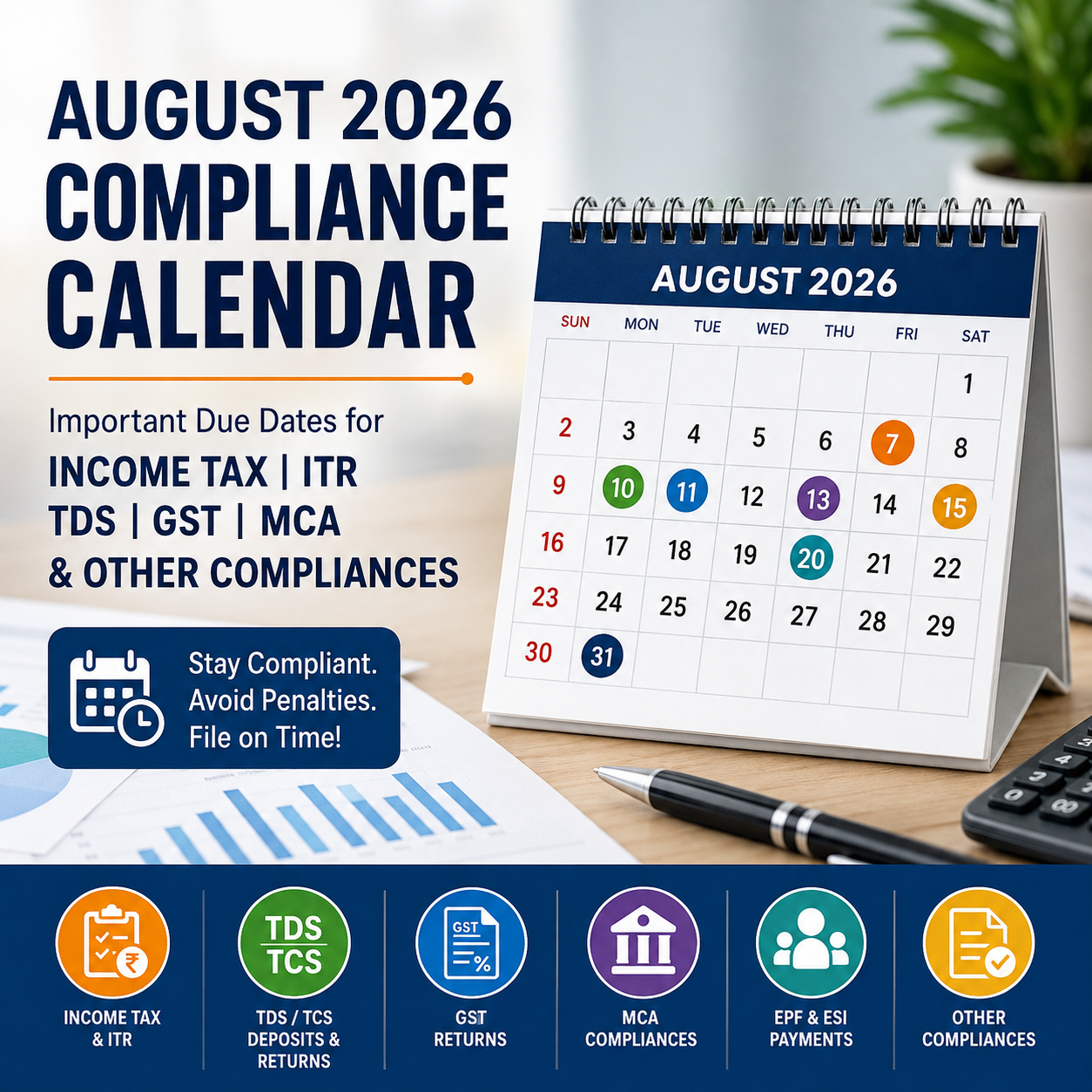
June 2026 Compliance Calendar: Key GST, Income Tax, PF, ESI, MCA & Statutory Deadlines

June 2026 is a crucial month for businesses, professionals, LLPs, companies, and taxpayers, as several important statutory compliances fall due during the month. Timely completion of GST filings, TDS/TCS payments, PF and ESI deposits, and other regulatory obligations is necessary to avoid penalties, interest charges, and compliance-related notices.

Presented below is a detailed compliance calendar for June 2026 covering significant due dates under GST, Income Tax, PF, ESI, MCA, and other applicable laws.

7 June 2026 (Sunday)

Income Tax

✅ Deposit of TDS/TCS deducted or collected during May 2026.

Applicable to all taxpayers responsible for deducting or collecting tax at source, subject to prescribed exceptions under the Income-tax provisions.


10 June 2026

GST

GSTR-7 for May 2026
Return to be filed by taxpayers required to deduct TDS under GST.

GSTR-8 for May 2026
Return to be filed by e-commerce operators liable to collect TCS under GST.


11 June 2026

GST

GSTR-1 (Monthly) for May 2026
Filing of details relating to outward supplies by monthly GST return filers.


13 June 2026

GST

GSTR-6
Return applicable to Input Service Distributors (ISD).

GSTR-5
Return applicable to Non-Resident Taxable Persons (NRTP), wherever required.


15 June 2026

Income Tax

First Advance Tax Installment for FY 2026-27

Taxpayers liable to pay advance tax should ensure payment of at least 15% of their estimated annual tax liability by this date.

PF & ESI

✅ Deposit of EPF contributions for May 2026.

✅ Deposit of ESI contributions for May 2026.

Applicable to establishments covered under the respective labour laws.


20 June 2026

GST

GSTR-3B for May 2026

Monthly summary return and tax payment for regular GST taxpayers.


25 June 2026

GST

GST PMT-06 Payment

Tax payment under the QRMP Scheme for May 2026 through Form GST PMT-06.


30 June 2026

Income Tax

✅ Submission of Challan-cum-Statements for tax deducted during May 2026 under:

• Section 194-IA – Purchase of Immovable Property (Form 26QB)

• Section 194-IB – Rent Paid by Individual/HUF (Form 26QC)

• Section 194M – Specified Payments by Individual/HUF (Form 26QD)

• Section 194S – Transfer of Virtual Digital Assets, where applicable (Form 26QE)


Additional Compliance Activities

✅ Review and update books of accounts for the first quarter of FY 2026-27.

✅ Reconcile GST liabilities, Input Tax Credit (ITC), and E-Way Bill records.

✅ Verify vendor GST compliance to safeguard ITC eligibility.

✅ Complete TDS reconciliation before filing quarterly TDS returns.


Compliance Tip

Businesses and professionals should avoid postponing compliance activities until the due date. Regular reconciliation of GST returns, accounting records, TDS transactions, and employee-related statutory payments helps minimize compliance risks and prevents avoidable notices, late fees, and interest liabilities. Maintaining a structured monthly compliance calendar can greatly improve regulatory adherence and support smooth business operations throughout the financial year.

The above due dates have been compiled after reviewing GST, Income Tax, and professional compliance calendars available from official and industry-recognized sources.    

Compliance Due Dates & Key Filings for April 2026

With the start of the new financial year FY 2026–27, April emerges as a critical month for compliance from both Income Tax and GST perspectives. Businesses, professionals, and tax practitioners must stay on top of key deadlines to avoid interest, penalties, and potential notices.

🗓️ Compliance Timeline & Important Dates for April 2026

April sets the tone for the entire financial year, making it essential to ensure:

  • Timely GST return filings (GSTR-1, GSTR-3B, etc.)
  • Deposit of TDS/TCS within due dates
  • Proper documentation and reconciliation of transactions
  • Early planning for advance tax and regulatory compliances

    Compliance Calendar – April 2026 (Complete Guide)

    https://images.openai.com/static-rsc-4/zXx9R0Y3W9RUTZri8CNntnZVqNTyeeWaYbeqWgVw8F3TLlO_GHcXgBncfAoWH43AbADbv78IYLSabfRTGA9fEgD-xO0n-SJ3D6ULQMaUmt4QAKQlI0x8r-T4EFtzBNkVQV9FQ990xijfmRpgavEmqr80sNwaY-tQpvQMyDo1IvpjIfJY1aPprLDmTkDx0iKO?purpose=fullsize
    https://images.openai.com/static-rsc-4/5Sl9naNGQCWstT78h1FiYaDiANVfxgH0JlReCDdri6QF_oznPgLttDBFsDWUKCdZ53Rw6iAQF_k0eyedImpjMj0rjF15RFuL9EfaBfihQWI8g96gBjTn-bpgu96QURONSAX5wr3geZ6kK6ZgsqZsYyG7xIw1nFSZrQ232_O57aODHG0DQDQKnhyfhCnVUVdf?purpose=fullsize
    https://images.openai.com/static-rsc-4/KxcvggfFVwOL7SNUbELL82f31HbUhT3sQMB5m-hL8Z0rezQvAeLhdUBz6tyoJMGYoATEIlnMM8yXx-5qDe5tvUjV4_e3B4HVdqNjEu--W1S8D32OwNPXc_dR3A5tvh_NOAUeZBL4x-nHqvQ90ged6okgq9RU9YU2wVFUBaUiKfwojG8kYJNQkLP2JOaABOeO?purpose=fullsize
    5

    This article provides a comprehensive compliance calendar for April 2026, covering GST, Income Tax (TDS/TCS), PF, ESI, MCA, and other key regulatory requirements.


    🔰 Important Update from 1 April 2026

    With the beginning of FY 2026–27, several critical changes come into effect:

    • Reset of aggregate turnover under GST
    • Adoption of a new invoice series
    • Applicability of provisions under the Income Tax Act, 2025
    • Revised TDS/TCS rates (where applicable)
    • Start of a fresh compliance cycle for all taxpayers

    💰 Income Tax Compliance (TDS/TCS)

    📌 7 April 2026

    • Deposit of TCS for March 2026
    • Submission of declarations (Form 27C)

    📌 14 April 2026

    • Issue of TDS certificates:
      • Form 16B (property)
      • Form 16C (rent)
      • Other applicable certificates

    📌 30 April 2026

    • Deposit of TDS for March (non-government deductors)
    • Filing of:
      • Form 26QB (property transactions)
      • Form 26QC (rent payments)
      • Form 26QD (specified payments)

    📊 GST Compliance

    April is a high-volume GST compliance month due to both monthly and quarterly filings:

    📌 10 April 2026

    • GSTR-7 (TDS under GST)
    • GSTR-8 (E-commerce operators)

    📌 11 April 2026

    • GSTR-1 (Monthly – March 2026)

    📌 13 April 2026

    • GSTR-1 (QRMP – Jan–Mar quarter)
    • GSTR-5 (Non-resident taxable persons)
    • GSTR-6 (Input Service Distributor)

    📌 18 April 2026

    • CMP-08 (Composition scheme)

    📌 20 April 2026

    • GSTR-3B (Monthly filers)

    📌 22 & 24 April 2026

    • GSTR-3B (QRMP scheme)

    📌 25 April 2026

    • ITC-04 (Job work return)

    📌 28 April 2026

    • GSTR-11 (UIN holders)

    📌 30 April 2026

    • GSTR-4 (Annual return for composition dealers – FY 2025–26)

    👨‍💼 PF & ESI Compliance

    📌 15 April 2026

    • Deposit of Provident Fund (PF)
    • Filing of ECR (Electronic Challan-cum-Return)
    • Deposit of ESI contributions

    🏢 MCA / Companies Act Compliance

    While April has no major fixed ROC due dates, it remains important for:

    • Planning annual compliance strategy
    • Conducting the first Board Meeting (if applicable)
    • Reviewing statutory registers and disclosures

    🌍 Other Key Compliance

    📌 7 April 2026

    • Filing of ECB-2 Return (foreign borrowings under FEMA)

    📌 15 April 2026

    • Submission of Form 15CC (foreign remittance compliance)

    ✅ Final Takeaway

    April is not just the start of a new financial year—it’s a foundation month for compliance discipline. Staying updated with deadlines across GST, Income Tax, and other laws helps:

    • Avoid penalties and interest
    • Ensure smooth operations
    • Build a strong compliance track record for the year ahead
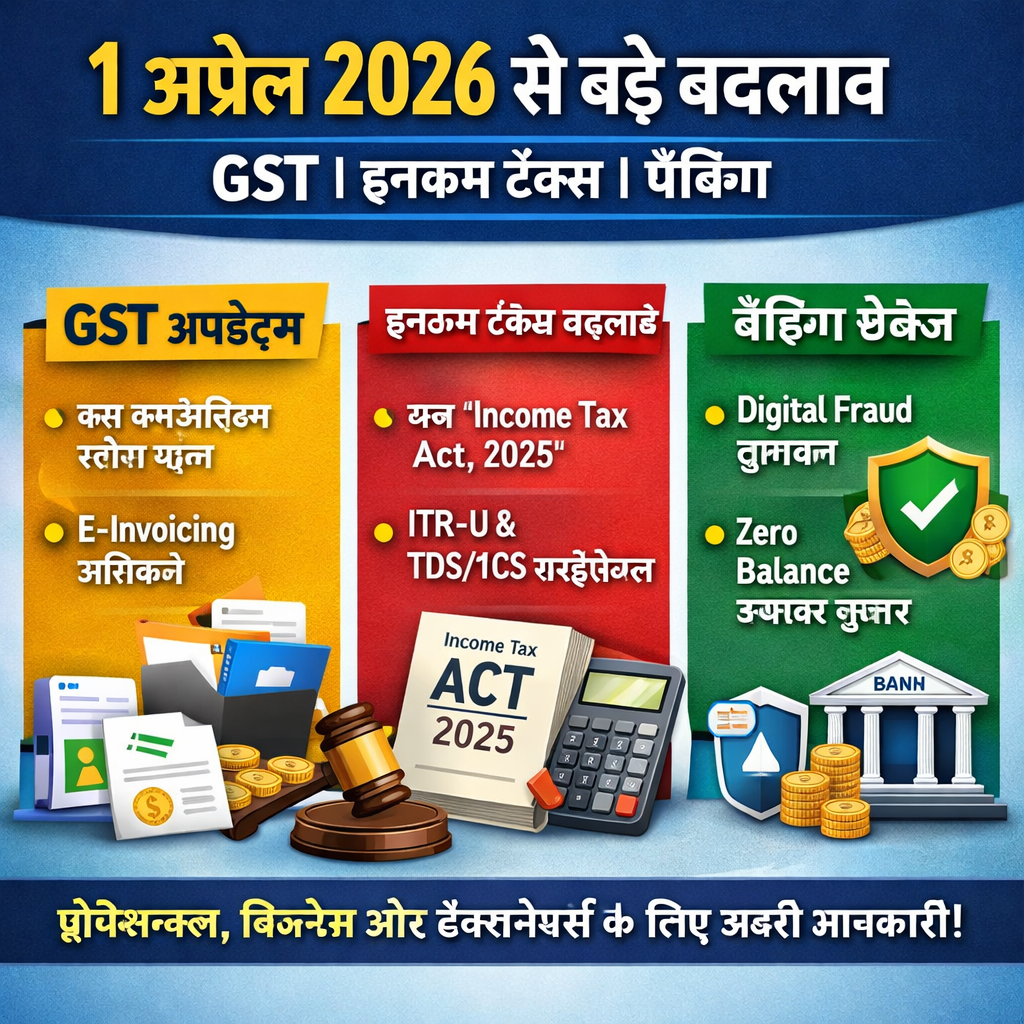
1 अप्रैल 2026 से टैक्स सिस्टम में परिवर्तन | जानें प्रमुख बदलाव

1 अप्रैल 2026 से लागू बड़े बदलाव | GST और इनकम टैक्स अपडेट

यह आर्टिकल 1 अप्रैल 2026 से लागू होने वाले सभी महत्वपूर्ण बदलावों को कवर करता है — प्रोफेशनल्स, बिज़नेस और टैक्सपेयर्स के लिए एक कम्प्लीट गाइड।


🟡 PART 1: GST में 1 अप्रैल 2026 से बदलाव

🔸 1. कंपोज़िशन स्कीम की डेडलाइन खत्म

31 मार्च 2026 अंतिम तिथि थी।
👉 1 अप्रैल के बाद:

  • नया ऑप्शन अब उपलब्ध नहीं
  • अगला मौका अगले वित्त वर्ष में ही मिलेगा

🔸 2. LUT (Letter of Undertaking) जरूरी

FY 2026-27 के लिए नया LUT फाइल करना अनिवार्य
👉 अगर फाइल नहीं किया:

  • एक्सपोर्ट टैक्सेबल माना जाएगा
  • GST देना पड़ेगा

⚠️ सलाह: वर्किंग कैपिटल ब्लॉक होने से बचने के लिए तुरंत LUT फाइल करें


🔸 3. GTA फॉरवर्ड चार्ज ऑप्शन बंद

31 मार्च 2026 तक ही विकल्प उपलब्ध था
👉 1 अप्रैल से:

  • डिफॉल्ट = Reverse Charge लागू

🔸 4. Rule 14A में राहत

👉 1 अप्रैल 2026 के बाद DRC-32 फाइल करने पर:

  • सिर्फ 1 महीने का GST रिटर्न देना होगा
  • पहले की तुलना में बड़ी राहत

🔸 5. नया इनवॉइस सीरीज़ अनिवार्य

नए वित्त वर्ष के साथ:

  • नई इनवॉइस नंबरिंग शुरू करें
  • GST और ऑडिट के लिए जरूरी

🔸 6. E-Invoicing लागू

👉 अगर टर्नओवर ₹5 करोड़ से अधिक है:

  • 1 अप्रैल 2026 से E-invoicing अनिवार्य

🔸 7. बुक्स ऑफ अकाउंट्स क्लोजर

31 मार्च 2026 तक:

  • बुक्स क्लोज करें
  • बैकडेट एंट्री से बचें
  • ऑडिट ट्रेल बनाए रखें

🔸 8. टर्नओवर की सही गणना

महत्वपूर्ण उपयोग:

  • E-invoicing
  • ऑडिट
  • कंपोज़िशन स्कीम

👉 ध्यान रखें:

  • सभी GSTIN का PAN आधारित टर्नओवर शामिल करें

🔸 9. GST रेट वेरिफिकेशन

  • हाल के बदलाव वाले प्रोडक्ट्स पर खास ध्यान दें
  • सही रेट लागू करें

🔸 10. MRP आधारित वैल्यूएशन (तंबाकू)

1 फरवरी 2026 से लागू
👉 जांचें:

  • क्या MRP बेस्ड वैल्यूएशन लागू है
  • सभी कंप्लायंस पूरे हैं या नहीं

🔸 11. ITC रीकंसिलिएशन जरूरी

मिलान करें:

  • बुक्स vs GSTR-2B
  • वेंडर फाइलिंग

👉 इससे नोटिस से बचा जा सकता है


🔸 12. ITC रिवर्सल और रिक्लेम ट्रैकिंग

  • पोर्टल पर नए स्टेटमेंट उपलब्ध
    👉 सुनिश्चित करें:
  • सही रिवर्सल
  • योग्य रिक्लेम लिया गया

🔸 13. अन्य महत्वपूर्ण GST पॉइंट्स

✅ HSN कोड अपडेट करें
✅ RCM लायबिलिटी चेक करें
✅ GSTR-9 / 9C की तैयारी शुरू करें
✅ E-Way Bill नियमों की जांच करें


🔵 PART 2: INCOME TAX में 1 अप्रैल 2026 से बदलाव

🔸 1. नया Income Tax Act, 2025 लागू

👉 1 अप्रैल 2026 से:

  • पुराना कानून रिप्लेस
  • नया टैक्स फ्रेमवर्क लागू

🔸 2. नए ITR फॉर्म और नियम

👉 नए बदलाव:

  • अपडेटेड रिपोर्टिंग फॉर्मेट
  • अतिरिक्त डिस्क्लोज़र आवश्यक
  • पोर्टल पर नए फॉर्म उपलब्ध

    🔸 3. नया चालान सिस्टम लागू

    टैक्स भुगतान के लिए नई संरचना लागू की गई है

    🔸 3. सही चालान का उपयोग अनिवार्य

    टैक्स पेमेंट करते समय अब सही चालान चुनना बेहद जरूरी है

    👉 उपयोग करें:

    • Advance Tax के लिए अलग चालान
    • Self-Assessment Tax के लिए अलग चालान

    ⚠️ गलत चालान चयन करने पर:

    • पेमेंट mismatch हो सकता है
    • नोटिस या एडजस्टमेंट की समस्या आ सकती है

    🔸 4. Income Tax Portal अपडेट

    इनकम टैक्स पोर्टल में बड़े बदलाव किए गए हैं

    👉 नए फीचर्स:

    • नया User Interface (UI)
    • आसान Navigation System

    👉 इसमें शामिल:

    • नया फॉर्म चयन सिस्टम
    • अपडेटेड फाइलिंग वर्कफ्लो

    📌 असर:
    रिटर्न फाइलिंग अब अधिक streamlined और user-friendly हो गई है


    🔸 5. Updated Return (ITR-U) पर रोक

    👉 FY 2020-21 के लिए:
    ❌ अब Updated Return फाइल नहीं कर सकते

    📌 1 अप्रैल 2026 से:

    • यह वर्ष पूरी तरह time-barred हो गया है

    🔸 6. TDS/TCS Correction Statements पर प्रतिबंध

    Section 397(3)(f) के अनुसार:

    👉 निम्न वर्षों के लिए correction अब संभव नहीं:

    • FY 2018-19 (Q4)
    • FY 2019-20 से 2022-23 (Q1–Q4)
    • FY 2023-24 (Q1–Q3)

    👉 1 अप्रैल 2026 से:
    ❌ कोई correction allowed नहीं


    🔸 7. अन्य महत्वपूर्ण Income Tax पॉइंट्स

    AIS / TIS Reconciliation

    • AIS/TIS को books से मैच करना जरूरी

    Advance Tax Planning

    • नए एक्ट के अनुसार calculation में बदलाव संभव

    Carry Forward Loss Check

    • losses सही तरीके से report किए गए हों

    Capital Gains Adjustments

    • नए नियमों के अनुसार verify करें

    🏦 PART 3: RBI & BANKING CHANGES (2026 से महत्वपूर्ण)

    🔸 1. Digital Fraud Compensation (बड़ी राहत)

    Reserve Bank of India ने नया customer protection framework लागू किया है

    👉 यदि आप डिजिटल फ्रॉड का शिकार होते हैं:

    • मुआवजा = 85% नुकसान या ₹25,000 (जो कम हो)
    • लागू: ₹50,000 तक के छोटे फ्रॉड पर
    • जीवन में केवल 1 बार

    ⚠️ शर्तें:

    • 5 दिनों के भीतर रिपोर्ट करना जरूरी
    • रिपोर्ट करें:
      • बैंक
      • Cyber Crime Portal

    👉 बैंक की जिम्मेदारी:

    • 5 दिनों के भीतर राशि क्रेडिट करना

    📌 प्रभाव:

    • पहली बार मजबूत कस्टमर सुरक्षा
    • डिजिटल पेमेंट्स पर भरोसा बढ़ेगा

    🔸 2. UPI और ATM लिमिट – स्पष्टता

    👉 महत्वपूर्ण बात:

    • UPI ट्रांजैक्शन ATM लिमिट में शामिल नहीं होते
    • ATM लिमिट केवल ATM withdrawals पर लागू होती है

    🔸 3. Zero Balance Accounts (BSBDA) में सुधार

    BSBDA खातों के लिए RBI ने सुविधाएं बढ़ाई हैं

    कोई Minimum Balance नहीं

    • पहले की तरह जारी

    ATM / Debit Card सुविधा

    • अब ज्यादा व्यापक रूप से उपलब्ध

    फ्री ट्रांजैक्शन लिमिट

    • कम से कम 4 फ्री withdrawal प्रति माह

    UPI और डिजिटल एक्सेस

    • UPI, Mobile Banking, AEPS पूरी तरह उपलब्ध

    बेसिक सर्विसेज पर कोई चार्ज नहीं

    • डिपॉजिट
    • बेसिक withdrawal
    • अकाउंट मेंटेनेंस

    फ्री पासबुक / स्टेटमेंट

    ओवरड्राफ्ट सुविधा

    • बैंक की शर्तों के अनुसार उपलब्ध

      📌 निष्कर्ष

      1 अप्रैल 2026 से GST, Income Tax और Banking तीनों क्षेत्रों में बड़े बदलाव लागू हो चुके हैं।
      समय पर इन अपडेट्स को समझकर और लागू करके आप compliance risk, penalties और financial losses से बच सकते हैं।

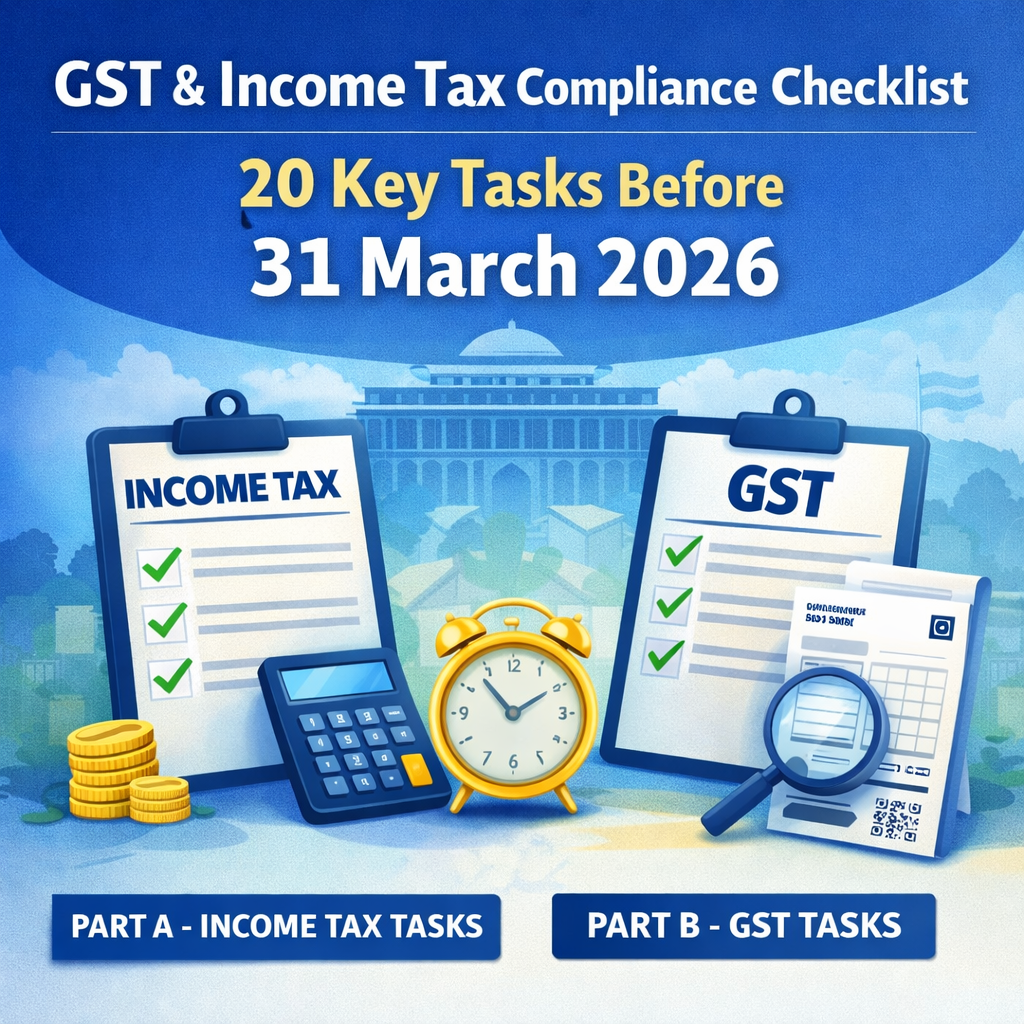
GST and Income Tax Checklist: 20 Key Compliances Before 31 March 2026

GST & Income Tax Year-End Compliance Guide

With the financial year 2025–26 drawing to a close, 31st March 2026 becomes a critical deadline for businesses, professionals, exporters, and salaried taxpayers.

Several tax planning measures, compliance requirements, and strategic decisions must be finalised before the year ends. Failure to act within the prescribed timelines may result in additional tax burden, penalties, interest costs, or loss of eligible benefits.

Below is a comprehensive checklist to help you stay compliant and tax-efficient before the financial year

PART A – INCOME TAX ACTION POINTS BEFORE 31 MARCH 2026

1️⃣ Advance Tax Payment (Where Applicable)

If your total tax liability for FY 2025–26 exceeds ₹10,000:

  • Ensure the final instalment of advance tax (due on 15 March) has been paid

  • Reassess whether any shortfall exists

  • Clear remaining dues before 31 March to minimise interest under Sections 234B and 234C

Timely review can help avoid unnecessary interest costs.


2️⃣ Year-End Tax Planning & Investments

This is the final opportunity in the current financial year to:

  • Invest under Section 80C (LIC, PPF, ELSS, etc.)

  • Pay medical insurance premium under Section 80D

  • Contribute to NPS under Section 80CCD(1B)

  • Optimise HRA and other salary exemptions

  • Make eligible donations under Section 80G

Strategic planning before 31 March can substantially reduce overall tax liability.


3️⃣ TDS Deduction & Deposit Check

Before closing the books:

  • Confirm TDS has been deducted on all applicable payments

  • Review contractor, professional, rent, and commission payments

  • Ensure timely deposit of deducted TDS

Non-compliance may lead to:

  • 40% disallowance of expenditure

  • Interest and penalty exposure

Important – Time Limit for Old TDS Corrections:
As per Section 397(3)(f) of the Income-tax Act, 2025, correction statements relating to certain past financial years (FY 2018–19 onwards as specified) will be accepted only up to 31 March 2026. From 1 April 2026, these will become time-barred. Deductors and collectors should take necessary action immediately.


4️⃣ TCS Compliance Review

For persons required to collect TCS:

  • Verify correct collection

  • Deposit any outstanding amount

  • Reconcile TCS figures with books

This is especially important considering revised TCS rates effective from 1 April 2026.


5️⃣ Capital Gains Planning

Before the year ends:

  • Strategically plan sale of shares or property

  • Undertake tax-loss harvesting where beneficial

  • Invest in eligible exemptions under Sections 54, 54F, or 54EC

  • Deposit funds in the Capital Gain Account Scheme, if applicable

Advance planning helps lawfully optimise capital gains tax.


6️⃣ MSME Payment Compliance – Section 43B(h)

Businesses must:

  • Ensure payments to MSME vendors are made within 45 days

Failure to comply may result in disallowance of the expense in FY 2025–26. This is particularly relevant for traders and manufacturers.


7️⃣ Finalisation of Books & Reconciliation

Before 31 March, complete:

  • Bank reconciliations

  • Debtor and creditor confirmations

  • Physical stock verification

  • Cash verification

  • Loan account reconciliation

Proper year-end closure reduces audit observations and scrutiny risks.


8️⃣ Prepare for Income-tax Act, 2025 (Effective 1 April 2026)

From the next financial year:

  • The Income-tax Act, 2025 will replace the existing Act

  • New Income-tax Rules, 2026 will be notified

  • Forms will be renumbered and simplified

Professionals should:

  • Map old provisions with new ones

  • Update compliance trackers

  • Inform and educate clients

  • Upgrade systems and software

Advance preparation in March will prevent confusion in April.


PART B – GST ACTION POINTS BEFORE 31 MARCH 2026

9️⃣ Composition Scheme – Opt In / Opt Out

Eligible taxpayers must:

  • File intimation before 31 March

  • Review turnover limits

  • Ensure readiness for FY 2026–27

The option must be exercised before the new financial year begins.


🔟 Letter of Undertaking (LUT) for Exporters

Exporters should:

  • File fresh LUT for FY 2026–27 before 1 April 2026

  • Verify IEC and GST details

  • Update DSC credentials

Failure to file LUT may require payment of IGST on exports.


1️⃣1️⃣ QRMP Scheme Decision

Taxpayers with turnover up to ₹5 crore:

  • May opt in or opt out of QRMP

  • Decision deadline is 30 April, but review should be done before year-end

Turnover analysis is essential before opting.


1️⃣2️⃣ GTA – Forward Charge or Reverse Charge

Goods Transport Agencies must:

  • File required annexures

  • Choose between Forward Charge Mechanism (FCM) or Reverse Charge Mechanism (RCM)

  • Exercise option within prescribed timelines

This decision impacts tax collection structure for the upcoming year.


1️⃣3️⃣ Hotels – Declaration of Specified Premises

Hotels are required to:

  • Submit Annexure VII

  • Declare specified premises for GST rate determination

This directly affects GST rates applicable in the next financial year.


1️⃣4️⃣ ITC Reconciliation

Before year-end:

  • Match books with GSTR-2B

  • Reconcile GSTR-1 with GSTR-3B

  • Reverse ineligible ITC

  • Follow up with vendors for mismatches

March is ideal for cleaning ITC discrepancies.


1️⃣5️⃣ Review Reverse Charge Liability

Verify whether RCM has been correctly paid and reported for:

  • GTA services

  • Legal services

  • Director remuneration

  • Other notified categories

Ensure correct reporting in GSTR-3B.


1️⃣6️⃣ E-Invoicing Compliance Check

If turnover exceeds prescribed limits:

  • Ensure e-invoicing compliance from 1 April

  • Update ERP systems

  • Generate IRN correctly

Non-compliance attracts substantial penalties.


1️⃣7️⃣ Turnover Assessment for FY 2026–27

Review aggregate turnover to determine:

  • Eligibility for Composition Scheme

  • QRMP eligibility

  • Audit applicability

Proactive review supports smooth compliance next year.


1️⃣8️⃣ Update GST Registration Details

Before year-end, verify:

  • Bank account details

  • Business address

  • Additional place of business

  • Authorised signatory information

Accurate records help avoid future notices.


1️⃣9️⃣ Refund Review (For Exporters)

Exporters should:

  • File pending refund claims

  • Review inverted duty structure claims

  • Ensure documentation is complete

Avoid delaying claims unnecessarily.


2️⃣0️⃣ Clean Compliance Record

Before closing the year:

  • File all pending GST returns

  • Clear late fees

  • Respond to outstanding notices

  • Maintain proper documentation

A clean compliance history reduces risk under the evolving tax regime.


Final Thoughts

31 March 2026 is more than just the end of a financial year. It is:

✔ The final window for tax planning
✔ The deadline for key GST decisions
✔ An opportunity to rectify compliance gaps
✔ The preparation phase for the Income-tax Act, 2025

Ignoring these action points may result in:

  • Higher tax outgo

  • Interest and penalties

  • Loss of eligible benefits

  • Increased compliance burden in the next financial year

Renumbering of Income Tax Forms as per ITA 2025 and Income-tax Rules, 2026

Income-tax Forms Revamped under ITA 2025 & Draft Income-tax Rules, 2026

The Government has initiated one of the most significant compliance overhauls in the history of Indian direct taxation with the introduction of the Income-tax Act, 2025 and the Draft Income-tax Rules, 2026.

A major component of this reform is the comprehensive restructuring, simplification, and renumbering of Income-tax Forms.

👉 Click here to get …

This article covers:

  • The reason behind the change in forms

  • Key forms that have been renumbered

  • The impact on taxpayers and professionals

  • What lies ahead


Background of the Reform

The proposed Income-tax Act, 2025, expected to come into force from 1 April 2026, seeks to:

  • Simplify drafting and terminology

  • Minimise litigation

  • Eliminate redundant provisions

  • Strengthen technology-based compliance

To align with the new legislation, the Government has released the Draft Income-tax Rules, 2026 for public consultation.


Extent of Rationalisation

Particulars Old Rules (1962) Draft Rules (2026)
Number of Rules 511 333
Number of Forms 399 190

The reduction has been achieved through consolidation, elimination of repetitive disclosures, and standardisation of reporting requirements.


1️⃣ Audit & Reporting Forms – Fully Reorganised

Audit and reporting formats have been merged and logically restructured.

Earlier Form Purpose New Form
3CA / 3CB / 3CD Tax Audit Report Form 26 (55 segmented clauses)
3CEB Transfer Pricing Audit Form 48
29B MAT Audit Report Form 66
10FA Tax Residency Certificate Form 42
10F DTAA Details (u/s 90 / 90A) Form 41

🔎 Key Change:
Multiple audit formats are consolidated into structured, segment-wise forms, reducing duplication and interpretational issues.


2️⃣ Charitable Trusts & NGOs – Streamlined Compliance

Compliance requirements for trusts and NGOs, previously considered complex, have been simplified and renumbered.

Earlier Form Purpose New Form
10A Provisional Registration Form 104
10AB Registration / Renewal Form 105
Form 10 Accumulation of Income Form 109
10B / 10BB Audit Report Form 112
10BD Donee Statement Form 113
10BE Donor Certificate Form 114

🔎 Key Change:
Distinct segregation between registration, audit, accumulation, and donation reporting reduces the risk of technical rejections.


3️⃣ TDS / TCS Compliance – Rationalised & Standardised

TDS/TCS forms have been logically renumbered and aligned for improved automation.

Earlier Form Purpose New Form
Form 13 Lower / NIL TDS Application Form 128
Form 16 Salary TDS Certificate Form 130
24Q TDS Return – Salary Form 138
26Q TDS Return – Residents Form 140
27Q TDS Return – Non-Residents Form 144
27EQ TCS Return Form 143

🔎 Key Change:
Enhanced design supports automated validation, reconciliation, and centralised processing — reducing mismatches and notices.


4️⃣ Other Significant Renumbered Forms

Several widely used compliance forms have also been reassigned:

Earlier Form Purpose New Form
Form 26AS Annual Tax Statement Form 168
15CA Foreign Remittance Form 145
15CB CA Certificate for Remittance Form 146
61A SFT Reporting Form 165

5️⃣ Philosophy Behind the New Structure

The new Rules and Forms reflect the same guiding principles as the Income-tax Act, 2025:

✔ Simpler Drafting

Clear and accessible language to avoid ambiguity.

✔ Uniform Data Fields

Standardised disclosures across forms to prevent repetitive reporting.

✔ Intelligent Forms

Designed with:

  • Pre-filled information

  • Built-in validations

  • Automated reconciliation

✔ Technology-Led Administration

Facilitates:

  • Centralised processing

  • Data analytics

  • Improved taxpayer services


6️⃣ Public Consultation & Participative Reform

The Draft Rules and Forms were placed in the public domain for 15 days (up to 22 February 2026).

Two comparative navigators have been provided:

  • Old Rules vs New Rules Mapping

  • Old Forms vs New Forms Mapping

Stakeholders can submit feedback rule-wise and form-wise, ensuring transparency and participative policymaking.


7️⃣ Implications for Stakeholders

For Taxpayers

  • Fewer forms to interpret

  • Reduced repetitive disclosures

  • More intuitive filing experience

For Professionals

  • Short-term adjustment phase

  • Long-term efficiency gains

  • Lower litigation and compliance risks

For the Tax Administration

  • Cleaner and structured data

  • Improved analytics

  • More predictable compliance environment


Conclusion

The restructuring and renumbering of Income-tax Forms under the Income-tax Act, 2025 and Draft Income-tax Rules, 2026 goes far beyond mere renaming.

It marks a structural shift toward a simplified, digitised, and taxpayer-centric compliance framework, laying the foundation for a modern and technology-driven direct tax regime in India.

Budget 2026 Update: Changes in TDS and TCS from 1 April 2026

Budget 2026: Key Amendments in TDS & TCS Framework (Effective from 1 April 2026)

The Union Budget 2026 has introduced wide-ranging reforms in the TDS and TCS provisions under the Income-tax Act, 2025. These measures are aimed at rate rationalisation, simplification of compliance, removal of ambiguities, taxpayer relief, and selective decriminalisation of offences.

Unless specifically mentioned otherwise, all amendments will come into force from 1 April 2026 and apply from Tax Year 2026–27 onwards.


1. Rationalisation of TCS Rates – Section 394(1)

Earlier, Section 394(1) prescribed multiple and inconsistent TCS rates across different categories of transactions. Budget 2026 proposes to standardise TCS rates wherever feasible, while also granting rate relief in select cases.

Revised TCS Rate Structure

Sl. No. Nature of Receipt Existing Rate Proposed Rate
1 Sale of alcoholic liquor for human consumption 1% 2%
2 Sale of tendu leaves 5% 2%
3 Sale of scrap 1% 2%
4 Sale of minerals (coal, lignite, iron ore) 1% 2%
5(a) LRS remittance – education / medical treatment exceeding ₹10 lakh 5% 2%
5(b) LRS remittance – other purposes 20% 20% (unchanged)
6 Overseas tour programme package Tiered (5% / 20%) 2% flat

2. Overseas Tour Programme Package – Significant Relief

Earlier Regime

  • 5% TCS on amounts up to ₹10 lakh

  • 20% TCS on amounts exceeding ₹10 lakh

Budget 2026 Change

  • Uniform TCS rate of 2%

  • ₹10 lakh threshold removed

  • Applicable irrespective of transaction value

Impact

  • Substantial reduction in tax burden on travellers

  • Prevents diversion of business to foreign tour operators

  • Simplifies compliance for Indian tour operators


3. Liberalised Remittance Scheme (LRS) – Rate Reduction

For remittances under RBI’s LRS:

Purpose Earlier TCS Revised TCS
Education / Medical treatment (above ₹10 lakh) 5% 2%
Other purposes 20% No change

This amendment provides notable relief to students and individuals remitting funds for medical treatment abroad.


4. Electronic Filing for Lower / Nil TDS Certificates – Section 395

Earlier Position

  • Manual application before the Assessing Officer

  • Lengthy and compliance-intensive process

Amendment under Budget 2026

  • Payees can now apply electronically

  • Application to be made before a prescribed income-tax authority

  • Certificate may be:

    • Issued electronically, or

    • Rejected if conditions are not met or details are incomplete

Benefit

  • Faster processing

  • Improved transparency

  • Major compliance relief for small and medium taxpayers


5. TDS on Supply of Manpower – Ambiguity Clarified

Issue Earlier

Confusion existed on whether manpower supply should be classified as:

  • Contract work (1% / 2%), or

  • Technical / professional services (up to 10%)

Budget 2026 Clarification

  • Supply of manpower is explicitly included under “work” in Section 402(47)

Applicable TDS Rates

  • 1% – where payee is Individual or HUF

  • 2% – in all other cases

Outcome

  • Uniform tax treatment

  • Reduced litigation and interpretational disputes


6. Deduction Allowed to Non-Life Insurance Business for Delayed TDS

Earlier Issue

  • Expenses were disallowed if TDS was not deducted or paid on time

  • No explicit provision for allowing deduction in a subsequent year

Budget 2026 Amendment

  • Schedule XIV amended

  • New provision allows deduction in the year in which TDS is deducted and paid

Applicability

  • Non-life insurance businesses

  • Effective from AY 2026–27 onwards


7. Decriminalisation and Rationalisation of TDS/TCS Offences

Fully Decriminalised Defaults

Failure to deposit TDS relating to:

  • Lottery or crossword puzzle winnings

  • Benefits or perquisites arising from business or profession

➡️ No imprisonment prescribed

Revised Punishment Structure (Selected Cases)

Applicable to:

  • Online gaming winnings

  • Virtual Digital Asset (VDA) transactions

Amount of TDS Default Punishment
Above ₹50 lakh Imprisonment up to 2 years / fine / both
₹10 lakh – ₹50 lakh Imprisonment up to 6 months / fine / both
Other cases Fine only

Wholly in-kind transactions involving online gaming or VDAs are excluded from prosecution.


8. TDS on Sale of Immovable Property by Non-Residents – Procedural Ease

Earlier

  • Buyer was required to obtain TAN for TDS compliance

Now

  • TDS can be deposited using PAN-based challan

  • No TAN required

Impact

  • Simplified property transactions with NRIs

  • Reduced compliance burden for resident buyers


Effective Date

1 April 2026
✔ Applicable from Tax Year 2026–27 onwards


Closing Note

With these comprehensive reforms, Budget 2026 significantly reshapes the TDS–TCS landscape, balancing automation, relief, and enforcement. Taxpayers, professionals, tour operators, insurers, and businesses engaged in manpower supply or cross-border remittances should realign systems, contracts, and compliance processes well ahead of 1 April 2026.

New Income Tax Slab Rates in Budget 2026: FY 2026-27 (AY 2027-28), ITR Deadlines & TDS/TCS Rules

Key Income Tax & ITR Updates – Budget 2026

  • No change in income tax slab rates under either tax regime.

  • Simplified ITR forms will be introduced shortly to ease compliance.

📅 Revised ITR Due Dates (Non-Audit Cases)

  • Business & Trust cases: Due date extended from 31 July to 31 August

  • Other non-audit cases: Due date continues to be 31 July

🔁 Revised Return – Section 139(5)

  • Time limit to file a revised return extended from 31 December to 31 March of the relevant assessment year.

🔄 TDS & TCS Updates

  • TDS and TCS rates rationalised to reduce complexity and mismatches.

🏠 Property Purchase from NRI – Key Relief

  • TAN requirement removed for buyers of property from an NRI.

  • A PAN-based challan system has been introduced for payment of TDS, simplifying the compliance process.

    Income Tax Slab Rates – Default (New) Tax Regime

    The following income tax slab rates will apply to individuals opting for the default new tax regime for FY 2026-27 (AY 2027-28):

    Total Income Tax Rate
    Up to ₹4,00,000 Nil
    ₹4,00,001 – ₹8,00,000 5%
    ₹8,00,001 – ₹12,00,000 10%
    ₹12,00,001 – ₹16,00,000 15%
    ₹16,00,001 – ₹20,00,000 20%
    ₹20,00,001 – ₹24,00,000 25%
    Above ₹24,00,000 30%

    These slab rates apply uniformly to all individuals, including salaried taxpayers, with no age-based differentiation.


    Key Features of the New Tax Regime

    1️⃣ Rebate under Section 87A

    Budget 2026 has enhanced tax relief through Section 87A:

    • Individuals with net taxable income up to ₹12,00,000 are eligible for a 100% tax rebate.

    • Consequently, the total tax liability becomes NIL for such taxpayers under the default regime.

    • This change significantly improves affordability for middle-income earners.

    2️⃣ Standard Deduction for Salaried Taxpayers

    • Salaried individuals can claim a standard deduction of ₹75,000 under the new tax regime.

    • Because of this deduction, effective tax-free income can extend up to ₹12.75 lakh.

    • This makes the default regime even more beneficial for salaried employees.


    Old Tax Regime (Optional)

    The old tax regime continues as an optional choice and follows a different slab structure. It allows various deductions and exemptions, such as HRA, Section 80C, Section 80D, and others.

    Income Tax Slabs under the Old Regime

    Income Slab Tax Rate
    Up to ₹2,50,000 Nil
    ₹2,50,001 – ₹5,00,000 5%
    ₹5,00,001 – ₹10,00,000 20%
    Above ₹10,00,000 30%

    While deductions are permitted under the old regime, it does not provide the higher rebate threshold available under the new tax regime. As a result, it may be less beneficial for taxpayers with limited deductions.


    Which Tax Regime Is Better for You?

    • Taxpayers with minimal deductions or exemptions may benefit more from the new default tax regime due to lower slab rates, higher rebate, and standard deduction.

    • Taxpayers who claim substantial deductions, such as housing loan interest, insurance premiums, and eligible investments, may still find the old regime more suitable.

    • It is advisable to perform a comparative tax calculation before choosing the appropriate regime.

Income Tax Changes Announced in Union Budget 2026

Direct Tax Proposals in Budget 2026 – Key Highlights

In Union Budget 2026, the Government has announced a wide-ranging and future-oriented set of Direct Tax reforms aimed at simplifying tax laws, reducing disputes, improving compliance, and enhancing India’s appeal as a global investment destination. These measures signal a decisive shift from a complex, enforcement-driven regime to a trust-based, technology-enabled, and taxpayer-friendly tax system, aligned with the vision of Viksit Bharat.


1. New Income-tax Act, 2025 – A Structural Overhaul

One of the most significant announcements in Budget 2026 is the replacement of the Income-tax Act, 1961 with the Income-tax Act, 2025, effective from 1 April 2026.

The new legislation is designed to:

  • Be substantially shorter and simpler, with fewer sections and chapters

  • Use clear and unambiguous language to minimise interpretational disputes

  • Be easier for taxpayers and tax authorities to understand and implement

Simplified Income-tax Rules and redesigned return forms will be notified shortly, enabling individuals to comply without professional assistance.


2. Taxpayer Relief & Ease of Living Measures

The Budget introduces multiple measures to address long-standing taxpayer concerns:

MACT Interest Exemption

  • Interest awarded by the Motor Accident Claims Tribunal (MACT) to individuals will be fully exempt from tax.

  • No TDS will apply, irrespective of the amount received.

Rationalisation of TCS under LRS

  • TCS on overseas tour packages reduced to 2% (from 5% / 20%), without any threshold.

  • TCS on education and medical remittances under LRS reduced from 5% to 2%.

Clarity on TDS for Manpower Supply

  • Manpower supply services classified as contractor payments.

  • TDS rate capped at 1% / 2%, eliminating ambiguity and litigation.

Automated Lower / Nil TDS Certificates

  • Eligible small taxpayers can obtain lower or nil TDS certificates through an automated, rule-based system without Assessing Officer interaction.

Simplification of Form 15G / 15H

  • Depositories authorised to accept declarations centrally and share them with multiple companies, reducing repetitive filings.


3. Rationalised Return Filing Timelines

To ease compliance pressure:

  • Belated and revised returns can now be filed up to 31 March (earlier 31 December) on payment of a nominal fee.

  • Staggered ITR due dates introduced:

    • ITR-1 & ITR-2 (Individuals): 31 July

    • Non-audit cases and trusts: 31 August


4. Relief for Property Transactions Involving NRIs

For purchase of immovable property from a non-resident:

  • Resident buyers are no longer required to obtain a TAN.

  • TDS can be deposited using a PAN-based challan, similar to resident transactions.


5. One-Time Foreign Asset Disclosure Scheme (FAST-DS, 2026)

A special 6-month disclosure window has been introduced for genuine hardship cases involving small taxpayers.

Category A

  • Undisclosed foreign income / assets up to ₹1 crore

  • Payment of:

    • 30% tax

    • 30% additional tax (in lieu of penalty)

  • Immunity from prosecution granted

Category B

  • Foreign assets up to ₹5 crore

  • One-time fee of ₹1 lakh

  • Full immunity from penalty and prosecution

Immunity from prosecution is also retrospectively extended for non-immovable foreign assets up to ₹20 lakh.


6. Rationalisation of Penalty & Prosecution Regime

Key reforms include:

  • Assessment and penalty proceedings to be concluded through a single consolidated order

  • No interest on penalty amounts during pendency of first appeal

  • Pre-deposit for appeal reduced from 20% to 10%, limited to core tax demand

Updated Returns Post Reassessment

  • Taxpayers can file updated returns even after reassessment initiation by paying an additional 10% tax.

Penalty to Fee Conversion

  • Certain technical defaults (audit, TP report, SFT) converted into fee-based non-criminal defaults.

Decriminalisation Measures

  • Minor offences punishable only with fines

  • Maximum imprisonment reduced to two years

  • Penalties graded based on tax evasion quantum


7. Targeted Tax Relief for Cooperatives

  • Deduction extended to supply of cattle feed and cotton seed by primary cooperatives

  • Inter-cooperative dividend income allowed as deduction under the new tax regime

  • Three-year dividend exemption for notified national cooperative federations, subject to redistribution


8. IT Sector Boost & Transfer Pricing Certainty

  • IT and IT-enabled services consolidated under “Information Technology Services”

  • Uniform safe harbour margin of 15.5%

  • Threshold enhanced from ₹300 crore to ₹2,000 crore

  • Automated safe harbour approvals valid for 5 years

  • Fast-track unilateral APA with targeted 2-year resolution


9. Measures to Attract Global Business & Talent

  • Tax holiday till 2047 for foreign cloud service providers using Indian data centres

  • 15% safe harbour margin for data-centre support entities

  • 5-year tax exemption for non-residents supplying capital goods to bonded zone manufacturers

  • Exemption of global income for foreign experts residing in India up to 5 years

  • MAT exemption for non-residents taxed on presumptive basis


10. Tax Administration Reforms

  • ICDS to be merged with Ind-AS from FY 2027-28

  • Definition of “accountant” rationalised to support global expansion of Indian advisory firms


11. Other Key Direct Tax Measures

  • Buyback taxation shifted to capital gains for all shareholders

  • Additional tax for promoters to prevent arbitrage

  • TCS on liquor, scrap and minerals reduced to 2%; tendu leaves from 5% to 2%

  • STT increased on futures and options

  • MAT to become final tax from 1 April 2026, rate reduced to 14%, with limited MAT credit set-off


Conclusion

The Direct Tax proposals in Budget 2026 mark a bold move towards simplicity, certainty, and trust-based taxation. With a new Income-tax Act, substantial compliance relief, rationalised penalties, and strong incentives for investment and global integration, the reforms aim to strike a balance between revenue mobilisation and taxpayer confidence, supporting long-term economic growth.