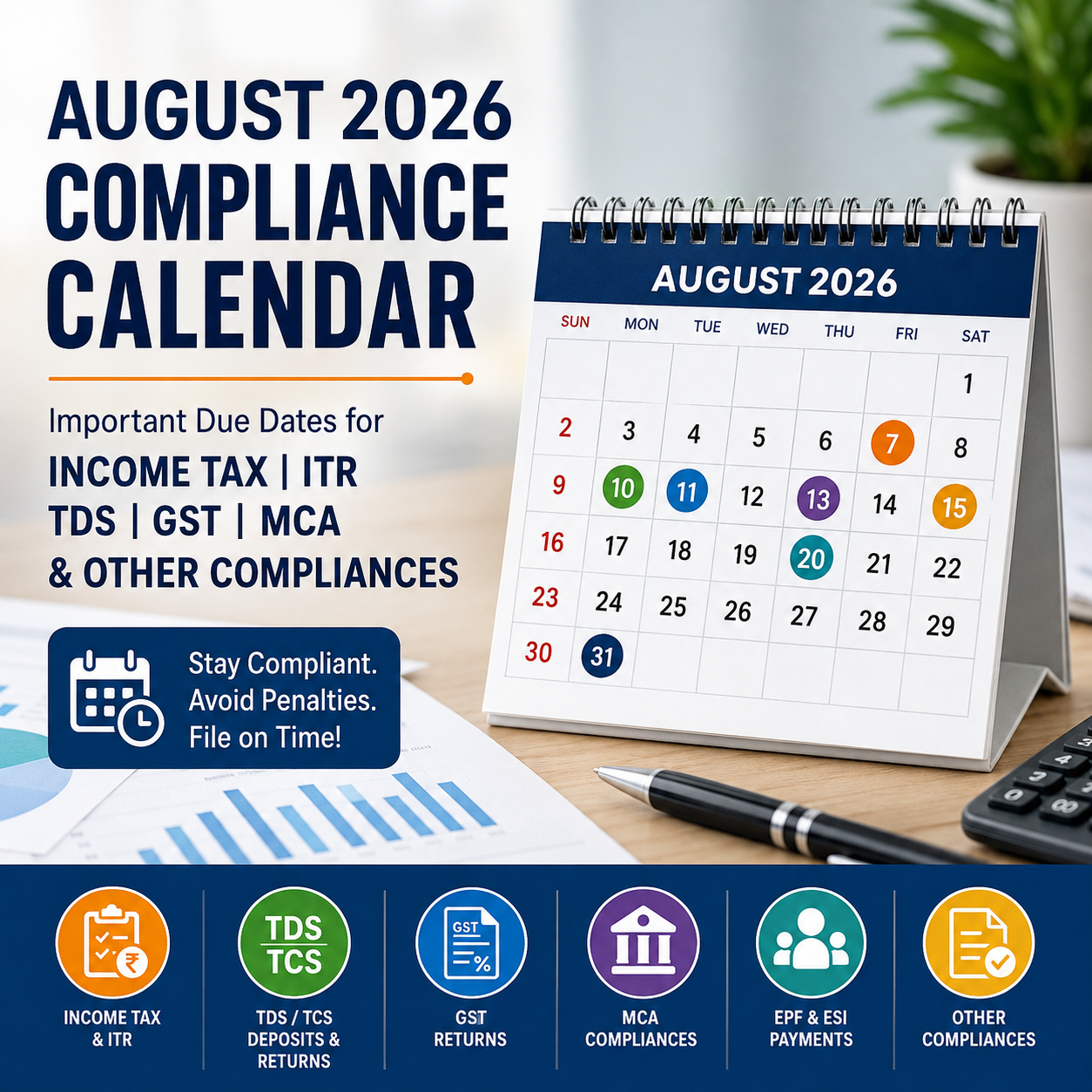
Mark Your Calendar: August 2026 Compliance Due Dates for GST, ITR, TDS & MCA

August 2026 Compliance Calendar: Major Income Tax, ITR, TDS, GST & MCA Deadlines

August 2026 is a crucial month for tax compliance, with several important statutory deadlines applicable to taxpayers, businesses, professionals, companies, and tax deductors. After the busy filing season in July, various obligations under the Income-tax Act, GST laws, MCA regulations, and labour legislations become due during August.

Failure to comply with these deadlines may lead to late filing fees, interest liabilities, penalties, delays in processing returns, or even the loss of certain tax benefits.

Below is a detailed compliance calendar highlighting the key due dates for August 2026.

Income Tax Compliance

7 August 2026 – Due Date for Deposit of TDS/TCS

Tax Deducted at Source (TDS) and Tax Collected at Source (TCS) deducted or collected during July 2026 should generally be deposited with the Central Government on or before 7 August 2026, unless a different timeline applies under the law.

This requirement generally applies to:

  • Employers
  • Companies
  • Partnership firms
  • Proprietorship businesses
  • Government deductors and other entities responsible for TDS/TCS compliance

31 August 2026 – Last Date to File ITR-3 & ITR-4

The revised Income-tax framework prescribes a separate filing deadline for certain non-audit business taxpayers.

Accordingly, 31 August 2026 is the due date for filing:

  • ITR-3 (for eligible taxpayers not subject to tax audit)
  • ITR-4 (Sugam)
  • Eligible working partners covered under the prescribed provisions

Taxpayers should carefully determine the due date applicable to their category rather than assuming that every return was due on 31 July.

Belated Return for ITR-1 & ITR-2

The original due date for filing ITR-1 and ITR-2 was 31 July 2026, and that deadline has already passed.

Those who could not file within the due date may still submit a Belated Return within the time permitted under the Income-tax Act. However, such filing may attract late filing fees, interest, and other statutory consequences wherever applicable.

Before submitting a belated return, taxpayers should reconcile and verify:

  • Annual Information Statement (AIS)
  • Form 26AS
  • Taxpayer Information Summary (TIS)
  • Any outstanding tax demand
  • Bank account validation status

Updated Return (ITR-U)

Eligible taxpayers also have the option of filing an Updated Return (ITR-U), provided they satisfy the conditions specified under the Income-tax Act.

The amended provisions now allow updated returns to be filed for a longer period than earlier, subject to payment of the prescribed additional tax and compliance with other statutory requirements.

TDS/TCS Compliance

Quarter 1 TDS/TCS Statements

The due date for filing Quarter 1 TDS/TCS statements for FY 2026-27 was 31 July 2026.

If the statement has not yet been filed, deductors should complete the filing without further delay.

Delayed filing may result in:

  • Late filing fee under Section 234E
  • Interest, where applicable
  • Additional penalties or other legal consequences in eligible cases

Important TRACES Portal Update

The TRACES Portal has introduced revised TDS certificate formats, including Form 131, for Tax Year 2026–27.

Deductors should use the updated portal functionality to download and issue the applicable TDS certificates wherever required.

GST Compliance

For GST-registered businesses, August 2026 is another important month with multiple return filing deadlines that must be monitored carefully.

10 August 2026

Due date for filing:

  • GSTR-7
  • GSTR-8

11 August 2026

Last date to file:

  • Monthly GSTR-1 (for taxpayers filing returns on a monthly basis)

13 August 2026

Due date for:

  • GSTR-5
  • GSTR-6

20 August 2026

Due date for filing:

  • Monthly GSTR-3B
  • GSTR-5A (where applicable)

GST Update: E-Way Bill System Changes Postponed

GSTN has deferred the implementation of the proposed enhancements to the E-Way Bill system.

As a result, businesses are not required to make immediate changes to their ERP software or existing operational processes. The revised rollout timeline will be communicated separately by GSTN.

MCA (Ministry of Corporate Affairs)

Company Compliance Facilitation Scheme (CCFS) 2026

A significant MCA compliance opportunity continues to be available through the Company Compliance Facilitation Scheme (CCFS), 2026, which remains open until 31 August 2026.

The scheme allows eligible companies to regularize pending ROC filings and obtain the benefits offered under the scheme, subject to the prescribed conditions.

Companies with outstanding ROC compliances should complete the necessary filings before the scheme expires to avoid missing this one-time compliance opportunity.

Regular ROC Compliances

Apart from the special compliance schemes, companies should also ensure that all routine ROC filings are completed within the prescribed timelines under the Companies Act.

Depending on the nature of the transaction, the commonly applicable ROC forms include:

  • DIR-12
  • MGT-14
  • INC-22
  • SH-7

Companies should review their statutory obligations and file the relevant forms on time to avoid additional fees and regulatory non-compliance.

EPF & ESI Compliance

15 August 2026

Employers covered under the respective labour laws should ensure timely remittance of:

  • EPF (Employees’ Provident Fund) contributions
  • ESI (Employees’ State Insurance) contributions

Timely payment helps employers remain compliant and prevents interest and penalty liabilities.

Checklist Before Filing Your Income Tax Return

Whether filing your original Income Tax Return or submitting a belated return, it is advisable to verify the following documents and records before filing:

  • ✅ Annual Information Statement (AIS)
  • ✅ Form 26AS
  • ✅ Taxpayer Information Summary (TIS)
  • ✅ Form 16 or Form 16A (where applicable)
  • ✅ Capital Gains Statement
  • ✅ Interest Certificates
  • ✅ Validated Bank Account Details

Cross-checking these documents helps ensure accurate reporting of income and reduces the chances of receiving tax notices or processing delays.

Important Due Dates – August 2026

Due Date Compliance
7 August 2026 Deposit of TDS/TCS deducted or collected during July 2026
10 August 2026 Filing of GSTR-7 and GSTR-8
11 August 2026 Monthly GSTR-1 return
13 August 2026 Filing of GSTR-5 and GSTR-6
15 August 2026 Payment of EPF and ESI contributions
20 August 2026 Monthly GSTR-3B and GSTR-5A (where applicable)
31 August 2026 Due date for filing ITR-3 and ITR-4 for eligible non-audit taxpayers
31 August 2026 Last date to avail benefits under the Company Compliance Facilitation Scheme (CCFS) 2026

Conclusion

August 2026 is a significant month for meeting tax, GST, and corporate compliance obligations. Eligible taxpayers should ensure that ITR-3 and ITR-4 are filed by 31 August 2026, while businesses must also comply with GST return filing schedules, TDS/TCS payment requirements, EPF and ESI contributions, and applicable ROC filings.

Companies with pending ROC compliances should make full use of the Company Compliance Facilitation Scheme (CCFS) 2026 before the scheme concludes on 31 August 2026. Completing these compliances within the prescribed timelines can help avoid late fees, interest, penalties, and other legal consequences while ensuring smooth regulatory compliance.
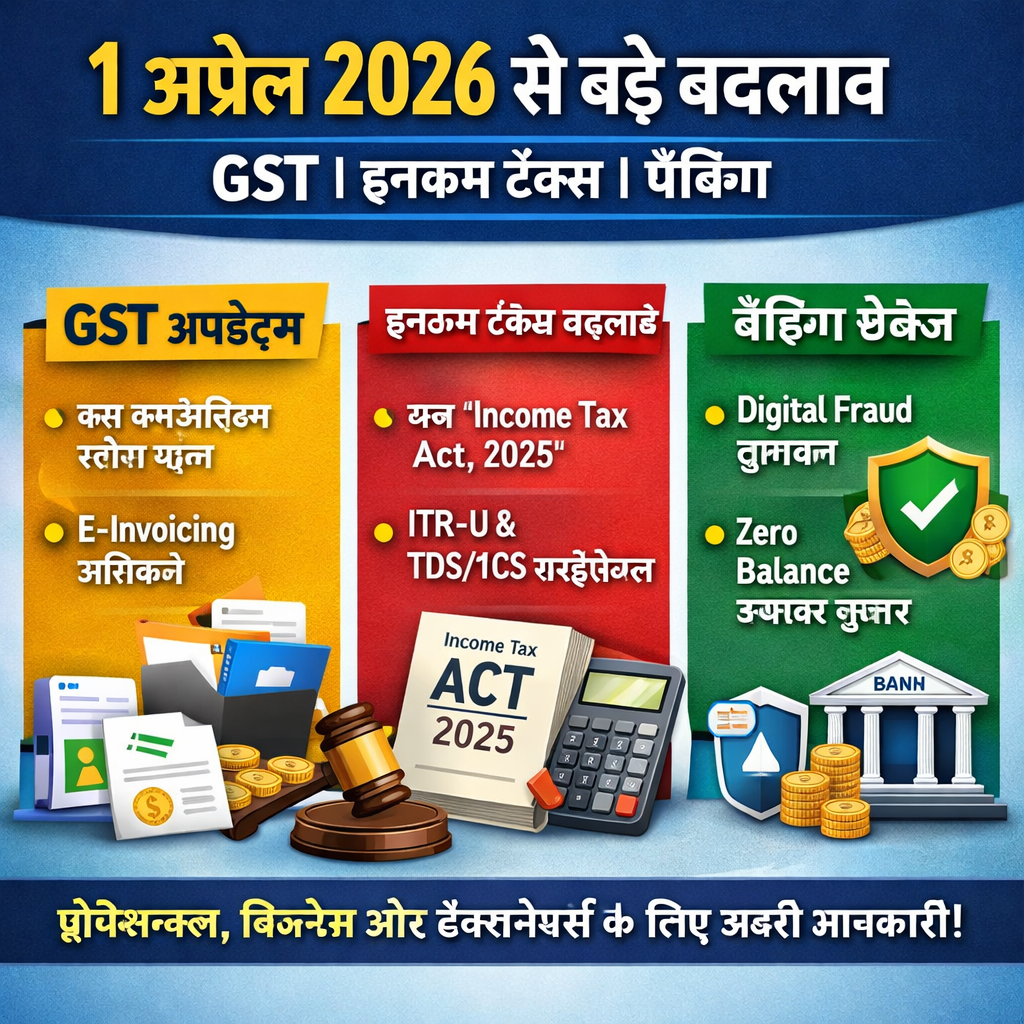
1 अप्रैल 2026 से टैक्स सिस्टम में परिवर्तन | जानें प्रमुख बदलाव

1 अप्रैल 2026 से लागू बड़े बदलाव | GST और इनकम टैक्स अपडेट

यह आर्टिकल 1 अप्रैल 2026 से लागू होने वाले सभी महत्वपूर्ण बदलावों को कवर करता है — प्रोफेशनल्स, बिज़नेस और टैक्सपेयर्स के लिए एक कम्प्लीट गाइड।


🟡 PART 1: GST में 1 अप्रैल 2026 से बदलाव

🔸 1. कंपोज़िशन स्कीम की डेडलाइन खत्म

31 मार्च 2026 अंतिम तिथि थी।
👉 1 अप्रैल के बाद:

  • नया ऑप्शन अब उपलब्ध नहीं
  • अगला मौका अगले वित्त वर्ष में ही मिलेगा

🔸 2. LUT (Letter of Undertaking) जरूरी

FY 2026-27 के लिए नया LUT फाइल करना अनिवार्य
👉 अगर फाइल नहीं किया:

  • एक्सपोर्ट टैक्सेबल माना जाएगा
  • GST देना पड़ेगा

⚠️ सलाह: वर्किंग कैपिटल ब्लॉक होने से बचने के लिए तुरंत LUT फाइल करें


🔸 3. GTA फॉरवर्ड चार्ज ऑप्शन बंद

31 मार्च 2026 तक ही विकल्प उपलब्ध था
👉 1 अप्रैल से:

  • डिफॉल्ट = Reverse Charge लागू

🔸 4. Rule 14A में राहत

👉 1 अप्रैल 2026 के बाद DRC-32 फाइल करने पर:

  • सिर्फ 1 महीने का GST रिटर्न देना होगा
  • पहले की तुलना में बड़ी राहत

🔸 5. नया इनवॉइस सीरीज़ अनिवार्य

नए वित्त वर्ष के साथ:

  • नई इनवॉइस नंबरिंग शुरू करें
  • GST और ऑडिट के लिए जरूरी

🔸 6. E-Invoicing लागू

👉 अगर टर्नओवर ₹5 करोड़ से अधिक है:

  • 1 अप्रैल 2026 से E-invoicing अनिवार्य

🔸 7. बुक्स ऑफ अकाउंट्स क्लोजर

31 मार्च 2026 तक:

  • बुक्स क्लोज करें
  • बैकडेट एंट्री से बचें
  • ऑडिट ट्रेल बनाए रखें

🔸 8. टर्नओवर की सही गणना

महत्वपूर्ण उपयोग:

  • E-invoicing
  • ऑडिट
  • कंपोज़िशन स्कीम

👉 ध्यान रखें:

  • सभी GSTIN का PAN आधारित टर्नओवर शामिल करें

🔸 9. GST रेट वेरिफिकेशन

  • हाल के बदलाव वाले प्रोडक्ट्स पर खास ध्यान दें
  • सही रेट लागू करें

🔸 10. MRP आधारित वैल्यूएशन (तंबाकू)

1 फरवरी 2026 से लागू
👉 जांचें:

  • क्या MRP बेस्ड वैल्यूएशन लागू है
  • सभी कंप्लायंस पूरे हैं या नहीं

🔸 11. ITC रीकंसिलिएशन जरूरी

मिलान करें:

  • बुक्स vs GSTR-2B
  • वेंडर फाइलिंग

👉 इससे नोटिस से बचा जा सकता है


🔸 12. ITC रिवर्सल और रिक्लेम ट्रैकिंग

  • पोर्टल पर नए स्टेटमेंट उपलब्ध
    👉 सुनिश्चित करें:
  • सही रिवर्सल
  • योग्य रिक्लेम लिया गया

🔸 13. अन्य महत्वपूर्ण GST पॉइंट्स

✅ HSN कोड अपडेट करें
✅ RCM लायबिलिटी चेक करें
✅ GSTR-9 / 9C की तैयारी शुरू करें
✅ E-Way Bill नियमों की जांच करें


🔵 PART 2: INCOME TAX में 1 अप्रैल 2026 से बदलाव

🔸 1. नया Income Tax Act, 2025 लागू

👉 1 अप्रैल 2026 से:

  • पुराना कानून रिप्लेस
  • नया टैक्स फ्रेमवर्क लागू

🔸 2. नए ITR फॉर्म और नियम

👉 नए बदलाव:

  • अपडेटेड रिपोर्टिंग फॉर्मेट
  • अतिरिक्त डिस्क्लोज़र आवश्यक
  • पोर्टल पर नए फॉर्म उपलब्ध

    🔸 3. नया चालान सिस्टम लागू

    टैक्स भुगतान के लिए नई संरचना लागू की गई है

    🔸 3. सही चालान का उपयोग अनिवार्य

    टैक्स पेमेंट करते समय अब सही चालान चुनना बेहद जरूरी है

    👉 उपयोग करें:

    • Advance Tax के लिए अलग चालान
    • Self-Assessment Tax के लिए अलग चालान

    ⚠️ गलत चालान चयन करने पर:

    • पेमेंट mismatch हो सकता है
    • नोटिस या एडजस्टमेंट की समस्या आ सकती है

    🔸 4. Income Tax Portal अपडेट

    इनकम टैक्स पोर्टल में बड़े बदलाव किए गए हैं

    👉 नए फीचर्स:

    • नया User Interface (UI)
    • आसान Navigation System

    👉 इसमें शामिल:

    • नया फॉर्म चयन सिस्टम
    • अपडेटेड फाइलिंग वर्कफ्लो

    📌 असर:
    रिटर्न फाइलिंग अब अधिक streamlined और user-friendly हो गई है


    🔸 5. Updated Return (ITR-U) पर रोक

    👉 FY 2020-21 के लिए:
    ❌ अब Updated Return फाइल नहीं कर सकते

    📌 1 अप्रैल 2026 से:

    • यह वर्ष पूरी तरह time-barred हो गया है

    🔸 6. TDS/TCS Correction Statements पर प्रतिबंध

    Section 397(3)(f) के अनुसार:

    👉 निम्न वर्षों के लिए correction अब संभव नहीं:

    • FY 2018-19 (Q4)
    • FY 2019-20 से 2022-23 (Q1–Q4)
    • FY 2023-24 (Q1–Q3)

    👉 1 अप्रैल 2026 से:
    ❌ कोई correction allowed नहीं


    🔸 7. अन्य महत्वपूर्ण Income Tax पॉइंट्स

    AIS / TIS Reconciliation

    • AIS/TIS को books से मैच करना जरूरी

    Advance Tax Planning

    • नए एक्ट के अनुसार calculation में बदलाव संभव

    Carry Forward Loss Check

    • losses सही तरीके से report किए गए हों

    Capital Gains Adjustments

    • नए नियमों के अनुसार verify करें

    🏦 PART 3: RBI & BANKING CHANGES (2026 से महत्वपूर्ण)

    🔸 1. Digital Fraud Compensation (बड़ी राहत)

    Reserve Bank of India ने नया customer protection framework लागू किया है

    👉 यदि आप डिजिटल फ्रॉड का शिकार होते हैं:

    • मुआवजा = 85% नुकसान या ₹25,000 (जो कम हो)
    • लागू: ₹50,000 तक के छोटे फ्रॉड पर
    • जीवन में केवल 1 बार

    ⚠️ शर्तें:

    • 5 दिनों के भीतर रिपोर्ट करना जरूरी
    • रिपोर्ट करें:
      • बैंक
      • Cyber Crime Portal

    👉 बैंक की जिम्मेदारी:

    • 5 दिनों के भीतर राशि क्रेडिट करना

    📌 प्रभाव:

    • पहली बार मजबूत कस्टमर सुरक्षा
    • डिजिटल पेमेंट्स पर भरोसा बढ़ेगा

    🔸 2. UPI और ATM लिमिट – स्पष्टता

    👉 महत्वपूर्ण बात:

    • UPI ट्रांजैक्शन ATM लिमिट में शामिल नहीं होते
    • ATM लिमिट केवल ATM withdrawals पर लागू होती है

    🔸 3. Zero Balance Accounts (BSBDA) में सुधार

    BSBDA खातों के लिए RBI ने सुविधाएं बढ़ाई हैं

    कोई Minimum Balance नहीं

    • पहले की तरह जारी

    ATM / Debit Card सुविधा

    • अब ज्यादा व्यापक रूप से उपलब्ध

    फ्री ट्रांजैक्शन लिमिट

    • कम से कम 4 फ्री withdrawal प्रति माह

    UPI और डिजिटल एक्सेस

    • UPI, Mobile Banking, AEPS पूरी तरह उपलब्ध

    बेसिक सर्विसेज पर कोई चार्ज नहीं

    • डिपॉजिट
    • बेसिक withdrawal
    • अकाउंट मेंटेनेंस

    फ्री पासबुक / स्टेटमेंट

    ओवरड्राफ्ट सुविधा

    • बैंक की शर्तों के अनुसार उपलब्ध

      📌 निष्कर्ष

      1 अप्रैल 2026 से GST, Income Tax और Banking तीनों क्षेत्रों में बड़े बदलाव लागू हो चुके हैं।
      समय पर इन अपडेट्स को समझकर और लागू करके आप compliance risk, penalties और financial losses से बच सकते हैं।

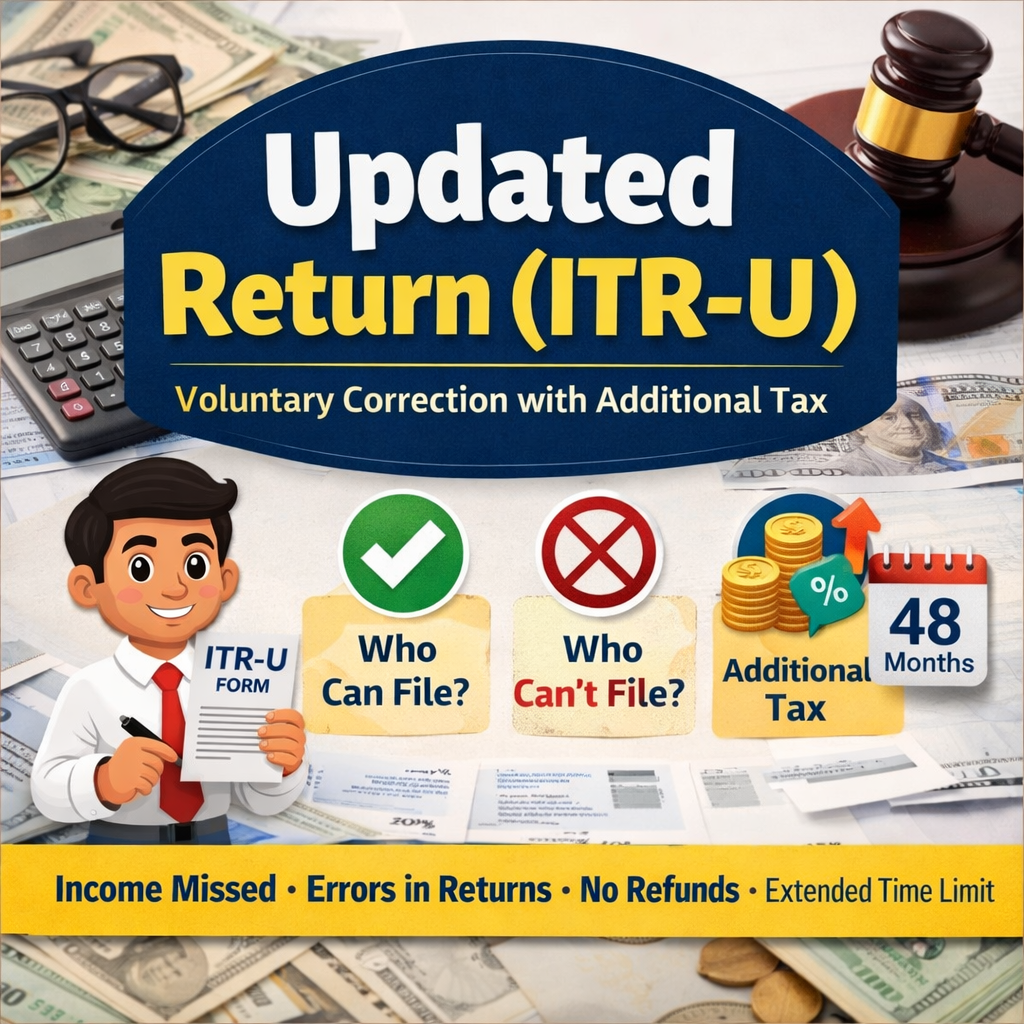
✅ Who is Eligible to File ITR-U? You may file an Updated Return if you need to: Report missed or under-reported income Correct wrong income details Amend an incorrect tax rate Reduce excess loss or depreciation claimed Update wrong deductions or exemptions File a return even if no return was filed earlier

Income-tax law ke andar voluntary compliance ko badhava dene ke liye Updated Return (ITR-U) ka concept laya gaya hai. Iska main objective ye hai ki agar kisi taxpayer se return file karte samay koi income reh gayi ho, galat details report ho gayi ho, ya return file hi nahi hui ho, to wo apni galti khud se sudhaar sake — bas shart ye hai ki uske saath due tax, interest aur additional tax ka payment kiya jaye.

Recent amendments ke baad ITR-U ki time limit aur additional tax structure dono me kaafi bade badlav kiye gaye hain. Is article me updated provisions ko simple language me samjhaya gaya hai.


ITR-U kya hota hai?

ITR-U (Updated Income-tax Return) ek special return hai jo Income-tax Act ke Section 139(8A) ke tahat file ki jaati hai. Ye tab file hoti hai jab:

  • Pehle file ki hui return me koi income disclose nahi hui ho

  • Income ya details galat report hui ho

  • Taxpayer ne pehle koi return file hi nahi ki ho

👉 Lekin dhyaan rahe, ITR-U sirf tab allowed hai jab usse extra tax payable banta ho.


Kaun ITR-U file kar sakta hai?

Neeche diye gaye taxpayers ITR-U file kar sakte hain:

  • Individual

  • HUF

  • Firm

  • Company

  • AOP / BOI

  • Trust ya anya entities

Aap ITR-U file kar sakte hain agar:

  • Aapne pehle original / belated / revised return file ki ho

  • Ya pehle return file nahi ki ho, lekin ab income disclose karne par tax payable ho raha ho

🔔 Important condition:
Updated return file karne ke baad tax liability increase honi chahiye. Agar tax nil ho ya refund ban raha ho, to ITR-U file nahi ki ja sakti.


Kaun ITR-U file nahi kar sakta?

Nimn situations me ITR-U file karna allowed nahi hai:

  • Agar updated return se:

    • Refund mil raha ho, ya

    • Pehle se due refund ki amount badh rahi ho

  • Agar updated return se:

    • Total tax liability kam ho rahi ho

  • Agar us assessment year ke liye:

    • Search u/s 132

    • Survey (specified cases)

    • Requisition u/s 132A
      jaise proceedings start ho chuki ho

  • Agar taxpayer:

    • Carry forward loss ko increase karna chahta ho
      (loss sirf reduce kiya ja sakta hai, badhaya nahi)


ITR-U file karne ki time limit (Updated Provision)

Purana rule:
ITR-U sirf 24 months ke andar file ki ja sakti thi.

Naya rule (1 April 2025 se effective):
Ab ITR-U 48 months (4 saal) tak file ki ja sakti hai, relevant assessment year ke end se.

Example:

  • Assessment Year: 2024-25

  • AY ka end: 31 March 2025

  • ITR-U ki last date: 31 March 2029

👉 Is extension ka purpose ye hai ki taxpayers ko zyada samay mile voluntarily income disclose karne ke liye.


ITR-U par Additional Tax (Section 140B)

ITR-U file karte waqt taxpayer ko ye payments karni hoti hain:

  • Applicable Income Tax

  • Interest (Section 234A / 234B / 234C, jo bhi apply ho)

  • Additional Income-tax

Additional tax ka calculation Tax + Interest ke total amount par hota hai.


Additional Tax Rates – Updated Structure

ITR-U Filing Period Additional Tax
12 months ke andar 25%
12–24 months 50%
24–36 months 60%
36–48 months 70%

Delay jitna zyada, additional tax utna hi zyada — isliye early compliance financially faydemand hai.


Simple Example

Maan lijiye:

  • Additional tax payable: ₹1,00,000

  • Interest: ₹10,000

  • Total (Tax + Interest): ₹1,10,000

12 months ke andar filing:

  • Additional tax @25% = ₹27,500

  • Total payable = ₹1,37,500

3rd year me filing (24–36 months):

  • Additional tax @60% = ₹66,000

  • Total payable = ₹1,76,000


Important Practical Points

  • ITR-U ka use refund claim ke liye nahi ho sakta

  • Ye facility sirf voluntary disclosure ke liye hai

  • Interest calculation me chhoti si galti additional tax ko bhi badha sakti hai

  • Har assessment year ke liye sirf ek baar ITR-U file ki ja sakti hai

  • Hamesha correct ITR-U form aur latest utility ka hi use karein