When Will the 57th GST Council Meeting Be Held? Date Announced

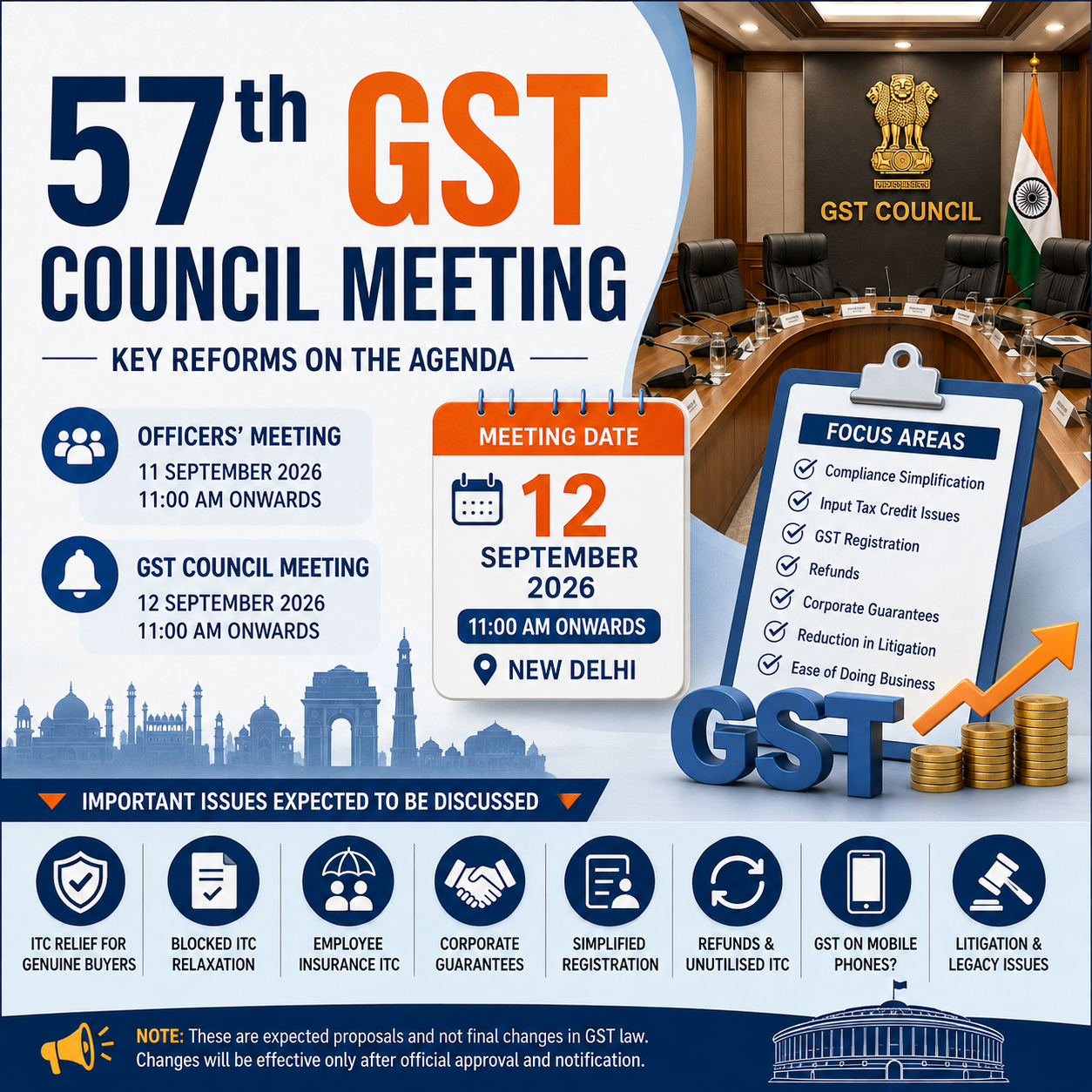
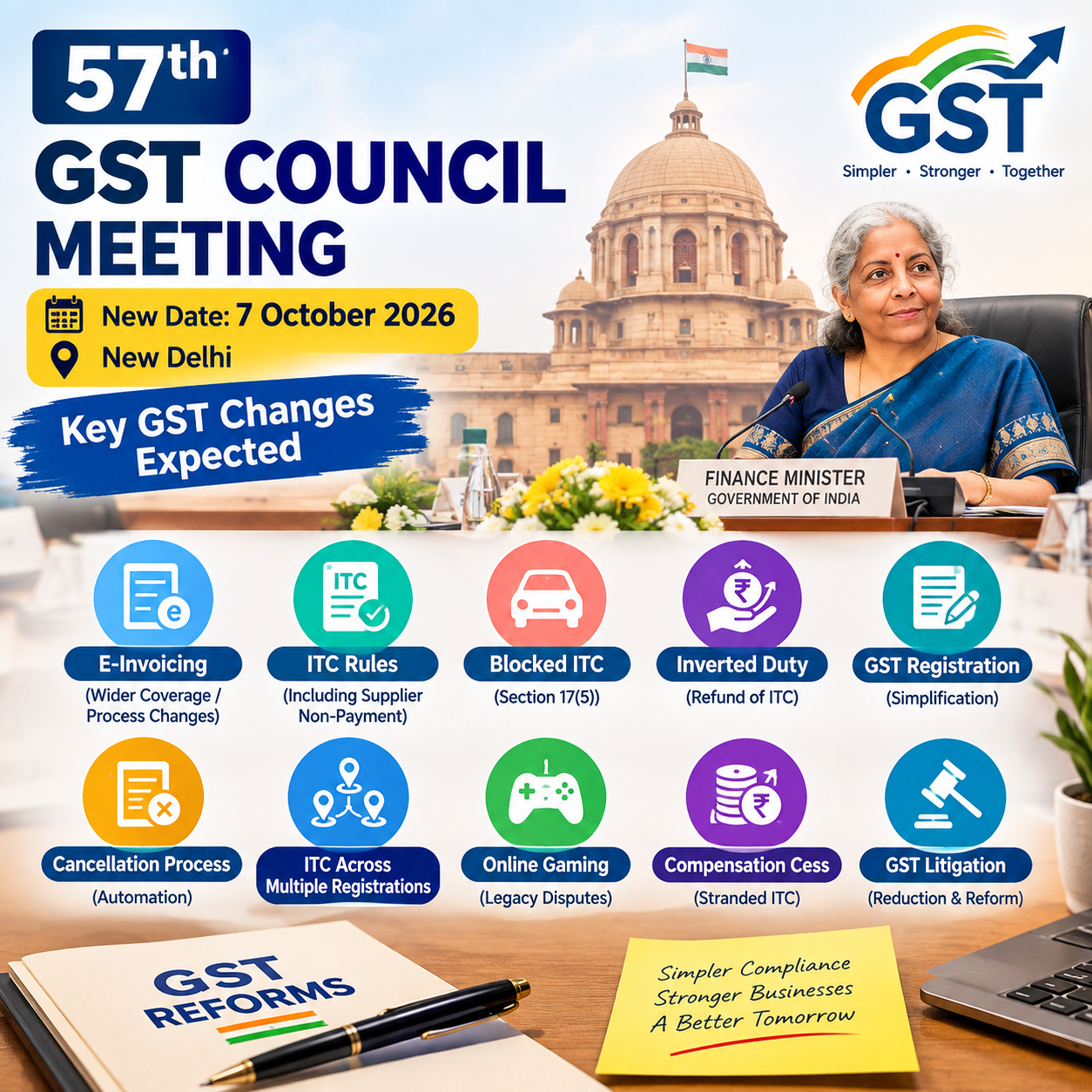
The 57th GST Council Meeting is scheduled to take place on 12 September 2026 in New Delhi. The meeting is likely to address several significant GST-related matters, including GST compliance, Input Tax Credit (ITC), GST registration, refunds, corporate guarantees, and other concerns raised by various industries.

As per the official notice issued by the GST Council Secretariat, the 57th GST Council Meeting will be held on Saturday, 12 September 2026, from 11:00 AM onwards. Prior to this meeting, an Officers’ Meeting is scheduled to be held on 11 September 2026 from 11:00 AM onwards.

The detailed agenda for the meeting has not yet been officially announced. Therefore, the topics mentioned in this article are based on issues that are reportedly being considered, industry representations, and recent developments. These should not be considered final GST changes unless they are formally approved by the GST Council and subsequently implemented through the necessary notification, rule amendment, or other legal procedure.

57th GST Council Meeting: Key Dates

Particulars Details
GST Council Meeting 57th GST Council Meeting
Date 12 September 2026
Time 11:00 AM onwards
Venue New Delhi
Officers’ Meeting 11 September 2026
Officers’ Meeting Time 11:00 AM onwards

The previous 56th GST Council Meeting was held on 3 and 4 September 2025.

Since there has been a considerable gap between the 56th and 57th meetings, the upcoming GST Council Meeting is expected to be particularly important for businesses, tax professionals and GST taxpayers.


Why Is the 57th GST Council Meeting Significant?

The 56th GST Council Meeting led to major GST rate rationalisation and several significant reforms.

The upcoming phase of GST reforms is expected to concentrate on areas such as:

  • Simplifying GST compliance requirements
  • Reducing GST-related litigation
  • Resolving Input Tax Credit (ITC) issues
  • Improving the GST registration process
  • Strengthening the refund mechanism
  • Promoting ease of doing business
  • Providing clarity on complex GST provisions
  • Addressing transitional issues resulting from previous GST changes

Several matters have remained pending before the GST authorities, while industry stakeholders have also submitted representations seeking clarification and relief.

Therefore, the 57th GST Council Meeting may result in important developments affecting businesses and taxpayers.


1. Possible Relief for Genuine Buyers When Suppliers Fail to Pay GST

One of the key issues that may be considered relates to Input Tax Credit (ITC) in cases where a supplier collects GST from the buyer but subsequently fails to deposit the tax with the Government.

What Is the Existing Issue?

Consider the following example:

A purchases goods worth ₹10 lakh from B.

B issues a valid GST invoice and charges the applicable GST.

A:

  • receives the goods;
  • pays B for the purchase;
  • records the transaction in its books of accounts;
  • receives the invoice details through the GST system; and
  • claims eligible ITC.

However, B later fails to deposit the GST collected from A with the Government.

In such situations, A may face ITC reversal or a GST demand, despite having entered into a genuine transaction and fulfilled all the compliance requirements that were within its control.

This has remained a significant and long-standing concern under the GST system.

What Relief Could Be Considered?

A proposal is reportedly under consideration to provide greater protection to genuine and bona fide purchasers.

Under the proposed approach, a buyer may receive protection where it can demonstrate that:

  • the transaction was genuine;
  • the goods or services were actually received;
  • payment was made to the supplier;
  • the GST amount was paid to the supplier; and
  • proper supporting documents and evidence are available.

The objective could be to place the primary responsibility for tax recovery on the defaulting supplier, especially in cases where the buyer has not engaged in fraud, collusion or any fake transaction.

Important

This is currently an expected or proposed reform and should not be treated as a final amendment to GST law.

If such a proposal is approved, the final rules, conditions, documentation requirements and safeguards will be crucial.


2. Possible Changes in Blocked ITC Under Section 17(5)

Another important matter that may receive attention is blocked Input Tax Credit under Section 17(5) of the CGST Act.

Currently, ITC is restricted on various categories of goods and services, subject to certain specified exceptions.

Some of these categories include:

  • Motor vehicles
  • Food and beverages
  • Outdoor catering services
  • Beauty treatment
  • Health-related services
  • Club memberships
  • Certain travel-related benefits
  • Works contract services and construction-related expenses in specified cases

Businesses have been seeking relaxation of some of these restrictions, particularly in situations where the expenditure has a direct connection with business operations.

The GST Council may consider whether certain existing ITC restrictions should be reviewed or rationalised.

However, taxpayers should not claim ITC that is currently blocked merely because changes are expected.

The existing legal provisions will continue to apply unless and until any amendment is formally introduced and becomes legally effective.


3. ITC on Health and Life Insurance Provided to Employees

Employee-related insurance may also be among the issues considered by the GST Council.

Many companies provide their employees with benefits such as:

  • Group health insurance
  • Group medical insurance
  • Group life insurance
  • Other employee welfare-related benefits

The availability of ITC on such expenses depends on the nature of the expenditure and the relevant provisions of Section 17(5), including any applicable exceptions.

Industry stakeholders have been seeking greater clarity and, in certain cases, relaxation from ITC restrictions relating to employee insurance.

If the Council approves any changes in this area, it could provide significant benefits to organisations with a large workforce and substantial employee insurance expenditure.

However, as with other expected reforms, the final conditions and legal provisions will be important.

4. Corporate Guarantees: Possible Simplification of GST Provisions

The GST treatment of corporate guarantees provided between related parties has become an important area of concern for many companies.

Under the current GST framework, specific valuation rules apply where a corporate guarantee is provided to a banking company or financial institution on behalf of a related party.

The prescribed deemed valuation mechanism has led to significant debate and, in some cases, GST litigation.

For instance, the existing provisions may result in GST liability even when a corporate guarantee is provided without charging any separate consideration.

What Changes Could Be Expected?

Industry stakeholders have been seeking:

  • Simplified valuation rules;
  • Reduced compliance requirements;
  • Greater certainty regarding the taxable value;
  • Lower unnecessary working-capital burden;
  • Clearer treatment of intra-group transactions.

The 57th GST Council Meeting may consider providing further clarification or simplifying the existing rules relating to corporate guarantees.

Any such development could be particularly important for large corporate groups with parent companies, subsidiaries and other related entities.


5. Possible Simplification of GST Registration

GST registration is another key area where further reforms may be considered.

Although the GST registration system has become increasingly technology-based, businesses may still face challenges due to:

  • Additional verification procedures;
  • Extensive documentation requirements;
  • Physical verification in certain cases;
  • Differences in registration practices;
  • Queries raised by tax authorities; and
  • Delays in obtaining registration approval.

There are reports that the GST Council may consider introducing greater standardisation in the GST registration process.

One of the matters reportedly under consideration involves improving uniformity in the registration process between Central and State tax authorities, particularly for businesses with higher monthly output tax liability.

The overall objective would be to make the GST registration process:

Faster + More Predictable + More Standardised + Less Dependent on Manual Intervention


6. Simplified Multi-State GST Registration for Small Businesses

Businesses that expand their operations across multiple States often face significant GST compliance challenges.

Depending on the nature and structure of their operations, such businesses may be required to obtain and maintain separate GST registrations in different States.

This can result in:

  • Multiple GST return filings;
  • Multiple reconciliations;
  • Separate GST electronic ledgers;
  • Separate compliance obligations;
  • Multiple notices and assessments; and
  • Higher professional and administrative expenses.

A simplified mechanism for small businesses operating across multiple States has reportedly been under consideration.

Such a mechanism, if introduced, could help reduce the overall compliance burden for small businesses while making it easier for them to expand their operations across different States.

If such a reform is introduced, it could substantially reduce the compliance burden for small businesses that are expanding their operations across different geographical locations.

However, the final eligibility conditions and the legal framework of any such scheme will be crucial.


7. Possible Automation of GST Registration Cancellation

Another administrative reform that may be considered is the automation of GST registration cancellation.

Currently, the cancellation process may involve manual intervention, and the procedure can vary depending on the facts and circumstances of each case.

A more automated system could potentially offer:

  • Uniform cancellation procedures;
  • System-driven processing;
  • Faster disposal of cancellation applications;
  • Reduced manual intervention; and
  • Clearer communication with taxpayers.

The GST Council may consider measures to simplify and streamline the existing cancellation process.

For taxpayers who have discontinued their business or are no longer required to remain registered under GST, a simpler and faster cancellation mechanism could help reduce unnecessary compliance requirements.


8. Unutilised ITC Refund and Inverted Duty Structure

The refund of accumulated and unutilised Input Tax Credit (ITC) is another significant issue affecting many businesses.

An inverted duty structure arises when the GST rate applicable to inputs is higher than the GST rate charged on outward supplies.

As a result, businesses may accumulate excess ITC, leading to a blockage of working capital.

Various industries have been seeking improvements and greater clarity in the refund mechanism, particularly regarding:

  • Input services;
  • Accumulated ITC;
  • Refund calculation procedures;
  • Transfer of accumulated credit;
  • Utilisation of unutilised ITC; and
  • Issues arising from an inverted duty structure.

If reforms are introduced in this area, they could provide significant working-capital relief to businesses facing the accumulation of unused ITC.


9. Compensation Cess Credit and Transitional Concerns

Changes in GST rates and the movement away from the earlier compensation cess framework have created several practical and transitional concerns for businesses.

One important issue relates to accumulated compensation cess credit, especially in industries such as the automobile sector.

Businesses holding inventory on which compensation cess had already been paid before changes in the tax structure may face uncertainty regarding the future treatment and utilisation of the accumulated credit.

Industry stakeholders have raised concerns about the possible blockage of substantial amounts of such credit.

The GST Council may therefore examine transitional matters relating to:

  • Existing inventory;
  • Accumulated compensation cess credit;
  • Credit already available in the electronic ledger;
  • Treatment of credit following GST rate changes; and
  • The resulting impact on working capital.

Any clarification or relief in this area could be particularly beneficial for industries significantly affected by these transitional issues.


10. Mobile Phones: Could GST Be Reduced From 18% to 5%?

One of the more widely discussed issues ahead of the GST Council Meeting concerns the GST rate applicable to mobile phones.

Currently, mobile phones are subject to 18% GST.

There have been reports suggesting that the GST Council may consider reducing the GST rate on certain categories of mobile phones.

Some reports have specifically referred to a possible proposal for 5% GST on mobile phones priced up to ₹25,000.

If such a proposal is approved, it could potentially benefit consumers and provide support to the smartphone and electronics industry.

Has 5% GST on Mobile Phones Been Confirmed?

No.

At present, this remains only a reported proposal or possibility and has not been confirmed as a final decision.

Therefore, consumers and taxpayers should not assume that:

“Mobile phones priced up to ₹25,000 now attract only 5% GST.”

The existing GST rate will remain applicable unless and until an official decision is taken and the required notification is issued.

Any final decision would also need to clarify:

  • The applicable price threshold;
  • Product classification;
  • Effective date of the revised rate;
  • Treatment of existing inventory; and
  • Related Input Tax Credit implications.

11. Will There Be Another Reduction in GST Rates?

Following the major GST rate rationalisation carried out during the 56th GST Council Meeting, there is considerable interest in whether the 57th meeting will introduce another round of GST rate cuts.

At present, there is no officially confirmed list of GST rate reductions for the 57th GST Council Meeting.

Therefore, claims on social media regarding specific products becoming cheaper should be viewed with caution.

The 56th GST Council Meeting had already introduced significant changes to the GST rate structure, including a broad 5% and 18% rate framework along with a special higher rate for specified goods.

As a result, the 57th meeting may focus more on areas such as:

  • Input Tax Credit;
  • GST compliance;
  • Registration;
  • Refund mechanisms;
  • Litigation;
  • Administrative reforms and simplification.

Therefore, the meeting may focus more on improving the GST system rather than introducing another broad-based restructuring of GST rates.


12. GST Litigation and Pending Legacy Issues

GST-related litigation continues to be a major challenge for businesses and taxpayers.

Disputes can arise because of:

  • Different interpretations of GST provisions;
  • Procedural and compliance-related issues;
  • Defaults by suppliers;
  • Input Tax Credit disputes;
  • Transitional matters;
  • Valuation-related disagreements; and
  • Classification disputes.

The GST Council may consider steps to reduce avoidable litigation and provide greater clarity and certainty to taxpayers.

A simpler GST framework, supported by clear rules and practical guidance, can help reduce disputes and lower the overall compliance cost for businesses.

13. GST Treatment of App-Based Passenger Transport Services

Another area that may require additional clarification is the GST treatment of app-based passenger transportation services.

With the increasing use of digital platforms and the emergence of different business models, several GST-related questions may arise, including:

  • Who is responsible for paying GST?
  • Whether the provisions of Section 9(5) are applicable;
  • Whether the GST liability falls on the platform or the actual service provider;
  • Registration requirements; and
  • Various compliance obligations.

Further clarification from the GST authorities could help provide greater certainty to both technology-based platforms and passenger transport service providers.


14. Petroleum Products Under GST — Will Petrol and Diesel Be Included?

Petroleum products currently remain outside the main GST framework.

From time to time, discussions have taken place regarding the possible inclusion of certain petroleum products under GST, including:

  • Petrol;
  • Diesel;
  • Aviation Turbine Fuel (ATF); and
  • Natural Gas.

However, there is currently no officially confirmed decision that petrol or diesel will be brought under GST from September 2026.

Any decision to include these products under GST would require extensive discussions, particularly because State Governments receive substantial revenue from taxes on petroleum products.

Therefore, claims suggesting that petrol and diesel will definitely be brought under GST during the upcoming GST Council Meeting should not be considered confirmed.


Conclusion

The 57th GST Council Meeting scheduled for 12 September 2026 could be an important step in the next phase of GST reforms.

While the previous GST Council Meeting focused significantly on GST rate rationalisation, the upcoming meeting is expected to give considerable attention to simplifying GST compliance, resolving Input Tax Credit issues, improving GST registration, streamlining refunds, clarifying corporate guarantee provisions and reducing litigation.

Some of the key issues to watch include:

  • Protection of ITC for genuine buyers
  • Possible relaxation of blocked ITC under Section 17(5)
  • ITC relating to employee insurance
  • GST treatment of corporate guarantees
  • Simplification of GST registration
  • Multi-State GST registration for businesses
  • Automation of GST registration cancellation
  • Refund of accumulated and unutilised ITC
  • Transitional issues relating to compensation cess
  • Possible reduction in GST on mobile phones
  • GST litigation and pending legacy issues

However, taxpayers should keep in mind that reported or expected proposals do not become law unless they are formally approved and legally implemented.

The final GST position can be determined only after the GST Council makes its decisions and the required notification, circular, rule amendment or statutory amendment is issued.

Until any changes are officially implemented, businesses and taxpayers should continue to comply with the existing GST provisions.

This article will be updated once the official agenda is released and again after the 57th GST Council Meeting to cover the final decisions, applicable effective dates and their practical impact on taxpayers.

Supreme Court Safeguards GST ITC Rights of Genuine Purchasers

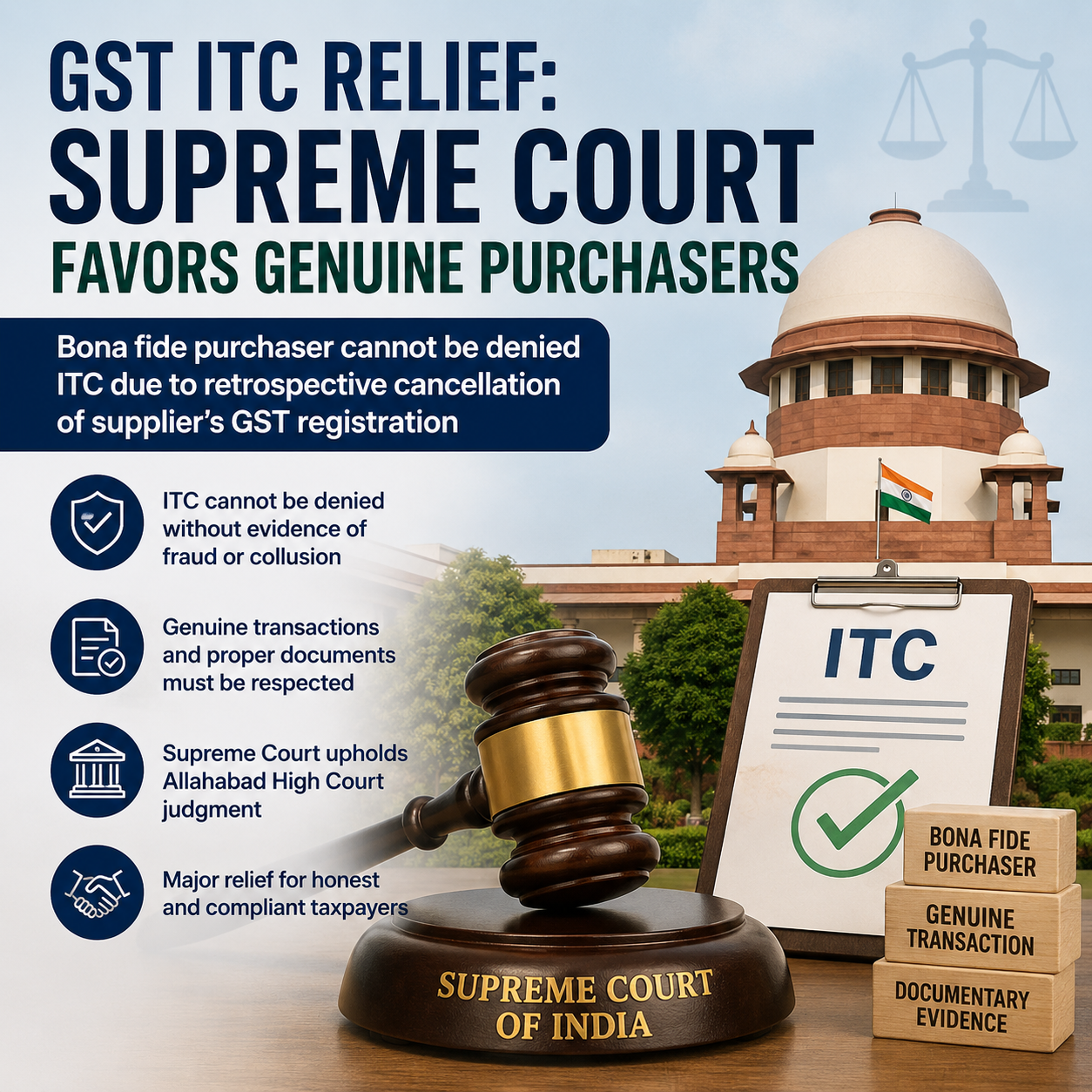
The Supreme Court has provided major relief to genuine taxpayers by dismissing the Revenue’s Special Leave Petition (SLP) in Additional Commissioner Grade 2 & Anr. v. M/s Safecon Lifescience Private Limited [SLP (C) No. 23993 of 2026, Order dated 17 July 2026]. As a result, the judgment of the Allahabad High Court continues to hold the field and reinforces a crucial principle under GST law.

A genuine purchaser cannot be denied Input Tax Credit (ITC solely because the supplier’s GST registration was cancelled with retrospective effect. Such denial can be justified only where fraud, deliberate misrepresentation, or suppression of material facts is established on the part of the recipient.

The decision is expected to bring significant relief and clarity to honest businesses that face ITC disputes because of subsequent action taken against their suppliers, even after legitimate transactions have already been completed.

Background of the Case

M/s Safecon Lifescience Private Limited was involved in the wholesale trading and manufacturing of pharmaceutical products. During April 2021, the company purchased medicines from a supplier who was registered under GST.

At the time of the transactions:

  • The supplier held a valid GST registration.
  • Proper tax invoices were issued.
  • E-way bills and transportation records were maintained.
  • The goods were actually delivered and received.
  • Payments were made through banking channels.
  • The supplier filed the applicable GST returns.

Later, the GST Department received intelligence regarding alleged irregularities in the supplier’s business activities. Proceedings were subsequently initiated under Section 74 of the UPGST Act against Safecon Lifescience.

The Department denied the company’s ITC mainly on the ground that the supplier’s GST registration was later cancelled and that certain irregularities were allegedly found in the supplier’s upstream transactions.

Issue Before the Court

The key legal question before the Court was:

Can a genuine purchaser be denied Input Tax Credit merely because the supplier’s GST registration was subsequently cancelled retrospectively or because the supplier was allegedly involved in certain irregularities, despite the purchaser having undertaken a genuine transaction and fulfilled the necessary conditions for claiming ITC?

Allahabad High Court’s Findings

The Allahabad High Court ruled in favour of the taxpayer and set aside the GST demand.

The Court noted that:

  • The purchaser had submitted sufficient documentary evidence to establish that the transactions were genuine.
  • The Department was unable to disprove the actual movement and delivery of the goods or the payments made through banking channels.
  • There was no specific finding that the recipient had engaged in fraud, wilful misstatement, or suppression of material facts.
  • Proceedings under Section 74 cannot be based solely on suspicion or unverified information.
  • Information received from another authority must be independently examined and verified before being used against a taxpayer.

Supreme Court’s Ruling

The Revenue subsequently challenged the Allahabad High Court’s decision before the Supreme Court.

The Supreme Court, however, declined to interfere with the High Court’s order and dismissed the Revenue’s SLP, finding no sufficient ground to entertain the petition.

While the Supreme Court’s order was brief, its effect is significant. The Allahabad High Court’s decision remains undisturbed, thereby strengthening the legal protection available to genuine purchasers claiming ITC.

Key Legal Principle Emerging from the Decision

The ruling reinforces the principle that a recipient should not automatically lose Input Tax Credit merely because:

  • The supplier’s GST registration was cancelled retrospectively;
  • The supplier later failed to comply with GST requirements; or
  • Allegations of irregularities were subsequently raised against the supplier.

The recipient should remain protected where the transaction was genuine, the recipient acted in good faith, and there is no evidence of fraud, collusion, or deliberate wrongdoing on the recipient’s part.

Documents Businesses Should Maintain

The case also underlines the importance of maintaining complete and reliable transaction records.

Businesses should preserve documents such as:

  • Valid GST tax invoices;
  • E-way bills;
  • Transport documents and lorry receipts;
  • Proof confirming actual receipt of goods;
  • Bank statements and payment records;
  • Purchase registers and related accounting records;
  • GST return records; and
  • Vendor verification and due diligence documents.

Maintaining proper documentation can significantly strengthen a taxpayer’s defence during GST scrutiny, audit, or litigation.

Practical Impact on Businesses

The decision offers considerable relief to businesses that have genuinely purchased goods from registered suppliers and complied with the applicable GST requirements.

However, the ruling should not be understood as providing unconditional protection in every ITC dispute.

The benefit of the judgment may not be available where the Department is able to establish that:

  • The transaction was fictitious or non-existent;
  • The invoices were fabricated;
  • The goods were never actually supplied; or
  • The recipient knowingly participated in fraudulent activities.

Key Takeaways

  • A genuine purchaser should not ordinarily be penalised for a supplier’s subsequent tax default.
  • Retrospective cancellation of a supplier’s GST registration, by itself, does not automatically justify denial of ITC.
  • Proceedings under Section 74 must be supported by evidence of fraud, wilful misstatement, or suppression of facts attributable to the recipient.
  • Complete and accurate documentation remains one of the strongest safeguards in GST disputes.
  • The Supreme Court’s decision not to interfere provides additional support to taxpayers facing similar ITC-related proceedings.

The Safecon Lifescience decision is a significant development for genuine taxpayers. It reinforces the principle that businesses acting honestly and complying with the statutory requirements should not be punished solely because of subsequent defaults or regulatory action involving their suppliers.

At the same time, taxpayers should continue to conduct reasonable vendor due diligence and maintain proper transaction records. The decision makes it clear that the retrospective cancellation of a supplier’s GST registration, standing alone, cannot be the sole reason for denying ITC where the purchaser has acted bona fide and satisfied the applicable legal requirements.

Big Change Introduced in GST Refund Filing Process

Annexure-B Offline Utility Introduced on GST Portal for Accumulated ITC Refunds

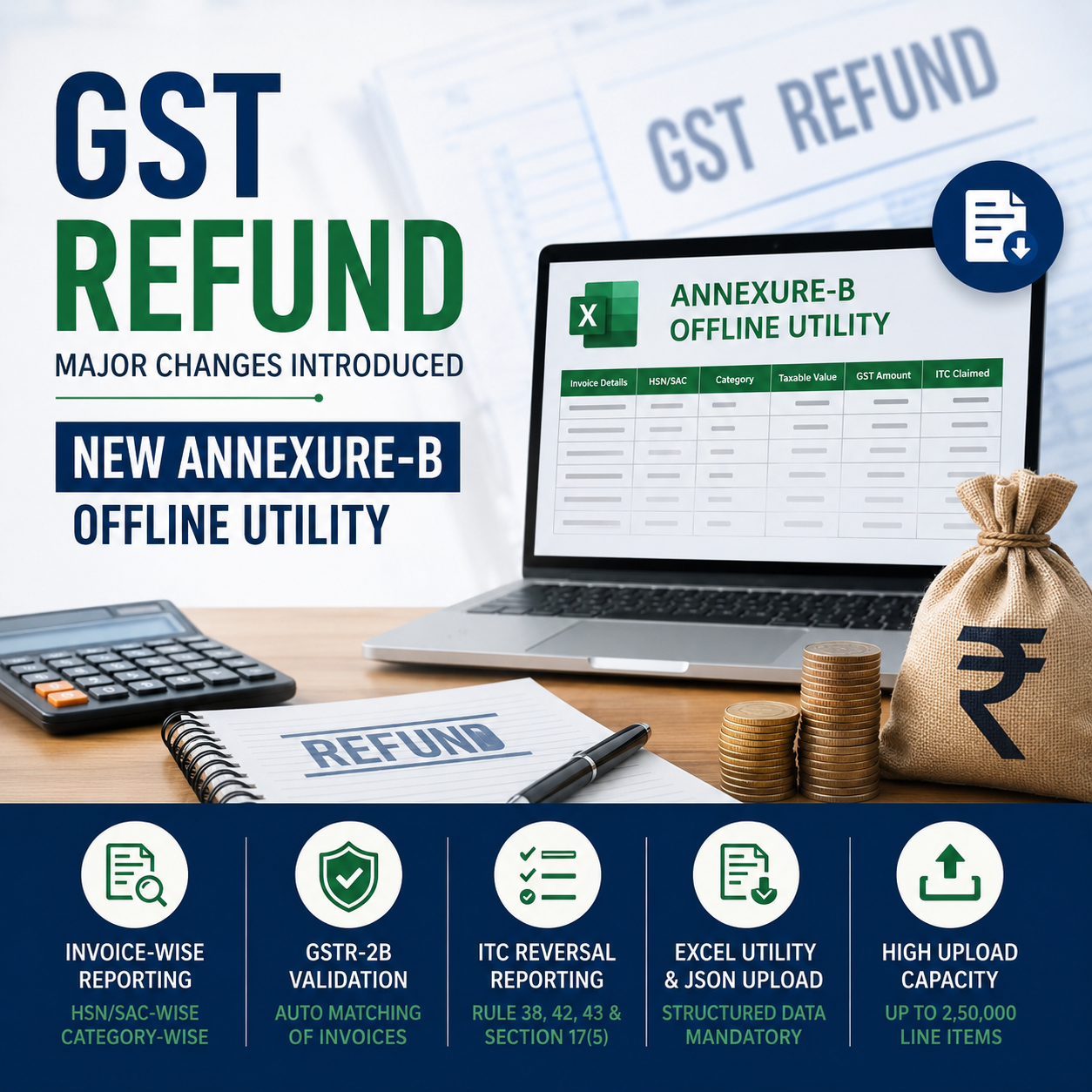
The GST Network (GSTN) has introduced a major change in the refund filing process for taxpayers claiming refund of accumulated Input Tax Credit (ITC). Earlier, taxpayers were uploading Annexure-B in PDF format while filing refund applications under certain refund categories. However, to improve automation, invoice-level verification, and system-based validation, GSTN has now launched a standardized Annexure-B Offline Utility in Excel format.

Going forward, taxpayers filing refund claims involving accumulated ITC will be required to furnish Annexure-B only through this prescribed offline utility. This update aims to bring uniformity in refund applications and enable validation of invoices directly with GSTR-2B data.

This is an important compliance change for exporters, SEZ suppliers, inverted duty structure claimants, and electricity exporters.

Refund Categories Where Annexure-B Utility is Mandatory
The new Annexure-B Offline Utility is applicable for the following refund categories:

Refund Category
Export of Goods/Services without payment of tax (Accumulated ITC)
Supplies made to SEZ Unit/SEZ Developer without payment of tax
Refund due to Inverted Tax Structure under Section 54(3)
Export of Electricity without payment of tax
Taxpayers filing refund claims under these categories must now upload Annexure-B through the

offline utility instead of PDF attachments.

What is the New Annexure-B Offline Utility?
GSTN has introduced an Excel-based offline utility where taxpayers are required to report invoice-wise inward supply details for which refund is claimed.

The utility requires detailed reporting:

HSN/SAC-wise
Category-wise
Invoice-wise
Tax amount-wise
Invoices must be bifurcated according to:

Inputs
Input Services
Capital Goods
This means a single invoice may now need to be split into multiple line items if it contains different HSN/SAC codes or different categories of inward supplies.

The utility also captures:

taxable value,
GST amount,
ITC reversal details,
blocked ITC under Section 17(5),
and Net ITC calculations.
Structure of the Annexure-B Utility
The utility contains two important tables:

Table 1 – Reversal Details
This table captures:

Rule 38 reversals,
Rule 42 reversals,
Rule 43 reversals,
Section 17(5) blocked credit,
and other reversals reported in GSTR-3B.
Table 2 – HSN/SAC-wise Inward Invoice Details
This table captures:

invoice-wise inward supplies,

HSN/SAC details,
tax values,
category of supplies,
and ITC claimed in GSTR-3B.
Major Compliance Change: Invoice Splitting Requirement
One of the biggest practical changes introduced through this utility is mandatory splitting of invoices.

If one invoice contains:

multiple HSN/SAC codes,
multiple supply categories,
or both,
then taxpayers must split the invoice into separate line items.

For example:
A single invoice containing:

Inputs,
Input Services,
and Capital Goods
cannot be reported in one consolidated row anymore.

Each line item should represent:

one HSN/SAC code,
and one category of inward supply.
The taxable value and tax amount must also be proportionately allocated.

This change may significantly increase data preparation work for taxpayers and consultants.

Duplicate Invoice Validation Introduced
GSTN has now introduced duplicate validation checks.

The system will validate invoices based on:

Supplier GSTIN

Invoice Number
Invoice Date
Category of Input Supply
HSN/SAC
If all these parameters are identical, only one line item will be accepted.

Multiple entries under the same parameters will trigger validation errors.

Therefore, taxpayers must carefully prepare invoice data before generating JSON.

GSTR-2B Validation Introduced
One of the most important changes is automatic validation of uploaded invoices with GSTR-2B.

After uploading the Annexure-B JSON file:

invoices will be matched with GSTR-2B,
valid invoices will appear in “Valid Documents” report,
mismatches will appear in “Invalid Documents” report.
This system-driven validation will significantly impact refund processing.

Special Relaxation for Old Period Invoices
GSTN has clarified an important relief for old invoices.

For invoices pertaining to:

October 2024 or earlier periods,
the portal will not validate them with GSTR-2B.

Although such invoices may display a generic “not validated” message, taxpayers can still proceed with refund filing.

This will not be treated as an error.

However, for invoices from:

November 2024 onwards,
full validation with GSTR-2B will apply.

Reporting of ITC Reversals
Taxpayers must correctly report ITC reversals while preparing Annexure-B.

The utility requires disclosure of:

Rule 38 reversals,
Rule 42 reversals,
Rule 43 reversals,
blocked credit under Section 17(5),
and other reversals reported in Table 4(B)(2) of GSTR-3B.
GSTN has also clarified that if multiple utility files are uploaded:

reversal values should be entered only in the final file,
previous files should contain reversal amount as zero.
The portal will then calculate consolidated Net ITC automatically.

Huge Upload Capacity Allowed
GSTN has allowed substantial upload limits in the utility.

Particulars Limit
Maximum entries in one utility file 10,000
Maximum utility files uploadable 25
Total line items allowed 2,50,000
If invoices exceed this limit:

remaining invoices can be submitted in PDF format as supporting documents.
This is especially important for exporters and large taxpayers having massive invoice volumes.

Important Technical Instructions Issued by GSTN
GSTN has issued several technical precautions for taxpayers:

  1. Avoid Extra Spaces
    Leading or trailing spaces may cause:

validation failures,
JSON errors,
upload issues.
2. Do Not Modify JSON Directly
Once JSON is generated:

taxpayers should not edit it manually.
Any modification should be made only in the Excel utility followed by fresh JSON generation.

  1. Do Not Rename JSON File
    Changing the JSON filename may create upload failures.
  2. Use Correct Dropdown Values
    Copy-paste functionality is enabled, but dropdown values must exactly match prescribed values.

Even small deviations can trigger errors.

  1. Close Old Utility Versions
    GSTN has advised users to completely close older versions of the utility before using the latest version to avoid processing problems.

Practical Impact on Taxpayers and Consultants
This change will significantly impact refund filing procedures.

Earlier:

taxpayers simply uploaded Annexure-B PDFs.
Now:

invoice-level structured reporting is mandatory,
HSN-wise bifurcation is required,
GSTR-2B validation applies,
JSON generation becomes compulsory,
and reconciliation work will increase substantially.
Tax professionals handling refund claims must now:

maintain proper invoice mapping,
reconcile GSTR-2B carefully,
track reversals accurately,
and prepare structured refund working papers.
Key Benefits of the New Utility
Despite increased compliance workload, the utility offers several long-term benefits:

✅ Faster system-based verification
✅ Reduction in manual scrutiny
✅ Standardized refund filing
✅ Better invoice reconciliation
✅ Improved transparency
✅ Faster processing of genuine refunds

Conclusion
The introduction of the Annexure-B Offline Utility marks a major step towards automation of GST refund processing. Taxpayers claiming refund of accumulated ITC must now shift from PDF-based Annexure-B filing to structured invoice-level reporting through the prescribed Excel utility.

This change will require:

stronger reconciliation processes,
better invoice management,
proper HSN/SAC mapping,
and accurate GSTR-2B matching.
Exporters, SEZ suppliers, and inverted duty refund claimants should immediately familiarize themselves with the new utility to avoid validation failures and refund delays.

Since invoice-level verification is now system-driven, accurate reporting will become the key factor for smooth GST refund processing in 2026.

GST Latest Update: IMS Offline Tool Comes into Effect

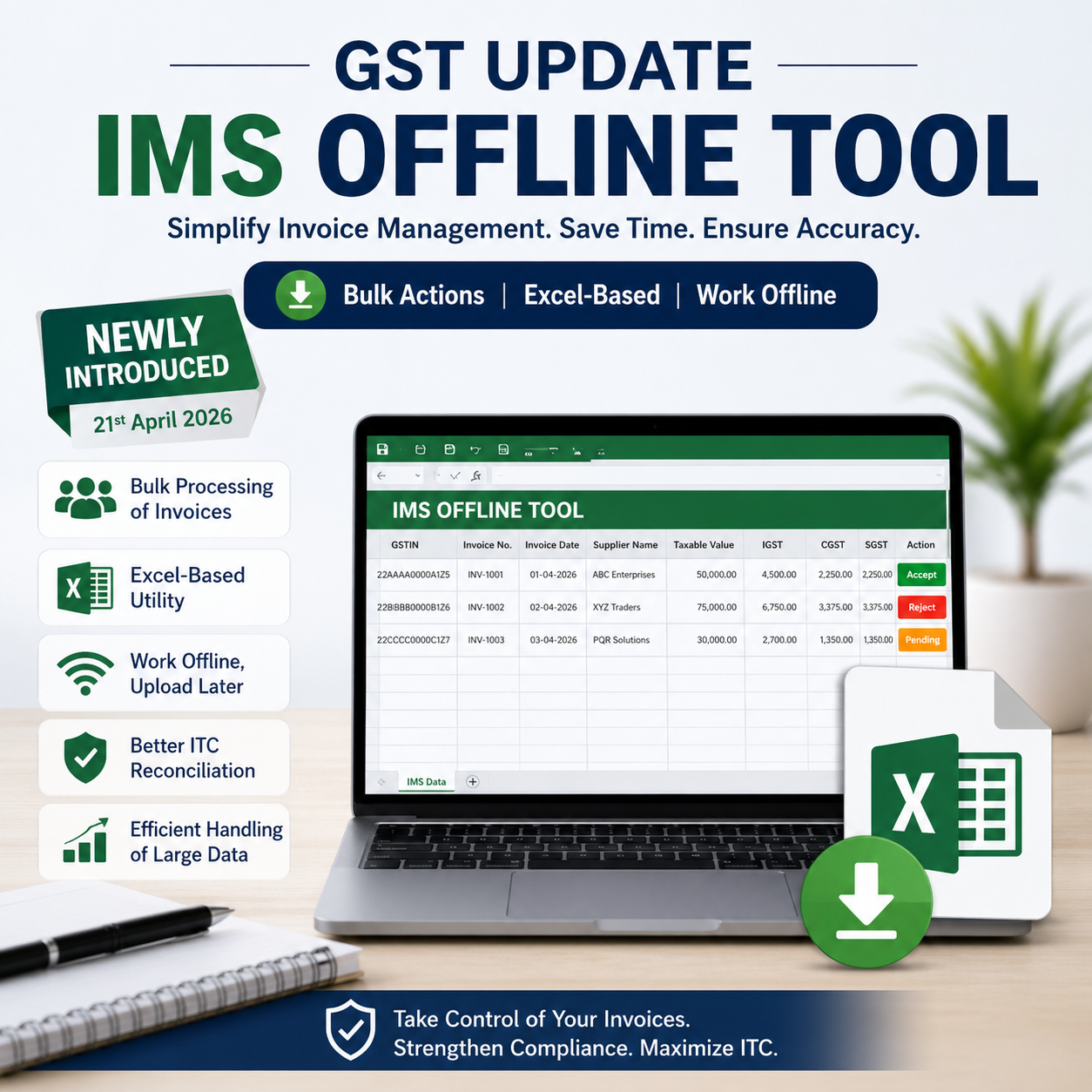
In a major move to enhance GST compliance efficiency, the GST Network (GSTN) rolled out the IMS (Invoice Management System) Offline Tool on 21st April 2026. This initiative is designed to simplify invoice-level activities for taxpayers and improve the reconciliation process.

Background – What is IMS?

The Invoice Management System (IMS) was introduced on the GST portal starting from the October 2024 tax period. Its key objective is to provide taxpayers with greater control over their inward supplies (purchase invoices) reflected in the system.

Under IMS, taxpayers can review and take appropriate action on invoices uploaded by suppliers through:

  • GSTR-1
  • GSTR-1A
  • IFF (Invoice Furnishing Facility)

Available Actions in IMS include:
✔️ Accept invoice
❌ Reject invoice
⏳ Keep invoice pending

This system plays a vital role in Input Tax Credit (ITC) reconciliation by ensuring that ITC is claimed only on valid and verified invoices, thereby improving overall compliance accuracy.

What’s New? – IMS Offline Tool

To enhance usability and address practical challenges faced by taxpayers, the GST Network (GSTN) has introduced the IMS Offline Tool.

📌 Key Highlight:
👉 Excel-based utility (MS Excel format)
👉 Designed for ease of use and bulk processing


🎯 Key Features of IMS Offline Tool

1️⃣ Bulk Processing of Invoices

Previously, taxpayers were required to take action on invoices individually through the GST portal.

Now:
👉 Download invoice data
👉 Take action in bulk (Accept / Reject / Pending)
👉 Upload the updated file back to the portal

📌 This is a significant time-saving feature, especially for:

  • Large businesses
  • Professionals managing multiple clients

2️⃣ Excel-Based Utility (User-Friendly)

The tool is built on MS Excel, making it:

  • Easy to understand
  • Familiar for accountants and tax professionals
  • Usable without advanced technical knowledge

3️⃣ Offline Working Capability

👉 No need for continuous internet access

You can:

  • Work offline
  • Review invoices carefully
  • Upload once the process is complete

📌 This helps reduce:

  • Dependency on the GST portal
  • Last-minute filing stress

4️⃣ Improved ITC Reconciliation

While IMS already supports ITC validation, the offline tool further enhances the process.

👉 Reconciliation becomes:

  • Faster
  • More accurate
  • Less prone to errors

5️⃣ Efficient Handling of Large Data

For taxpayers dealing with high volumes of invoices:

👉 The tool ensures:

  • Smooth data handling
  • Reduced issues related to portal lag

⚠️ Important Points to Note

  • The IMS Offline Tool is optional but highly recommended
  • Final upload must be completed on the GST portal
  • Careful review before uploading is essential
  • Incorrect actions may impact ITC eligibility
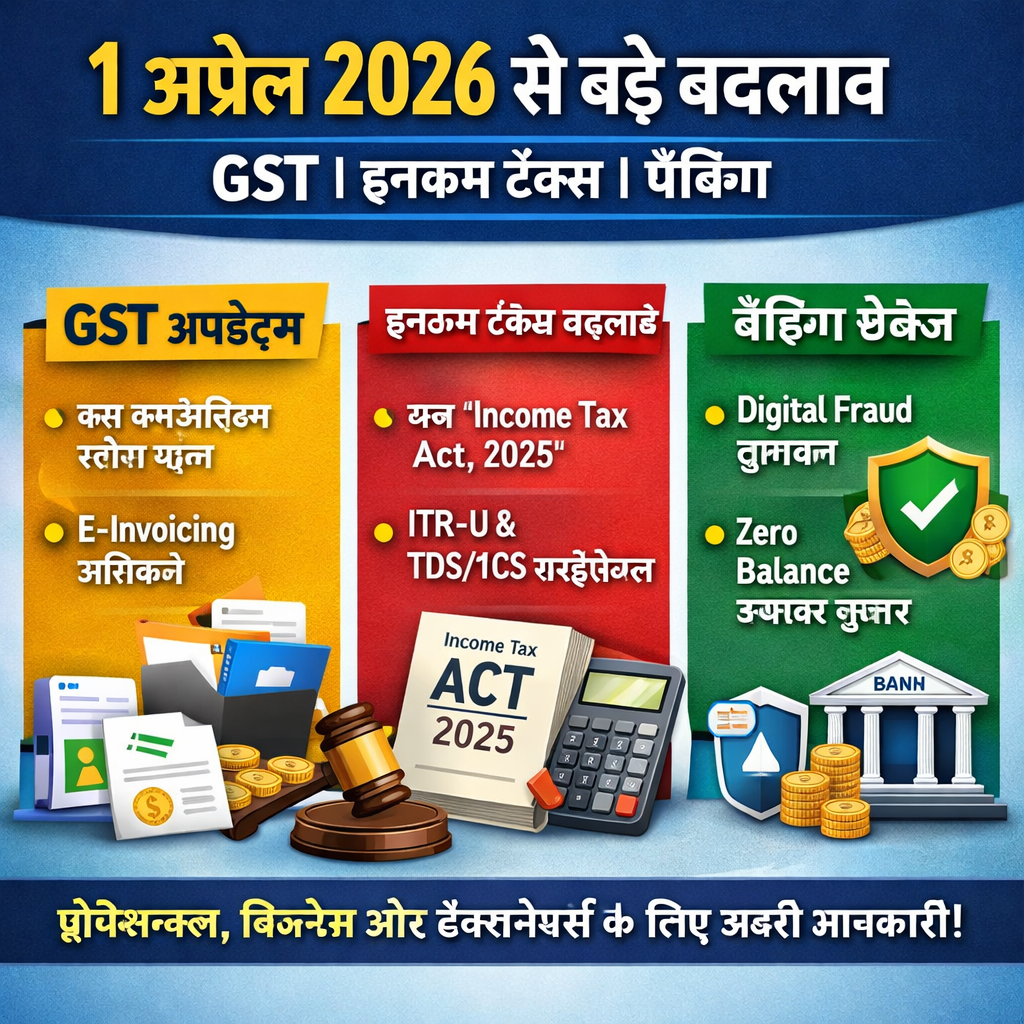
1 अप्रैल 2026 से टैक्स सिस्टम में परिवर्तन | जानें प्रमुख बदलाव

1 अप्रैल 2026 से लागू बड़े बदलाव | GST और इनकम टैक्स अपडेट

यह आर्टिकल 1 अप्रैल 2026 से लागू होने वाले सभी महत्वपूर्ण बदलावों को कवर करता है — प्रोफेशनल्स, बिज़नेस और टैक्सपेयर्स के लिए एक कम्प्लीट गाइड।


🟡 PART 1: GST में 1 अप्रैल 2026 से बदलाव

🔸 1. कंपोज़िशन स्कीम की डेडलाइन खत्म

31 मार्च 2026 अंतिम तिथि थी।
👉 1 अप्रैल के बाद:

  • नया ऑप्शन अब उपलब्ध नहीं
  • अगला मौका अगले वित्त वर्ष में ही मिलेगा

🔸 2. LUT (Letter of Undertaking) जरूरी

FY 2026-27 के लिए नया LUT फाइल करना अनिवार्य
👉 अगर फाइल नहीं किया:

  • एक्सपोर्ट टैक्सेबल माना जाएगा
  • GST देना पड़ेगा

⚠️ सलाह: वर्किंग कैपिटल ब्लॉक होने से बचने के लिए तुरंत LUT फाइल करें


🔸 3. GTA फॉरवर्ड चार्ज ऑप्शन बंद

31 मार्च 2026 तक ही विकल्प उपलब्ध था
👉 1 अप्रैल से:

  • डिफॉल्ट = Reverse Charge लागू

🔸 4. Rule 14A में राहत

👉 1 अप्रैल 2026 के बाद DRC-32 फाइल करने पर:

  • सिर्फ 1 महीने का GST रिटर्न देना होगा
  • पहले की तुलना में बड़ी राहत

🔸 5. नया इनवॉइस सीरीज़ अनिवार्य

नए वित्त वर्ष के साथ:

  • नई इनवॉइस नंबरिंग शुरू करें
  • GST और ऑडिट के लिए जरूरी

🔸 6. E-Invoicing लागू

👉 अगर टर्नओवर ₹5 करोड़ से अधिक है:

  • 1 अप्रैल 2026 से E-invoicing अनिवार्य

🔸 7. बुक्स ऑफ अकाउंट्स क्लोजर

31 मार्च 2026 तक:

  • बुक्स क्लोज करें
  • बैकडेट एंट्री से बचें
  • ऑडिट ट्रेल बनाए रखें

🔸 8. टर्नओवर की सही गणना

महत्वपूर्ण उपयोग:

  • E-invoicing
  • ऑडिट
  • कंपोज़िशन स्कीम

👉 ध्यान रखें:

  • सभी GSTIN का PAN आधारित टर्नओवर शामिल करें

🔸 9. GST रेट वेरिफिकेशन

  • हाल के बदलाव वाले प्रोडक्ट्स पर खास ध्यान दें
  • सही रेट लागू करें

🔸 10. MRP आधारित वैल्यूएशन (तंबाकू)

1 फरवरी 2026 से लागू
👉 जांचें:

  • क्या MRP बेस्ड वैल्यूएशन लागू है
  • सभी कंप्लायंस पूरे हैं या नहीं

🔸 11. ITC रीकंसिलिएशन जरूरी

मिलान करें:

  • बुक्स vs GSTR-2B
  • वेंडर फाइलिंग

👉 इससे नोटिस से बचा जा सकता है


🔸 12. ITC रिवर्सल और रिक्लेम ट्रैकिंग

  • पोर्टल पर नए स्टेटमेंट उपलब्ध
    👉 सुनिश्चित करें:
  • सही रिवर्सल
  • योग्य रिक्लेम लिया गया

🔸 13. अन्य महत्वपूर्ण GST पॉइंट्स

✅ HSN कोड अपडेट करें
✅ RCM लायबिलिटी चेक करें
✅ GSTR-9 / 9C की तैयारी शुरू करें
✅ E-Way Bill नियमों की जांच करें


🔵 PART 2: INCOME TAX में 1 अप्रैल 2026 से बदलाव

🔸 1. नया Income Tax Act, 2025 लागू

👉 1 अप्रैल 2026 से:

  • पुराना कानून रिप्लेस
  • नया टैक्स फ्रेमवर्क लागू

🔸 2. नए ITR फॉर्म और नियम

👉 नए बदलाव:

  • अपडेटेड रिपोर्टिंग फॉर्मेट
  • अतिरिक्त डिस्क्लोज़र आवश्यक
  • पोर्टल पर नए फॉर्म उपलब्ध

    🔸 3. नया चालान सिस्टम लागू

    टैक्स भुगतान के लिए नई संरचना लागू की गई है

    🔸 3. सही चालान का उपयोग अनिवार्य

    टैक्स पेमेंट करते समय अब सही चालान चुनना बेहद जरूरी है

    👉 उपयोग करें:

    • Advance Tax के लिए अलग चालान
    • Self-Assessment Tax के लिए अलग चालान

    ⚠️ गलत चालान चयन करने पर:

    • पेमेंट mismatch हो सकता है
    • नोटिस या एडजस्टमेंट की समस्या आ सकती है

    🔸 4. Income Tax Portal अपडेट

    इनकम टैक्स पोर्टल में बड़े बदलाव किए गए हैं

    👉 नए फीचर्स:

    • नया User Interface (UI)
    • आसान Navigation System

    👉 इसमें शामिल:

    • नया फॉर्म चयन सिस्टम
    • अपडेटेड फाइलिंग वर्कफ्लो

    📌 असर:
    रिटर्न फाइलिंग अब अधिक streamlined और user-friendly हो गई है


    🔸 5. Updated Return (ITR-U) पर रोक

    👉 FY 2020-21 के लिए:
    ❌ अब Updated Return फाइल नहीं कर सकते

    📌 1 अप्रैल 2026 से:

    • यह वर्ष पूरी तरह time-barred हो गया है

    🔸 6. TDS/TCS Correction Statements पर प्रतिबंध

    Section 397(3)(f) के अनुसार:

    👉 निम्न वर्षों के लिए correction अब संभव नहीं:

    • FY 2018-19 (Q4)
    • FY 2019-20 से 2022-23 (Q1–Q4)
    • FY 2023-24 (Q1–Q3)

    👉 1 अप्रैल 2026 से:
    ❌ कोई correction allowed नहीं


    🔸 7. अन्य महत्वपूर्ण Income Tax पॉइंट्स

    AIS / TIS Reconciliation

    • AIS/TIS को books से मैच करना जरूरी

    Advance Tax Planning

    • नए एक्ट के अनुसार calculation में बदलाव संभव

    Carry Forward Loss Check

    • losses सही तरीके से report किए गए हों

    Capital Gains Adjustments

    • नए नियमों के अनुसार verify करें

    🏦 PART 3: RBI & BANKING CHANGES (2026 से महत्वपूर्ण)

    🔸 1. Digital Fraud Compensation (बड़ी राहत)

    Reserve Bank of India ने नया customer protection framework लागू किया है

    👉 यदि आप डिजिटल फ्रॉड का शिकार होते हैं:

    • मुआवजा = 85% नुकसान या ₹25,000 (जो कम हो)
    • लागू: ₹50,000 तक के छोटे फ्रॉड पर
    • जीवन में केवल 1 बार

    ⚠️ शर्तें:

    • 5 दिनों के भीतर रिपोर्ट करना जरूरी
    • रिपोर्ट करें:
      • बैंक
      • Cyber Crime Portal

    👉 बैंक की जिम्मेदारी:

    • 5 दिनों के भीतर राशि क्रेडिट करना

    📌 प्रभाव:

    • पहली बार मजबूत कस्टमर सुरक्षा
    • डिजिटल पेमेंट्स पर भरोसा बढ़ेगा

    🔸 2. UPI और ATM लिमिट – स्पष्टता

    👉 महत्वपूर्ण बात:

    • UPI ट्रांजैक्शन ATM लिमिट में शामिल नहीं होते
    • ATM लिमिट केवल ATM withdrawals पर लागू होती है

    🔸 3. Zero Balance Accounts (BSBDA) में सुधार

    BSBDA खातों के लिए RBI ने सुविधाएं बढ़ाई हैं

    कोई Minimum Balance नहीं

    • पहले की तरह जारी

    ATM / Debit Card सुविधा

    • अब ज्यादा व्यापक रूप से उपलब्ध

    फ्री ट्रांजैक्शन लिमिट

    • कम से कम 4 फ्री withdrawal प्रति माह

    UPI और डिजिटल एक्सेस

    • UPI, Mobile Banking, AEPS पूरी तरह उपलब्ध

    बेसिक सर्विसेज पर कोई चार्ज नहीं

    • डिपॉजिट
    • बेसिक withdrawal
    • अकाउंट मेंटेनेंस

    फ्री पासबुक / स्टेटमेंट

    ओवरड्राफ्ट सुविधा

    • बैंक की शर्तों के अनुसार उपलब्ध

      📌 निष्कर्ष

      1 अप्रैल 2026 से GST, Income Tax और Banking तीनों क्षेत्रों में बड़े बदलाव लागू हो चुके हैं।
      समय पर इन अपडेट्स को समझकर और लागू करके आप compliance risk, penalties और financial losses से बच सकते हैं।

GST and Income Tax Checklist: 20 Key Compliances Before 31 March 2026

GST & Income Tax Year-End Compliance Guide

With the financial year 2025–26 drawing to a close, 31st March 2026 becomes a critical deadline for businesses, professionals, exporters, and salaried taxpayers.

Several tax planning measures, compliance requirements, and strategic decisions must be finalised before the year ends. Failure to act within the prescribed timelines may result in additional tax burden, penalties, interest costs, or loss of eligible benefits.

Below is a comprehensive checklist to help you stay compliant and tax-efficient before the financial year

PART A – INCOME TAX ACTION POINTS BEFORE 31 MARCH 2026

1️⃣ Advance Tax Payment (Where Applicable)

If your total tax liability for FY 2025–26 exceeds ₹10,000:

  • Ensure the final instalment of advance tax (due on 15 March) has been paid

  • Reassess whether any shortfall exists

  • Clear remaining dues before 31 March to minimise interest under Sections 234B and 234C

Timely review can help avoid unnecessary interest costs.


2️⃣ Year-End Tax Planning & Investments

This is the final opportunity in the current financial year to:

  • Invest under Section 80C (LIC, PPF, ELSS, etc.)

  • Pay medical insurance premium under Section 80D

  • Contribute to NPS under Section 80CCD(1B)

  • Optimise HRA and other salary exemptions

  • Make eligible donations under Section 80G

Strategic planning before 31 March can substantially reduce overall tax liability.


3️⃣ TDS Deduction & Deposit Check

Before closing the books:

  • Confirm TDS has been deducted on all applicable payments

  • Review contractor, professional, rent, and commission payments

  • Ensure timely deposit of deducted TDS

Non-compliance may lead to:

  • 40% disallowance of expenditure

  • Interest and penalty exposure

Important – Time Limit for Old TDS Corrections:
As per Section 397(3)(f) of the Income-tax Act, 2025, correction statements relating to certain past financial years (FY 2018–19 onwards as specified) will be accepted only up to 31 March 2026. From 1 April 2026, these will become time-barred. Deductors and collectors should take necessary action immediately.


4️⃣ TCS Compliance Review

For persons required to collect TCS:

  • Verify correct collection

  • Deposit any outstanding amount

  • Reconcile TCS figures with books

This is especially important considering revised TCS rates effective from 1 April 2026.


5️⃣ Capital Gains Planning

Before the year ends:

  • Strategically plan sale of shares or property

  • Undertake tax-loss harvesting where beneficial

  • Invest in eligible exemptions under Sections 54, 54F, or 54EC

  • Deposit funds in the Capital Gain Account Scheme, if applicable

Advance planning helps lawfully optimise capital gains tax.


6️⃣ MSME Payment Compliance – Section 43B(h)

Businesses must:

  • Ensure payments to MSME vendors are made within 45 days

Failure to comply may result in disallowance of the expense in FY 2025–26. This is particularly relevant for traders and manufacturers.


7️⃣ Finalisation of Books & Reconciliation

Before 31 March, complete:

  • Bank reconciliations

  • Debtor and creditor confirmations

  • Physical stock verification

  • Cash verification

  • Loan account reconciliation

Proper year-end closure reduces audit observations and scrutiny risks.


8️⃣ Prepare for Income-tax Act, 2025 (Effective 1 April 2026)

From the next financial year:

  • The Income-tax Act, 2025 will replace the existing Act

  • New Income-tax Rules, 2026 will be notified

  • Forms will be renumbered and simplified

Professionals should:

  • Map old provisions with new ones

  • Update compliance trackers

  • Inform and educate clients

  • Upgrade systems and software

Advance preparation in March will prevent confusion in April.


PART B – GST ACTION POINTS BEFORE 31 MARCH 2026

9️⃣ Composition Scheme – Opt In / Opt Out

Eligible taxpayers must:

  • File intimation before 31 March

  • Review turnover limits

  • Ensure readiness for FY 2026–27

The option must be exercised before the new financial year begins.


🔟 Letter of Undertaking (LUT) for Exporters

Exporters should:

  • File fresh LUT for FY 2026–27 before 1 April 2026

  • Verify IEC and GST details

  • Update DSC credentials

Failure to file LUT may require payment of IGST on exports.


1️⃣1️⃣ QRMP Scheme Decision

Taxpayers with turnover up to ₹5 crore:

  • May opt in or opt out of QRMP

  • Decision deadline is 30 April, but review should be done before year-end

Turnover analysis is essential before opting.


1️⃣2️⃣ GTA – Forward Charge or Reverse Charge

Goods Transport Agencies must:

  • File required annexures

  • Choose between Forward Charge Mechanism (FCM) or Reverse Charge Mechanism (RCM)

  • Exercise option within prescribed timelines

This decision impacts tax collection structure for the upcoming year.


1️⃣3️⃣ Hotels – Declaration of Specified Premises

Hotels are required to:

  • Submit Annexure VII

  • Declare specified premises for GST rate determination

This directly affects GST rates applicable in the next financial year.


1️⃣4️⃣ ITC Reconciliation

Before year-end:

  • Match books with GSTR-2B

  • Reconcile GSTR-1 with GSTR-3B

  • Reverse ineligible ITC

  • Follow up with vendors for mismatches

March is ideal for cleaning ITC discrepancies.


1️⃣5️⃣ Review Reverse Charge Liability

Verify whether RCM has been correctly paid and reported for:

  • GTA services

  • Legal services

  • Director remuneration

  • Other notified categories

Ensure correct reporting in GSTR-3B.


1️⃣6️⃣ E-Invoicing Compliance Check

If turnover exceeds prescribed limits:

  • Ensure e-invoicing compliance from 1 April

  • Update ERP systems

  • Generate IRN correctly

Non-compliance attracts substantial penalties.


1️⃣7️⃣ Turnover Assessment for FY 2026–27

Review aggregate turnover to determine:

  • Eligibility for Composition Scheme

  • QRMP eligibility

  • Audit applicability

Proactive review supports smooth compliance next year.


1️⃣8️⃣ Update GST Registration Details

Before year-end, verify:

  • Bank account details

  • Business address

  • Additional place of business

  • Authorised signatory information

Accurate records help avoid future notices.


1️⃣9️⃣ Refund Review (For Exporters)

Exporters should:

  • File pending refund claims

  • Review inverted duty structure claims

  • Ensure documentation is complete

Avoid delaying claims unnecessarily.


2️⃣0️⃣ Clean Compliance Record

Before closing the year:

  • File all pending GST returns

  • Clear late fees

  • Respond to outstanding notices

  • Maintain proper documentation

A clean compliance history reduces risk under the evolving tax regime.


Final Thoughts

31 March 2026 is more than just the end of a financial year. It is:

✔ The final window for tax planning
✔ The deadline for key GST decisions
✔ An opportunity to rectify compliance gaps
✔ The preparation phase for the Income-tax Act, 2025

Ignoring these action points may result in:

  • Higher tax outgo

  • Interest and penalties

  • Loss of eligible benefits

  • Increased compliance burden in the next financial year

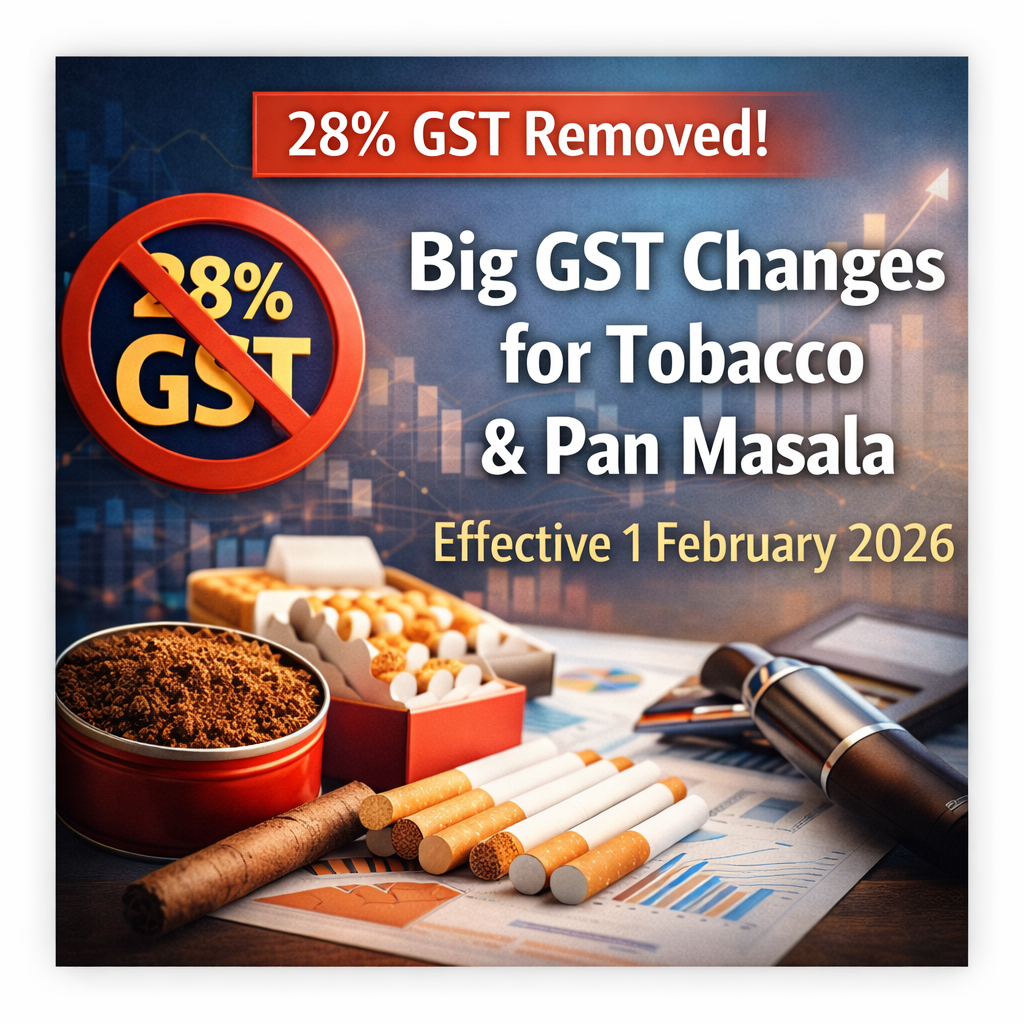
GST Update: 28% Tax Scrapped on Tobacco & Pan Masala Under New Notifications

GST Notifications Covered

  • Notification No. 19/2025 – Central Tax (Rate)

  • Notification No. 20/2025 – Central Tax

  • Notification No. 19/2025 – Central Tax
    (All applicable from 1 February 2026)


1. Background & Policy Rationale

For many years, products such as tobacco, pan masala and cigarettes were subject to 28% GST along with Compensation Cess, and in some cases additional levies like excise duty or NCCD. This multi-layered tax structure led to valuation disputes, litigation, and frequent cases of undervaluation.

With the compensation cess regime approaching its end, the Government has rolled out a comprehensive GST reset for sin goods. Through a coordinated set of three notifications, changes have been introduced covering:

  • GST rates

  • Valuation mechanism

  • Statutory backing under section 15(5) of the CGST Act


2. Notification No. 19/2025 – Central Tax (Rate)

GST Rate Rationalisation

Key Changes

  • The 28% GST slab is withdrawn for tobacco and pan masala.

  • Biris are specifically taxed at 18% GST.

  • All other tobacco-related products are now subject to 40% GST (20% CGST + 20% SGST), including:

    • Pan masala

    • Unmanufactured tobacco and tobacco refuse

    • Cigarettes, cigars and cheroots

    • Manufactured tobacco (excluding biris)

    • Heated tobacco and nicotine inhalation products such as vapes

  • The earlier 14% GST schedule is deleted.

Significance

  • Signals a clear exit from the 28% + Compensation Cess framework.

  • Consolidates taxation into higher GST slabs to ensure revenue stability.

  • Reflects policy intent to discourage consumption while safeguarding tax collections.

📄 Source: Notification No. 19/2025 – Central Tax (Rate)


3. Notification No. 20/2025 – Central Tax

Shift to MRP / Retail Sale Price–Based Valuation

Introduction of Rule 31D

For specified tobacco and pan masala products, GST valuation will no longer be based on transaction value.

Value of supply = Retail Sale Price (RSP/MRP) minus GST

Products Covered

The valuation change applies to the same product categories covered under the rate notification, excluding biris.

Key Valuation Provisions

  • RSP includes all taxes, duties, cess and surcharges.

  • Where multiple MRPs are printed, the highest MRP will apply.

  • Any increase in MRP at any stage becomes the taxable value.

  • If different MRPs are declared for different regions, valuation will be based on the area-specific MRP.

Rule 86B Relaxation (ITC Payment Restriction)

  • Traders (non-manufacturers) dealing in these goods are exempt from the 99% cash payment restriction, provided GST has been paid by the supplier on an RSP basis.

Significance

  • Effectively eliminates undervaluation.

  • Aligns GST valuation with the earlier excise-style MRP regime.

  • Guarantees minimum assured tax realisation.

📄 Source: Notification No. 20/2025 – Central Tax


4. Notification No. 19/2025 – Central Tax

Legal Backing under Section 15(5)

This notification amends Notification No. 49/2023–Central Tax to formally notify goods whose value shall be determined under section 15(5) of the CGST Act.

Key Purpose

  • Specifies tobacco and pan masala products bearing RSP as goods subject to special valuation rules.

  • Overrides transaction-value-based valuation.

Importance

  • Provides statutory authority to Rule 31D.

  • Minimises valuation disputes and litigation risks.

  • Ensures uniform nationwide application.

📄 Source: Notification No. 19/2025 – Central Tax


5. How the Three Notifications Operate Together

Aspect CT (Rate) 19/2025 CT 20/2025 CT 19/2025
Focus Rate restructuring Valuation & ITC Legal authority
Core Change 28% slab removed MRP-based valuation Section 15(5) coverage
Goods Tobacco, pan masala, vapes Same goods Same goods
Outcome Higher GST slabs No undervaluation Strong legal backing

6. Practical Impact on Stakeholders

Manufacturers

  • Pricing must be strictly aligned with declared MRP.

  • Any MRP increase results in higher GST liability.

  • ERP, invoicing and compliance systems require updates for tax back-calculation.

Traders & Distributors

  • Relief from Rule 86B restrictions where suppliers pay GST on RSP basis.

  • Must ensure MRP compliance throughout the supply chain.

Tax Professionals

  • Clear shift from transaction-value disputes to MRP-based certainty.

  • Critical advisory role in pricing, packaging, valuation and compliance reviews.

Top 10 Changes in GST & Income Tax Applicable from January 1, 2026

Important Tax Compliance Changes from 1 January 2026 – What Every Taxpayer Must Know

The commencement of 1 January 2026 brings significant compliance implications under GST and Income Tax laws in India. Multiple statutory deadlines expire on 31 December 2025, after which several system-driven restrictions, penalties, and consequences automatically come into force.

Failure to act before these cut-off dates may lead to late fees, interest liabilities, denial of Input Tax Credit (ITC), inoperative PAN, suspension of GST registration, and increased tax burden.

This article outlines the key changes effective from 1 January 2026, including several often overlooked but high-risk compliance areas.


1. GSTR-9 / GSTR-9C Due Date Expired – Late Fees Triggered

The last date to file GSTR-9 and GSTR-9C for FY 2024-25 is 31 December 2025.

From 1 January 2026, these returns can still be filed, but mandatory late fees will apply based on turnover slabs.

GSTR-9 Late Fee Structure (Applicable from FY 2022-23 onwards)

Annual Turnover Late Fee per Day (CGST + SGST) Maximum Late Fee
Up to ₹5 crore ₹50 (₹25 + ₹25) 0.04% of turnover
₹5 crore – ₹20 crore ₹100 (₹50 + ₹50) 0.04% of turnover
Above ₹20 crore ₹200 (₹100 + ₹100) 0.05% of turnover

Important Points:

  • Late fees continue to accumulate until the return is filed

  • No automatic waiver is available after the due date

  • GSTR-9C cannot be filed unless GSTR-9 is first filed

  • Late fee for GSTR-9C is ₹200 per day, capped at 0.05% of turnover


2. Belated and Revised ITR Filing Window Closes on 31 December 2025

For FY 2024-25 (AY 2025-26):

  • Belated Return under Section 139(4)

  • Revised Return under Section 139(5)

👉 Both are permitted only up to 31 December 2025.

From 1 January 2026, taxpayers will no longer be allowed to file either a belated or revised return for this financial year.


3. Updated Return Remains the Only Option – At a High Cost

Post 31 December 2025, the only return filing option available is the Updated Return under Section 139(8A).

Key Rules for Updated Returns

  • Can be filed up to 4 years from the end of the relevant assessment year

  • Allowed only in cases of:

    • Omitted income

    • Incorrect claims of exemptions, deductions, or losses

  • Refunds cannot be claimed

  • Losses cannot be carried forward

  • Additional tax payment is mandatory

📌 Updated returns are meant for tax recovery, not routine corrections.


4. PAN Becomes Inoperative If Aadhaar Is Not Linked

Failure to link PAN with Aadhaar results in the PAN becoming inoperative, leading to serious consequences.

Impact of Inoperative PAN

  • Income Tax Return cannot be filed

  • Tax refunds will not be issued

  • TDS will be deducted at higher rates

  • Certain banking transactions may be restricted

  • PAN becomes invalid for GST, investments, loans, and other financial compliance

    5. GSTR-3B Filing to Be Blocked Due to ITC Restrictions from 1 January 2026

    Starting with returns filed for January 2026 onwards, the GST portal will restrict GSTR-3B filing in certain ITC-related mismatch situations.

    ITC Reclaim Ledger Validation

    The amount of ITC reclaimed in Table 4(D)(1) must not exceed:

    • Closing balance of the ITC Reclaim Ledger, plus

    • ITC reversed in Table 4(B)(2) during the current tax period

    Reverse Charge (RCM) Ledger Validation

    ITC claimed under RCM in Table 4A(2) / 4A(3) must not exceed:

    • RCM tax paid and reported in Table 3.1(d), plus

    • Available balance in the RCM Ledger

    Any negative balance in the ITC or RCM ledger will automatically block GSTR-3B filing.


    6. Non-Submission of Bank Details Will Trigger GST Registration Suspension

    As per Rule 10A of the CGST Rules, furnishing bank account details is mandatory:

    • Within 30 days of GST registration, or

    • Before filing GSTR-1 or IFF, whichever occurs first

    Consequences of Non-Compliance

    • GST registration will be system-suspended

    • Taxpayer will be unable to file returns

    • E-way bill generation will be blocked

    • Suspension remains until bank details are updated


    7. GST Returns Older Than Three Years Become Non-Fileable

    A critical but frequently overlooked provision:

    👉 GST returns pending for more than 3 years become time-barred and cannot be filed.

    This restriction applies to:

    • GSTR-1

    • GSTR-3B

    • GSTR-4

    • GSTR-5, 6, 7, 8, and 9

    📌 Once a return becomes time-barred:

    • Related ITC is permanently forfeited

    • Annual return reconciliation becomes impossible

    • Departmental notices and demand proceedings may follow


    8. Reassess Aggregate Annual Turnover (AATO) – GST Registration May Be Required

    At the beginning of a new financial cycle, businesses should recalculate their Aggregate Annual Turnover (AATO).

    GST registration becomes mandatory if AATO exceeds:

    • ₹20 lakh (₹10 lakh for special category states), or

    • ₹40 lakh for goods suppliers, subject to prescribed conditions

    Failure to register can result in:

    • Tax demand along with interest

    • Monetary penalties

    • Denial of ITC to customers, affecting business credibility


    9. Pay Advance Tax by 15 March to Avoid Interest Liability

    Where total tax liability exceeds ₹10,000, payment of advance tax is compulsory.

    • Final instalment due: 15 March (100% of tax liability)

    Non-payment or short payment may attract:

    • Interest under Sections 234B and 234C

    • Additional tax cost even if the ITR is filed within the due date


    10. Regular Monitoring of Income Tax Portal Is Essential

    Taxpayers must frequently review communications available on the Income Tax Portal, including:

    • E-proceedings and notices

    • Intimations under Section 143(1)

    • Defective return alerts

    • Refund adjustments

    • AIS/TIS mismatch communications

    Ignoring portal notices may lead to:

    • Best judgment assessments

    • Withholding of refunds

    • Penalty and prosecution proceedings

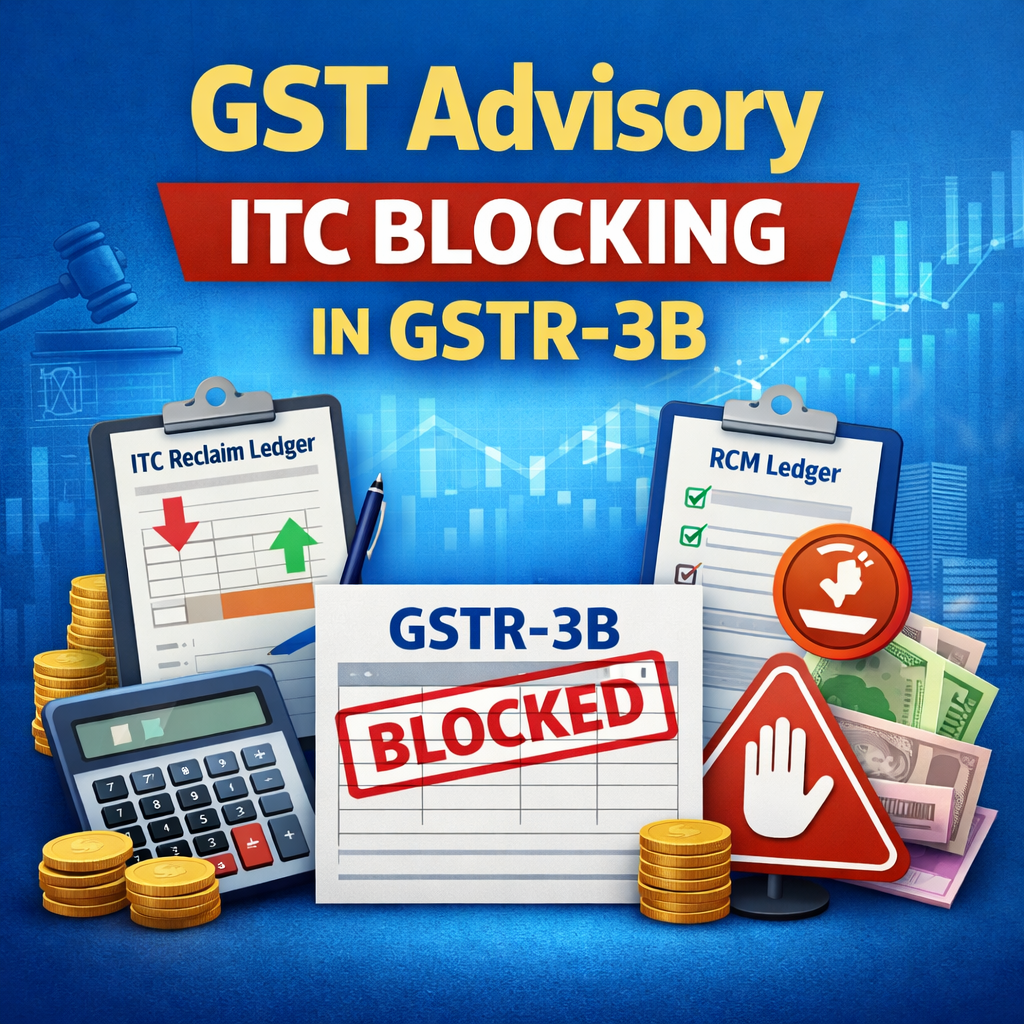
GST Authorities Notify Revised Advisory on ITC Blocking in GSTR-3B

Background of the Advisory

To improve discipline in Input Tax Credit (ITC), minimise manual mistakes, and enable accurate tracking of ITC reversals, reclaims, and Reverse Charge Mechanism (RCM) credits, GSTN has introduced two dedicated electronic statements on the GST portal:

  • Electronic Credit Reversal and Re-claimed Statement (ITC Reclaim Ledger)

  • RCM Liability / ITC Statement (RCM Ledger)

Initially, these statements were only informational and displayed warning messages. However, GSTN has now decided to enforce strict system-based validations, under which GSTR-3B filing will be blocked if excess ITC is claimed or ledger balances turn negative.

This advisory is particularly critical for regular GST taxpayers, especially those involved in:

  • ITC reversals under Rules 37, 42, and 43

  • Temporary ITC reversals followed by re-claims

  • Transactions covered under Reverse Charge Mechanism (RCM)


1. Electronic Credit Reversal & Re-claimed Statement (ITC Reclaim Ledger)

Introduction & Applicability

This ledger has been implemented from:

  • August 2023 for monthly filers

  • July–September 2023 quarter for QRMP taxpayers

Objective

Its main purpose is to monitor ITC that is reversed temporarily and subsequently reclaimed, ensuring proper linkage between the two.

Details Captured

The statement records:

  • ITC reversed in Table 4(B)(2) of GSTR-3B

  • ITC reclaimed through:

    • Table 4(A)(5)

    • Table 4(D)(1)

This mechanism ensures that only ITC previously reversed can be reclaimed.

Navigation Path

Dashboard → Services → Ledger → Electronic Credit Reversal and Re-claimed Statement


2. Current System Behaviour (Till Now)

At present:

  • If reclaimed ITC exceeds the available reversed balance,
    👉 the system only displays a warning message

  • GSTR-3B filing is still permitted

GSTN observed that many taxpayers ignored these alerts, which resulted in:

  • Negative balances in ledgers

  • Excess utilisation of ITC

  • Increased scrutiny, disputes, and notices later


3. RCM Liability / ITC Statement (RCM Ledger)

Introduction & Applicability

This ledger became operational from:

  • August 2024 for monthly filers

  • July–September 2024 quarter for QRMP taxpayers

Purpose

It ensures that:

  • RCM tax liability is properly discharged

  • ITC under RCM is claimed only after payment

Information Tracked

The statement captures:

  • RCM liability reported in Table 3.1(d) of GSTR-3B

  • Corresponding ITC claimed in:

    • Table 4(A)(2) – RCM on inward supplies

    • Table 4(A)(3) – RCM on import of services

Navigation Path

Services → Ledger → RCM Liability / ITC Statement


4. Opening Balance Facility – Relief Provided Earlier

GSTN had earlier allowed taxpayers multiple opportunities to:

  • Declare opening balances in both ledgers

  • Correct excess reversals or excess RCM ITC claimed earlier

  • Rectify historical mismatches before enforcement

This was offered as a one-time corrective measure to help taxpayers clean up past errors.


5. Key Upcoming Change – Mandatory System Validation

GSTN has now announced that shortly:

  • ❌ Negative ledger balances will not be allowed

  • ❌ Excess ITC claims will result in blocking of GSTR-3B filing


6. New Validation Rules – Explained Simply

A. Validation for ITC Re-claim (Table 4(D)(1))

ITC reclaimed in Table 4(D)(1) must not exceed:

Closing balance of ITC Reclaim Ledger
+
ITC reversed in Table 4(B)(2) of the same return

In simple terms:
You can reclaim ITC only if:

  • It was reversed earlier, or

  • It is being reversed again in the same tax period


B. Validation for RCM ITC Claim

RCM ITC claimed in Table 4(A)(2) and 4(A)(3) must not exceed:

RCM tax paid in Table 3.1(d) of the same period
+
Available balance in the RCM Ledger

In simple terms:
RCM ITC can be claimed only when:

  • The corresponding RCM tax is paid, or

  • Adequate balance is available in the RCM ledger


7. What If the Ledger Balance Is Already Negative?

A. Negative ITC Reclaim Ledger

A negative balance indicates that excess ITC was reclaimed in the past.

👉 Mandatory correction to file GSTR-3B:

  • Reverse the excess ITC in Table 4(B)(2)

    📌 When No ITC Is Available

    If sufficient ITC is not available for reversal:

    • The reversed amount will be automatically added to tax liability

    Illustration:

    • Closing balance: –₹10,000

    • ITC reversed in Table 4(B)(2): ₹10,000

    • If ITC is insufficient → the amount must be paid in cash as tax


    B. Negative RCM Ledger

    A negative balance in the RCM ledger indicates that RCM ITC has been claimed without corresponding tax payment.

    To successfully file GSTR-3B, the taxpayer must choose either of the following:

    1️⃣ Pay the pending RCM liability in Table 3.1(d)
    OR
    2️⃣ Reduce the RCM ITC claimed in Table 4(A)(2) / 4(A)(3)

    Illustration:

    • RCM Ledger balance: –₹5,000

    Options available:

    • Pay ₹5,000 as RCM tax
      OR

    • Reduce RCM ITC claim by ₹5,000


    8. Effect on GSTR-3B Filing – Practical Impact

    Once system validations are implemented:

    • ❌ GSTR-3B filing will be blocked if ledger balances are negative

    • ❌ Excess ITC re-claims or RCM ITC claims will not be permitted

    • ✔ Only accurate and reconciled ITC will be accepted

    This represents a clear transition from advisory-based compliance to strict enforcement.


    9. Important Takeaways for Taxpayers & Professionals

    ✔ Reclaim only ITC that was genuinely reversed earlier
    ✔ Claim RCM ITC only after ensuring tax payment
    ✔ Review ITC Reclaim Ledger and RCM Ledger regularly
    ✔ Rectify negative balances without delay
    ✔ Never ignore system warning messages
    ✔ Reconcile GSTR-3B figures with ledger balances every month


    10. Who Needs to Be Extra Vigilant?

    This advisory is particularly critical for:

    • Businesses facing delays in vendor payments

    • Taxpayers applying Rule 37 reversals

    • Entities availing provisional ITC

    • Businesses with high RCM exposure

    • Chartered Accountants and consultants managing multiple clients

    • Taxpayers who made manual ITC adjustments in earlier years


    Final Note

    This advisory signals a decisive move towards automated and system-driven ITC governance.
    Manual adjustments and post-compliance justifications are no longer sustainable.

    👉 Ledger balance now determines return filing eligibility.

    Taxpayers are strongly advised to immediately review their ITC Reclaim Ledger and RCM Ledger and correct discrepancies before validations are enforced, to avoid return filing blocks, additional cash payments, and departmental notices.