
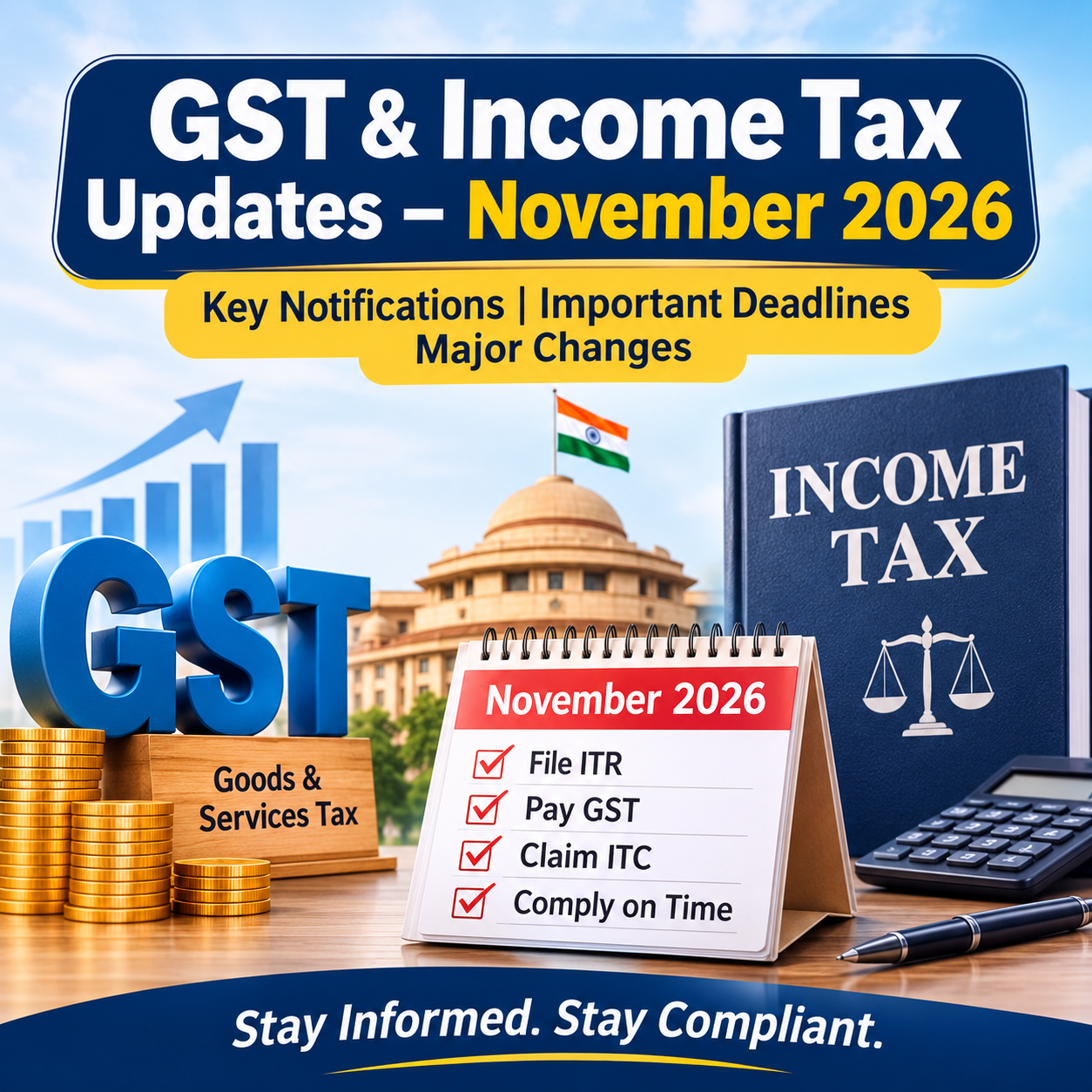
GST & Income Tax Updates for November 2026: Important Changes for Professionals
GST & Income Tax Updates – November 2026: Important Notifications, Deadlines and Key Changes
Stay informed about the latest GST and Income Tax notifications, departmental advisories, upcoming compliance deadlines and significant legal rulings—all in one place. Every update is explained in simple language to help professionals and businesses understand the changes and take timely action.
Below is a detailed overview of the important tax developments applicable as of 15 November 2026.
⏰ Important Compliance Deadlines: Key Dates for the Next 15 Days
| Due Date | Compliance Requirement | Applicable Taxpayers |
|---|---|---|
| 20 Nov 2026 | Filing of GSTR-3B for October 2026 | Monthly GST taxpayers |
| 21 Nov 2026 | ITR filing for AY 2026-27 – Tax Audit Cases (Extended Deadline) | Businesses and professionals subject to tax audit |
| 25 Nov 2026 | Payment of October 2026 tax through PMT-06 | QRMP scheme taxpayers |
| 30 Nov 2026 | ITR filing for AY 2026-27 – Transfer Pricing Cases | Taxpayers required to submit Form 3CEB |
| 30 Nov 2026 | Final date for claiming pending ITC relating to FY 2025-26 under Section 16(4) | GST-registered taxpayers |
| 30 Nov 2026 | Deadline for reporting FY 2025-26 credit notes under Section 34(2) | Suppliers issuing GST credit notes |
Important reminder: Tax audit ITR filing deadline is approaching!
Taxpayers covered under the audit category have only a few days remaining to submit their income tax returns. CBDT previously extended the tax audit report submission deadline from 30 September to 21 October 2026 and the ITR filing deadline from 31 October to 21 November 2026 through Circular No. 07/2026 dated 28 September 2026.
Taxpayers should complete their return filing without waiting for another possible extension. Early filing will help avoid last-minute technical issues and unnecessary delays.
GST Compliance Reminder:
Under Section 16(4) and Section 34(2) of the CGST Act, the deadline is 30 November or the date of filing the annual return, whichever occurs earlier.
Therefore, businesses filing their GSTR-9 for FY 2025-26 before 30 November must ensure that all eligible ITC claims and credit note adjustments are completed before submitting the annual return.
Reconcile your GSTR-2B with the purchase register and accounting records to identify any missed ITC. Eligible pending credits should be considered in the October GSTR-3B (due on 20 November) or, where permitted, the November return filed within the applicable deadline.
Enrol in Our Practical GSTR-9 and GSTR-9C Course
Get practical guidance on GST annual return preparation, reconciliation and compliance requirements.
🟢 GST Update 1: Important CGST Act Amendments Effective from 1 November 2026
CBIC Notification No. 03/2026–Central Tax dated 26 October 2026 has brought amendments relating to Sections 15, 34 and 54 of the CGST Act, introduced through the Finance Act, 2026, into effect from 1 November 2026.
These amendments are aligned with the recommendations made during the 57th GST Council Meeting.
(a) Post-Supply Discount Rules Relaxed – Section 15(3)(b)
The conditions for excluding post-supply discounts from the taxable value of goods or services have been simplified.
- Previously, discounts given after the supply were eligible for exclusion from taxable value only when they were agreed upon before the supply and specifically linked to the relevant invoices.
- With effect from 1 November 2026, these two requirements have been removed.
- A post-supply discount can now be excluded from the taxable value when the supplier issues a credit note under Section 34 and the recipient reverses the corresponding proportionate ITC.
Business Impact: Companies can now manage volume-based discounts, annual sales incentives, promotional offers and target-based schemes more conveniently through GST credit notes.
(b) Major Improvements in GST Refund Provisions – Section 54
Several changes have been introduced to make GST refund processing more taxpayer-friendly.
- Refunds of accumulated ITC arising from an inverted duty structure will now cover input services as well, for eligible credit availed on or after 1 November 2026.
- The earlier minimum refund threshold of ₹1,000 for export refund applications has been eliminated.
- The provisional refund facility has been expanded to cover additional categories of refund claims, helping eligible taxpayers receive refunds more quickly.
Important Note: These amendments are applicable prospectively from 1 November 2026 and do not apply retrospectively to earlier transactions.
Certain technology-driven reforms, including complete refund automation, are expected to be implemented in stages during December 2026, January 2027 and April 2027.
🟢 GST Update 2: GST Registration Rules and Portal Procedures Revised
GSTN Advisories dated 1 November 2026 have introduced significant changes to the GST registration process following Notification No. 05/2026–Central Tax (CGST Amendment Rules, 2026).
The revised procedures bring changes to the registration application, business information requirements and online verification process.
Revised FORM GST REG-01: Additional Details Required
The updated GST registration application requires more comprehensive information regarding the business constitution and its registered premises.
Key changes include:
- One Person Company (OPC): OPC has been introduced as a separate business constitution category in the registration application.
- LLP Designated Partners: Designated partners of an LLP are required to provide their Director Identification Number (DIN).
- Online CIN/LLPIN Verification: Corporate Identification Number (CIN) and Limited Liability Partnership Identification Number (LLPIN) details will be verified online before the generation of the Application Reference Number (ARN).
Practical Advice: Applicants should arrange all necessary business constitution documents, partner details, identification information and premises-related documents before starting the GST registration application. This will help prevent application errors, verification delays and unnecessary queries.
Registration Amendments – New Rule 19
Under the newly introduced Rule 19, the process for amending GST registration details has been simplified. Most changes relating to both core and non-core fields, except changes to the Principal Place of Business (PPOB), will now be approved automatically after successful online validation and OTP verification, generally within 3 days.
However, applications involving changes to the Principal Place of Business will continue to be referred to the jurisdictional proper officer for verification and approval.
GST Registration Cancellation – FORM GST REG-16
The GST portal has introduced an additional verification mechanism for registration cancellation applications. Before accepting the application, the system verifies whether all pending GST returns due up to the effective date of cancellation have been duly filed.
For Composition Taxpayers, Non-Resident Taxable Persons (NRTPs), OIDAR Service Providers and Input Service Distributors (ISDs), cancellation approval will now be processed electronically without requiring manual intervention or approval from a GST officer.
Rule 14B – Simplified GST Registration for E-Commerce Sellers
E-commerce sellers who already hold GST registration in their home State can now obtain registration in another State through a simplified procedure, even if they do not have a physical business location in that State. They can use the warehouse of an e-commerce operator for this purpose, subject to the monthly output tax limit specified in the relevant advisory.
GST TDS Registration for Scrap Dealers and Specified Goods
Dealers engaged in the supply of metal scrap, used cooking oil, plastic waste, tyre waste and electronic waste (e-waste) are required to follow the prescribed registration procedure.
While applying through FORM GST REG-07, such taxpayers must select “Others” under the Constitution of Business field and clearly mention their applicable business category.
Composition Scheme – GST Portal Improvements
The GST portal has introduced upgraded features and enhancements to simplify the process of managing compliance-related activities under the Composition Scheme.
GST Update 3: Revised E-Way Bill Numbering System Effective from 1 January 2027
GSTN has announced a change in the numbering structure of E-Way Bills and Consolidated E-Way Bills, which will become applicable from 1 January 2027.
Businesses that generate e-way bills through ERP systems or API integrations should coordinate with their software providers in advance. Necessary modifications should be made to system validations, report formats and document printing layouts to ensure a smooth transition to the revised numbering system.
🟢 GST Update 4: GST Revenue Collection for October 2026
India recorded a gross GST collection of ₹2.31 lakh crore in October 2026, indicating healthy revenue growth supported by increased consumer spending during the festive season.
🔵 Income Tax Update 1: Direct Tax Revenue Records 11.76% Growth
According to the latest CBDT figures available as of 10 November 2026, direct tax collections for FY 2026-27 have registered positive growth compared with the corresponding period of the previous year.
The collection details are provided below:
| Particulars | FY 2026-27 (₹ crore) | Growth Rate |
|---|---|---|
| Gross Direct Tax Collection | 17,50,286 | 14.02% |
| Income Tax Refunds Issued | 3,08,307 | 25.91% |
| Net Direct Tax Collection | 14,41,979 | 11.76% |
| Net Corporate Tax | 6,31,960 | Approx. 17.8% |
| Net Non-Corporate Tax | 7,55,945 | Approx. 5.3% |
| Securities Transaction Tax (STT) | 54,078 | Approx. 51.6% |
What does this indicate?
The increase in direct tax collections reflects a positive trend in tax revenue. At the same time, the substantial amount of refunds issued indicates faster refund processing, which is encouraging for taxpayers who have completed their income tax return filing.
🔵 Income Tax Update 2: Important CBDT Notifications under the Income-tax Act, 2025
CBDT has issued several important notifications introducing exemptions, revised procedures and additional compliance requirements under the Income-tax Act, 2025.
(a) Dividend Payments Between IFSC Aircraft Leasing Units Exempt from TDS
Notification No. 141/2026 dated 4 November 2026
CBDT has provided TDS relief on dividend payments made by an IFSC unit engaged in aircraft leasing to another eligible aircraft-leasing unit operating in an IFSC.
Under this provision, tax deduction under Section 393(1) will not be required, subject to the recipient furnishing the prescribed Form No. 1(N).
The exemption is effective from 1 April 2026.
(b) Merger Guidelines for Registered Trusts and Non-Profit Organisations
Income-tax (Eighth Amendment) Rules, 2026 – Notification No. 139/2026 dated 30 October 2026
CBDT has introduced Rule 189A and Form No. 112A to establish the conditions and reporting procedure for mergers involving two registered non-profit organisations or trusts having identical or similar objectives.
The prescribed requirements include:
- Settlement of all outstanding tax liabilities before the merger.
- Transfer of all assets and liabilities to the merged organisation.
- Continuation of the same or similar charitable objectives for the prescribed minimum period.
- Submission of merger-related information to the Income Tax Department through the prescribed form.
Professional Impact: These provisions are particularly important for Chartered Accountants, tax consultants and professionals advising charitable trusts, NGOs and other registered non-profit entities.
(c) TDS and TCS Exemption for Payments Received by IRRI
Notification No. 138/2026 dated 28 October 2026
CBDT has granted an exemption from the applicability of Chapter XIX (TDS/TCS provisions) of the Income-tax Act, 2025, in respect of payments received by the International Rice Research Institute (IRRI).
The exemption will be available subject to compliance with the conditions prescribed in the notification.
(d) New Form 173A for Claiming Exemption on Specified Government Securities
CBDT has introduced Rule 281A and Form No. 173A for reporting information required to claim exemptions relating to interest income and capital gains arising from specified Government securities under Schedule IV of the Income-tax Act, 2025.
Eligible taxpayers must follow the prescribed reporting procedure and furnish the required details using the newly introduced form.
⚖️ Important GST Judgments and Rulings of the Week
The following important judicial and advance ruling developments are relevant for GST practitioners, businesses and tax professionals.
- GSTAT – Missing E-Invoice During Transit: The absence of an e-invoice, by itself, cannot be treated as sufficient grounds for imposing a penalty under Section 129 when the taxpayer possesses a valid tax invoice and e-way bill.
- GSTAT – Refund of Export ITC: The calculation of export refunds must be based on the net Input Tax Credit (ITC) reported in GSTR-3B.
- AAR – Kraft Paper Bags: Kraft paper bags are taxable at 5% GST, with the benefit of Input Tax Credit available.
- AAR – Plastic Nursery Pots and Seedling Trays: Plastic nursery pots and seedling trays attract 18% GST, even when these products are used for agricultural purposes.
- Calcutta High Court – Delayed GST Appeal: The Court restored a GST appeal filed by a senior citizen after finding that the delay had occurred due to the illness of the taxpayer’s tax consultant.
✅ November 2026: Essential Compliance Checklist for Tax Professionals
To avoid missing important statutory deadlines and regulatory requirements, professionals should review the following action points:
- ITR Filing – Tax Audit Cases: Complete and submit pending income tax returns for AY 2026-27 on or before 21 November 2026.
- Transfer Pricing Compliance: Ensure timely filing of Form 3CEB and the applicable ITR for transfer pricing cases by 30 November 2026.
- Pending ITC Reconciliation: Match GSTR-2B with books of accounts for FY 2025-26 and identify and claim eligible missed ITC within the prescribed time limit, ending on 30 November 2026 or the earlier annual return filing date.
- Credit Note Reporting: Verify that all applicable credit notes relating to FY 2025-26 are issued and reported within the deadline of 30 November 2026, subject to the earlier annual return filing date.
- Post-Supply Discount Review: Examine existing post-sale discount arrangements and revise GST credit note procedures in accordance with the amended Section 15(3)(b).
- GST Registration Applications: Inform clients about the revised FORM GST REG-01 requirements and ensure that all supporting documents are ready before applying.
- E-Way Bill Software Updates: Contact ERP and software service providers to ensure compatibility with the revised e-way bill numbering format before 1 January 2027.
Final Takeaway: November 2026 brings several important GST and Income Tax developments, covering registration procedures, refund provisions, statutory deadlines, direct tax collections and judicial decisions. Businesses and tax professionals should review these changes carefully and complete their pending compliances within the prescribed timelines.