
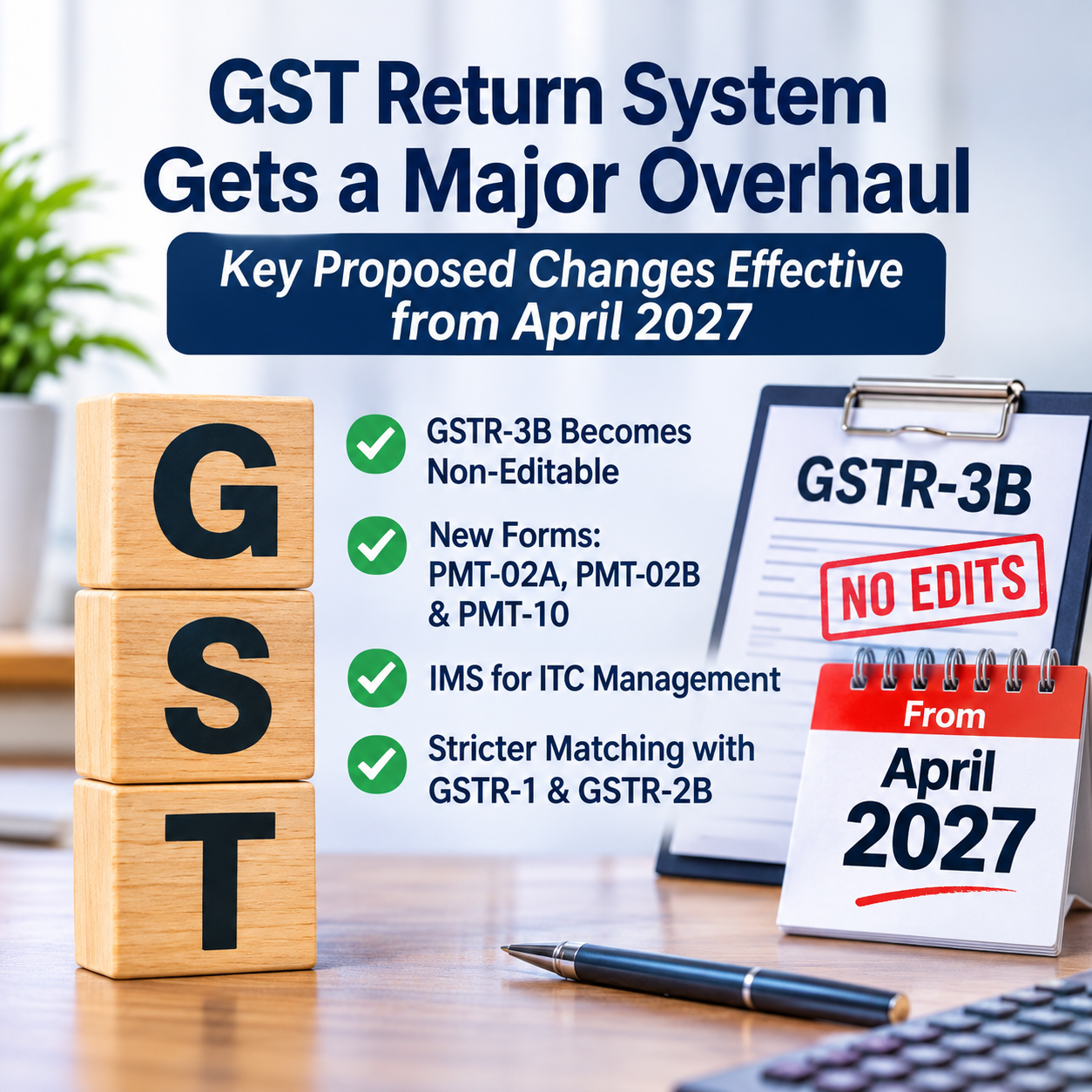
GST Returns Reforms from April 2027: Changes to GSTR-3B, GSTR-2B and the New Filing System
Starting from the April 2027 tax period, taxpayers may lose the option to modify auto-filled tax liability and Input Tax Credit (ITC) figures in GSTR-3B. As per the proposed framework, any adjustments must be made through the original reporting platforms—GSTR-1, GSTR-1A, or IFF for tax liability, while ITC-related corrections will be handled through the Invoice Management System (IMS) and the newly introduced electronic statements.
Background of the Proposed GST Return Reforms
The proposed changes are based on the recommendations made during the 57th GST Council meeting held on 8 October 2026. A public consultation document (Annexure X) has been issued, containing proposed changes to the CGST Rules, 2017, revised forms, and a draft circular. Interested stakeholders can submit their feedback, comments, and recommendations up to Monday, 30 November 2026.
Important: These amendments are currently at the proposal stage and are open for public consultation. They will become effective only after the relevant rules and forms are officially notified. The final provisions, implementation dates, and details may be revised.
This article covers the existing issues in the GST return system, the proposed changes, all nine recommendations of the GST Council, the draft rule amendments, and the steps businesses and tax professionals should consider in advance.
Existing GSTR-3B Mechanism and Its Challenges
At present, several details in GSTR-3B are automatically populated using information reported through other GST systems:
- Outward tax liability: Automatically derived from the taxpayer’s GSTR-1, GSTR-1A, or IFF filings.
- Input Tax Credit (ITC): Auto-populated based on GSTR-2B, which reflects supplier-reported details and the recipient’s actions through the Invoice Management System (IMS).
Although these figures are auto-filled, taxpayers are currently permitted to modify them before submitting GSTR-3B. Businesses often make such changes to account for unreported invoices, credit note adjustments, or ITC claims that are not reflected in GSTR-2B. This flexibility can result in two major reconciliation issues:
1. Difference in Tax Liability
The outward tax liability declared in GSTR-1 may not match the amount reported and paid through GSTR-3B. Such discrepancies may trigger a system-generated intimation under FORM GST DRC-01B, as prescribed under Rule 88C.
2. Difference in ITC Claimed
The ITC available as per GSTR-2B may differ from the credit claimed in GSTR-3B. This variation can result in an automated intimation through FORM GST DRC-01C under Rule 88D.
These differences may lead to automated alerts, notices, restrictions on filing subsequent GSTR-1 returns, or demand-related proceedings if the taxpayer fails to provide a satisfactory explanation. Such adjustments also affect the accuracy of ITC reconciliation between suppliers and recipients.
Existing GST Portal Facilities
GSTN has introduced various tools over time to enable taxpayers to correct and manage their information through the relevant source systems instead of making direct changes in GSTR-3B.
| Facility | Main purpose | Introduced from | Current legal position |
|---|---|---|---|
| GSTR-1A | Amend GSTR-1 details before filing GSTR-3B | July 2024 tax period | Notified under Rule 59 |
| Invoice Management System (IMS) | Accept, reject or keep supplier invoices and other inward supply documents pending | October 2024 | Portal facility |
| Electronic Credit Reversal and Re-claimed Statement | Maintain records of ITC reversed and subsequently reclaimed | August 2023 | Portal facility |
| RCM Liability / ITC Statement | Reconcile reverse-charge ITC against the actual RCM tax payment | August 2024 (monthly), July–September 2024 (quarterly) | Portal facility |
Apart from GSTR-1A, these facilities have not yet been incorporated into the CGST Rules. According to the consultation document, taxpayers have not been consistently using these tools or have been using them incorrectly, resulting in continued manual adjustments in GSTR-3B.
The proposed amendments aim to formally incorporate these mechanisms into the GST framework and eliminate the ability to modify auto-populated figures directly in GSTR-3B.
Proposed Changes: Auto-Filled GSTR-3B Figures to Become Non-Editable
The draft amendments propose adding two new sub-rules to Rule 61 of the CGST Rules. These provisions will transform GSTR-3B into a summary return based on information already reported and reconciled through the relevant GST systems, rather than a return where taxpayers can make independent corrections.
Proposed Rule 61(1A): Reporting of Outward Tax Liability
- The outward supply details reported in GSTR-3B must match the information furnished in GSTR-1, including amendments made through GSTR-1A, or details submitted through IFF.
- Any mistake or omission relating to an earlier period’s outward liability must be corrected through GSTR-1 or GSTR-1A for the period in which the error is identified, subject to the limitation prescribed under Section 37(3).
- Exception: Tax liability relating to inward supplies covered under the reverse charge mechanism may continue to be adjusted in a subsequent GSTR-3B.
Proposed Rule 61(1B): Reporting and Claim of Input Tax Credit
- ITC other than credit relating to reverse-charge supplies must correspond with the amount reflected in GSTR-2B. Any required correction will be processed through IMS actions, resulting in an updated GSTR-2B.
- ITC relating to reverse-charge supplies will be restricted to the amount available in the proposed electronic statement FORM GST PMT-02B, under Rule 86D.
- ITC reclaimed after reversal will be limited to the available balance in FORM GST PMT-02A, as proposed under Rule 86C.
- Where ITC has been permanently reversed in excess during an earlier period, the correction may be made using the newly proposed FORM GST PMT-10.
In summary: Outward liability adjustments will be made through GSTR-1 or GSTR-1A, while ITC-related changes will be managed through IMS and the prescribed electronic statements. Direct editing of GSTR-3B will no longer be permitted under the proposed system.
Nine GST Council Recommendations Explained
The recommendations are designed to address the various situations in which taxpayers currently make manual changes to GSTR-3B.
1. Improvements to GSTR-1, GSTR-1A and IFF
Current issue: Credit notes, debit notes, advances received, and advances adjusted are not classified according to the type of underlying transaction, such as regular taxable supplies, supplies where the e-commerce operator pays tax under Section 9(5), or zero-rated supplies. As a result, these amounts may be automatically reflected in the wrong GSTR-3B table, requiring manual correction.
Additionally, GSTR-1 currently does not provide an adequate mechanism to reconcile transactions made through e-commerce operators with the corresponding information reported in GSTR-8.
Proposed changes:
- Taxpayers will be required to specify the category of underlying supply for credit notes, debit notes, and advances, allowing the portal to populate the appropriate GSTR-3B tables.
- Transactions made through e-commerce operators will be provided with better reconciliation facilities against GSTR-8. Under the draft GSTR-1 format, Table 4 excludes supplies covered under reverse charge and supplies made through ECOs liable to TCS under Section 52, which will be reported separately.
- Additional guidance, tooltips, and step-by-step navigation support will be introduced for GSTR-1, GSTR-1A, and IFF to help taxpayers complete filings accurately.
2. Expansion of GSTR-1A Amendment Facility
Current issue: GSTR-1A is presently limited to making corrections for the current tax period. Taxpayers cannot use it to amend details belonging to previous tax periods or correct the recipient’s GSTIN.
Proposed changes: The existing limitations are proposed to be removed. The amended proviso to Rule 59(1) will allow taxpayers to use GSTR-1A for amendments relating to the current period as well as earlier tax periods, subject to the time limit prescribed under Section 37(3). The facility will also permit corrections to the recipient’s GSTIN.
All permitted amendments will need to be completed before GSTR-3B for the relevant period is filed.
3. Correction of Previous-Period Liability Through GSTR-1 or GSTR-1A
Current issue: Taxpayers sometimes adjust previous-period outward tax liability directly in the GSTR-3B of a subsequent period without revising the original GSTR-1. Consequently, the supplier’s reported outward supply information remains incorrect, which may also affect the recipient’s ITC records.
Proposed changes: Amendments relating to earlier-period outward tax liability will have to be made through the amendment tables of GSTR-1 or GSTR-1A. Direct adjustments in GSTR-3B will no longer be permitted for these corrections.
The only proposed exception is tax liability arising on inward supplies under reverse charge, which may continue to be adjusted through a subsequent GSTR-3B.
4. Introduction of Part B in DRC-03 to Avoid Duplicate Tax Payments
Current issue: Following audits, inspections, scrutiny, or enforcement proceedings, taxpayers may discharge their tax liability through FORM GST DRC-03. To enable the buyer to obtain the related ITC, the supplier may subsequently report the same invoice or debit note through GSTR-1 or GSTR-1A.
Once the transaction is reported through GSTR-1 or GSTR-1A, the corresponding tax liability gets auto-populated again in GSTR-3B. Suppliers currently modify GSTR-3B to avoid paying the same tax amount twice.
4. Part B of DRC-03 to Avoid Double Tax Payment
Proposed amendments to Rule 142(2) and Rule 142(3):
Under the proposed mechanism, taxpayers will follow these steps:
- Deposit the applicable tax amount using Part A of FORM GST DRC-03.
- Within 7 days of payment, report the corresponding invoice or debit note in the newly introduced Part B of DRC-03.
- Once the invoice or debit note is subsequently disclosed in GSTR-1 or GSTR-1A, the related tax liability will not be included again in GSTR-3B.
- The recipient will continue to receive the eligible ITC through GSTR-2B.
5. RCM Liability and ITC Statement to Get Legal Recognition – FORM GST PMT-02B
The GST portal has provided the RCM Liability / ITC Statement facility since the August 2024 tax period for monthly taxpayers and the July–September 2024 quarter for quarterly taxpayers. The portal also allows taxpayers to enter their cumulative opening balances.
Proposed Rule 86D: The existing facility will receive statutory recognition through a new electronic statement called FORM GST PMT-02B, which will record reverse-charge tax payments and the corresponding ITC claims.
The proposed statement will operate as follows:
- Credit entry: The statement will be credited with the reverse-charge tax liability reported and paid through GSTR-3B.
- Debit entry: The statement will be debited when ITC relating to reverse-charge supplies is claimed in GSTR-3B.
- ITC restriction: RCM ITC, except ITC on imported goods, claimed in GSTR-3B cannot be higher than the RCM liability declared in that return plus the available closing balance in PMT-02B.
- Reporting differences: Any inconsistency in the statement can be brought to the department’s notice through FORM GST PMT-04.
6. IMS to Become the Primary Mechanism for ITC Management
The Invoice Management System (IMS) has been available on the GST portal since October 2024. Through this facility, recipients can select one of three actions for each inward supply document:
- Accept the document.
- Reject the document.
- Keep the document pending.
If the recipient does not take any action, the document is treated as accepted when GSTR-3B is filed. The recipient can modify the selected action until GSTR-3B submission, after which the system can generate an updated GSTR-2B.
Proposed amendment: Under the new Rule 60(6A), ITC reporting in GSTR-3B will be controlled through IMS rather than by manually modifying the auto-populated figures. A draft circular issued as Annexure C provides guidance on the appropriate IMS actions for different ITC-related situations.
Extended Time Limit for Keeping Credit Notes Pending
Under the existing facility, recipients can keep a credit note pending only until GSTR-3B for the relevant tax period is filed. The proposed amendment provides a longer period for taking a decision.
| Taxpayer category | Pending facility available until | Final deadline for deemed acceptance |
|---|---|---|
| Monthly filer | Filing of GSTR-3B for the second succeeding month | Last day of the month in which that GSTR-3B is due |
| Quarterly filer (QRMP) | Filing of GSTR-3B for the following quarter | Last day of the month in which that GSTR-3B is due |
Illustration from the consultation document:
Suppose a supplier reports a credit note in GSTR-1 for April 2026 and files the return on 11 May 2026.
- For monthly filers: The recipient can keep the credit note pending until filing GSTR-3B for June 2026. If the June return is not submitted by 31 July 2026, the credit note will automatically be considered accepted.
- For quarterly filers: If the credit note is reflected in the April–June 2026 quarter, the recipient can keep it pending until filing GSTR-3B for July–September 2026. However, the maximum permitted date will be 31 October 2026.
Interest Implications for Suppliers and Recipients
The proposed amendments also specify interest consequences depending on how recipients deal with credit notes.
1. When the recipient keeps a credit note pending
If the recipient has already claimed and utilised ITC against the original invoice, keeping the related credit note pending may attract interest under Section 50(3) on the corresponding credit amount.
Interest will be calculated from the GSTR-3B due date for the period in which the credit note was reflected in IMS until the return period in which the credit note is finally accepted or treated as accepted.
2. When the recipient rejects a credit note
Under the proposed Rule 67B, rejection of a credit note will result in the supplier having to restore the output tax previously reduced through that credit note.
The additional tax liability will become payable in the subsequent return, along with interest under Section 50, calculated from the due date of GSTR-3B for the period in which the credit note was originally reported.
Optional Linking of Credit Notes and Debit Notes
The proposed system will also provide suppliers with an option to link credit notes and debit notes with their original invoices while filing GSTR-1, GSTR-1A, or IFF.
This facility will help recipients identify the original transaction and select the appropriate IMS action. It is also expected to reduce unnecessary pending actions and incorrect rejections.
7. ITC Reversal and Reclaim Statement to Become a Notified Form – FORM GST PMT-02A
The Electronic Credit Reversal and Re-claimed Statement has been available on the GST portal since the August 2023 return period. Taxpayers have also been provided with an option to enter their cumulative closing balance in this statement.
Proposed Rule 86C: The existing electronic statement will be formally recognised under the CGST Rules through FORM GST PMT-02A.
The proposed working mechanism is as follows:
- Credit: ITC reversed in GSTR-3B that is eligible for future re-availment will be added to the statement. Corrections made through PMT-10 will also be credited wherever applicable.
- Debit: Whenever previously reversed ITC is reclaimed through GSTR-3B, the corresponding amount will be deducted from the statement.
- Reclaim restriction: The amount of ITC reclaimed cannot exceed the available balance recorded in PMT-02A.
- New GSTR-3B reporting field: A separate Table 4(AA) is proposed for reporting reclaimed ITC. At present, taxpayers generally include such amounts in Table 4(A)(5) by modifying the auto-populated figures.
- Discrepancy reporting: Any errors or differences in the electronic statement can be reported through FORM GST PMT-04.
8. Introduction of FORM GST PMT-10 for Correction of Excess Permanent ITC Reversal
Existing difficulty: When a taxpayer reverses excess ITC as a temporary reversal under Table 4(B)(2) of GSTR-3B, the amount gets reflected in the reversal and reclaim statement and can be claimed again when eligible.
However, if the additional reversal is mistakenly reported as a permanent reversal under Table 4(B)(1), there is currently no dedicated systematic facility to correct the excess amount.
Proposed solution: The GST Council has proposed introducing a new form, FORM GST PMT-10, to enable taxpayers to correct excess permanent ITC reversals made in an earlier tax period through self-assessment, subject to the time limit specified under Section 39(9).
Depending on the nature of the correction:
- ITC eligible for immediate availment will be credited to the Electronic Credit Ledger.
- ITC eligible for reclaim in a future period will be transferred to the PMT-02A statement.
This mechanism is expected to provide a structured process for correcting excess permanent ITC reversals.
9. Treatment of ITC Distributed by an Input Service Distributor (ISD)
Existing issue: When an Input Service Distributor (ISD) distributes ineligible ITC through GSTR-6, the amount is not properly reflected in the recipient’s GSTR-2B. Consequently, the recipient may end up reversing the same credit again under Table 4(B)(1) of GSTR-3B.
Similarly, an ineligible credit note issued by an ISD may currently reduce the recipient’s eligible ITC, creating an incorrect adjustment.
Proposed changes:
- Ineligible ITC distributed by an ISD will be automatically reflected in Table 4(D)(2) of GSTR-3B. Therefore, recipients will not have to make an additional reversal under Table 4(B)(1).
- Credit notes relating to ineligible ITC distributed by an ISD will no longer be adjusted against the recipient’s eligible ITC.
Additional Important Amendments Proposed in the Draft CGST Rules
Apart from the nine major recommendations, the consultation document also proposes several supporting amendments under Annexure A to ensure smooth implementation of the revised GST return mechanism.
| CGST Rule | Proposed amendment |
|---|---|
| Rule 61(1), new proviso | If a taxpayer intends to claim ITC other than reverse-charge credit, GSTR-3B can be submitted only after GSTR-2B for the relevant period has been generated. |
| Rule 60(8), new proviso | If GSTR-3B for the previous period remains unfiled, GSTR-2B for the current period will be generated only after the earlier GSTR-3B is filed. |
| Rule 60(9), new provision | Taxpayers can request generation of a revised GSTR-2B if IMS actions are modified before filing GSTR-3B. |
| Rules 85(7), 86(6) and 87(12) | Differences identified in the electronic liability register, electronic credit ledger, or electronic cash ledger must be reported through FORM GST PMT-04. |
| Rules 88C and 88D | These provisions are proposed to be discontinued from a future effective date. They currently deal with tax liability and ITC mismatch intimations through DRC-01B and DRC-01C. |
| Annexure C | A draft circular has been provided explaining the appropriate reporting of ITC availment and reversal through IMS, PMT-02A and PMT-02B. |
The proposed removal of Rules 88C and 88D is connected with the new return structure. Once GSTR-3B is required to match the information available in GSTR-1 and GSTR-2B, the existing mismatch-intimation mechanism under these rules may no longer be necessary.
Comparison of the Existing GST Return System and the Proposed Framework
The following table highlights the major differences between the current GST return process and the proposed mechanism expected to apply from April 2027.
| Particulars | Existing system (up to March 2027) | Proposed system (from April 2027) |
|---|---|---|
| Incorrect outward liability in GSTR-3B | Taxpayer can modify the figures directly in GSTR-3B. | Correction must be made through GSTR-1A before filing GSTR-3B. |
| Invoice missed in an earlier period | Can be included directly in the current GSTR-3B. | Must be reported through the amendment tables of GSTR-1 or GSTR-1A. |
| Incorrect recipient GSTIN | Generally corrected through a subsequent GSTR-1. | Correction facility will also be available through GSTR-1A. |
| Tax already deposited through DRC-03 | GSTR-3B is manually adjusted to prevent duplicate payment. | Related invoice must be disclosed through Part B of DRC-03 within 7 days. |
| ITC discrepancy in GSTR-2B | Taxpayer can modify Table 4(A) of GSTR-3B. | ITC must be managed through IMS, followed by generation of revised GSTR-2B where applicable. |
| Credit note pending in IMS | Can remain pending only until filing GSTR-3B for that period. | Longer pending period until GSTR-3B of the second succeeding month or following quarter. |
| Reverse-charge ITC | Can be entered directly; existing statement is primarily a tracking facility. | Restricted by RCM liability reported in GSTR-3B and the PMT-02B balance. |
| Reclaiming reversed ITC | Added by adjusting Table 4(A)(5). | Reported through new Table 4(AA), subject to the PMT-02A balance. |
| Excess permanent ITC reversal | No dedicated correction facility. | Correction through new FORM GST PMT-10. |
| Ineligible ITC distributed by ISD | Recipient may reverse the amount again under Table 4(B)(1). | Automatically reported in Table 4(D)(2). |
| GST mismatch intimations | Intimations issued through DRC-01B and DRC-01C under Rules 88C and 88D. | Rules 88C and 88D are proposed to be omitted. |
Practical Impact of the Proposed GST Return Changes and Preparatory Measures
The proposed reforms will change the way businesses manage their monthly GST compliance. Instead of correcting mistakes while filing GSTR-3B, taxpayers will need to ensure that their invoices, outward supply details, and ITC records are accurate well before the return filing stage.
With GSTR-3B becoming non-editable for the relevant auto-populated figures, proper reporting in GSTR-1 and regular monitoring of IMS will become essential.
Important Steps for Businesses and Tax Professionals
- Ensure accurate GSTR-1 reporting: Classify credit notes, debit notes, and advances correctly according to the nature of the supply. Use GSTR-1A to rectify errors before submitting GSTR-3B.
- Include IMS in monthly compliance: Regularly examine inward supply documents and select the appropriate action for every invoice. Documents without any action will be treated as accepted under the proposed mechanism.
- Evaluate the impact of credit notes: Recipients should consider the interest implications before keeping credit notes pending. Suppliers should also understand the tax and interest consequences of rejected credit notes.
- Reconcile electronic statement balances: Verify the opening and closing balances of the existing ITC reversal-reclaim statement (proposed PMT-02A) and RCM Liability / ITC Statement (proposed PMT-02B). Incorrect balances may affect future ITC claims and RCM credits. Report discrepancies through PMT-04.
- Maintain invoice-level DRC-03 payment records: Businesses should maintain proper documentation of tax payments made through DRC-03 so that the related invoices can be reported in Part B within the prescribed 7-day period.
- Prepare accounting and GST software: Update accounting applications, including Tally, ERP systems, and Excel-based working templates, to accommodate the revised GSTR-1 requirements and new Table 4(AA).
- Coordinate with suppliers: Regular follow-up with vendors will become increasingly important because the recipient’s ITC availability will depend on the accuracy and timely reporting of supplier invoices.
- Submit feedback before the deadline: Businesses, tax professionals, and other stakeholders should review the consultation proposals and submit their suggestions by 30 November 2026.
Frequently Asked Questions (FAQs)
1. When is the proposed new GST return system expected to start?
The proposed implementation date is the April 2027 return period. Accordingly, the first affected GSTR-3B would generally be filed in May 2027, subject to formal notification of the amendments.
2. Will taxpayers still be allowed to make changes in GSTR-3B?
Under the proposed framework, auto-populated outward tax liability and non-RCM ITC figures will not be editable. Reverse-charge liability may still be adjusted in a subsequent GSTR-3B. RCM ITC and reclaimed ITC will also be subject to the limits available in PMT-02B and PMT-02A, respectively.
3. How should an earlier-period invoice be reported if it was missed?
The taxpayer will have to disclose the missed invoice through the amendment tables of GSTR-1 or GSTR-1A for the period in which the error is identified, subject to the time limit prescribed under Section 37(3). Direct addition of the invoice in GSTR-3B will not be permitted under the proposal.
4. What should a recipient do if a supplier’s invoice is incorrect in GSTR-2B?
The recipient should take the appropriate action in IMS by accepting, rejecting, or keeping the document pending, depending on the circumstances. The supplier should be requested to correct the information through GSTR-1A or a subsequent GSTR-1, as applicable. If IMS actions are changed before filing GSTR-3B, a revised GSTR-2B can be generated.
5. Will GST mismatch notices under DRC-01B and DRC-01C continue?
The draft amendments propose removing Rules 88C and 88D from a future effective date. These provisions currently deal with outward liability and ITC mismatches. Their removal is proposed because the revised system will require GSTR-3B figures to match the relevant GSTR-1 and GSTR-2B information.
6. What is the purpose of the newly proposed FORM GST PMT-10?
FORM GST PMT-10 is proposed as a facility to correct excess permanent ITC reversals made in an earlier period under Table 4(B)(1) of GSTR-3B. The correction will be available on a self-assessment basis, subject to the limitation period under Section 39(9).
Conclusion
The proposed GST return reforms aim to establish stronger coordination between GSTR-1, GSTR-2B, IMS, and GSTR-3B. Under the revised mechanism, GSTR-3B will primarily serve as a summary of previously reported and verified information instead of allowing taxpayers to make direct adjustments.
For businesses that maintain accurate records and follow regular reconciliation practices, these changes may reduce reporting differences, improve ITC transparency, and minimise mismatch-related notices. At the same time, timely GSTR-1 filing, proper IMS management, and regular reconciliation of electronic statements will become increasingly important.
Since these proposals are currently under public consultation, the final provisions and implementation details will depend on the official notification of the amended rules and forms. Businesses and tax professionals should monitor further GSTN updates and prepare their compliance systems accordingly.
Source: Public consultation document (Annexure X) covering the recommendations of the 57th GST Council meeting held on 8 October 2026, including the draft amendments to the CGST Rules, 2017 (Annexure A) and the draft circular on ITC reporting (Annexure C).
Disclaimer: This article is intended for general educational and informational purposes. Taxpayers should refer to the applicable official notifications, rules, and circulars and seek professional guidance before implementing any changes.