Top 10 Changes in GST & Income Tax Applicable from January 1, 2026

Important Tax Compliance Changes from 1 January 2026 – What Every Taxpayer Must Know

The commencement of 1 January 2026 brings significant compliance implications under GST and Income Tax laws in India. Multiple statutory deadlines expire on 31 December 2025, after which several system-driven restrictions, penalties, and consequences automatically come into force.

Failure to act before these cut-off dates may lead to late fees, interest liabilities, denial of Input Tax Credit (ITC), inoperative PAN, suspension of GST registration, and increased tax burden.

This article outlines the key changes effective from 1 January 2026, including several often overlooked but high-risk compliance areas.


1. GSTR-9 / GSTR-9C Due Date Expired – Late Fees Triggered

The last date to file GSTR-9 and GSTR-9C for FY 2024-25 is 31 December 2025.

From 1 January 2026, these returns can still be filed, but mandatory late fees will apply based on turnover slabs.

GSTR-9 Late Fee Structure (Applicable from FY 2022-23 onwards)

Annual Turnover Late Fee per Day (CGST + SGST) Maximum Late Fee
Up to ₹5 crore ₹50 (₹25 + ₹25) 0.04% of turnover
₹5 crore – ₹20 crore ₹100 (₹50 + ₹50) 0.04% of turnover
Above ₹20 crore ₹200 (₹100 + ₹100) 0.05% of turnover

Important Points:

  • Late fees continue to accumulate until the return is filed

  • No automatic waiver is available after the due date

  • GSTR-9C cannot be filed unless GSTR-9 is first filed

  • Late fee for GSTR-9C is ₹200 per day, capped at 0.05% of turnover


2. Belated and Revised ITR Filing Window Closes on 31 December 2025

For FY 2024-25 (AY 2025-26):

  • Belated Return under Section 139(4)

  • Revised Return under Section 139(5)

👉 Both are permitted only up to 31 December 2025.

From 1 January 2026, taxpayers will no longer be allowed to file either a belated or revised return for this financial year.


3. Updated Return Remains the Only Option – At a High Cost

Post 31 December 2025, the only return filing option available is the Updated Return under Section 139(8A).

Key Rules for Updated Returns

  • Can be filed up to 4 years from the end of the relevant assessment year

  • Allowed only in cases of:

    • Omitted income

    • Incorrect claims of exemptions, deductions, or losses

  • Refunds cannot be claimed

  • Losses cannot be carried forward

  • Additional tax payment is mandatory

📌 Updated returns are meant for tax recovery, not routine corrections.


4. PAN Becomes Inoperative If Aadhaar Is Not Linked

Failure to link PAN with Aadhaar results in the PAN becoming inoperative, leading to serious consequences.

Impact of Inoperative PAN

  • Income Tax Return cannot be filed

  • Tax refunds will not be issued

  • TDS will be deducted at higher rates

  • Certain banking transactions may be restricted

  • PAN becomes invalid for GST, investments, loans, and other financial compliance

    5. GSTR-3B Filing to Be Blocked Due to ITC Restrictions from 1 January 2026

    Starting with returns filed for January 2026 onwards, the GST portal will restrict GSTR-3B filing in certain ITC-related mismatch situations.

    ITC Reclaim Ledger Validation

    The amount of ITC reclaimed in Table 4(D)(1) must not exceed:

    • Closing balance of the ITC Reclaim Ledger, plus

    • ITC reversed in Table 4(B)(2) during the current tax period

    Reverse Charge (RCM) Ledger Validation

    ITC claimed under RCM in Table 4A(2) / 4A(3) must not exceed:

    • RCM tax paid and reported in Table 3.1(d), plus

    • Available balance in the RCM Ledger

    Any negative balance in the ITC or RCM ledger will automatically block GSTR-3B filing.


    6. Non-Submission of Bank Details Will Trigger GST Registration Suspension

    As per Rule 10A of the CGST Rules, furnishing bank account details is mandatory:

    • Within 30 days of GST registration, or

    • Before filing GSTR-1 or IFF, whichever occurs first

    Consequences of Non-Compliance

    • GST registration will be system-suspended

    • Taxpayer will be unable to file returns

    • E-way bill generation will be blocked

    • Suspension remains until bank details are updated


    7. GST Returns Older Than Three Years Become Non-Fileable

    A critical but frequently overlooked provision:

    👉 GST returns pending for more than 3 years become time-barred and cannot be filed.

    This restriction applies to:

    • GSTR-1

    • GSTR-3B

    • GSTR-4

    • GSTR-5, 6, 7, 8, and 9

    📌 Once a return becomes time-barred:

    • Related ITC is permanently forfeited

    • Annual return reconciliation becomes impossible

    • Departmental notices and demand proceedings may follow


    8. Reassess Aggregate Annual Turnover (AATO) – GST Registration May Be Required

    At the beginning of a new financial cycle, businesses should recalculate their Aggregate Annual Turnover (AATO).

    GST registration becomes mandatory if AATO exceeds:

    • ₹20 lakh (₹10 lakh for special category states), or

    • ₹40 lakh for goods suppliers, subject to prescribed conditions

    Failure to register can result in:

    • Tax demand along with interest

    • Monetary penalties

    • Denial of ITC to customers, affecting business credibility


    9. Pay Advance Tax by 15 March to Avoid Interest Liability

    Where total tax liability exceeds ₹10,000, payment of advance tax is compulsory.

    • Final instalment due: 15 March (100% of tax liability)

    Non-payment or short payment may attract:

    • Interest under Sections 234B and 234C

    • Additional tax cost even if the ITR is filed within the due date


    10. Regular Monitoring of Income Tax Portal Is Essential

    Taxpayers must frequently review communications available on the Income Tax Portal, including:

    • E-proceedings and notices

    • Intimations under Section 143(1)

    • Defective return alerts

    • Refund adjustments

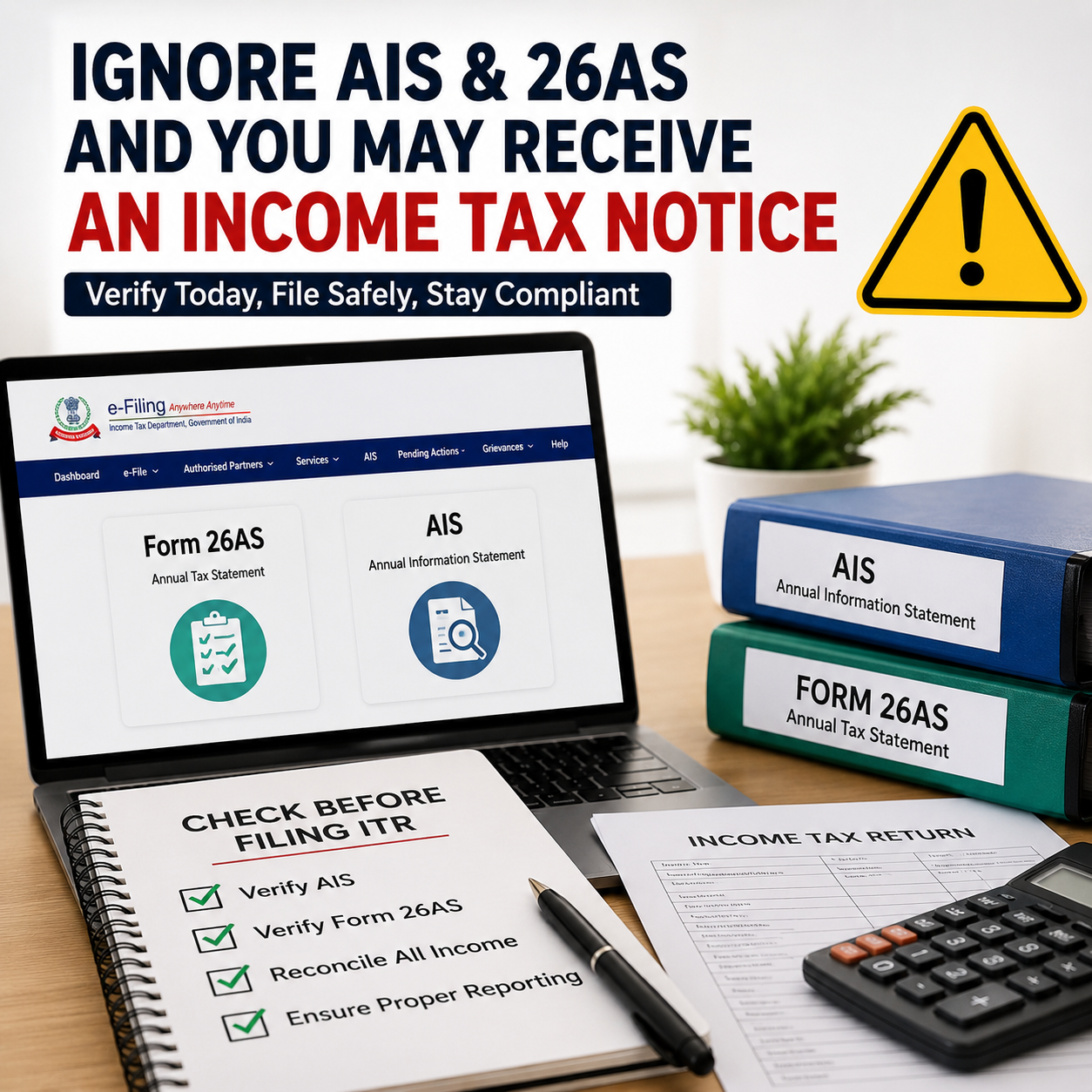
    • AIS/TIS mismatch communications

    Ignoring portal notices may lead to:

    • Best judgment assessments

    • Withholding of refunds

    • Penalty and prosecution proceedings

GST Authorities Notify Revised Advisory on ITC Blocking in GSTR-3B

Background of the Advisory

To improve discipline in Input Tax Credit (ITC), minimise manual mistakes, and enable accurate tracking of ITC reversals, reclaims, and Reverse Charge Mechanism (RCM) credits, GSTN has introduced two dedicated electronic statements on the GST portal:

  • Electronic Credit Reversal and Re-claimed Statement (ITC Reclaim Ledger)

  • RCM Liability / ITC Statement (RCM Ledger)

Initially, these statements were only informational and displayed warning messages. However, GSTN has now decided to enforce strict system-based validations, under which GSTR-3B filing will be blocked if excess ITC is claimed or ledger balances turn negative.

This advisory is particularly critical for regular GST taxpayers, especially those involved in:

  • ITC reversals under Rules 37, 42, and 43

  • Temporary ITC reversals followed by re-claims

  • Transactions covered under Reverse Charge Mechanism (RCM)


1. Electronic Credit Reversal & Re-claimed Statement (ITC Reclaim Ledger)

Introduction & Applicability

This ledger has been implemented from:

  • August 2023 for monthly filers

  • July–September 2023 quarter for QRMP taxpayers

Objective

Its main purpose is to monitor ITC that is reversed temporarily and subsequently reclaimed, ensuring proper linkage between the two.

Details Captured

The statement records:

  • ITC reversed in Table 4(B)(2) of GSTR-3B

  • ITC reclaimed through:

    • Table 4(A)(5)

    • Table 4(D)(1)

This mechanism ensures that only ITC previously reversed can be reclaimed.

Navigation Path

Dashboard → Services → Ledger → Electronic Credit Reversal and Re-claimed Statement


2. Current System Behaviour (Till Now)

At present:

  • If reclaimed ITC exceeds the available reversed balance,
    👉 the system only displays a warning message

  • GSTR-3B filing is still permitted

GSTN observed that many taxpayers ignored these alerts, which resulted in:

  • Negative balances in ledgers

  • Excess utilisation of ITC

  • Increased scrutiny, disputes, and notices later


3. RCM Liability / ITC Statement (RCM Ledger)

Introduction & Applicability

This ledger became operational from:

  • August 2024 for monthly filers

  • July–September 2024 quarter for QRMP taxpayers

Purpose

It ensures that:

  • RCM tax liability is properly discharged

  • ITC under RCM is claimed only after payment

Information Tracked

The statement captures:

  • RCM liability reported in Table 3.1(d) of GSTR-3B

  • Corresponding ITC claimed in:

    • Table 4(A)(2) – RCM on inward supplies

    • Table 4(A)(3) – RCM on import of services

Navigation Path

Services → Ledger → RCM Liability / ITC Statement


4. Opening Balance Facility – Relief Provided Earlier

GSTN had earlier allowed taxpayers multiple opportunities to:

  • Declare opening balances in both ledgers

  • Correct excess reversals or excess RCM ITC claimed earlier

  • Rectify historical mismatches before enforcement

This was offered as a one-time corrective measure to help taxpayers clean up past errors.


5. Key Upcoming Change – Mandatory System Validation

GSTN has now announced that shortly:

  • ❌ Negative ledger balances will not be allowed

  • ❌ Excess ITC claims will result in blocking of GSTR-3B filing


6. New Validation Rules – Explained Simply

A. Validation for ITC Re-claim (Table 4(D)(1))

ITC reclaimed in Table 4(D)(1) must not exceed:

Closing balance of ITC Reclaim Ledger
+
ITC reversed in Table 4(B)(2) of the same return

In simple terms:
You can reclaim ITC only if:

  • It was reversed earlier, or

  • It is being reversed again in the same tax period


B. Validation for RCM ITC Claim

RCM ITC claimed in Table 4(A)(2) and 4(A)(3) must not exceed:

RCM tax paid in Table 3.1(d) of the same period
+
Available balance in the RCM Ledger

In simple terms:
RCM ITC can be claimed only when:

  • The corresponding RCM tax is paid, or

  • Adequate balance is available in the RCM ledger


7. What If the Ledger Balance Is Already Negative?

A. Negative ITC Reclaim Ledger

A negative balance indicates that excess ITC was reclaimed in the past.

👉 Mandatory correction to file GSTR-3B:

  • Reverse the excess ITC in Table 4(B)(2)

    📌 When No ITC Is Available

    If sufficient ITC is not available for reversal:

    • The reversed amount will be automatically added to tax liability

    Illustration:

    • Closing balance: –₹10,000

    • ITC reversed in Table 4(B)(2): ₹10,000

    • If ITC is insufficient → the amount must be paid in cash as tax


    B. Negative RCM Ledger

    A negative balance in the RCM ledger indicates that RCM ITC has been claimed without corresponding tax payment.

    To successfully file GSTR-3B, the taxpayer must choose either of the following:

    1️⃣ Pay the pending RCM liability in Table 3.1(d)
    OR
    2️⃣ Reduce the RCM ITC claimed in Table 4(A)(2) / 4(A)(3)

    Illustration:

    • RCM Ledger balance: –₹5,000

    Options available:

    • Pay ₹5,000 as RCM tax
      OR

    • Reduce RCM ITC claim by ₹5,000


    8. Effect on GSTR-3B Filing – Practical Impact

    Once system validations are implemented:

    • ❌ GSTR-3B filing will be blocked if ledger balances are negative

    • ❌ Excess ITC re-claims or RCM ITC claims will not be permitted

    • ✔ Only accurate and reconciled ITC will be accepted

    This represents a clear transition from advisory-based compliance to strict enforcement.


    9. Important Takeaways for Taxpayers & Professionals

    ✔ Reclaim only ITC that was genuinely reversed earlier
    ✔ Claim RCM ITC only after ensuring tax payment
    ✔ Review ITC Reclaim Ledger and RCM Ledger regularly
    ✔ Rectify negative balances without delay
    ✔ Never ignore system warning messages
    ✔ Reconcile GSTR-3B figures with ledger balances every month


    10. Who Needs to Be Extra Vigilant?

    This advisory is particularly critical for:

    • Businesses facing delays in vendor payments

    • Taxpayers applying Rule 37 reversals

    • Entities availing provisional ITC

    • Businesses with high RCM exposure

    • Chartered Accountants and consultants managing multiple clients

    • Taxpayers who made manual ITC adjustments in earlier years


    Final Note

    This advisory signals a decisive move towards automated and system-driven ITC governance.
    Manual adjustments and post-compliance justifications are no longer sustainable.

    👉 Ledger balance now determines return filing eligibility.

    Taxpayers are strongly advised to immediately review their ITC Reclaim Ledger and RCM Ledger and correct discrepancies before validations are enforced, to avoid return filing blocks, additional cash payments, and departmental notices.

CBDT issues statement after Income Tax Department sends SMS to taxpayers

NEW DELHI: The Central Board of Direct Taxes (CBDT) on Tuesday urged taxpayers to voluntarily recheck the deductions and exemptions claimed in their annual income tax returns, after data analysis revealed that a significant number of claims were incorrect or ineligible.

Issuing a clarification following widespread discussion on social media about SMS alerts sent by the Income Tax Department, the CBDT said it has launched a special initiative to prompt taxpayers to review and rectify such claims on their own.

Under this drive, identified taxpayers are being contacted through SMS and email as part of the “Non-intrusive Usage of Data to Guide and Enable (NUDGE)” campaign, encouraging them to correct errors and file revised returns by December 31, 2025.

The CBDT explained that using advanced data analytics under its risk management framework, cases for Assessment Year 2025–26 have been flagged where claims such as bogus donations to Registered Unrecognised Political Parties (RUPPs) or other inadmissible deductions and exemptions appear to have been made. In some instances, incorrect or invalid PAN details of donees were used, or the deduction amounts claimed exceeded permissible limits, said CBDT spokesperson V Rajitha.

Taxpayers have been advised to verify the accuracy of their claims and submit revised returns wherever necessary to avoid further scrutiny.

However, the CBDT clarified that taxpayers whose deductions and exemptions are genuine and fully compliant with the law need not take any action.

Those who miss the December 31, 2025 deadline will still have the option to file an updated return from January 1, 2026, subject to payment of additional tax as prescribed.

The statement added that during FY 2025–26, over 21 lakh taxpayers have already updated their ITRs for assessment years 2021–22 to 2024–25, resulting in the collection of more than ₹2,500 crore. Additionally, more than 15 lakh returns have already been revised for the current assessment year.

Why 31 December Is So Important for Professionals and Businesses

31st December 2025 is far more than just the close of the calendar year.
It marks one of the most crucial compliance cut-off dates under GST, Income Tax, and MCA regulations for FY 2024-25 / AY 2025-26.

For Chartered Accountants, tax consultants, business owners, companies, and professionals, overlooking this deadline can lead to loss of refunds, late fees, penalties, and long-term litigation exposure.

Let us break down why this single date carries such immense importance.


🔴 1. Deadline for Filing GSTR-9 (GST Annual Return) – FY 2024-25

GSTR-9 is the annual GST return that provides a consolidated view of:

  • Outward supplies

  • Inward supplies

  • Input Tax Credit (ITC) claimed

  • Taxes paid

  • Year-end adjustments

Important points to note:

  • 31st December 2025 is the statutory due date for filing GSTR-9 for FY 2024-25

  • Filing is optional for taxpayers with AATO up to ₹2 crore

  • Once submitted, GSTR-9 cannot be revised

This return plays a key role in:

  • GST scrutiny proceedings

  • Departmental notices

  • ITC verification and reconciliation

Who needs to be especially cautious?

  • Businesses with multiple amendments during the year

  • Taxpayers who rectified FY 2024-25 errors in FY 2025-26

  • Taxpayers facing ITC mismatches with GSTR-2B


🔴 2. Due Date for Filing GSTR-9C (GST Reconciliation Statement)

GSTR-9C is a reconciliation statement comparing:

  • Audited financial statements

  • GSTR-9 annual return

Key highlights:

  • Applicable to taxpayers whose turnover exceeds the prescribed audit limit

  • 31st December 2025 is the final due date

  • Although now self-certified, it remains a high-risk compliance document

Any mismatch may trigger:

  • GST audits

  • Demand notices

  • Interest and penalty proceedings


🔴 3. Final Date to File Belated or Revised ITR – AY 2025-26

This is one of the most overlooked yet most critical year-end deadlines.

What closes on 31st December 2025?

  • Filing of Belated Income Tax Returns

  • Filing of Revised Income Tax Returns

Why this date is crucial:

  • It is the last chance for non-filers to submit their return

  • Errors in earlier returns can no longer be corrected after this date

  • Unclaimed income tax refunds may lapse permanently

Who should be extra alert?

  • Salaried individuals awaiting refunds

  • Professionals and freelancers with TDS deductions

  • Businesses that filed incorrect or incomplete returns earlier

  • Taxpayers who have received CPC intimations or mismatch notices

    🔴 4. MCA Annual Compliance – Extended Due Date up to 31st December 2025

    The Ministry of Corporate Affairs (MCA) has permitted companies to complete their annual compliance filings for FY 2024-25 on or before 31st December 2025.

    Forms included:

    • AOC-4 – Filing of financial statements

    • MGT-7 / MGT-7A – Annual return

    Why this deadline matters:

    • Filing within the extended timeline helps avoid substantial additional fees

    • Failure to comply may result in:

      • Monetary penalties on the company

      • Personal penalties on directors

      • Long-term risk of director disqualification


    🔴 5. PAN–Aadhaar Linking – Practical Year-End Implications

    While PAN–Aadhaar linking requirements differ based on taxpayer categories, 31st December 2025 effectively serves as a practical deadline to ensure:

    • Hassle-free income tax return filing

    • Timely processing of tax refunds

    • Prevention of PAN becoming inoperative for income tax purposes

    Taxpayers with pending PAN–Aadhaar linkage issues frequently encounter:

    • Delays or blockage of refunds

    • Difficulties in filing returns

    • Increased scrutiny, notices, and compliance-related delays

      📌 Professional Compliance Checklist – Tasks to Complete Before 31st December 2025

      ✔ Ensure filing of GSTR-9 for FY 2024-25
      ✔ Submit GSTR-9C wherever reconciliation requirements apply
      ✔ File belated or revised Income Tax Returns for AY 2025-26
      ✔ Complete MCA annual compliances, including AOC-4 and MGT-7 / MGT-7A
      ✔ Confirm and regularise PAN–Aadhaar linkage status
      ✔ Finalise reconciliations, verifications, and supporting documentation

GST in 2025: Simplified tax rates, quicker dispute resolution, and stricter compliance


Representative Image

Nearly ten years after its introduction, the Goods and Services Tax (GST) entered a more stable and mature phase in 2025. The emphasis moved away from resolving transitional challenges to creating a predictable, consistent, and trust-based tax system. Tax professionals have termed this phase GST 2.0, as multiple policy initiatives and compliance reforms reshaped India’s indirect tax landscape.

Experts say 2025 represents a decisive shift for GST, moving beyond legacy problem-solving towards addressing deeper structural inefficiencies. The focus this year was on curbing litigation and laying the groundwork for a more transparent and growth-oriented tax regime.

GST rate rationalisation takes centre stage

One of the most significant developments in 2025 was the rollout of GST rate rationalisation in September. The revised framework consolidated tax rates into fewer slabs — 5% for essential goods, 18% as the standard rate, and 40% for luxury and sin goods.

This restructuring aimed to ease the tax burden on widely consumed items while safeguarding government revenues. It also sought to resolve persistent classification disputes and inverted duty structures that had long fuelled litigation between taxpayers and authorities.

GST Appellate Tribunal finally operational

After prolonged delays, the GST Appellate Tribunal (GSTAT) became functional in 2025, completing the dispute resolution mechanism under GST.

The tribunal is expected to reduce pressure on high courts, ensure uniform interpretation of GST laws across states, and enable faster resolution of disputes. For MSMEs and mid-sized enterprises, this marks a crucial development that could substantially lower litigation costs and timelines.

“The operationalisation of the GST Appellate Tribunal completes the adjudication framework. It is expected to bring consistency in rulings, reduce the burden on high courts, and provide quicker and more predictable dispute resolution,” an expert said.

Government acts to safeguard revenue

In 2025, the government also addressed a key revenue concern by overturning the Supreme Court’s ruling in the Safari Retreats case, which had permitted input tax credit (ITC) on construction costs where buildings were used for taxable rentals.

Through the Finance Act, 2025, Section 17(5)(d) of the CGST Act was amended retrospectively from July 1, 2017. A subtle yet significant change in wording — replacing “plant or machinery” with “plant and machinery” — aligned the provision with the statutory definition that excludes buildings and civil structures. As a result, ITC on construction of buildings now stands explicitly blocked, even when such properties generate taxable rental income.

While the government described the earlier wording as a drafting oversight, experts noted that the amendment has far-reaching implications, particularly for the real estate and leasing sectors.

“This amendment could negatively impact businesses engaged in renting commercial properties. Its consequences may require companies to reassess financial and operational strategies,” an expert observed.

Relief for post-sale discounts

Among the more taxpayer-friendly measures introduced in 2025 was the relaxation of rules governing post-sale discounts. Following the 56th GST Council meeting, amendments to Sections 15(3)(b) and 34 of the CGST Act now permit suppliers to issue GST credit notes for post-sale discounts without linking them to individual invoices.

Experts say this reform brings GST law closer to standard commercial practices such as annual turnover-based rebates, reduces compliance burdens, minimises disputes, and improves overall ease of doing business.

As India approaches the next decade of GST, 2025 is likely to stand out as the year when the tax system transitioned decisively from stabilisation to deep structural reform.

Income Tax Department’s access to emails and social media from April 2026: What you need to know

A message widely circulating on social media claims that from April 1, 2026, the Income Tax Department will be empowered to access citizens’ social media accounts, emails, and other digital platforms to curb tax evasion. The viral claim has generated significant curiosity and concern among taxpayers about whether the tax authorities will actually receive such extensive powers.

In response to the growing confusion, the Press Information Bureau’s (PIB) Fact Check team issued a clarification through a post on X (formerly Twitter) to verify the authenticity of the claim.

What does the viral social media post claim?

According to a post shared by the handle @IndianTechGuide, the Income Tax Department would gain sweeping authority from April 1, 2026, to monitor and access private digital platforms, including emails and social media accounts, as part of efforts to tackle tax evasion.

Can the Income Tax Department access private digital accounts?

The PIB Fact Check team has clarified that the claim is misleading. It stated that the Income Tax Department will not receive any such blanket powers.

As per the clarification, Section 247 of the Income Tax Act, 2025 allows access to digital records only during authorised search and survey operations. Such action can be taken solely when there is credible evidence of significant tax evasion and a formal search operation has been initiated. In the absence of such proceedings, the department has no authority to access a taxpayer’s private digital space.

Can these powers be used for routine assessments?

The PIB further emphasised that these provisions cannot be used for routine tax processing, information gathering, or scrutiny assessments. The powers are strictly intended to combat black money and large-scale tax evasion during search and survey operations and are not applicable to law-abiding taxpayers.

Has the power to seize documents been newly introduced?

The clarification also noted that the authority to seize documents and evidence during search and survey operations has existed since the Income Tax Act, 1961 and is not a new provision under the 2025 Act.

What is black money?

Black money refers to income earned through illegal activities or income on which tax has not been paid. It may arise from legitimate sources that are not disclosed to tax authorities or from inherently illegal activities such as smuggling, illicit trade, counterfeit currency operations, arms trafficking, terrorism financing, and corruption. In essence, black money comprises assets or resources that were neither reported at the time of generation nor disclosed during their possession.

RBI puts Phase 2 of Cheque Truncation System on hold

The decision follows operational issues faced during the rollout of Phase 1.

The Reserve Bank of India (RBI) has deferred the implementation of Phase 2 of Continuous Clearing and Settlement on Realisation under the Cheque Truncation System (CTS) until further directions. The move is aimed at allowing banks additional time to stabilise and fine-tune their processes.

Phase 2 was originally scheduled to come into effect from January 3, 2026. However, the RBI cited challenges experienced during Phase 1 as the primary reason for the postponement.

After the introduction of the same-day cheque clearance facility on October 4, 2025, several banks, businesses, and individual customers reported delays in cheque realisation, highlighting system and operational glitches.

Under Phase 2, the item expiry time for cheques was proposed to be revised to T+3 clear hours. For instance, cheques received by the drawee bank between 10 am and 11 am would be required to be either positively or negatively confirmed by 2 pm, i.e., within three hours from the cut-off time.

If no confirmation is received from the drawee bank within the stipulated three-hour window, the cheque would be deemed approved and automatically included in the 2 pm settlement cycle.

Additionally, in its latest circular to banks, the RBI announced revisions in session timings. The presentation session has been rescheduled to 9 am to 3 pm, instead of the earlier proposed 10 am to 4 pm, while the confirmation session timing has been adjusted to 9 am to 7 pm, from the previously envisaged 10 am to 7 pm as mentioned in the August 2025 circular.

Income Tax Department Alerted 21 Lakh Taxpayers – Did You Receive the SMS? Take Action Immediately

Income Tax Alert: CBDT Launches NUDGE Campaign Against Incorrect Deductions & Exemptions (AY 2025-26)

Government of India | Ministry of Finance | Central Board of Direct Taxes
Press Release | 23 December 2025

The Central Board of Direct Taxes (CBDT) has released a significant advisory calling upon taxpayers to review their Income Tax Returns (ITRs) for Assessment Year 2025-26 and voluntarily rectify any incorrect claims of deductions or exemptions.

This action is part of the Government’s “NUDGE” Campaign (Non-intrusive Usage of Data to Guide and Enable), which focuses on encouraging voluntary tax compliance by using data analytics—without resorting to coercive or intrusive measures.

What Prompted This Action by CBDT?

Using advanced data analytics and risk management tools, the CBDT has detected several instances where taxpayers have made incorrect claims in their Income Tax Returns. These include cases where taxpayers have:

  • Claimed deductions or exemptions that are not legally admissible

  • Reported bogus or questionable donations, particularly to:

    • Registered Unrecognised Political Parties (RUPPs)

  • Quoted incorrect or invalid PAN details of donation recipients

  • Claimed deductions in excess of prescribed limits

  • Incorrectly disclosed exempt income amounts in their ITRs

Such inaccuracies lead to under-reporting of taxable income, making these returns prone to scrutiny.


📩 How Are Taxpayers Being Notified?

Taxpayers identified through this exercise are being informed through:

  • SMS

  • Email

These messages advise taxpayers to:

  • Review their already-filed ITRs

  • Voluntarily correct any errors, if found

⚠️ Important Clarification

This communication is not a statutory notice under the Income Tax Act.
It is an early compliance alert, giving taxpayers a chance to self-correct.


⏰ Deadline to Take Corrective Action

👉 31 December 2025

Before this date, taxpayers may:

  • File a Revised Return, or

  • Submit an Updated Return, wherever permitted

Timely correction can help avoid:

  • Further verification or scrutiny

  • Formal notices

  • Penalties or additional proceedings


📊 CBDT Data Shows Strong Voluntary Compliance

The CBDT has highlighted encouraging results from this approach:

  • Over 21 lakh taxpayers have already:

    • Updated their returns for AYs 2021-22 to 2024-25

    • Paid more than ₹2,500 crore in additional taxes

  • For AY 2025-26 alone, more than 15 lakh revised returns have been filed

These figures demonstrate that voluntary compliance is more effective than coercive enforcement.


✅ What Should Taxpayers Do Now?

Step-by-Step Guidance:

  1. Review your ITR carefully, especially:

    • Chapter VI-A deductions (Sections 80C, 80G, etc.)

    • Exempt income disclosures

  2. Verify supporting documents, such as:

    • Donation receipts

    • PAN details of donees

    • Eligibility criteria for exemptions

  3. If any discrepancy is found:

    • File a Revised or Updated Return

  4. If all claims are accurate and genuine:

    • No further action is required


❌ Who Does Not Need to Worry?

The CBDT has clearly assured that:

Taxpayers who have correctly claimed legitimate deductions and exemptions need not take any action.

Honest taxpayers remain fully safeguarded under this initiative.


📅 What Happens If This Opportunity Is Ignored?

  • Taxpayers may still file an Updated Return from 1 January 2026

  • However:

    • Additional tax liability will arise

    • The risk of future inquiries or assessments increases


🧠 Key Takeaway

The NUDGE Campaign reflects the government’s:

  • Trust-based, taxpayer-friendly approach

  • Emphasis on voluntary compliance

  • Strategic use of technology and data, instead of harassment

Senior Citizens Get Special Tax Advantages in 2026

Senior Citizens in India: Comprehensive Tax & Financial Benefits Guide 2026

The Government of India acknowledges the lifelong contribution of senior citizens and, in return, extends a broad set of tax concessions, exemptions, compliance relaxations, banking advantages, and lifestyle-related benefits to ensure financial stability and dignity during retirement.

This detailed guide explains 30+ benefits and features available to senior and super senior citizens in India for FY 2025–26 / AY 2026–27.


1. Definition of Senior Citizen Under Income Tax Law

As per the Income Tax Act:

  • Senior Citizen: Resident individual aged 60 years or more but below 80 years

  • Super Senior Citizen: Resident individual aged 80 years or above

  • Specified Senior Citizen (Section 194P): Resident aged 75 years or above, earning only pension and interest from the same bank, and eligible for exemption from filing ITR


2. Income Tax Slabs – New Tax Regime (FY 2025–26)

The New Tax Regime, which is now the default option, applies equally to all taxpayers, including senior citizens:

Total Income Tax Rate
Up to ₹4,00,000 Nil
₹4,00,001 – ₹8,00,000 5%
₹8,00,001 – ₹12,00,000 10%
₹12,00,001 – ₹16,00,000 15%
₹16,00,001 – ₹20,00,000 20%
₹20,00,001 – ₹24,00,000 25%
Above ₹24,00,000 30%

Taxpayers may still opt for the old tax regime if it offers better savings.


3. Zero Tax on Income Up to ₹12.75 Lakh – Major Relief

Under the New Regime:

  • Standard deduction on salary/pension: ₹75,000

  • Taxable income up to ₹12,00,000

  • Section 87A rebate applicable

As a result, a senior citizen earning up to ₹12.75 lakh from pension/salary pays zero income tax, making the new regime highly beneficial for retirees.


4. Higher Basic Exemption Under Old Tax Regime

Those opting for the old regime enjoy enhanced exemption limits:

Category Exemption Limit
General taxpayer ₹2,50,000
Senior Citizen (60–79 years) ₹3,00,000
Super Senior Citizen (80+ years) ₹5,00,000

5. Section 80TTB – Deduction on Interest Income

Senior citizens can claim a deduction up to ₹50,000 on interest earned from:

  • Savings bank accounts

  • Fixed & recurring deposits

  • Post office schemes

  • Co-operative bank deposits

This benefit is exclusive to senior citizens and replaces Section 80TTA.


6. Section 80D – Health Insurance & Medical Expenses

To reduce healthcare costs, senior citizens are eligible for:

  • ₹50,000 deduction for health insurance premium

  • Medical expenses allowed if insurance is not taken

  • Additional deduction for premiums paid for dependent parents


7. Section 80DDB – Deduction for Specified Diseases

For treatment of serious ailments such as cancer, kidney failure, Parkinson’s disease, etc., senior citizens can claim:

  • Deduction up to ₹1,00,000, subject to conditions and certification


8. No Advance Tax Liability (Section 207)

Senior citizens are not required to pay advance tax if:

  • They do not have business income, and

  • Their income consists only of pension and interest

This also protects them from interest under Sections 234B and 234C.


9. Relaxations in ITR Filing

Offline ITR Filing

Super senior citizens may file paper returns (ITR-1 or ITR-4) instead of mandatory e-filing.

Section 194P – ITR Filing Exemption

Eligible residents aged 75+ earning only pension and bank interest are not required to file ITR, as the bank computes and deducts tax.


10. TDS Benefits & Form 15H

  • Form 15H can be submitted to avoid TDS if total tax liability is nil

  • TDS threshold on interest income increased to ₹1,00,000 per year

  • No TDS on bank/post office interest up to this limit


11. Enhanced Family Pension Exemption

Under the new regime:

  • Exemption increased to ₹25,000 per year

  • Allowed as lower of one-third of pension or ₹25,000


12. LTCG Benefits on Equity Investments

Senior citizens enjoy:

  • Basic exemption adjustment up to ₹4,00,000

  • Additional ₹1,50,000 LTCG exemption

  • Effectively, LTCG up to ₹1.5 lakh can be tax-free


13. Reverse Mortgage – Capital Gains Exemption

Amounts received through reverse mortgage of a residential property:

  • Are not treated as transfer

  • Hence, no capital gains tax applies


14. Higher Interest Rates on Senior Citizen FDs

Banks generally offer:

  • Additional 0.50% interest for senior citizens

  • Up to 0.75% extra for super senior citizens


15. Senior Citizen Savings Scheme (SCSS)

Key features:

  • Eligibility: Age 60+

  • Maximum investment: ₹30 lakh

  • Quarterly interest payout (rate as notified)

  • Eligible for Section 80C deduction

  • Backed by Government of India


16. Other Social, Banking & Lifestyle Benefits

Senior citizens also enjoy several non-tax advantages, including:

  • Railway & state transport concessions

  • Airline fare discounts

  • Healthcare priority & hospital rebates

  • Enhanced Ayushman Bharat coverage

  • Doorstep banking services (age 70+)

  • Property tax & stamp duty rebates (state-wise)

  • Telecom concessions

  • State-sponsored old-age pension schemes


Conclusion

For FY 2026, senior citizens in India benefit from a strong combination of:

✔ Lower tax burden
✔ Simplified compliance
✔ Higher exemptions and deductions
✔ Secure investment options
✔ Banking and lifestyle privileges

These measures collectively aim to ensure financial independence, stability, and improved quality of life after retirement.

New Banking and Cash Transaction Rules from 2026

🇮🇳 Introduction – Why Banking Transactions Deserve More Attention Today

In a rapidly digitising India, almost every financial move—personal or professional—passes through the banking system. Whether it’s UPI collections, cash deposits, fixed deposits, or GST-related receipts, banks today function not just as facilitators but also as statutory reporting entities.

A common misconception among taxpayers is that only very large or suspicious transactions attract scrutiny from the Income Tax Department.
However, this assumption is incorrect.

Even regular, everyday transactions—if misunderstood, misclassified, or improperly reported—can:

  • Get reported under Specified Financial Transactions (SFT)

  • Reflect in AIS / Form 26AS

  • Trigger income-tax notices

  • Result in bank account restrictions

  • Create GST registration or compliance complications

The purpose of this article/video is not to alarm, but to educate and empower.

In this guide, we clearly explain:

  • Banking transaction limits applicable for 2026

  • Transactions that are most likely to attract scrutiny

  • Rules related to cash, UPI, fixed deposits, and withdrawals

  • How bank activity links with Income Tax and GST

  • Practical steps to remain compliant and notice-free

If you carefully apply the compliance tips shared towards the end, you can manage your finances legally, confidently, and without unnecessary tax anxiety.


1️⃣ Banking Transaction Modes & Applicable Limits

🟦 UPI (Unified Payments Interface)

UPI remains India’s most popular digital payment method.

  • Standard daily limit: ₹1,00,000 per user

  • Per-transaction limit: Generally ₹1 lakh (varies by bank)

  • Higher limits: Up to ₹5 lakh per day for specific categories such as education, healthcare, government payments, and capital market transactions (effective 15 September 2025)

💡 Banks may impose lower internal limits—always verify with your bank.


🟦 IMPS (Immediate Payment Service)

  • Usually capped at ₹5 lakh per day per account

  • Available 24×7, making it suitable for urgent, higher-value transfers (subject to bank limits)


🟦 NEFT (National Electronic Funds Transfer)

  • Minimum: ₹1

  • No statutory maximum limit

  • Banks may set daily caps

  • Suitable for large-value transfers without UPI/IMPS restrictions


🟦 RTGS (Real-Time Gross Settlement)

  • Minimum transaction value: ₹2 lakh

  • No upper limit prescribed

  • Best for very high-value, time-sensitive transfers


2️⃣ Cash Transactions & Deposit Rules

🔸 Cash Deposit Reporting (SFT)

Banks and financial institutions are required to report:

  • ₹10 lakh or more cash deposits in a savings account in a financial year

  • ₹50 lakh or more cash deposits in a current account

  • ₹10 lakh or more in fixed deposits during a financial year

👉 This does not mean tax is levied automatically, but the transaction is reported and may be examined.


🔸 Cash Receipt Restrictions – Section 269ST

  • Receiving ₹2 lakh or more in cash from a single person:

    • In one day, or

    • In a single transaction, or

    • For one occasion/event
      is prohibited.

💡 Penalty can be equal to the cash amount received.


🔸 Cash Loans & Repayments – Sections 269SS & 269T

  • Acceptance or repayment of loans/deposits in cash above ₹20,000 is not allowed.

  • Penalty equals the amount involved.


3️⃣ TDS on Cash Withdrawals – Section 194N

This provision discourages excessive cash usage and promotes transparency.

🧾 TDS Applicability on Cash Withdrawals

ITR Filing Status Withdrawal Limit TDS Rate
ITR filed for last 3 AYs Above ₹1 crore 2%
ITR not filed for last 3 AYs Above ₹20 lakh 2% up to ₹1 crore, 5% thereafter

📌 Limits apply per bank, calculated cumulatively for the financial year.


4️⃣ Specified Financial Transactions (SFT)

Banks report high-value transactions such as:

  • Cash deposits crossing prescribed limits

  • Large or unusual digital inflows/outflows

These details appear in AIS and Form 26AS and must align with your ITR disclosures.


5️⃣ GST Linkage With Bank Accounts

🟡 GST Registration Threshold

  • Goods: ₹40 lakh

  • Services: ₹20 lakh

If bank receipts exceed these limits, GST registration becomes mandatory.

⚠️ Non-linking of bank account on GST portal within 30 days may lead to GST suspension.


6️⃣ Mandatory Disclosures in ITR & GST

📌 Income Tax Return

  • All bank accounts must be disclosed

  • Unexplained SFT entries can trigger notices

📌 GST Portal

  • Primary bank account linking is compulsory

  • Non-compliance can result in registration suspension


7️⃣ Business Cash Payment Restriction – Section 40A(3)

  • Cash expenses exceeding ₹10,000 per person per day are not deductible

  • Encourages digital payments and proper documentation


8️⃣ Practical Tips to Stay Notice-Free

✅ Maintain separate accounts for business and personal use
✅ Reconcile UPI inflows with business records
✅ Avoid unnecessary cash transactions
✅ File ITR regularly to benefit from higher withdrawal thresholds
✅ Maintain documentation for all large-value transactions


🧠 Key Takeaways

  • Know your banking limits and comply with them

  • Large cash dealings attract reporting and penalties

  • Regular ITR filing provides tangible compliance benefits

  • GST-bank linkage is critical for business continuity

  • Proper record-keeping is your best defence against notices