
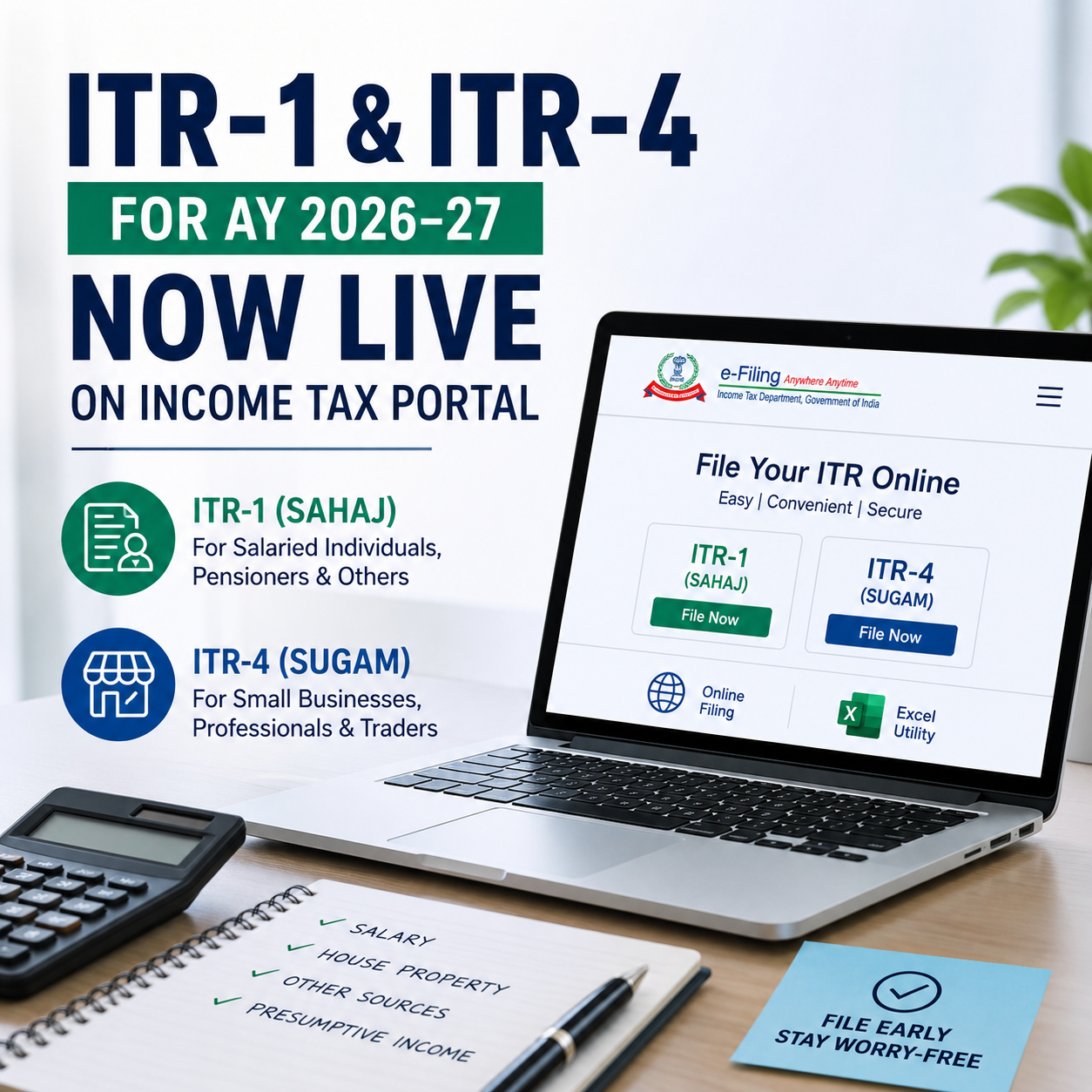

Income Tax Department Opens ITR-1 & ITR-4 Filing for AY 2026–27
Excel Utility & Online Filing Facility Now Available
The Income Tax Department has officially activated ITR-1 (Sahaj) and ITR-4 (Sugam) for Assessment Year 2026–27 on the Income Tax e-Filing Portal. Eligible taxpayers can now begin filing their Income Tax Returns through both:
- Online Filing Mode
- Excel Utility (Offline Mode)
available on the official Income Tax e-Filing Portal.
Major Relief for Salaried Individuals and Small Taxpayers
This update brings significant convenience for:
- Salaried individuals
- Pensioners
- Freelancers
- Small business proprietors
- Professionals opting for presumptive taxation
- Taxpayers filing simple income tax returns
Taxpayers can now prepare and submit returns in advance, helping them avoid last-minute technical issues and portal congestion.
ITR Forms Currently Enabled
1. ITR-1 (Sahaj)
ITR-1 is meant for resident individuals having:
- Salary or pension income
- Income from up to two house properties
- Income from other sources such as interest
- Agricultural income up to ₹5,000
- Total income up to ₹50 lakh
Who Is Not Eligible to File ITR-1?
ITR-1 cannot be used if the taxpayer has:
- Capital gains income
- Foreign income or foreign assets
- Business or professional income
- More than two house properties
- Directorship in a company
- Investment in unlisted equity shares
2. ITR-4 (Sugam)
ITR-4 applies to:
- Resident Individuals
- Hindu Undivided Families (HUFs)
- Partnership Firms (excluding LLPs)
earning income under presumptive taxation schemes such as:
- Section 44AD
- Section 44ADA
- Section 44AE
with total income up to ₹50 lakh.
Ideal For
- Small traders
- Retail shop owners
- Freelancers
- Consultants
- Professionals
- Small transport operators
Filing Options Available
The department has now enabled both filing methods:
✔ Online Filing
Eligible taxpayers can directly prepare and file their return online without downloading any software or utility.
✔ Excel Utility (Offline Filing)
Taxpayers can also download the Excel utility, prepare the return offline, generate the JSON file, and upload it on the portal.
This option is especially useful for:
- Chartered Accountants
- Tax professionals
- Bulk return filing
- Detailed verification before submission
Documents Required Before Filing ITR
Taxpayers should keep the following documents ready:
- PAN Card
- Aadhaar Card
- Form 16
- AIS/TIS
- Form 26AS
- Bank statements
- Interest certificates
- Investment proofs
- Home loan statement/certificate (if applicable)
Carefully Verify AIS and Form 26AS
Many taxpayers incorrectly rely only on Form 16 while filing returns.
Before filing, taxpayers should verify:
- Interest income
- Dividend income
- TDS credits
- Mutual fund transactions
- Share market transactions
- High-value transactions appearing in AIS
Any mismatch may lead to:
- Income tax notices
- Delay in refund processing
- Defective return notices
New Tax Regime Continues as Default
For AY 2026–27, the New Tax Regime remains the default tax regime for individual taxpayers.
However, eligible taxpayers may still choose the old tax regime within the prescribed timelines.
Before selecting the regime, taxpayers should compare:
- Available deductions and exemptions
- Total taxable income
- Rebate eligibility
- Final tax liability
Expected Due Date for Filing ITR
The expected due date for non-audit taxpayers for AY 2026–27 is:
31 July 2026
Taxpayers are advised not to wait until the deadline because:
- Heavy traffic may slow down the portal
- Refunds may get delayed
- Chances of filing mistakes increase near due dates
Advantages of Filing ITR Early
Faster Refunds
Early filers generally receive refunds sooner.
Easier Loan & Visa Processing
Income Tax Returns serve as valid income proof for:
- Home loans
- Vehicle loans
- Business loans
- Visa applications
Reduced Filing Errors
Early filing gives sufficient time to review and revise mistakes if needed.
Better Financial Planning
Taxpayers get clarity regarding tax payable or refund receivable at an early stage.
Steps to File ITR-1 or ITR-4
Step 1
Visit the Income Tax e-Filing Portal.
Step 2
Login using PAN and password.
Step 3
Navigate to:
e-File → Income Tax Return → File Income Tax Return
Step 4
Select:
- Assessment Year: 2026–27
- Relevant ITR Form
Step 5
Choose either:
- Online Filing Mode
- Offline Utility Mode
Step 6
Validate all details and submit the return.
Step 7
Complete e-Verification using:
- Aadhaar OTP
- Net Banking
- Demat Account EVC
- Bank Account EVC
Important Points to Check Before Submission
Before final filing, taxpayers should:
- Verify bank account details carefully
- Match TDS credits properly
- Reconcile AIS/TIS information
- Review deduction claims
- Confirm tax regime selection accurately
Filing the wrong ITR form or incorrect reporting of income may result in notices from the Income Tax Department.
Conclusion
The enabling of ITR-1 and ITR-4 for AY 2026–27 marks the beginning of the income tax return filing season for millions of taxpayers. With both online filing and Excel utility options now available, eligible taxpayers and professionals can start filing returns immediately without waiting for the deadline.
Filing returns early not only helps in faster refund processing but also minimizes the risk of errors, mismatches, and notices. Taxpayers should carefully reconcile all income and tax details before final submission of their return.