Major Rules Changing from 1 October 2026: GST, Tax, UPI, PF & TDS Updates You Need to Know

 Several new rules are scheduled to take effect, important compliance deadlines will fall during the month, and some major policy developments may also emerge.

In particular, people should keep an eye on important updates related to Income Tax, GST, UPI, PF, TDS, Aadhaar, and LPG.

It is important to note that not all of these changes will come into effect on 1 October itself. Some rules will become effective from 1 October, some are important developments taking place during October, while others were introduced in September but may have a more visible practical impact from October onwards.

Let us understand these updates one by one.


1. UPI MDR to Apply from 15 October 2026 — What You Need to Know

One of the major UPI-related developments in October concerns the introduction of a Merchant Discount Rate (MDR) framework.

From 15 October 2026, a new MDR framework will apply to specified Person-to-Merchant (P2M) UPI transactions. For eligible merchant transactions above ₹2,000, the standard MDR will be 0.4%. For transactions of ₹75,000 or more, the maximum MDR will be capped at ₹300 per transaction.

However, this does not mean that customers will have to pay a 0.4% charge on every UPI payment.

Person-to-Person (P2P) UPI transactions will continue to remain free. MDR will also not apply to merchant payments up to ₹2,000 and eligible transactions involving small merchants covered under the zero-MDR framework.

Another important point is that MDR is not a Government tax. It is a merchant-side charge distributed among participants in the payment ecosystem. Banks have also been advised to ensure that merchants do not pass this cost on to customers.

Therefore, if you make a UPI payment of ₹5,000 or ₹10,000, it should not automatically be interpreted as a “0.4% UPI tax” on the customer.

2. Tax Audit: Penalty Risk After 30 September 2026

For businesses and professionals, 30 September 2026 is an important compliance deadline.

For tax audit cases relating to FY 2025-26 (AY 2026-27), the due date for furnishing the tax audit report is 30 September 2026. The Income Tax Department has clarified that tax audits for FY 2025-26 will continue to be governed by the Income-tax Act, 1961, even if the audit report is filed after 1 April 2026.

If the tax audit report is not furnished by 30 September and the Government does not grant any extension, there may be an exposure to penalty under Section 271B.

The penalty is generally:

0.5% of turnover or gross receipts

or

₹1,50,000

whichever is lower.

ITR Due Date for Tax Audit Cases

For regular tax audit cases, the due date for filing the Income Tax Return (ITR) is 31 October 2026. Different deadlines may apply to taxpayers covered by transfer-pricing provisions.

According to the Income Tax Department’s FAQ, for FY 2025-26, the tax audit report is due by 30 September 2026, while the applicable ITR for audit cases is generally due by 31 October 2026.

3. Important GST Council Meeting Scheduled for 7 October 2026

Another major event for GST taxpayers in October is the upcoming 57th GST Council Meeting.

The 57th GST Council Meeting is now scheduled to be held on 7 October 2026 in New Delhi. The meeting was originally planned for 12 September but was later rescheduled. The meeting of GST officials is expected to take place on 5–6 October.

The meeting may discuss several GST process and compliance reforms, including matters relating to ITC rules, GST registration, e-invoicing, refunds, and GST-related litigation.

However, taxpayers should keep one important point in mind:

A discussion or recommendation by the GST Council does not automatically mean that a new GST rule will become effective on the same day.

Where required, any proposed change may need a formal notification, amendment to the rules, or a legislative amendment before it becomes applicable.

Therefore, taxpayers with an existing GST demand, ITC dispute, or statutory compliance deadline should not postpone their existing compliance obligations simply because they are waiting for the 7 October meeting.


4. No TAN Requirement for Property Purchase from an NRI

From 1 October 2026, the TAN requirement for a resident Individual or HUF purchasing immovable property from an NRI for TDS purposes is being removed.

As per Budget 2026, in such transactions the buyer will be able to deduct and report TDS using their PAN. The seller’s PAN will also need to be quoted in the relevant challan-cum-statement.

In simple terms, the earlier mechanism was:

Resident Individual/HUF + NRI Seller → TAN required

From 1 October 2026, the mechanism will be:

Resident Individual/HUF + NRI Seller → PAN-based TDS compliance

It is important to understand that removal of the TAN requirement does not mean that the TDS obligation itself has been abolished. Applicable TDS provisions will continue to apply, and the buyer must comply with the relevant requirements.

This change is particularly relevant for individuals and HUFs purchasing immovable property from NRI sellers.


5. EPF Wage Ceiling Increased from ₹15,000 to ₹25,000

A significant employee-related development concerns EPFO coverage.

The Government has increased the wage ceiling for mandatory EPFO coverage from:

₹15,000 → ₹25,000 per month

The change is effective from 17 September 2026, meaning its practical implications may start appearing in October payroll and subsequent payroll processing. According to the Government, around 51 lakh additional employees could potentially come under EPFO coverage.

This means that a substantial number of eligible employees earning wages between ₹15,000 and ₹25,000 per month may now come within the statutory EPF framework, subject to the applicable scheme provisions.

For example, if the contribution is calculated at 12% on the revised ceiling of ₹25,000:

₹25,000 × 12% = ₹3,000

Under the earlier ₹15,000 ceiling:

₹15,000 × 12% = ₹1,800

This results in a potential difference of:

₹3,000 − ₹1,800 = ₹1,200

However, the actual EPF contribution for an individual employee will depend on the person’s applicable EPF membership status and the relevant provisions of the scheme.

6. Children’s Aadhaar Mandatory Biometric Update — Free Facility Available Until 30 September

Parents should also take note of an important deadline at the end of September.

According to UIDAI, the Mandatory Biometric Update (MBU) for children aged 5 to 17 years is available free of charge until 30 September 2026.

Therefore, if your child’s mandatory biometric update is still pending, it would be advisable to complete it before 30 September, as the special free-of-cost facility is available only until this date.

One important clarification is that this is not the regular Aadhaar authentication process. It refers specifically to the Mandatory Biometric Update, under which biometric details such as the child’s fingerprints, iris scans, and photograph are updated.


7. Aadhaar Biometric Authentication Required for Subsidised LPG

Another important consumer-related development takes effect from October.

From 1 October 2026, domestic LPG consumers will need to complete Biometric Aadhaar Authentication (BAA) to book refills at the regulated retail selling price along with the applicable subsidy.

Consumers who have not yet completed the authentication can reportedly do so through any of the following options:

  • At the time of LPG delivery
  • At the LPG distributor’s showroom
  • Through the relevant Oil Marketing Company’s mobile application

According to the Government, 27.43 crore consumers, or approximately 89.9%, had already completed the authentication. Those consumers do not need to take any further action.

LPG consumers should therefore check whether their Aadhaar biometric authentication has already been completed.


8. TDS and TCS: Key Points to Keep in Mind During October

TDS and TCS compliance will also remain important for businesses during October. With the transition to the new Income-tax Act, taxpayers must be particularly careful not to confuse FY 2025-26 / AY 2026-27 with FY 2026-27 / Tax Year 2026-27.

Compliance relating to income earned during FY 2025-26 (AY 2026-27) will continue to be governed by the Income-tax Act, 1961.

On the other hand, income relating to FY 2026-27 (Tax Year 2026-27) will fall under the framework of the new Income-tax Act, 2025.

The Income Tax Department has provided clarification regarding this transition.

Therefore, while filing TDS/TCS returns, making challan payments, issuing certificates, or completing other related compliances during October, taxpayers should ensure that they select the correct financial year, tax year, applicable Act, and relevant form.


9. Companies Should Also Review Their MCA/ROC Compliance

For companies, October is not limited to tax-related compliance. Depending on the company’s AGM date and applicable provisions, several MCA/ROC filings may also become due during October.

These may include, where applicable:

  • AOC-4 / AOC-4 XBRL
  • ADT-1
  • MSME-related reporting
  • Other event-based ROC filings

The exact due date is not the same for every company. Certain filings depend on factors such as the actual AGM date and the company’s category.

Companies should therefore review their MCA compliance calendar before the beginning of October and identify all applicable filing deadlines.


10. Do Not Miss Regular GST and Other October Compliance Deadlines

The GST Council meeting is not the only GST-related development to watch in October. Regular GST return filing and tax payment obligations will continue to apply according to their respective due dates.

Taxpayers should not assume that the 7 October GST Council meeting will automatically postpone existing GST return or tax payment deadlines.

Accordingly, GSTR-1, GSTR-3B, CMP-08, and other applicable GST compliances should continue to be completed within their respective due dates, unless the Government officially announces a specific extension.


October 2026: Major Updates at a Glance

Update Important Date Who Is Affected?
TAN requirement removed for resident Individual/HUF purchasing property from an NRI 1 October 2026 NRI property buyers
Aadhaar Biometric Authentication for LPG 1 October 2026 Eligible subsidised LPG consumers
57th GST Council Meeting 7 October 2026 GST taxpayers and businesses
UPI MDR framework 15 October 2026 Specified merchant transactions
PF wage ceiling increased from ₹15,000 to ₹25,000 17 September 2026; impact on October payroll Eligible employees and employers
Free Aadhaar MBU facility for children ends 30 September 2026 Children aged 5–17
Tax Audit Report due date 30 September 2026 Tax audit cases
ITR due date for audit cases 31 October 2026 Tax audit cases

Conclusion

October 2026 is more than just the beginning of a new month. It brings several important compliance requirements, regulatory developments, and financial updates that may affect taxpayers, businesses, employees, and consumers.

Before October begins, it is therefore important to prepare a checklist covering GST returns, tax audit, ITR filing, TDS/TCS, PF, Aadhaar, LPG requirements, MCA/ROC filings, and other applicable compliances.

Keeping track of the relevant dates and completing the required actions on time can help taxpayers and businesses stay up to date with the applicable rules.

New Rules from 1 September 2026: Key Updates on ITR, Tax, GST and Banking

From 1 September 2026, several important developments will affect taxpayers, bank customers, and businesses. However, it would not be technically correct to say that every change is a “new law effective from 1 September.” Some are consequences arising after the 31 August deadline, while others are important regulatory developments scheduled during September. Certain banking-related changes may also vary from one bank to another.

Therefore, this article explains the key changes and developments that taxpayers, businesses, and bank customers should be aware of from 1 September 2026 onwards, particularly:

  • ITR filing after 31 August
  • Filing of Belated ITR
  • New timeline for Revised ITR
  • 57th GST Council Meeting
  • ATM withdrawal charges
  • Possible changes in bank-specific charges
  • New security features and alphanumeric codes in cheque books
  • Important tax compliance deadlines in September

ITR Filing: 31 August Deadline Has Ended

One of the most significant developments concerns Income Tax Return filing.

For AY 2026-27, the applicable due date for non-audit taxpayers to file their ITR was 31 August 2026. Therefore, after 31 August, the normal deadline for filing an original return under Section 139(1) has expired.

The Income Tax Department has also clarified that 31 August 2026 was the applicable due date for non-audit taxpayers for AY 2026-27.

Accordingly, if an eligible taxpayer files an ITR on or after 1 September 2026, it will generally be treated as a Belated Return.


Which ITR Can Be Filed After 1 September?

Missing the 31 August deadline does not mean that taxpayers can no longer file their ITR.

Taxpayers who failed to submit their original return by 31 August can still file a Belated Return, subject to the applicable provisions.

For AY 2026-27:

Last Date for Filing Belated ITR: 31 December 2026

As per the Income Tax Department, a belated return for AY 2026-27 can be filed up to 31 December 2026, subject to the earlier completion of assessment.

However, filing a belated return may attract the applicable late filing fee:

  • Total income up to ₹5 lakh → ₹1,000
  • Total income above ₹5 lakh → ₹5,000

In addition, interest on outstanding tax liability may also apply wherever applicable.

Therefore, the key takeaway from 1 September is:

ITR filing does not stop after 31 August. However, returns filed after the deadline will generally be treated as Belated Returns, and applicable late filing fees may be payable.

Major Change in the Revised ITR Filing Timeline

There is an important change regarding Revised Income Tax Returns for AY 2026-27.

If you have already filed your ITR within the prescribed time and later discover any issue, such as:

  • Income was not reported;
  • An incorrect deduction was claimed;
  • Bank interest was missed;
  • There was an error in reporting capital gains;
  • A TDS mismatch was noticed;
  • Incorrect information was entered;

you can generally file a Revised Return to correct the details.

The timeline for filing a revised return has also been extended compared with the earlier framework.

New Last Dates for Revised ITR

31 December 2026

If the Revised ITR is filed on or before 31 December 2026, the return can be filed within this extended timeline without the additional fee prescribed under Section 234I.

31 March 2027

A Revised ITR can also be filed between 1 January 2027 and 31 March 2027. However, in such cases, the additional fee prescribed under Section 234I will apply.

The Income Tax Department’s current FAQs specifically confirm that for AY 2026-27, a revised return can be filed up to 31 March 2027, subject to completion of assessment. A revised return filed after 31 December 2026 will attract the applicable Section 234I fee.

In Simple Terms:

Type of ITR Last Date Consequence
Original ITR – Non-Audit 31 Aug 2026 Normal due date has expired
Belated ITR 31 Dec 2026 Late filing fee + applicable interest
Revised ITR 31 Dec 2026 No Section 234I additional fee
Revised ITR after 31 Dec 31 Mar 2027 Section 234I additional fee applicable

Therefore, if you have already filed your ITR but later realize that there is an error or omission, filing the revised return before 31 December 2026 may be financially more beneficial.


Important Difference Between Belated and Revised ITR

Taxpayers should clearly understand the difference between these two types of returns.

Belated Return

If the original ITR was not filed within the applicable due date:

31 August deadline missed → Belated ITR

Revised Return

If the ITR has already been filed and an error is discovered later:

ITR already filed → Revised ITR

Therefore, a taxpayer who did not file the ITR by 31 August 2026 will generally need to file a Belated Return.

On the other hand, a taxpayer who filed the ITR on or before 31 August 2026 but later discovers an error can generally file a Revised Return to correct it.

57th GST Council Meeting: Major Meeting Scheduled for 12 September

September brings an important development for GST taxpayers and businesses.

The 57th GST Council Meeting is scheduled to take place in New Delhi on 12 September 2026.

According to the official memorandum issued by the GST Council Secretariat:

57th GST Council Meeting

Date: 12 September 2026
Time: 11:00 AM onwards

A meeting of GST officers will also be held one day earlier:

Officers’ Meeting

Date: 11 September 2026
Time: 11:00 AM onwards

This GST Council meeting is being held after a gap of more than a year since the previous Council meeting.


ATM Cash Withdrawal Charges

Now let us look at an important development concerning the banking sector.

Under the RBI’s existing framework, customers are entitled to a certain number of free ATM transactions every month.

At the customer’s own bank’s ATM, the general framework provides for:

5 Free Transactions

At another bank’s ATM:

Metro Cities — 3 Free Transactions

Non-Metro Cities — 5 Free Transactions

Once the free transaction limit is exhausted, banks may charge up to ₹23 per transaction, along with applicable taxes.


Are All Banks Increasing ATM Charges from 1 September?

No.

This distinction is very important.

The RBI specifies the maximum permissible charges, while individual banks determine their actual applicable fee structure within the regulatory framework.

Therefore:

ATM charges can differ depending on the bank and the type of account.

For example, certain banks may have separate charges for:

  • Additional ATM transactions;
  • Non-financial ATM transactions;
  • Cash withdrawals;
  • Balance enquiries.

Customers should therefore check their bank’s latest Schedule of Charges to understand the applicable fees during September.

Important Point

It would be incorrect to assume that ₹23 is a fixed charge for every ATM transaction.

The ₹23 amount relates to the applicable maximum customer charge after the prescribed free transaction limit has been exceeded, subject to the RBI framework.


ATM Transaction Failed but Money Was Debited?

This is another important protection available to bank customers.

If an ATM transaction fails and:

  • Money is debited from the bank account; but
  • Cash is not dispensed by the ATM,

the bank is required to reverse the amount within the prescribed timeline.

Under the RBI framework, failed ATM transactions have an outer reversal timeline of T+5 calendar days.

If the amount is not reversed beyond this prescribed period, a compensation of ₹100 per day is applicable.

Therefore, if an ATM transaction fails, customers should not simply wait for the refund.

Keep records such as:

Bank statement + ATM receipt + Complaint Number

New Alpha-Numeric Security Code May Be Introduced in Cheque Books

Cheque users may also see an important development going forward from September.

Several banks are introducing additional security features in cheque leaves to strengthen cheque security and reduce the risk of cheque fraud.

One such feature is the Alpha-Numeric Code.

An alpha-numeric code means that, instead of using numbers alone, a combination of letters and numbers may be printed on the cheque leaf.

The primary objective is to strengthen cheque authentication and help prevent fraudulent cheque transactions.

For example, policy documents of Bank of India mention the Alphanumeric Code as an enhanced security feature, and the bank has introduced it in its new-series cheque books.


Will All Old Cheque Books Become Invalid After 31 December 2026?

Customers should be cautious about such claims circulating on social media.

Some banks have issued communications asking customers to adopt new-series cheque books with enhanced security features.

However, it would be incorrect to claim that:

“The RBI has made all old cheque books across India automatically invalid after 31 December 2026.”

Requirements for replacing an existing cheque book may depend on the specific instructions issued by the respective bank.

Therefore, if your bank asks you to:

  • Obtain a new cheque book;
  • Replace your existing cheque series;
  • Use a newly introduced alphanumeric security code;

you should follow the bank’s instructions.

Customers who frequently use cheques for high-value transactions should especially verify the validity of their cheque book and any applicable security requirements.

The RBI’s Cheque Truncation System (CTS) framework has also continued to focus on cheque security, standardisation, and prevention of cheque-related fraud.


Second Advance Tax Instalment Due in September

September is important not only for banking and ITR matters but also for Income Tax compliance.

For taxpayers covered by the advance tax provisions, 15 September 2026 is an important due date for the second instalment of Advance Tax.

Generally, cumulative advance tax payments are scheduled as follows:

15 June → 15%

15 September → 45%

15 December → 75%

15 March → 100%

These percentages are subject to the applicable provisions and taxpayer circumstances.

Therefore, taxpayers who are liable to pay advance tax should review their estimated income, tax liability, and payments already made before the September deadline.


GST Compliance Also Remains Important in September

September is also an important month for GST taxpayers because of various regular compliance deadlines.

Monthly filers should keep track of the applicable due dates for August 2026 transactions, including returns and tax payments.

Important GST compliances may include:

  • GSTR-1
  • GSTR-3B
  • GSTR-7
  • GSTR-8
  • GSTR-5
  • GSTR-6
  • QRMP-related payments

Taxpayers should verify the applicable due dates based on their registration type and filing frequency.

Moreover, the 12 September GST Council Meeting makes September 2026 particularly significant from the perspective of GST policy developments.


Another Important Income Tax Deadline in September

September is also significant for taxpayers covered by tax audit requirements.

For applicable tax audit cases for AY 2026-27, the Tax Audit Report is due by 30 September 2026, while the corresponding ITR filing deadline may fall later depending on the applicable category.

The Income Tax Department has also clarified the tax audit report timeline for AY 2026-27.

Therefore, audit taxpayers should not assume:

“The ITR due date is in October, so there is no compliance required in September.”

The Tax Audit Report must be submitted first, within the prescribed timeline.


MCA DIR-3 KYC: No Longer an Annual Requirement

The MCA has provided an important compliance relief for company directors.

Earlier, DIN holders generally had to complete DIR-3 KYC compliance every year.

However, the MCA has amended the Companies (Appointment and Qualification of Directors) Rules and changed the annual KYC requirement.

DIR-3 KYC Is No Longer Required Every Year

Under the revised system, DIR-3 KYC Web is required once in every three consecutive financial years.

This change became effective from 31 March 2026.

Therefore, directors should understand an important point in September 2026:

DIR-3 KYC is no longer an annual compliance requirement.

However, There Is an Important Condition

If there is any change in the Director’s:

  • Mobile Number
  • Email Address
  • Residential Address

the updated details must be reported through DIR-3 KYC Web within 30 days, along with the applicable fee.

Therefore, directors should ensure that their contact and residential details remain updated in the MCA records.

Therefore, do not assume that no MCA KYC update is required for the next three years.

Example

Suppose a director was allotted a DIN during FY 2025-26.

In that case, the director’s three-year KYC cycle will begin from that financial year, and the applicable DIR-3 KYC Web filing will be required in the third consecutive financial year.

For directors who had already completed their KYC by FY 2025-26, the MCA indicates that their next KYC filing cycle would generally be due by 30 June 2028.

Another Important Point

If there is any change in the director’s:

Mobile Number / Email Address / Residential Address

there is no need to wait for the three-year KYC cycle.

Such changes must be updated within the prescribed period as applicable.

Therefore, in September 2026, directors should review their:

DIN + KYC Status + Mobile Number + Email Address + Residential Address

to ensure that all details are accurate and up to date.


Companies Compliance Facilitation Scheme 2026

According to the recent update, the window for the Companies Compliance Facilitation Scheme, 2026 (CCFS-2026) has been extended up to 15 September 2026.

The scheme provides eligible companies with an opportunity to regularise pending statutory filings, subject to the applicable terms and conditions.

This can be particularly useful for companies that have outstanding or delayed MCA filings.

September MCA Compliance Checklist

For Directors:

  • Check the DIR-3 KYC cycle
  • Update any changes in mobile number, email address, or residential address

For Companies:

  • Review pending MCA forms
  • Check eligibility under CCFS-2026
  • Ensure the 15 September deadline is not missed, wherever applicable

Major Opportunity for Small Taxpayers with Foreign Assets — FAST-DS 2026

The Government has introduced the Foreign Assets of Small Taxpayers – Disclosure Scheme, 2026 (FAST-DS).

It is a one-time voluntary disclosure opportunity that allows eligible taxpayers to declare specified foreign assets or foreign income that may not have been disclosed earlier, subject to the prescribed conditions.

Most importantly:

On 1 September 2026, the Income Tax Department enabled FAST-DS Form 1 for online filing.

This makes FAST-DS an important Income Tax development associated with 1 September 2026.


Who May Benefit from FAST-DS?

The scheme may be relevant for eligible taxpayers who hold certain specified foreign assets or foreign income that were not properly disclosed earlier.

Some examples include:

1. Foreign Bank Account

An individual may have opened a bank account abroad while studying or working overseas and later returned to India, but the account was not properly disclosed.

2. Foreign Shares / ESOP / RSU

An employee may have received:

  • ESOPs
  • RSUs
  • Shares
  • Other securities

from a foreign company, but the required foreign asset disclosure may have been missed.

3. Foreign Insurance

A person may hold a foreign insurance policy or a cash-value insurance contract that was omitted from the required disclosure.

4. Foreign Property

A taxpayer may own property or another specified asset outside India that was not disclosed as required.

5. Foreign Income

Income earned from a foreign source may not have been appropriately reported for Indian tax purposes.

The Income Tax Department’s FAQs specifically refer to situations such as MNC employees holding foreign ESOPs/RSUs, former students with dormant overseas bank accounts, and returning non-residents as examples of potentially relevant cases.


What Is the Value Limit Under FAST-DS?

An important distinction needs to be understood here.

Broadly, the scheme provides for two categories.

Category A

Where the combined value of specified undisclosed foreign income/assets is up to ₹1 crore, the prescribed scheme mechanism may apply.

Under this category, the prescribed amount is calculated at 60% of the relevant value, subject to the applicable provisions.

Category B

For certain specified foreign assets or income having a value of up to ₹5 crore, a separate mechanism applies. Subject to the prescribed conditions, there is a provision for a ₹1 lakh fee.


FAST-DS Last Date

This is one of the most important dates to remember:

31 December 2026

The last date for submitting a declaration under the scheme is 31 December 2026.

Therefore, eligible taxpayers have a limited window beginning in September 2026 to evaluate their position and take appropriate action.

What Should Foreign Asset Holders Do?

If you have any of the following:

  • Foreign Bank Account
  • Foreign Shares
  • ESOPs / RSUs
  • Foreign Property
  • Foreign Insurance
  • Foreign Investments
  • Foreign Income

and believe that a previous disclosure may have been missed or incomplete, the matter should not be ignored.

The first step should be to determine:

Am I eligible for FAST-DS?

If you are eligible, then carefully evaluate:

Value + Source + Applicable Category + Tax/Fee + Supporting Documentation

before making the disclosure.


Important: A Foreign Asset Is Not Limited to a Foreign Bank Account

A foreign asset does not simply mean a bank account maintained outside India.

Foreign shares, securities, ESOPs, RSUs, insurance policies, overseas property, investments, and other specified foreign assets may also be relevant depending on the applicable disclosure requirements.

Therefore, taxpayers should review their complete overseas asset and income position rather than checking only for foreign bank accounts.

Taxpayers often assume:

“I do not have a foreign bank account, so I do not need to worry about Schedule FA.”

However, this assumption may not always be correct.

Depending on the circumstances, foreign assets may include:

  • Foreign bank accounts
  • Foreign custodial accounts
  • Foreign equity or debt interests
  • Foreign financial interests
  • Immovable property located outside India
  • Foreign insurance or cash-value policies
  • Interests in foreign trusts
  • Foreign accounts for which the taxpayer has signing authority
  • Other specified foreign assets

The Income Tax Department also covers several categories within the scope of foreign asset disclosure.


FAST-DS and Foreign Asset Disclosure in ITR — Understand Both Separately

This distinction is also important for taxpayers.

FAST-DS is a special one-time disclosure scheme.

On the other hand, under the regular ITR filing framework, eligible resident taxpayers are required to disclose applicable foreign assets and foreign income through the prescribed schedules.

According to the Income Tax Department, Schedule FA, Schedule FSI, and Schedule TR are associated with the disclosure of foreign assets and foreign income. These schedules are not available in ITR-1 and ITR-4.

Therefore, taxpayers holding foreign assets should not consider only:

“Is my income taxable?”

They should also ask:

“Do I have any foreign assets or foreign income, and am I required to disclose them?”


🚨 1 September 2026 — Major Tax Update

The Foreign Assets of Small Taxpayers Disclosure Scheme (FAST-DS) 2026 – Form 1 has become available for filing through the Income Tax e-Filing Portal.

Eligible taxpayers can disclose specified undisclosed foreign assets or income subject to the prescribed conditions.

Last Date: 31 December 2026


Important SFT Reporting Thresholds

The following transactions may be reportable under the Statement of Financial Transactions (SFT) framework once the specified thresholds are reached:

S. No. Transaction SFT Reporting Threshold
1 Cash payment for purchasing a bank draft, pay order, or banker’s cheque ₹10 lakh or more in a financial year (with PAN); ₹5 lakh or more (without PAN)
2 Cash deposits in savings or other accounts, excluding current accounts and time deposits ₹10 lakh or more in a financial year (with PAN); ₹5 lakh or more (without PAN)
3 Time deposits, excluding renewal of another time deposit ₹10 lakh or more in a financial year
4 Credit card bill payments ₹1 lakh or more in cash OR ₹10 lakh or more through other modes in a financial year
5 Purchase of bonds or debentures ₹10 lakh or more in a financial year
6 Purchase of shares or payment towards share application money ₹10 lakh or more in a financial year
7 Buy-back of shares, other than purchases through the open market ₹10 lakh or more in a financial year
8 Sale or purchase of foreign currency, forex cards, etc. ₹10 lakh or more with PAN; ₹5 lakh or more without PAN
9 Purchase, sale, gift, or Joint Development Agreement (JDA) involving immovable property ₹45 lakh or more, or stamp duty value of ₹45 lakh or more
10 Purchase of stamp paper ₹2 lakh or more in a single transaction with PAN; ₹1 lakh or more without PAN
11 Payment of insurance premiums ₹5 lakh or more in a financial year with PAN; ₹2.5 lakh or more without PAN
12 Cash receipts from the sale of goods or services by a specified person liable to tax audit More than ₹2 lakh

Disclaimer

The proposed or expected changes discussed in relation to the GST Council should not be treated as final GST law unless officially notified. Before taking any action relating to tax, GST, or banking transactions, taxpayers and businesses should verify the relevant official notification, circular, and applicable instructions issued by their bank.

Why Quotation Management is Important for Every Business

Why Quotation Management is Important for Every Business

In today’s competitive business world, sending a professional quotation is the first step toward winning a customer’s trust and closing more deals. A quotation helps businesses clearly explain product pricing, taxes, discounts, delivery details, and terms before the final order confirmation.

Without a proper quotation system, businesses face:

  • Manual calculation errors
  • Delayed customer response
  • Unprofessional document formats
  • Poor follow-up management
  • Difficult sales tracking

That’s why EASY SMART SHOP provides a complete and advanced Quotation Management System designed to simplify your sales process and improve business productivity.


EASY SMART SHOP – Advanced Quotation Management System

Smart Dashboard for Fast Operations

https://images.openai.com/static-rsc-4/om9vy4T4iR-6RO6FEP37l99yiXJVbRmnQ8rW7H4rxgPpCkvn3rgIQX_s098fHX0X0TNQm7s4z2WbqRPmU3bQtQTG2HHdTJc-e8sw4BsH_e2Te5Wpndm1kQRsP4Ev-gzj2ufodJHhFuvNKPQFP2q3YB4YAy2bSDlz3ZyUSydeq8hivnbNMSBzNhZbpusqwIXK?purpose=fullsize

The EASY SMART SHOP dashboard gives users quick access to all important quotation and sales features from a single screen.

Dashboard Features:

  • New Quotation Creation
  • Sales Order Management
  • Invoice Generation
  • Purchase Management
  • Customer Management
  • Inventory Tracking
  • Job Management
  • Notification Alerts
  • Reports & Accounts

The software is designed with a simple and user-friendly interface so businesses can work faster and more efficiently.


Complete Quotation Management Panel

The Quotation Management screen helps businesses manage all quotations in one place.

Features Available:

  • Pending Quotation Tracking
  • Rejected Quotation Records
  • Final Quotation Management
  • Customer-wise Quotation Filter
  • Follow-Up Date Management
  • Closing Date Tracking
  • Sales ID & Invoice Linking

Businesses can easily track quotation status and follow up with customers at the right time.


Professional Quotation Creation Window

EASY SMART SHOP allows users to create detailed and professional quotations within seconds.

Powerful Features:

  • Item-wise quotation entry
  • GST tax calculation
  • Discount management
  • HSN code support
  • Quantity & stock tracking
  • Automatic amount calculation
  • CGST / SGST / IGST support
  • Subject & customer requirement notes

The software automatically calculates totals, taxes, discounts, and final invoice amounts, reducing manual errors.


Customer Detail Management

The Customer Details section helps businesses maintain professional customer records.

Information Managed:

  • Customer Name
  • Address
  • Contact Number
  • Email Address
  • GST Number
  • State Selection
  • Reference Details
  • Designation Information

This helps businesses maintain organized customer communication and accurate documentation.


Advanced Features in EASY SMART SHOP

The software includes multiple advanced features that make business operations faster and smarter.


Proforma Invoice System

Businesses can instantly convert quotations into professional Proforma Invoices.

Benefits:

  • Professional invoice format
  • GST-ready documents
  • Faster customer approval
  • Easy printing & sharing
  • Sales process automation

E-Mail Proforma Invoice

The software allows direct emailing of Proforma Invoices to customers.

Advantages:

  • Instant customer communication
  • PDF attachment support
  • Faster deal confirmation
  • Paperless workflow
  • Professional business impression

E-Mail Quotation Feature

Users can directly send quotations through email from the software.

Benefits:

  • One-click quotation sharing
  • Fast customer response
  • Better follow-up process
  • Improved sales conversion

Create Delivery Challan

EASY SMART SHOP also provides Delivery Challan creation for product dispatch management.

Features:

  • Delivery document generation
  • Dispatch tracking
  • Customer delivery records
  • Professional challan format

    Quotation Follow-up & Updates –
    Easily track quotation follow-ups and make quick updates based on customer requirements.
    Quotation History Management –
    Maintain a complete history of all quotations, making it easy to access previous records anytime.
    Document Management –
    Store and manage all quotation-related documents, PDFs, bills, and attachments in one secure place for better organization and faster access.


Terms & Conditions Management

The software allows users to add custom Terms & Conditions in quotations.

Features:

  • Add custom terms
  • Edit existing terms
  • Save templates
  • Reuse quotation formats
  • Print-ready documentation

This makes every quotation more professional and legally clear.


Why Businesses Prefer EASY SMART SHOP

✔ Professional Quotation System
✔ GST Billing Support
✔ Proforma Invoice Feature
✔ Email Quotation Sending
✔ Delivery Challan Management
✔ Customer Database Management
✔ Smart Tax Calculation
✔ Inventory Integration
✔ User-Friendly Interface
✔ Faster Business Workflow


Perfect Solution For

  • Retail Shops
  • Wholesale Businesses
  • Electronics Shops
  • Mobile Shops
  • Service Centers
  • Hardware Stores
  • Manufacturing Businesses
  • Computer Shops
  • Distributors

Grow Your Business with EASY SMART SHOP

EASY SMART SHOP helps businesses manage quotations, invoices, customers, and sales operations professionally from one software platform.

With advanced quotation features, automated calculations, email integration, and delivery management, businesses can save time, reduce manual work, and improve customer satisfaction.


EASY SMART SHOP

“FOR EVERY SHOP & EVERYONE IN THE SHOP”

New Regulations for TDS Return Rectification Applicable from 01-04-2026

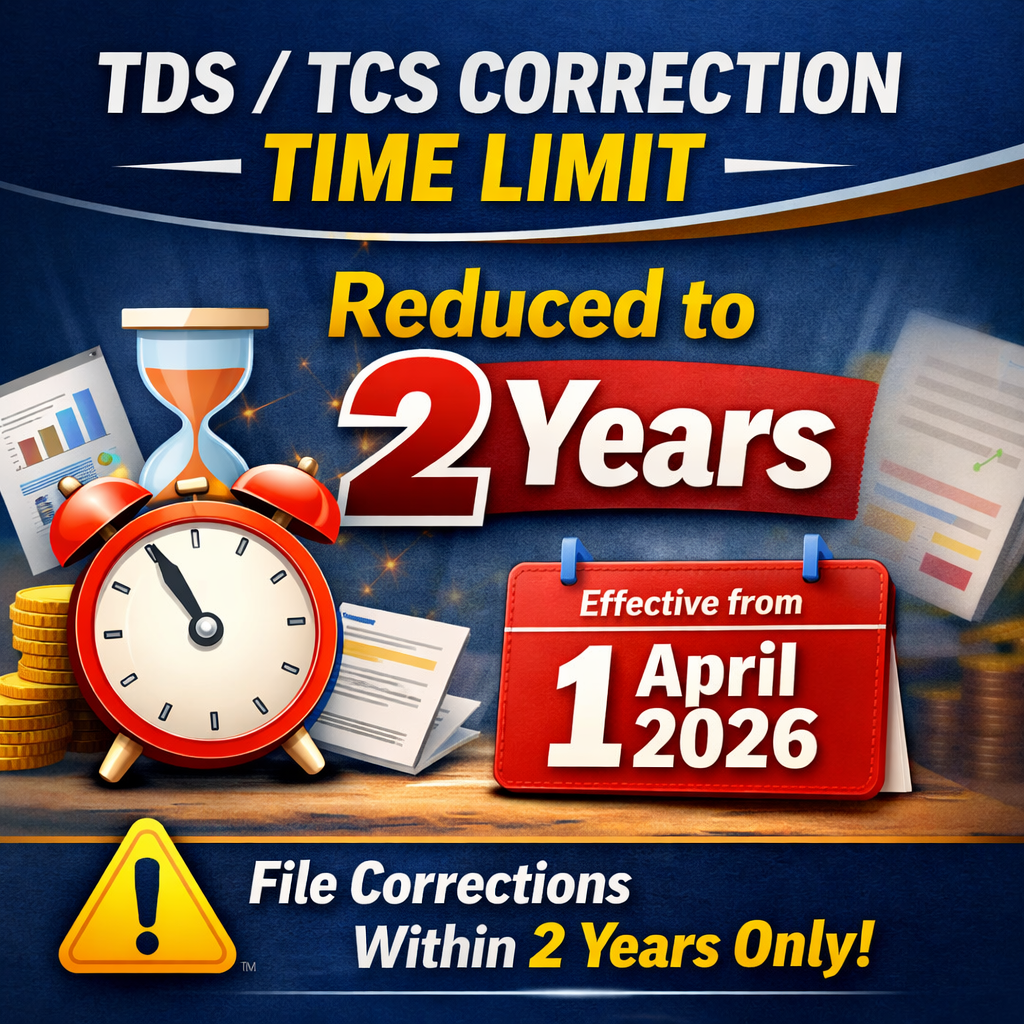
TDS / TCS Correction Statements: Time Limit Cut Down to 2 Years (Effective 01 April 2026)

🔔 What’s the Latest Change?

The Income Tax Department has introduced a major compliance reform by reducing the time limit for filing TDS and TCS correction statements to just 2 years, applicable from 1 April 2026.

Until now, deductors had the flexibility to revise old TDS/TCS returns even after many years. This long-standing practice will no longer be permitted.


⏳ Key Change Explained: Old Rule vs New Rule

🔙 Earlier Position (Before 01.04.2026)

  • No strict statutory deadline for filing correction statements

  • Corrections were practically allowed up to 7 years or more

  • Deductors commonly rectified:

    • Incorrect PAN details

    • Challan mapping errors

    • Short or excess deduction

    • Late reporting issues

  • Corrections were accepted even after several years

🔜 New Rule (From 01.04.2026)

  • ⛔ Correction statements allowed only within 2 years

  • The 2-year period will be calculated from:

    • End of the relevant financial year

  • ❌ No correction will be permitted beyond this period

  • This is a strict and absolute deadline, not extendable in any case


📅 Last Opportunity for Old TDS/TCS Periods

Correction statements for the following quarters will be allowed only up to 31 March 2026:

  • Q4 of FY 2018–19

  • Q1 to Q4 of FY 2019–20 to FY 2022–23

  • Q1 to Q3 of FY 2023–24

⚠️ From 1 April 2026 onwards, the TRACES portal will permanently block corrections for these periods.


❌ Impact of Missing the 2-Year Deadline

Failure to file corrections within the prescribed time may result in:

  • ❌ Permanent denial of correction facility

  • ❌ Loss of TDS/TCS credit for deductees in Form 26AS / AIS

  • ❌ Disputes with employees, vendors, or contractors

  • ❌ Penalties ranging from ₹10,000 to ₹1,00,000

  • ❌ Higher compliance and audit risks

  • ❌ Interest liability and possible disallowance of expenses


✅ Reason Behind This Amendment

The department aims to promote:

  • Timely reconciliation of data

  • Faster and accurate credit to deductees

  • Reduced backlog of old corrections

  • Lower litigation and disputes

  • A shift towards real-time, technology-driven compliance

This change reflects a move towards strict timelines and disciplined reporting.


🧾 Best Practices Suggested by the Department

  • Regularly use TRACES utilities and validation tools

  • Track defaults and mismatches frequently

  • File correction statements immediately upon detecting errors

  • Train staff on the revised timelines

  • Adopt a preventive compliance approach


📌 Action Checklist for Deductors & Tax Professionals

✔ Review all pending TDS/TCS correction requirements
✔ Resolve old mismatches before 31 March 2026
✔ Strengthen internal review and control systems
✔ Inform clients and staff about the 2-year non-negotiable limit

Attention – Advisory on IMS

Oct 14th, 2024


      • Invoice Management System (IMS) is made available to taxpayers from Today, 14th Oct, 2024. The new system shall facilitate taxpayers in matching their records/invoices vis a vis issued by their suppliers for availing the correct Input Tax Credit (ITC). Taxpayers can make use of this system to take action on the invoices reflecting on IMS from 14th Oct, 2024. The first GSTR-2B would be generated for the return period Oct’24 on 14thNovember, 2024 considering action taken on Invoice Management System. It may be noted that it is not mandatory to take action on invoices in IMS dashboard for GSTR-2B generation.


Thanking You,
Team GSTN