
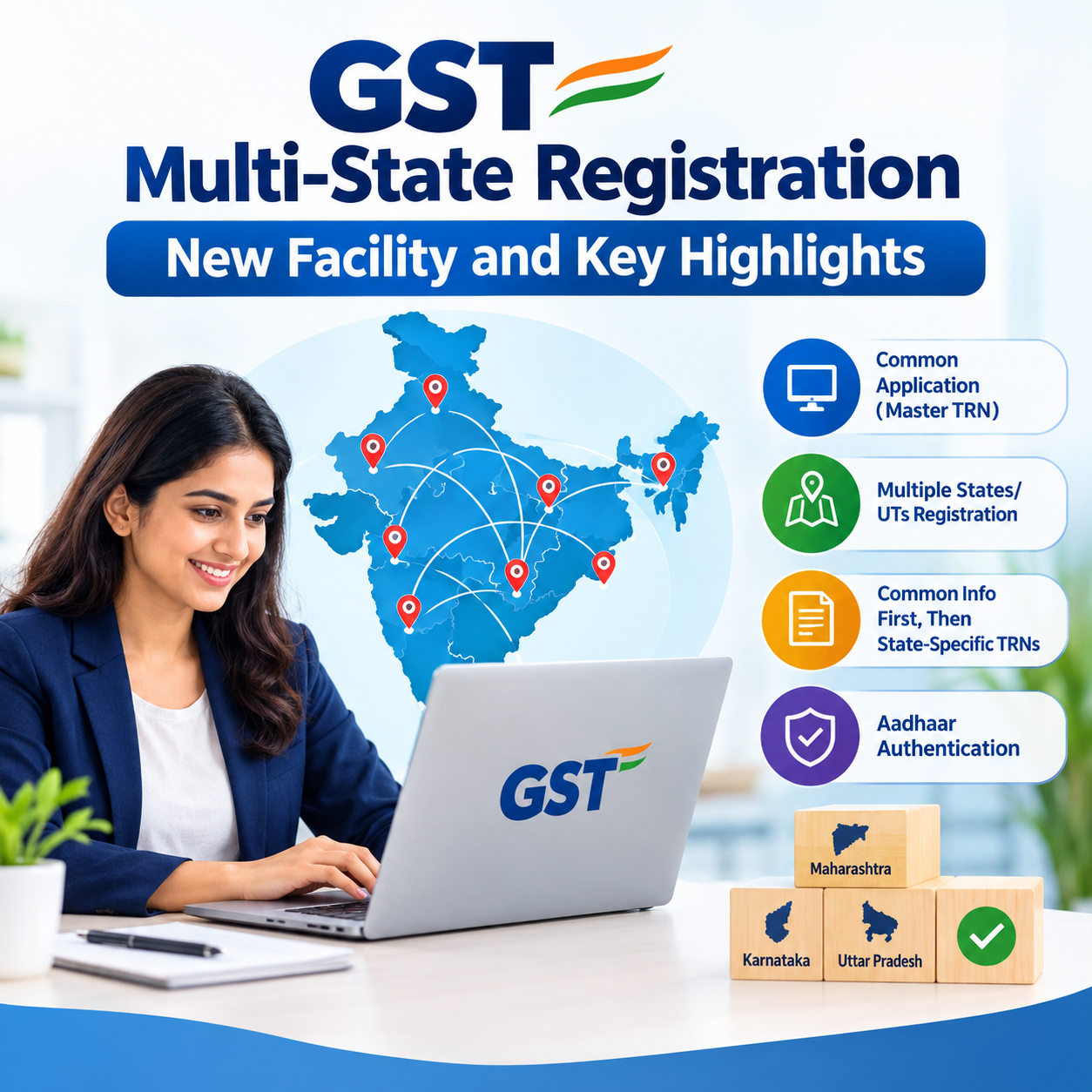
New GST Multi-State Registration Facility: Key Details
GSTN launches a new facility for GST registration across multiple States/UTs
Facility introduced from: 1 October 2026
GST registration has become more convenient for businesses that operate or plan to operate in multiple States and Union Territories.
GSTN has introduced a new “Multistate Registration” functionality on the GST Common Portal. This facility allows taxpayers having the same PAN to start GST registration applications for multiple States/UTs through a single process, eliminating the need to repeatedly enter common registration information for each State.
At present, the facility is available only to Normal Taxpayers.
The new functionality aims to simplify the registration process by reducing duplicate data entry and making it easier for businesses with operations in multiple States and Union Territories to complete their GST registrations.
What Is the New Multistate GST Registration Facility?
The GST Common Portal has introduced a new “Multistate Registration” facility for taxpayers who need GST registration in more than one State or Union Territory.
Under this facility, applicants can select all the required States/UTs together instead of initiating completely separate registration processes from the beginning for each State.
The applicant first enters the common details through a Master Temporary Reference Number (Master TRN).
After the common registration information is submitted, the GST portal creates separate State-specific TRNs for each selected State/UT.
This helps eliminate the need to repeatedly enter the same basic information for every State registration application.
Who Is Eligible to Use This Facility?
The Multistate Registration functionality is intended for taxpayers who:
- Need GST registration in multiple States or Union Territories;
- Have the same PAN for all the registrations; and
- Are registered or applying as a Normal Taxpayer.
According to the GSTN advisory, the functionality is currently available specifically for Normal Taxpayers.
Therefore, it should not be understood as a registration facility currently available to every category of taxpayer.
Where Can Applicants Find the New Multistate Registration Option?
A dedicated “Multistate Registration” option has been added to the GST Common Portal homepage.
Using this option, an applicant can choose the States and/or Union Territories where GST registration is required.
Once the required locations are selected, the portal generates a Master Temporary Reference Number (Master TRN).
This Master TRN is then used to provide the common registration details applicable to the selected registrations.
What Does Master TRN Mean?
The Master TRN (Temporary Reference Number) is generated after the applicant selects the States/UTs for which GST registration is required.
It serves as the initial reference for entering and submitting the Common Registration Information (CRI) for all the selected locations.
As a result, the applicant does not need to enter the same basic information separately at the initial stage of every State registration application.
This common-data approach is one of the key advantages of the new Multistate Registration facility.
What Is Common Registration Information (CRI)?
After receiving the Master TRN, the applicant can enter the Common Registration Information (CRI).
The GSTN advisory includes various common details, such as:
1. Business Information
Details concerning the business and its basic constitution are provided at this stage.
2. Promoter or Partner Details
Information relating to promoters or partners can be included in the common registration details.
3. Authorised Signatory Details
Details of the authorised signatory are also captured as part of the common information.
4. Authorised Representative
Where applicable, information relating to the authorised representative can also be provided.
5. Goods and Services
Details of the goods and services supplied or dealt with by the business are included in the common registration information.
The major benefit is that these common details are entered once instead of being repeatedly entered for every State.
Master TRN Must Be Submitted Within 15 Days
One important requirement under the GSTN advisory is that the Master TRN must be submitted within 15 days.
Simply generating the Master TRN does not mean that the GST registration process has been completed.
The applicant must use the Master TRN to provide and submit the Common Registration Information within the specified 15-day period.
Practical Tip
Businesses should keep the necessary information and supporting documents ready before starting the Multistate Registration process.
Generating a Master TRN without completing the common information within the prescribed period could result in unnecessary delays.
What Happens After the Common Information Is Submitted?
The major benefit of the new facility becomes visible after the Common Registration Information (CRI) is successfully submitted.
Once the CRI is submitted through the Master TRN, the GST portal generates separate TRNs for each State/UT selected by the applicant.
For example, assume a business requires GST registration in:
Delhi + Haryana + Maharashtra + Karnataka
The applicant can select all four locations through the Multistate Registration option.
The process will broadly work as follows:
Master TRN is generated
↓
Common Registration Information is entered and submitted
↓
Individual State-specific TRNs are generated
↓
Separate State registration applications are completed
Therefore, the applicant does not need to repeat the entire registration process independently from the beginning for every State.
Which Details Are Auto-Populated in State Applications?
Once the State-specific TRNs are generated, the common information submitted through the CRI is automatically populated in the respective State registration applications.
Importantly, the GSTN advisory clarifies that this information remains editable.
Applicants should therefore carefully review the pre-filled information and make corrections or modifications wherever required before submitting the individual State applications.
What Details Need to Be Entered Separately for Each State?
The Multistate Registration facility does not eliminate the need to provide State-specific information.
After the common details are carried forward, the applicant must complete the information applicable to each individual State/UT.
This includes:
Principal Place of Business (PPoB)
Details of the Principal Place of Business applicable to the particular State registration must be provided.
Additional Place of Business (APoB)
Where applicable, the applicant must enter details of the Additional Place of Business for that State.
State-Specific Details
Any other information specifically required for the relevant State/UT registration must also be furnished.
Aadhaar Authentication
Where applicable, the required Aadhaar authentication process must be completed separately for the respective registration application.
Does Multistate Registration Mean One GSTIN for Multiple States?
No.
The new facility does not create a single GST registration number that covers multiple States.
Instead, it simplifies the GST registration application process.
The applicant enters common information once through the Master TRN, after which that information is carried forward into the respective State applications.
Each State/UT will continue to have its own GST registration and applicable State-specific requirements.
In short, the new Multistate Registration facility makes applying for GST registrations across multiple States more convenient by reducing repetitive data entry while retaining separate State-wise registration requirements.
Master TRN vs State-Specific TRN
The new GST Multistate Registration process becomes easier to understand when the roles of the Master TRN and State-Specific TRN are separated.
| Particulars | Master TRN | State-Specific TRN |
|---|---|---|
| Role | Starts the common registration procedure | Used to complete registration for a particular State/UT |
| Generated when | After the applicant selects multiple States/UTs | After the Common Registration Information (CRI) is submitted |
| Common details | Common information is provided through it | Common information is pre-filled |
| PPoB | Not provided at the common stage | Must be provided for the relevant State |
| APoB | Not provided at the common stage | Required wherever applicable |
| State-specific details | Not required at this stage | Must be furnished |
| Aadhaar authentication | Forms part of the complete registration procedure | Completed for the relevant State application, wherever applicable |
In short, the Master TRN serves as the common entry point, while the State-Specific TRNs allow the applicant to proceed with registration separately for each selected State or Union Territory.
Key Benefit: Less Repetition in Data Entry
The biggest advantage of the Multistate Registration facility is that it helps businesses avoid entering identical information multiple times.
Previously, a business requiring GST registrations in several States generally had to complete separate applications and provide common business information repeatedly.
For businesses operating in many States, this could involve entering the same details again and again, including:
- Business information;
- Promoter or partner details;
- Authorised signatory information;
- Authorised representative details; and
- Goods and services information.
Under the new system, the common details are submitted through the Common Registration Information (CRI) at the initial stage.
That information is then carried forward to the respective State applications, making the registration procedure more convenient and efficient.
Does the Facility Provide a Single GSTIN for Multiple States?
No.
The introduction of Multistate Registration does not mean that a business will receive one GSTIN covering all its States.
The facility is designed to allow taxpayers to start applications for multiple State/UT registrations through a common process.
Once the Master TRN and CRI stages are completed, separate State-specific TRNs are generated. The applicant must then complete the registration requirements for each individual State or Union Territory.
Therefore, the facility simplifies the registration application workflow, but the State-wise GST registration structure continues to remain in place.
Multistate Registration: Step-by-Step Example
Consider a company named ABC Private Limited that has the same PAN and requires GST registration in:
Haryana, Delhi, Maharashtra and Karnataka.
The process would broadly work as follows.
Step 1 – Select the States
ABC Private Limited opens the Multistate Registration option on the GST Common Portal and selects Haryana, Delhi, Maharashtra and Karnataka.
Step 2 – Obtain the Master TRN
After the States are selected, the portal generates a Master TRN.
Step 3 – Provide Common Details
The applicant uses the Master TRN to submit the Common Registration Information.
The common information may include:
- Business details;
- Promoter/director/partner information, as applicable;
- Authorised signatory details;
- Authorised representative details, wherever applicable; and
- Goods and services details.
Step 4 – Submit the Master TRN
The Master TRN has to be submitted within the prescribed 15-day period.
Step 5 – Generate State-Specific TRNs
After submission of the CRI, the portal creates individual TRNs for the selected States:
- Haryana
- Delhi
- Maharashtra
- Karnataka
Step 6 – Complete Each State Application
The common information is carried forward and auto-populated in the respective State applications.
The applicant then completes the remaining State-level requirements, such as:
- Principal Place of Business;
- Additional Place of Business, where applicable;
- State-specific information; and
- Aadhaar authentication, wherever required.
Thus, the common registration information does not have to be entered from scratch for every State.
Who Can Benefit From the New Facility?
The Multistate Registration functionality can be particularly helpful for businesses that have operations spread across different parts of India.
Examples include businesses with:
- Multiple branches;
- Warehouses in different States;
- Manufacturing plants in different locations;
- Offices across various States;
- Distribution or supply networks; and
- Several State-wise business establishments.
Such businesses may require multiple GST registrations.
The ability to provide common registration information once can reduce the administrative effort involved in preparing multiple applications.
Which Information Still Has to Be Provided Separately?
The new facility does not remove State-specific requirements.
Even after the common information has been submitted, the applicant must complete the information relevant to each individual State or Union Territory.
The State-level information includes:
Principal Place of Business
The applicant must provide the PPoB details applicable to the particular State registration.
Additional Place of Business
Where relevant, APoB details must also be furnished for that State.
State-Specific Information
Any information specifically required for the relevant State/UT must be completed separately.
Aadhaar Authentication
Where applicable, the required Aadhaar authentication must be completed as part of the respective State registration application.
For example, if a company operates warehouses in both Haryana and Maharashtra, the applicable location details for Haryana and Maharashtra will still need to be entered separately.
How Can Tax Professionals Use This Facility?
The new functionality can also be useful for CAs, GST consultants and tax professionals managing multiple registrations for their clients.
Instead of preparing every application independently from the beginning, the work can be divided into common and State-specific information.
Stage 1 – Common Data Preparation
The professional can first collect and verify:
- Business details;
- Promoter/partner details;
- Authorised signatory information;
- Authorised representative information; and
- Goods and services details.
Stage 2 – State-Wise Data Preparation
Separate State-level information can then be arranged for:
- PPoB;
- APoB;
- State-specific requirements; and
- Applicable Aadhaar authentication.
This two-stage approach can make the registration exercise more structured and reduce duplicate data entry.
Important Things to Keep in Mind
Taxpayers should consider the following points before starting the Multistate Registration process.
1. Currently Applicable to Normal Taxpayers
As stated in the GSTN advisory, the functionality is presently available for Normal Taxpayers.
2. Same PAN Is Required
The facility is designed for obtaining multiple State/UT registrations under the same PAN.
3. Master TRN Is Not the Final Registration
Generating the Master TRN does not mean that GST registration has been completed.
The applicant must submit the CRI and subsequently finish the individual State applications.
4. 15-Day Requirement
The Master TRN must be submitted within 15 days as prescribed under the functionality.
5. State-Level Details Continue
PPoB, APoB, State-specific information and applicable Aadhaar authentication still need to be completed for the respective State applications.
6. Common Data Is Auto-Populated
After the CRI is submitted, the common registration information is automatically carried into the individual State applications.
7. Pre-Filled Information Can Be Modified
The auto-populated information is editable. Applicants should therefore check the details carefully and make corrections wherever necessary before submitting the State application.
How Does Multistate Registration Make GST Compliance Easier?
The main purpose of the new functionality is to minimise duplicate information entry.
For businesses seeking GST registrations across multiple States, entering identical details separately can take additional time and may create inconsistencies between applications.
With the new process, common information can be submitted once and subsequently used in the selected State/UT applications.
This can make the registration procedure more organised, especially for businesses that are expanding their operations across multiple States.
Conclusion
The new Multistate Registration facility introduced on the GST Common Portal provides a more streamlined approach for taxpayers who need GST registrations in multiple States or Union Territories.
The process begins with the selection of the required States/UTs, following which a Master TRN is generated. Through this Master TRN, the applicant submits the Common Registration Information, covering common details such as business information, promoters/partners, authorised signatory, authorised representative and goods/services.
After the CRI is submitted, the portal generates individual State-Specific TRNs. The common information is then auto-populated into the respective State applications.
However, applicants must still complete State-specific requirements, including Principal Place of Business, Additional Place of Business, State-specific information and applicable Aadhaar authentication.
Therefore, Multistate Registration does not replace separate GST registrations for individual States. Its main purpose is to make the application process faster and easier by reducing repetitive entry of common information.
For businesses with a presence across several States, as well as professionals managing multiple GST registrations, this functionality can help create a more efficient registration workflow.
In Simple Terms
Select States/UTs → Generate Master TRN → Submit Common Information → Generate State TRNs → Complete Individual State Applications
The facility is currently available for Normal Taxpayers, and taxpayers should refer to the latest GST Common Portal instructions while using the functionality.
Source: GSTN Advisory on the “Multistate Registration” Facility for GST Registration, dated 1 October 2026.