Senior Citizens Get Special Tax Advantages in 2026

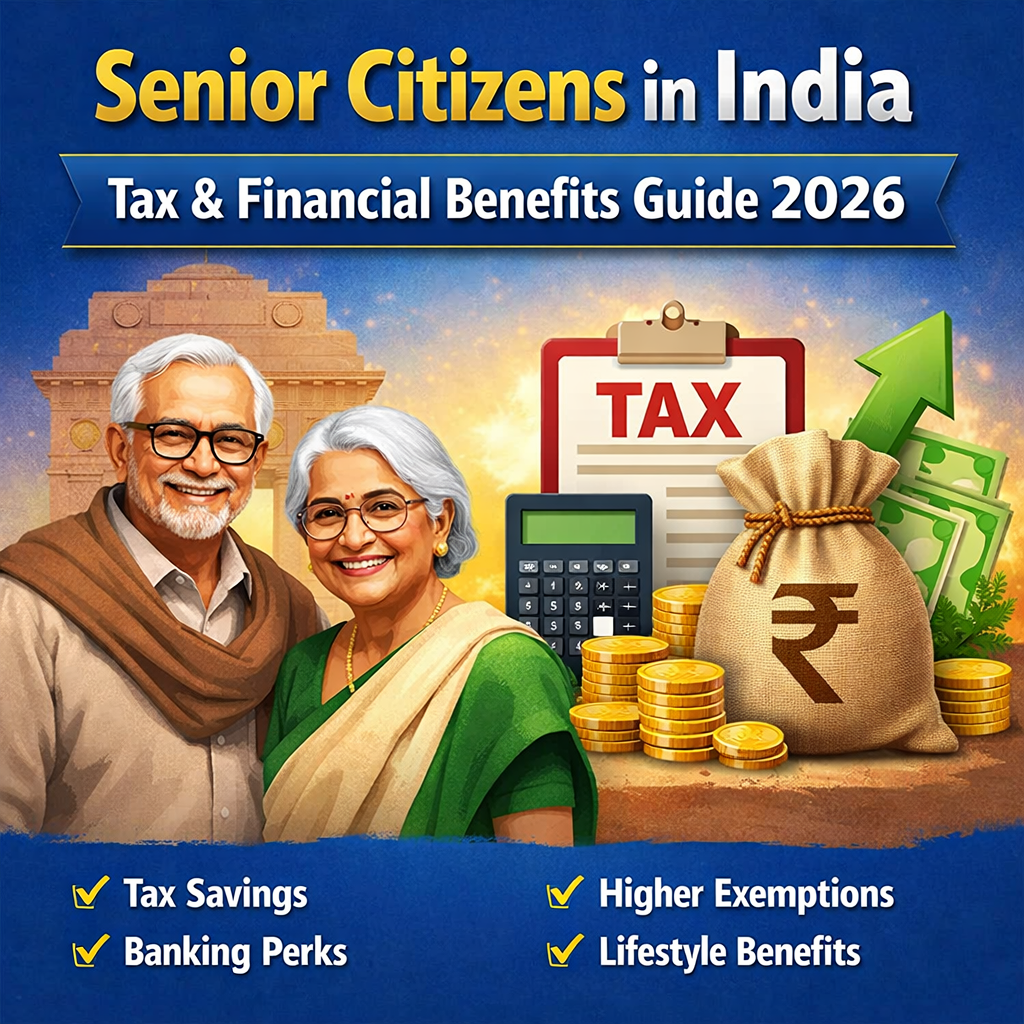
Senior Citizens in India: Comprehensive Tax & Financial Benefits Guide 2026

The Government of India acknowledges the lifelong contribution of senior citizens and, in return, extends a broad set of tax concessions, exemptions, compliance relaxations, banking advantages, and lifestyle-related benefits to ensure financial stability and dignity during retirement.

This detailed guide explains 30+ benefits and features available to senior and super senior citizens in India for FY 2025–26 / AY 2026–27.


1. Definition of Senior Citizen Under Income Tax Law

As per the Income Tax Act:

  • Senior Citizen: Resident individual aged 60 years or more but below 80 years

  • Super Senior Citizen: Resident individual aged 80 years or above

  • Specified Senior Citizen (Section 194P): Resident aged 75 years or above, earning only pension and interest from the same bank, and eligible for exemption from filing ITR


2. Income Tax Slabs – New Tax Regime (FY 2025–26)

The New Tax Regime, which is now the default option, applies equally to all taxpayers, including senior citizens:

Total Income Tax Rate
Up to ₹4,00,000 Nil
₹4,00,001 – ₹8,00,000 5%
₹8,00,001 – ₹12,00,000 10%
₹12,00,001 – ₹16,00,000 15%
₹16,00,001 – ₹20,00,000 20%
₹20,00,001 – ₹24,00,000 25%
Above ₹24,00,000 30%

Taxpayers may still opt for the old tax regime if it offers better savings.


3. Zero Tax on Income Up to ₹12.75 Lakh – Major Relief

Under the New Regime:

  • Standard deduction on salary/pension: ₹75,000

  • Taxable income up to ₹12,00,000

  • Section 87A rebate applicable

As a result, a senior citizen earning up to ₹12.75 lakh from pension/salary pays zero income tax, making the new regime highly beneficial for retirees.


4. Higher Basic Exemption Under Old Tax Regime

Those opting for the old regime enjoy enhanced exemption limits:

Category Exemption Limit
General taxpayer ₹2,50,000
Senior Citizen (60–79 years) ₹3,00,000
Super Senior Citizen (80+ years) ₹5,00,000

5. Section 80TTB – Deduction on Interest Income

Senior citizens can claim a deduction up to ₹50,000 on interest earned from:

  • Savings bank accounts

  • Fixed & recurring deposits

  • Post office schemes

  • Co-operative bank deposits

This benefit is exclusive to senior citizens and replaces Section 80TTA.


6. Section 80D – Health Insurance & Medical Expenses

To reduce healthcare costs, senior citizens are eligible for:

  • ₹50,000 deduction for health insurance premium

  • Medical expenses allowed if insurance is not taken

  • Additional deduction for premiums paid for dependent parents


7. Section 80DDB – Deduction for Specified Diseases

For treatment of serious ailments such as cancer, kidney failure, Parkinson’s disease, etc., senior citizens can claim:

  • Deduction up to ₹1,00,000, subject to conditions and certification


8. No Advance Tax Liability (Section 207)

Senior citizens are not required to pay advance tax if:

  • They do not have business income, and

  • Their income consists only of pension and interest

This also protects them from interest under Sections 234B and 234C.


9. Relaxations in ITR Filing

Offline ITR Filing

Super senior citizens may file paper returns (ITR-1 or ITR-4) instead of mandatory e-filing.

Section 194P – ITR Filing Exemption

Eligible residents aged 75+ earning only pension and bank interest are not required to file ITR, as the bank computes and deducts tax.


10. TDS Benefits & Form 15H

  • Form 15H can be submitted to avoid TDS if total tax liability is nil

  • TDS threshold on interest income increased to ₹1,00,000 per year

  • No TDS on bank/post office interest up to this limit


11. Enhanced Family Pension Exemption

Under the new regime:

  • Exemption increased to ₹25,000 per year

  • Allowed as lower of one-third of pension or ₹25,000


12. LTCG Benefits on Equity Investments

Senior citizens enjoy:

  • Basic exemption adjustment up to ₹4,00,000

  • Additional ₹1,50,000 LTCG exemption

  • Effectively, LTCG up to ₹1.5 lakh can be tax-free


13. Reverse Mortgage – Capital Gains Exemption

Amounts received through reverse mortgage of a residential property:

  • Are not treated as transfer

  • Hence, no capital gains tax applies


14. Higher Interest Rates on Senior Citizen FDs

Banks generally offer:

  • Additional 0.50% interest for senior citizens

  • Up to 0.75% extra for super senior citizens


15. Senior Citizen Savings Scheme (SCSS)

Key features:

  • Eligibility: Age 60+

  • Maximum investment: ₹30 lakh

  • Quarterly interest payout (rate as notified)

  • Eligible for Section 80C deduction

  • Backed by Government of India


16. Other Social, Banking & Lifestyle Benefits

Senior citizens also enjoy several non-tax advantages, including:

  • Railway & state transport concessions

  • Airline fare discounts

  • Healthcare priority & hospital rebates

  • Enhanced Ayushman Bharat coverage

  • Doorstep banking services (age 70+)

  • Property tax & stamp duty rebates (state-wise)

  • Telecom concessions

  • State-sponsored old-age pension schemes


Conclusion

For FY 2026, senior citizens in India benefit from a strong combination of:

✔ Lower tax burden
✔ Simplified compliance
✔ Higher exemptions and deductions
✔ Secure investment options
✔ Banking and lifestyle privileges

These measures collectively aim to ensure financial independence, stability, and improved quality of life after retirement.

New Banking and Cash Transaction Rules from 2026

🇮🇳 Introduction – Why Banking Transactions Deserve More Attention Today

In a rapidly digitising India, almost every financial move—personal or professional—passes through the banking system. Whether it’s UPI collections, cash deposits, fixed deposits, or GST-related receipts, banks today function not just as facilitators but also as statutory reporting entities.

A common misconception among taxpayers is that only very large or suspicious transactions attract scrutiny from the Income Tax Department.
However, this assumption is incorrect.

Even regular, everyday transactions—if misunderstood, misclassified, or improperly reported—can:

  • Get reported under Specified Financial Transactions (SFT)

  • Reflect in AIS / Form 26AS

  • Trigger income-tax notices

  • Result in bank account restrictions

  • Create GST registration or compliance complications

The purpose of this article/video is not to alarm, but to educate and empower.

In this guide, we clearly explain:

  • Banking transaction limits applicable for 2026

  • Transactions that are most likely to attract scrutiny

  • Rules related to cash, UPI, fixed deposits, and withdrawals

  • How bank activity links with Income Tax and GST

  • Practical steps to remain compliant and notice-free

If you carefully apply the compliance tips shared towards the end, you can manage your finances legally, confidently, and without unnecessary tax anxiety.


1️⃣ Banking Transaction Modes & Applicable Limits

🟦 UPI (Unified Payments Interface)

UPI remains India’s most popular digital payment method.

  • Standard daily limit: ₹1,00,000 per user

  • Per-transaction limit: Generally ₹1 lakh (varies by bank)

  • Higher limits: Up to ₹5 lakh per day for specific categories such as education, healthcare, government payments, and capital market transactions (effective 15 September 2025)

💡 Banks may impose lower internal limits—always verify with your bank.


🟦 IMPS (Immediate Payment Service)

  • Usually capped at ₹5 lakh per day per account

  • Available 24×7, making it suitable for urgent, higher-value transfers (subject to bank limits)


🟦 NEFT (National Electronic Funds Transfer)

  • Minimum: ₹1

  • No statutory maximum limit

  • Banks may set daily caps

  • Suitable for large-value transfers without UPI/IMPS restrictions


🟦 RTGS (Real-Time Gross Settlement)

  • Minimum transaction value: ₹2 lakh

  • No upper limit prescribed

  • Best for very high-value, time-sensitive transfers


2️⃣ Cash Transactions & Deposit Rules

🔸 Cash Deposit Reporting (SFT)

Banks and financial institutions are required to report:

  • ₹10 lakh or more cash deposits in a savings account in a financial year

  • ₹50 lakh or more cash deposits in a current account

  • ₹10 lakh or more in fixed deposits during a financial year

👉 This does not mean tax is levied automatically, but the transaction is reported and may be examined.


🔸 Cash Receipt Restrictions – Section 269ST

  • Receiving ₹2 lakh or more in cash from a single person:

    • In one day, or

    • In a single transaction, or

    • For one occasion/event
      is prohibited.

💡 Penalty can be equal to the cash amount received.


🔸 Cash Loans & Repayments – Sections 269SS & 269T

  • Acceptance or repayment of loans/deposits in cash above ₹20,000 is not allowed.

  • Penalty equals the amount involved.


3️⃣ TDS on Cash Withdrawals – Section 194N

This provision discourages excessive cash usage and promotes transparency.

🧾 TDS Applicability on Cash Withdrawals

ITR Filing Status Withdrawal Limit TDS Rate
ITR filed for last 3 AYs Above ₹1 crore 2%
ITR not filed for last 3 AYs Above ₹20 lakh 2% up to ₹1 crore, 5% thereafter

📌 Limits apply per bank, calculated cumulatively for the financial year.


4️⃣ Specified Financial Transactions (SFT)

Banks report high-value transactions such as:

  • Cash deposits crossing prescribed limits

  • Large or unusual digital inflows/outflows

These details appear in AIS and Form 26AS and must align with your ITR disclosures.


5️⃣ GST Linkage With Bank Accounts

🟡 GST Registration Threshold

  • Goods: ₹40 lakh

  • Services: ₹20 lakh

If bank receipts exceed these limits, GST registration becomes mandatory.

⚠️ Non-linking of bank account on GST portal within 30 days may lead to GST suspension.


6️⃣ Mandatory Disclosures in ITR & GST

📌 Income Tax Return

  • All bank accounts must be disclosed

  • Unexplained SFT entries can trigger notices

📌 GST Portal

  • Primary bank account linking is compulsory

  • Non-compliance can result in registration suspension


7️⃣ Business Cash Payment Restriction – Section 40A(3)

  • Cash expenses exceeding ₹10,000 per person per day are not deductible

  • Encourages digital payments and proper documentation


8️⃣ Practical Tips to Stay Notice-Free

✅ Maintain separate accounts for business and personal use
✅ Reconcile UPI inflows with business records
✅ Avoid unnecessary cash transactions
✅ File ITR regularly to benefit from higher withdrawal thresholds
✅ Maintain documentation for all large-value transactions


🧠 Key Takeaways

  • Know your banking limits and comply with them

  • Large cash dealings attract reporting and penalties

  • Regular ITR filing provides tangible compliance benefits

  • GST-bank linkage is critical for business continuity

  • Proper record-keeping is your best defence against notices