
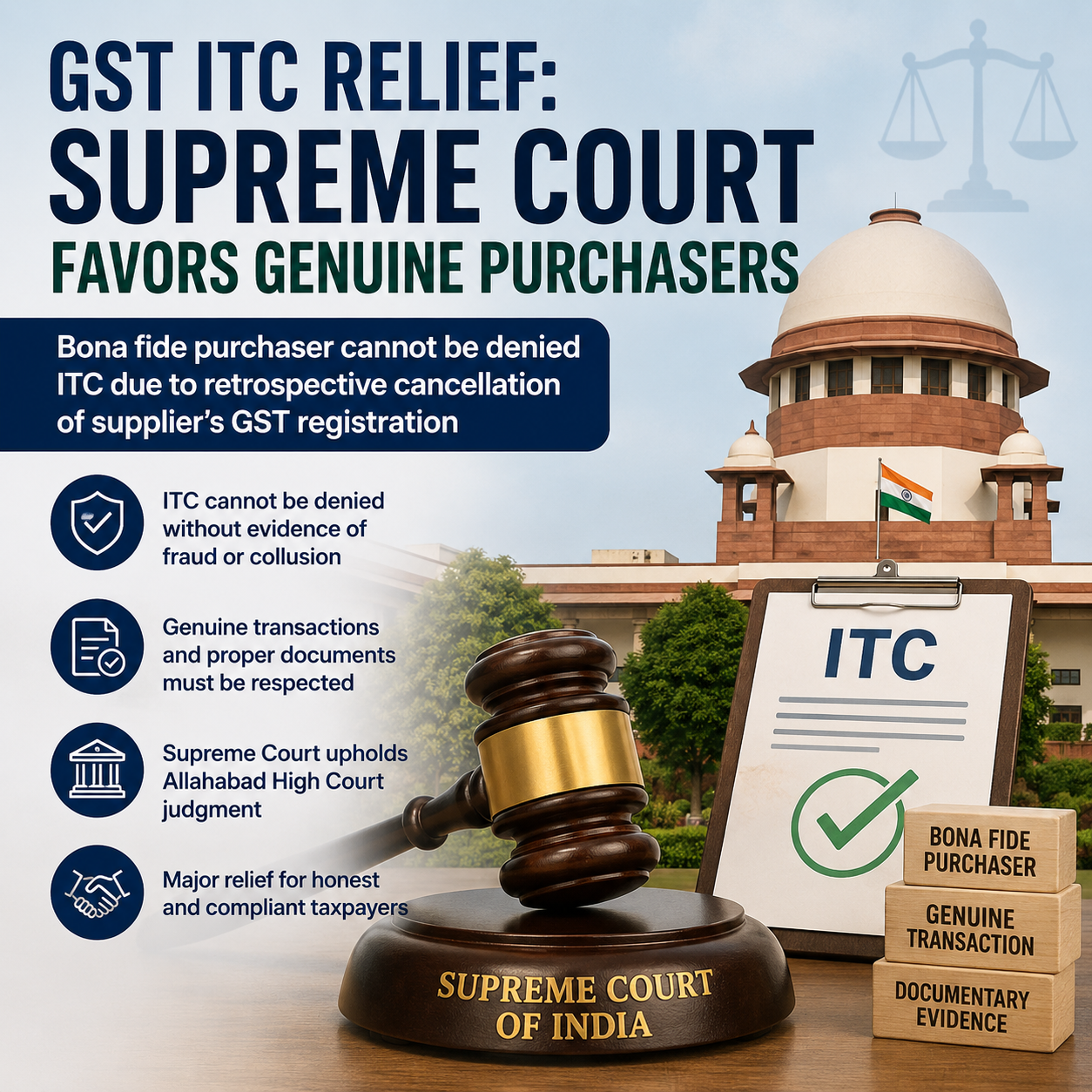

Supreme Court Safeguards GST ITC Rights of Genuine Purchasers
The Supreme Court has provided major relief to genuine taxpayers by dismissing the Revenue’s Special Leave Petition (SLP) in Additional Commissioner Grade 2 & Anr. v. M/s Safecon Lifescience Private Limited [SLP (C) No. 23993 of 2026, Order dated 17 July 2026]. As a result, the judgment of the Allahabad High Court continues to hold the field and reinforces a crucial principle under GST law.
A genuine purchaser cannot be denied Input Tax Credit (ITC solely because the supplier’s GST registration was cancelled with retrospective effect. Such denial can be justified only where fraud, deliberate misrepresentation, or suppression of material facts is established on the part of the recipient.
The decision is expected to bring significant relief and clarity to honest businesses that face ITC disputes because of subsequent action taken against their suppliers, even after legitimate transactions have already been completed.
Background of the Case
M/s Safecon Lifescience Private Limited was involved in the wholesale trading and manufacturing of pharmaceutical products. During April 2021, the company purchased medicines from a supplier who was registered under GST.
At the time of the transactions:
- The supplier held a valid GST registration.
- Proper tax invoices were issued.
- E-way bills and transportation records were maintained.
- The goods were actually delivered and received.
- Payments were made through banking channels.
- The supplier filed the applicable GST returns.
Later, the GST Department received intelligence regarding alleged irregularities in the supplier’s business activities. Proceedings were subsequently initiated under Section 74 of the UPGST Act against Safecon Lifescience.
The Department denied the company’s ITC mainly on the ground that the supplier’s GST registration was later cancelled and that certain irregularities were allegedly found in the supplier’s upstream transactions.
Issue Before the Court
The key legal question before the Court was:
Can a genuine purchaser be denied Input Tax Credit merely because the supplier’s GST registration was subsequently cancelled retrospectively or because the supplier was allegedly involved in certain irregularities, despite the purchaser having undertaken a genuine transaction and fulfilled the necessary conditions for claiming ITC?
Allahabad High Court’s Findings
The Allahabad High Court ruled in favour of the taxpayer and set aside the GST demand.
The Court noted that:
- The purchaser had submitted sufficient documentary evidence to establish that the transactions were genuine.
- The Department was unable to disprove the actual movement and delivery of the goods or the payments made through banking channels.
- There was no specific finding that the recipient had engaged in fraud, wilful misstatement, or suppression of material facts.
- Proceedings under Section 74 cannot be based solely on suspicion or unverified information.
- Information received from another authority must be independently examined and verified before being used against a taxpayer.
Supreme Court’s Ruling
The Revenue subsequently challenged the Allahabad High Court’s decision before the Supreme Court.
The Supreme Court, however, declined to interfere with the High Court’s order and dismissed the Revenue’s SLP, finding no sufficient ground to entertain the petition.
While the Supreme Court’s order was brief, its effect is significant. The Allahabad High Court’s decision remains undisturbed, thereby strengthening the legal protection available to genuine purchasers claiming ITC.
Key Legal Principle Emerging from the Decision
The ruling reinforces the principle that a recipient should not automatically lose Input Tax Credit merely because:
- The supplier’s GST registration was cancelled retrospectively;
- The supplier later failed to comply with GST requirements; or
- Allegations of irregularities were subsequently raised against the supplier.
The recipient should remain protected where the transaction was genuine, the recipient acted in good faith, and there is no evidence of fraud, collusion, or deliberate wrongdoing on the recipient’s part.
Documents Businesses Should Maintain
The case also underlines the importance of maintaining complete and reliable transaction records.
Businesses should preserve documents such as:
- Valid GST tax invoices;
- E-way bills;
- Transport documents and lorry receipts;
- Proof confirming actual receipt of goods;
- Bank statements and payment records;
- Purchase registers and related accounting records;
- GST return records; and
- Vendor verification and due diligence documents.
Maintaining proper documentation can significantly strengthen a taxpayer’s defence during GST scrutiny, audit, or litigation.
Practical Impact on Businesses
The decision offers considerable relief to businesses that have genuinely purchased goods from registered suppliers and complied with the applicable GST requirements.
However, the ruling should not be understood as providing unconditional protection in every ITC dispute.
The benefit of the judgment may not be available where the Department is able to establish that:
- The transaction was fictitious or non-existent;
- The invoices were fabricated;
- The goods were never actually supplied; or
- The recipient knowingly participated in fraudulent activities.
Key Takeaways
- A genuine purchaser should not ordinarily be penalised for a supplier’s subsequent tax default.
- Retrospective cancellation of a supplier’s GST registration, by itself, does not automatically justify denial of ITC.
- Proceedings under Section 74 must be supported by evidence of fraud, wilful misstatement, or suppression of facts attributable to the recipient.
- Complete and accurate documentation remains one of the strongest safeguards in GST disputes.
- The Supreme Court’s decision not to interfere provides additional support to taxpayers facing similar ITC-related proceedings.
The Safecon Lifescience decision is a significant development for genuine taxpayers. It reinforces the principle that businesses acting honestly and complying with the statutory requirements should not be punished solely because of subsequent defaults or regulatory action involving their suppliers.
At the same time, taxpayers should continue to conduct reasonable vendor due diligence and maintain proper transaction records. The decision makes it clear that the retrospective cancellation of a supplier’s GST registration, standing alone, cannot be the sole reason for denying ITC where the purchaser has acted bona fide and satisfied the applicable legal requirements.