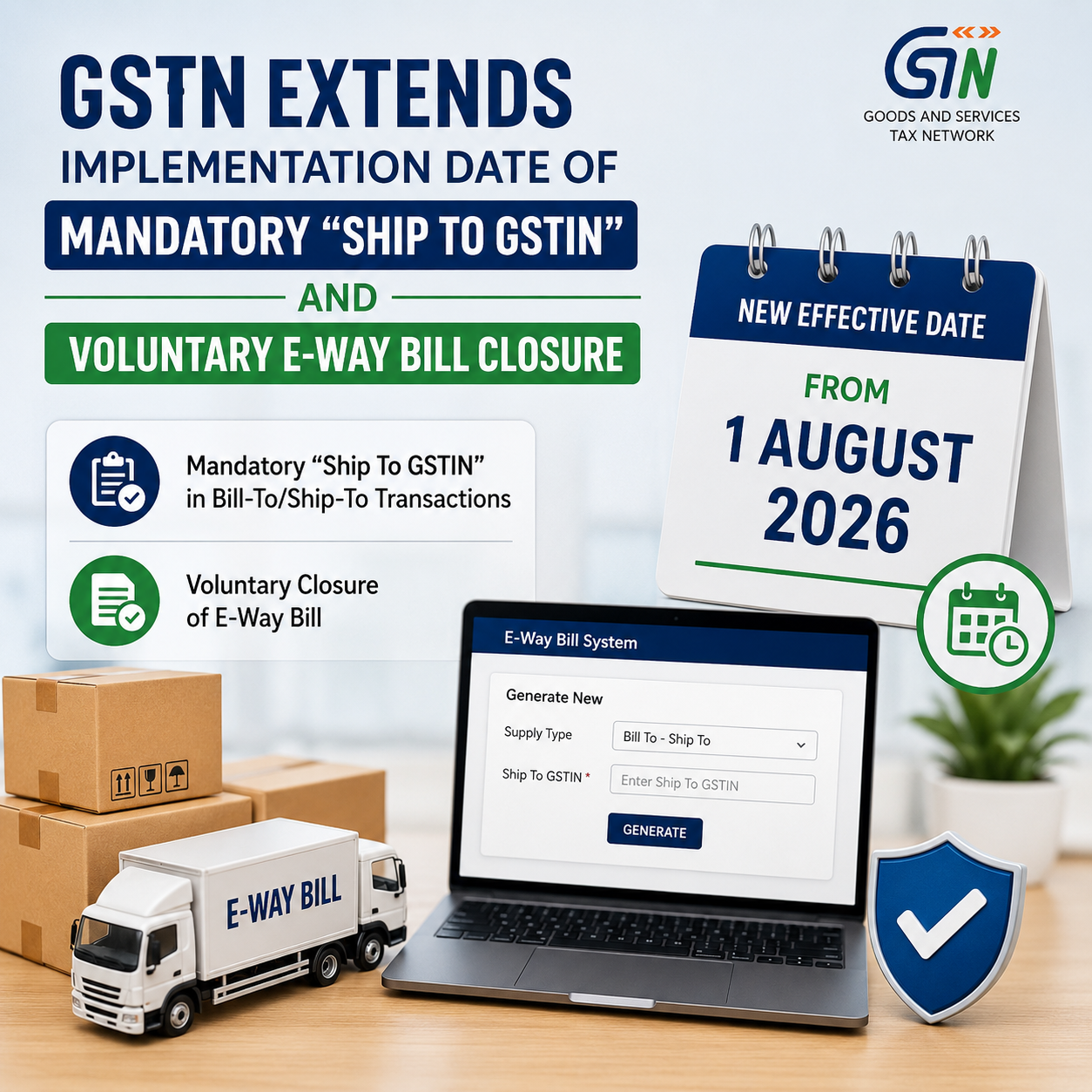
Mandatory “Ship To GSTIN” Entry and Voluntary E-Way Bill Closure Features Delayed by GSTN

Relief for Businesses: GSTN Provides Additional Time for System Preparedness

In a welcome move for taxpayers, transporters, GST Suvidha Providers (GSPs), ERP solution providers, and other stakeholders, the Goods and Services Tax Network (GSTN) has postponed the rollout of two key E-Way Bill enhancements that were originally scheduled to take effect from 15 June 2026.

According to the latest GSTN advisory released on 9 June 2026, the implementation of the following features has been rescheduled and will now come into force from 1 August 2026:

  • Mandatory reporting of “Ship To GSTIN” in Bill-To/Ship-To transactions.
  • Facility for Voluntary Closure of E-Way Bills.

Why Was the Implementation Deferred?

Earlier, through an advisory dated 20 May 2026, GSTN had announced that these functionalities would be introduced from 15 June 2026. Following the announcement, several industry bodies, businesses, ERP vendors, and other stakeholders highlighted the need for additional preparation time before the changes could be implemented smoothly.

The requests primarily cited the need for:

  • Upgrading and modifying existing software systems
  • API development, integration, and testing
  • Necessary changes in ERP applications
  • Correction and validation of master data
  • Training of users and operational teams
  • Ensuring overall system readiness

Taking these concerns into account, GSTN has extended the implementation timeline by around six weeks, providing stakeholders with sufficient time to complete the required technical and operational preparations before the new requirements become mandatory.

1. Mandatory Reporting of “Ship To GSTIN” in Bill-To/Ship-To Transactions

As part of the proposed enhancement to the E-Way Bill system, taxpayers involved in Bill-To/Ship-To transactions will be required to mention the GSTIN of the actual consignee (Ship-To party) while generating E-Way Bills.

This measure aims to:

  • Improve the quality and accuracy of transaction data
  • Minimize reporting discrepancies and mismatches
  • Create a stronger and more reliable audit trail
  • Increase transparency in the movement and delivery of goods

Businesses using accounting, billing, or ERP software should use the extended timeline to ensure that the necessary Ship-To GSTIN fields are incorporated and functioning correctly before the revised implementation date.

2. Introduction of Voluntary E-Way Bill Closure Facility

GSTN is also set to launch a new feature enabling taxpayers to voluntarily close an E-Way Bill in specified situations where the movement of goods does not take place or the E-Way Bill is no longer required.

The proposed facility is expected to offer several benefits, including:

  • Greater control over E-Way Bill management
  • Prevention of misuse of inactive or unused E-Way Bills
  • Better compliance tracking and monitoring
  • Improved reliability of logistics and transportation records

Further procedural instructions and operational guidelines are likely to be issued by GSTN before the feature becomes effective.

Revised Implementation Schedule

Particulars Earlier Effective Date Revised Effective Date
Mandatory reporting of Ship-To GSTIN in Bill-To/Ship-To transactions 15 June 2026 1 August 2026
Voluntary E-Way Bill Closure Facility 15 June 2026 1 August 2026

What Taxpayers Should Do Now

Taxpayers should make the most of the additional time provided by GSTN and undertake the following activities:

✅ Upgrade ERP, billing, and accounting applications

✅ Validate and test E-Way Bill API integrations

✅ Review and update customer and consignee GSTIN master data

✅ Conduct training sessions for GST, accounts, and logistics personnel

✅ Coordinate with GSPs, ERP providers, and software vendors

✅ Perform end-to-end testing to ensure readiness before 1 August 2026

Proper preparation during this extended period will help businesses achieve a smooth transition and avoid compliance issues once the new E-Way Bill requirements become operational.
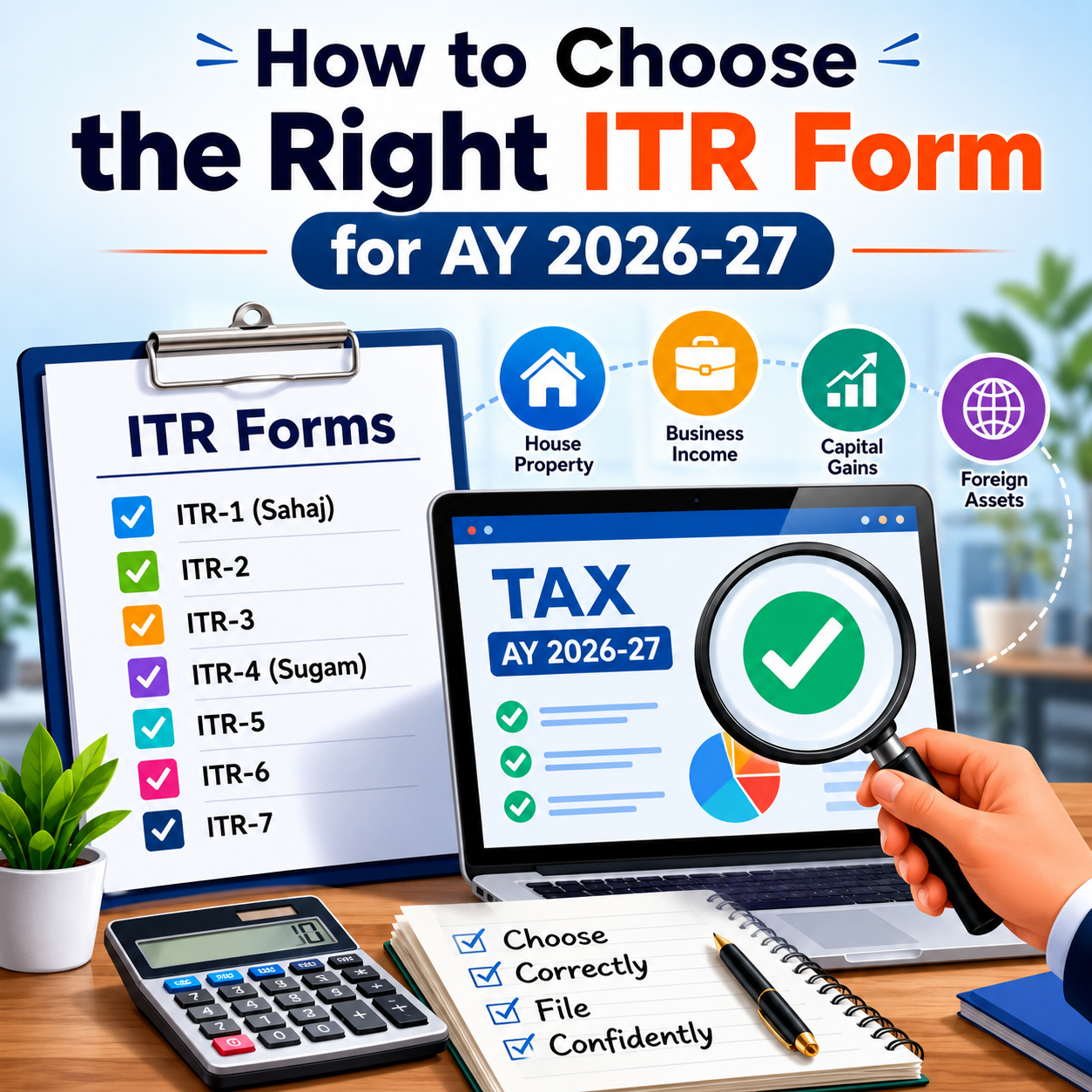
Complete Guide to Selecting the Proper ITR Form for AY 2026-27

How to Select the Right ITR Form for AY 2026-27

The filing season for Income Tax Returns (ITR) for Assessment Year (AY) 2026-27 is now open. One of the most frequent errors made by taxpayers is choosing an inappropriate ITR form while filing their return. Using the wrong form may cause the return to be considered defective, resulting in notices from the Income Tax Department and additional compliance requirements.

To ensure smooth and accurate filing, taxpayers should understand the eligibility criteria for each ITR form. This article highlights the key changes introduced for AY 2026-27 and explains who can use ITR-1 (Sahaj).

Major Updates for AY 2026-27

Before filing your return, it is important to be aware of the following changes applicable for the current assessment year.

1. Reporting of Two House Properties Allowed in ITR-1 and ITR-4

The government has provided relief to small taxpayers by allowing eligible individuals filing ITR-1 (Sahaj) and ITR-4 (Sugam) to disclose income from up to two house properties, provided all other prescribed conditions are fulfilled.

2. Updated Return Filing Deadlines

The due dates for filing Income Tax Returns for AY 2026-27 are as follows:

Taxpayer CategoryDue Date
Individuals/HUFs not subject to audit and not having business or professional income 31 July 2026
Taxpayers having business or professional income but not liable for audit 31 August 2026
Taxpayers covered under tax audit provisions 31 October 2026

Filing within the prescribed timeline helps avoid interest, penalties, late filing fees, and other inconveniences.

ITR-1 (SAHAJ)

Eligibility for Filing ITR-1

A resident individual may file ITR-1 if he or she has:

  • Income from salary or pension.
  • Income from not more than two house properties.
  • Income from other sources such as savings bank interest, fixed deposit interest, family pension, etc.
  • Agricultural income not exceeding ₹5,000.
  • Total income up to ₹50 lakh.
  • Long-term capital gains under Section 112A up to ₹1,25,000.

Persons Not Eligible to File ITR-1

ITR-1 cannot be used by a taxpayer who:

  • Has total income exceeding ₹50 lakh.
  • Is a director in any company.
  • Owns unlisted equity shares.
  • Has capital gains income not covered under the prescribed conditions.
  • Earns income from business or profession.
  • Possesses foreign assets or receives foreign income.
  • Is a Non-Resident (NR) or Resident but Not Ordinarily Resident (RNOR).

Best Suited For

ITR-1 is generally suitable for:

  • Salaried individuals.
  • Retired pensioners.

    ITR-2

    Who is Eligible to File ITR-2?

    ITR-2 is meant for Individuals and Hindu Undivided Families (HUFs) who do not have income from business or profession but earn income from one or more of the following sources:

    • Salary or pension.
    • Income from house property.
    • Capital gains arising from the sale of shares, mutual funds, immovable property, or other capital assets.
    • Foreign income or ownership of foreign assets.
    • Total income exceeding ₹50 lakh.
    • Holding the position of Director in a company.
    • Investment in unlisted equity shares.

    Who Should Use ITR-2?

    ITR-2 is generally suitable for:

    • Salaried individuals having capital gains transactions.
    • Taxpayers who have sold property, shares, mutual funds, or other capital assets during the financial year.
    • Non-Resident Indians (NRIs).
    • Individuals required to disclose foreign assets or foreign-source income in their Income Tax Return.
  • Taxpayers earning interest from bank deposits and other similar sources.

    ITR-3

    Who Can File ITR-3?

    ITR-3 is applicable to Individuals and Hindu Undivided Families (HUFs) who earn income from business or professional activities. This includes income from:

    • Proprietary business operations.
    • Professional services and practice.
    • Freelancing assignments.
    • Commission or brokerage earnings.
    • Futures and Options (F&O) trading.
    • Intraday stock trading.
    • Business or professional income along with income from salary, house property, capital gains, or other sources.

    Who Should Use ITR-3?

    ITR-3 is generally suitable for:

    • Chartered Accountants.
    • Doctors and medical practitioners.
    • Advocates and legal professionals.
    • Consultants and independent professionals.
    • Share and derivatives traders.
    • Freelancers.
    • Proprietors running their own business.

    ITR-4 (SUGAM)

    Who Can File ITR-4?

    ITR-4 is designed for Resident Individuals, HUFs, and Firms (excluding LLPs) who opt for the presumptive taxation scheme under:

    • Section 44AD – Presumptive taxation for eligible businesses.
    • Section 44ADA – Presumptive taxation for specified professionals.
    • Section 44AE – Presumptive taxation for goods carriage operators.

    Eligibility Conditions for ITR-4

    A taxpayer can file ITR-4 if:

    • Total income does not exceed ₹50 lakh.
    • Income is declared under the eligible presumptive taxation provisions.
    • Income is earned from up to two house properties.
    • Income includes interest and other permissible sources.
    • Long-Term Capital Gain (LTCG) under Section 112A does not exceed ₹1,25,000.

    Who Cannot File ITR-4?

    ITR-4 cannot be used by:

    • Taxpayers holding foreign assets or earning foreign income.
    • Directors in companies.
    • Limited Liability Partnerships (LLPs).

    Who Should Use ITR-4?

    ITR-4 is best suited for:

    • Small business owners opting for presumptive taxation.
    • Tax practitioners and consultants.
    • Professionals covered under Section 44ADA.
    • Retail traders and other eligible taxpayers under the presumptive taxation scheme.

      ITR-5

      Who Can File ITR-5?

      ITR-5 is applicable to various non-individual entities, including:

      • Partnership Firms.
      • Limited Liability Partnerships (LLPs).
      • Associations of Persons (AOPs).
      • Bodies of Individuals (BOIs).
      • Artificial Juridical Persons (AJPs).

      This return form is not meant for individual taxpayers.

      ITR-6

      Who Can File ITR-6?

      ITR-6 is required to be filed by companies that are not claiming exemption under Section 11 of the Income Tax Act.

      This form is commonly used by:

      • Private Limited Companies.
      • Public Limited Companies.
      • Other corporate entities not eligible for filing ITR-7.

      ITR-7

      Who Can File ITR-7?

      ITR-7 is prescribed for entities that are required to furnish returns under specific provisions of the Income Tax Act. These generally include:

      • Charitable Trusts.
      • Religious Trusts.
      • Political Parties.
      • Educational and Academic Institutions.
      • Research Associations and similar organizations.

      Consequences of Choosing the Wrong ITR Form

      Filing an incorrect ITR form can create unnecessary complications and may result in various issues such as:

      • Receipt of a defective return notice under Section 139(9).
      • Delay in processing of the Income Tax Return.
      • Delay in receiving income tax refunds.
      • Additional compliance and rectification requirements.
      • Necessity to file a revised return.

      Therefore, taxpayers should carefully assess all sources of income and verify their eligibility before selecting the applicable return form.

      Conclusion

      Selecting the correct ITR form is one of the most crucial steps in the return filing process. For AY 2026-27, taxpayers should take note of important updates, including the relaxation allowing eligible taxpayers to report income from up to two house properties and the revised return filing deadlines for different categories of taxpayers.

      Before filing the return, it is advisable to review all sources of income, including salary, house property, capital gains, business income, professional receipts, foreign assets, foreign income, and presumptive taxation income. Choosing the appropriate ITR form ensures accurate compliance with tax provisions and reduces the chances of notices, delays, and filing errors.

      A correctly filed Income Tax Return not only fulfills legal obligations but also facilitates quicker processing of returns and faster issuance of refunds.