Income Tax Department Opens ITR-1 & ITR-4 Filing for AY 2026–27

Excel Utility & Online Filing Facility Now Available

The Income Tax Department has officially activated ITR-1 (Sahaj) and ITR-4 (Sugam) for Assessment Year 2026–27 on the Income Tax e-Filing Portal. Eligible taxpayers can now begin filing their Income Tax Returns through both:

  • Online Filing Mode
  • Excel Utility (Offline Mode)

available on the official Income Tax e-Filing Portal.

Major Relief for Salaried Individuals and Small Taxpayers

This update brings significant convenience for:

  • Salaried individuals
  • Pensioners
  • Freelancers
  • Small business proprietors
  • Professionals opting for presumptive taxation
  • Taxpayers filing simple income tax returns

Taxpayers can now prepare and submit returns in advance, helping them avoid last-minute technical issues and portal congestion.

ITR Forms Currently Enabled

1. ITR-1 (Sahaj)

ITR-1 is meant for resident individuals having:

  • Salary or pension income
  • Income from up to two house properties
  • Income from other sources such as interest
  • Agricultural income up to ₹5,000
  • Total income up to ₹50 lakh

Who Is Not Eligible to File ITR-1?

ITR-1 cannot be used if the taxpayer has:

  • Capital gains income
  • Foreign income or foreign assets
  • Business or professional income
  • More than two house properties
  • Directorship in a company
  • Investment in unlisted equity shares

2. ITR-4 (Sugam)

ITR-4 applies to:

  • Resident Individuals
  • Hindu Undivided Families (HUFs)
  • Partnership Firms (excluding LLPs)

earning income under presumptive taxation schemes such as:

  • Section 44AD
  • Section 44ADA
  • Section 44AE

with total income up to ₹50 lakh.

Ideal For

  • Small traders
  • Retail shop owners
  • Freelancers
  • Consultants
  • Professionals
  • Small transport operators

Filing Options Available

The department has now enabled both filing methods:

✔ Online Filing

Eligible taxpayers can directly prepare and file their return online without downloading any software or utility.

✔ Excel Utility (Offline Filing)

Taxpayers can also download the Excel utility, prepare the return offline, generate the JSON file, and upload it on the portal.

This option is especially useful for:

  • Chartered Accountants
  • Tax professionals
  • Bulk return filing
  • Detailed verification before submission

Documents Required Before Filing ITR

Taxpayers should keep the following documents ready:

  • PAN Card
  • Aadhaar Card
  • Form 16
  • AIS/TIS
  • Form 26AS
  • Bank statements
  • Interest certificates
  • Investment proofs
  • Home loan statement/certificate (if applicable)

Carefully Verify AIS and Form 26AS

Many taxpayers incorrectly rely only on Form 16 while filing returns.

Before filing, taxpayers should verify:

  • Interest income
  • Dividend income
  • TDS credits
  • Mutual fund transactions
  • Share market transactions
  • High-value transactions appearing in AIS

Any mismatch may lead to:

  • Income tax notices
  • Delay in refund processing
  • Defective return notices

New Tax Regime Continues as Default

For AY 2026–27, the New Tax Regime remains the default tax regime for individual taxpayers.

However, eligible taxpayers may still choose the old tax regime within the prescribed timelines.

Before selecting the regime, taxpayers should compare:

  • Available deductions and exemptions
  • Total taxable income
  • Rebate eligibility
  • Final tax liability

Expected Due Date for Filing ITR

The expected due date for non-audit taxpayers for AY 2026–27 is:

31 July 2026

Taxpayers are advised not to wait until the deadline because:

  • Heavy traffic may slow down the portal
  • Refunds may get delayed
  • Chances of filing mistakes increase near due dates

Advantages of Filing ITR Early

Faster Refunds

Early filers generally receive refunds sooner.

Easier Loan & Visa Processing

Income Tax Returns serve as valid income proof for:

  • Home loans
  • Vehicle loans
  • Business loans
  • Visa applications

Reduced Filing Errors

Early filing gives sufficient time to review and revise mistakes if needed.

Better Financial Planning

Taxpayers get clarity regarding tax payable or refund receivable at an early stage.

Steps to File ITR-1 or ITR-4

Step 1

Visit the Income Tax e-Filing Portal.

Step 2

Login using PAN and password.

Step 3

Navigate to:

e-File → Income Tax Return → File Income Tax Return

Step 4

Select:

  • Assessment Year: 2026–27
  • Relevant ITR Form

Step 5

Choose either:

  • Online Filing Mode
  • Offline Utility Mode

Step 6

Validate all details and submit the return.

Step 7

Complete e-Verification using:

  • Aadhaar OTP
  • Net Banking
  • Demat Account EVC
  • Bank Account EVC

Important Points to Check Before Submission

Before final filing, taxpayers should:

  • Verify bank account details carefully
  • Match TDS credits properly
  • Reconcile AIS/TIS information
  • Review deduction claims
  • Confirm tax regime selection accurately

Filing the wrong ITR form or incorrect reporting of income may result in notices from the Income Tax Department.

Conclusion

The enabling of ITR-1 and ITR-4 for AY 2026–27 marks the beginning of the income tax return filing season for millions of taxpayers. With both online filing and Excel utility options now available, eligible taxpayers and professionals can start filing returns immediately without waiting for the deadline.

Filing returns early not only helps in faster refund processing but also minimizes the risk of errors, mismatches, and notices. Taxpayers should carefully reconcile all income and tax details before final submission of their return.

When Will the Income Tax Portal Open for ITR Filing 2026?

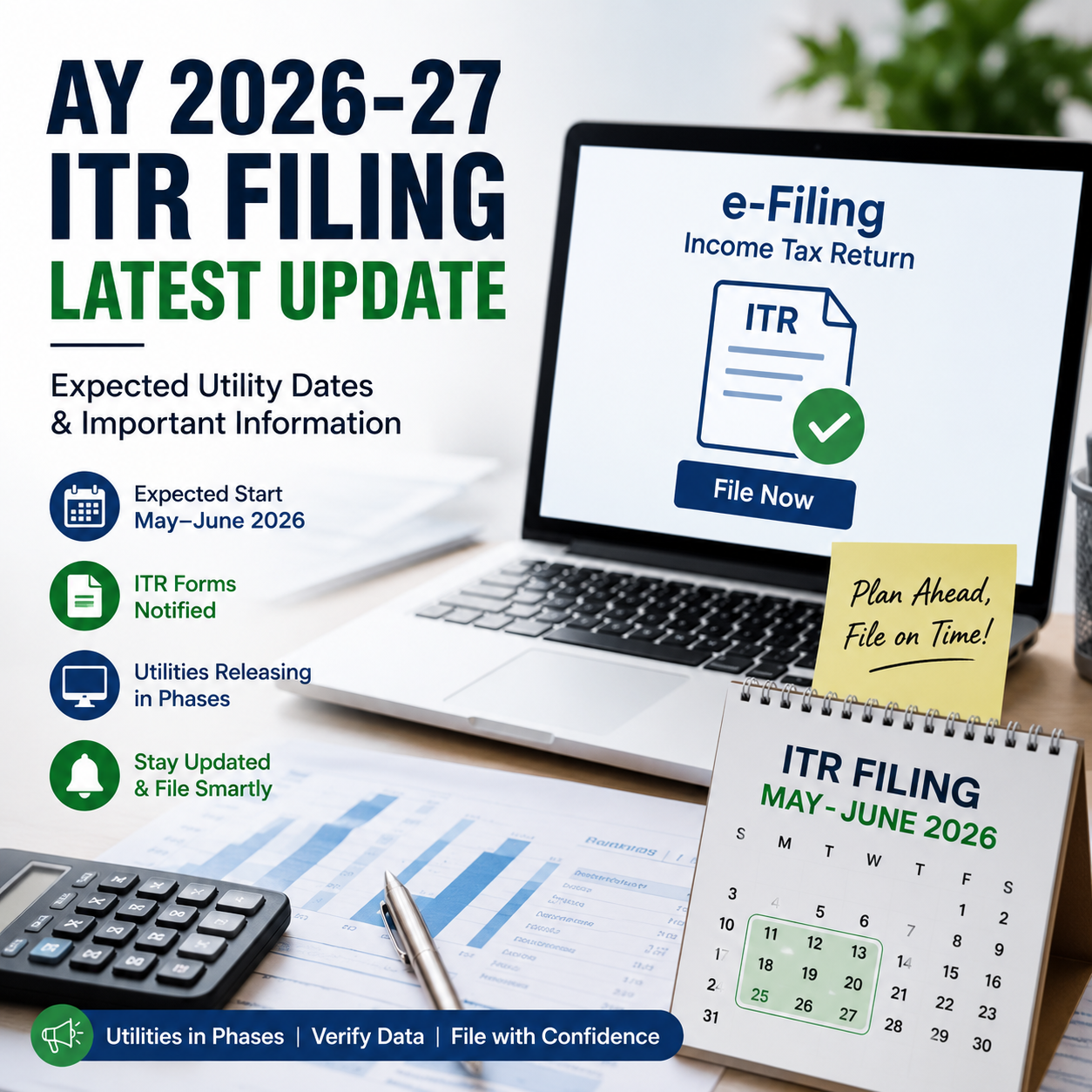
AY 2026-27 ITR Filing Latest Update: Expected Start Dates, Utility Release & Key Information

The biggest question among taxpayers right now is: “When will ITR filing start for AY 2026-27?” With the beginning of Financial Year 2025-26 and ongoing discussions around the new Income Tax framework, taxpayers are eagerly waiting for the Income Tax Department to activate the online filing utilities for Assessment Year 2026-27.

The positive news is that the Income Tax Department has already notified multiple ITR forms for AY 2026-27, which means the filing season has officially commenced from a legal standpoint. However, actual filing for most taxpayers will begin only after the online utilities and portal filing systems become fully operational.


Have ITR Forms for AY 2026-27 Been Notified?

Yes. The CBDT has already notified important ITR forms for AY 2026-27, including:

  • ITR-1
  • ITR-2
  • ITR-3
  • ITR-4

The newly notified forms also contain several important changes, such as:

  • Separate reporting of F&O and intraday trading income
  • Additional capital gain disclosures
  • Buyback loss reporting requirements
  • Enhanced foreign asset disclosures
  • Simplified eligibility conditions in certain forms

Although the forms are officially notified, taxpayers are still waiting for:

  • Online utility activation
  • JSON schema integration
  • Prefilled return updates
  • AIS/TIS synchronization
  • Stable portal functionality

Has ITR Filing Started on the Income Tax Portal?

Currently, the forms have been released, but filing utilities for all taxpayer categories are not completely live yet. Tax professionals and taxpayers are actively monitoring utility releases because practical filing starts only after:

  • Online utility activation
  • Offline utility release
  • Validation schema updates by the department

Many taxpayers expected filing to begin from 1 April 2026 itself, but utility rollout has been gradual.


Expected Dates for ITR Utility Activation – AY 2026-27

Based on previous years’ trends and the current pace of utility releases, the expected timeline may be:

ITR Form Expected Utility / Filing Activation
ITR-1 Mid May to Late May 2026
ITR-2 Late May to Early June 2026
ITR-3 June 2026
ITR-4 Mid May to Late May 2026

The Income Tax portal’s utility download section already reflects phased releases and updates for several forms, indicating that activation is underway.

In practice, salaried taxpayers usually prefer filing only after:

  • Form 16 issuance
  • AIS updates completion
  • Prefilled data stabilization

Therefore, even if utilities become available in May 2026, many taxpayers may choose to file from June onwards for smoother processing.


Why Is There Delay in ITR Utility Activation?

Several reasons are contributing to the delayed rollout of utilities this year:

✔️ Changes in ITR Forms

The introduction of additional disclosure requirements has increased validation complexity.

✔️ Transition Towards New Tax Framework

AY 2026-27 represents a transitional phase with multiple structural compliance changes under the revised tax framework.

✔️ AIS / TIS Integration

The department now heavily relies on integrated reporting systems such as:

  • AIS
  • TIS
  • Form 26AS
  • SFT reporting
  • Broker transaction data
  • GST-linked analytics

As a result, utility validation and synchronization take more time.

✔️ Enhanced Reporting Requirements

Taxpayers having:

  • Capital gains
  • F&O income
  • Foreign assets
  • High-value transactions

may face additional disclosure and verification requirements this year.


Should Taxpayers File ITR Immediately After Utilities Go Live?

Not necessarily.

Experts generally recommend waiting until:

  • AIS/TIS data is fully updated
  • Form 16 is issued
  • Form 26AS is reconciled
  • Utilities become stable

During the initial days after utility release, taxpayers often face:

  • Validation errors
  • Portal glitches
  • JSON/schema mismatches

Therefore, unless an urgent refund claim is involved, filing after the utilities stabilize is generally considered safer.


Important Due Dates for AY 2026-27

Taxpayer Category Due Date
ITR-1 & ITR-2 (Non-audit cases) 31 July 2026
ITR-3 & ITR-4 (Non-audit cases) 31 August 2026
Audit Cases 31 October 2026
Transfer Pricing Cases 30 November 2026

Important Guidance for Taxpayers Before Filing ITR for AY 2026-27

Before submitting the Income Tax Return for AY 2026-27, taxpayers should carefully:

  • verify AIS and Form 26AS details,
  • check whether all TDS credits are correctly reflected,
  • reconcile capital gain statements,
  • confirm reporting of bank interest income, and
  • thoroughly review prefilled information available on the portal.

Filing the return hastily without proper verification may lead to issues such as:

  • defective return notices,
  • delay in processing of refunds,
  • income mismatch notices, or
  • future reassessment proceedings.

ITR filing utilities for AY 2026-27 are expected to become fully operational gradually during May and June 2026 as the Income Tax Department releases utilities in phases. Although the ITR forms have already been officially notified, taxpayers are still waiting for stable online utilities and complete portal activation across all return categories.

For salaried individuals, large-scale filing activity is expected to pick up mainly after:

  • issuance of Form 16,
  • completion of AIS updates, and
  • stabilization of filing utilities.
All About TDS: Payment Procedures, Due Dates & Forms under Old vs Revised Income Tax Act, 2025

What is TDS? (Concept)

TDS (Tax Deducted at Source) refers to a system where tax is deducted by the payer at the time of making specified payments and then remitted to the government.

👉 Objective of TDS:

  • Collection of tax at the point of income generation
  • Prevention of tax evasion
  • Ensuring steady inflow of revenue to the government

👉 Tax Credit Available To Taxpayer In:

  • Form 26AS
  • Annual Information Statement (AIS)

🔄 Key Change from 1 April 2026 (New Income Tax Act, 2025)

Structural Transformation

Old Income Tax Act, 1961 New Income Tax Act, 2025
Multiple sections (192, 194 series) Consolidated framework
Complicated structure Simplified approach
Dispersed provisions Centralized system

👉 New Section Mapping:

  • Section 392 → TDS on Salary
  • Section 393 → TDS on Other Payments

✔️ The core concept remains unchanged, but the structure is simplified.


📅 TDS Payment Due Dates

Monthly Due Dates

Particular Due Date
TDS deducted during any month 7th of the following month
TDS deducted in March 30th April (next financial year)

👉 Example:

  • TDS deducted in April → Pay by 7 May
  • TDS deducted in March → Pay by 30 April

✔️ No change under the new Act.


⚠️ Special Case – Government Deductors

  • Payment required on the same day (through book entry)
  • For March deductions → 7 April

⚠️ Interest on Delay

Default Type Interest Rate
Failure to deduct TDS 1% per month
Delay in deposit 1.5% per month

📊 TDS Return Filing Due Dates (FY 2026–27)

Quarter Period Due Date
Q1 Apr – Jun 2026 31 July 2026
Q2 Jul – Sep 2026 31 Oct 2026
Q3 Oct – Dec 2026 31 Jan 2027
Q4 Jan – Mar 2027 31 May 2027

✔️ Filing timeline remains unchanged under the new law.


📄 TDS Return Forms

🔄 A. Quarterly TDS Returns

Purpose Old Form New Form (2025 Act)
Salary TDS 24Q Form 138
Non-salary (Resident) 26Q Form 140
Non-resident payments 27Q Form 142 / 144
TCS Return 27EQ Form 143

✔️ Only form numbers changed; compliance process remains same.


🔄 B. TDS Certificates

Purpose Old Form New Form
Salary Form 16 Form 130
Non-salary Form 16A Form 131

🔄 C. Declaration Forms

Purpose Old Forms New Form
Declaration for non-deduction of TDS 15G / 15H Form 121

✔️ Significant simplification introduced.


🔄 D. Challan-cum-Statement (Major Change)

Earlier Forms New Unified Form
26QB (Property)
26QC (Rent)
26QD (Contract)
26QE (Crypto)
👉 Merged Form 141

✔️ Four separate forms are now consolidated into a single form.


⏱️ Special Cases – Different Deadlines

Nature of Transaction Applicable Form Due Date
Property transactions Form 141 Within 30 days
Rent payments (Individual) Form 141 Within 30 days
Contract/Professional (Individual) Form 141 Within 30 days
Cryptocurrency transactions Form 141 Within 30 days

⚠️ Penalties & Consequences

📌 Late Filing Fee

  • ₹200 per day
  • Maximum penalty limited to the amount of TDS
Latest TDS Rates Table – Financial Year 2026–27

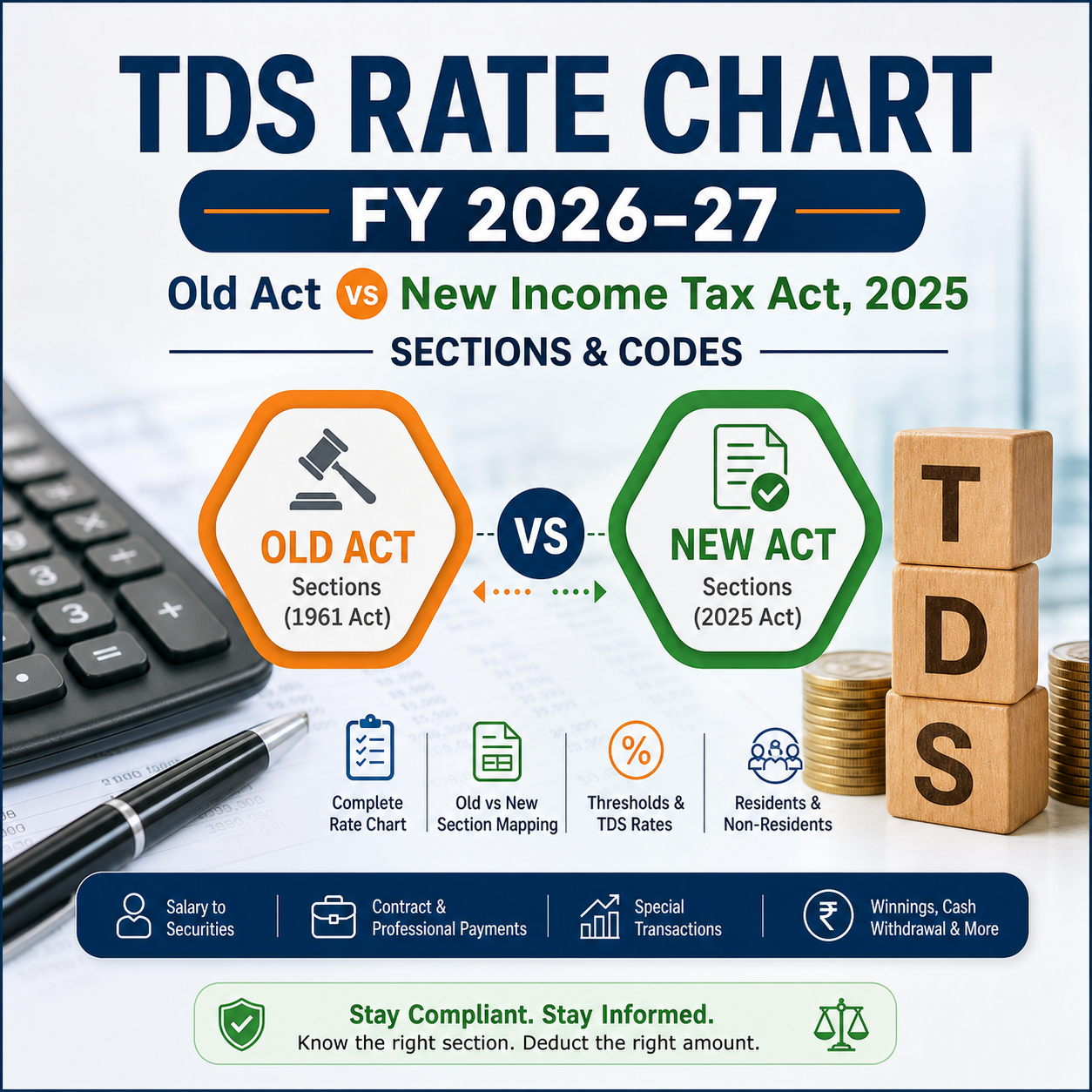
TDS Rates Comparison Chart for FY 2026–27 (Old vs New Act with Section Codes)                                                       TDS provisions have been updated in the Income Tax Act, 2025. Below is a detailed rate chart with old section references and corresponding new section codes.

TDS Rate Chart – FY 2026–27

(Old Act vs New Income Tax Act, 2025 – Sections & Codes)

With the implementation of the Income Tax Act, 2025, TDS provisions have been restructured and renumbered. While most rates and thresholds remain largely unchanged, the section references have shifted significantly.

Below is a comprehensive comparative chart mapping old sections with new section codes, along with applicable thresholds and TDS rates.


👤 Payment to Residents

Nature of Payment Old Section New Section (2025 Act) Threshold Rate
Salary 192 392(1) Basic exemption Slab
EPF Withdrawal 192A 392(7) ₹50,000 10%
Interest on Securities 193 393(1) Table Sl. 5(i) ₹10,000 10%
Dividend 194 393(1) Table Sl. 7 ₹10,000 (Individual) 10%
Interest (Senior Citizen) 194A 393(1) Table 5(ii)(D)(a) ₹1,00,000 10%
Interest (Others) 194A 393(1) Table 5(ii)(D)(b) ₹50,000 10%
Insurance Commission 194D 393(1) Table 1(i) ₹20,000 2% / 10%
Commission/Brokerage 194H 393(1) Table 1(ii) ₹20,000 2%
Rent (General) 194I 393(1) Table 2(i) ₹50,000 2%
Rent (Machinery) 194I 393(1) Table 2(ii)(D)(a) ₹50,000 2%
Rent (Land/Building) 194I 393(1) Table 2(ii)(D)(b) ₹50,000 10%
Purchase of Immovable Property 194-IA 393(1) Table 3(i) ₹50 lakh 1%
Compensation on Acquisition 194LA 393(1) Table 3(ii) ₹5 lakh 10%
Mutual Fund Income 194K 393(1) Table 4(i) ₹10,000 10%
Business Trust Income 194LBA 393(1) Table 4(ii) Nil 10%
Investment Fund Income 194LBB 393(1) Table 4(iii) Nil 10%
Securitisation Trust Income 194LBC 393(1) Table 4(iv) Nil 10%

🏢 Contract / Professional / Business Payments

Nature Old Section New Section Threshold Rate
Contractor (Individual/HUF) 194C 393(1) Table 6(i)(D)(a) ₹30,000 / ₹1 lakh 1%
Contractor (Others) 194C 393(1) Table 6(i)(D)(b) ₹30,000 / ₹1 lakh 2%
Individual/HUF paying Contractor/Professional 194M 393(1) Table 6(ii) ₹50 lakh 2%
Technical Services / Royalty 194J 393(1) Table 6(iii)(D)(a) ₹50,000 2%
Professional Services 194J 393(1) Table 6(iii)(D)(b) ₹50,000 10%
Director Remuneration 194J 393(1) Table 6(iii)(D)(b) No limit 10%

🔄 Special Transactions

Nature Old Section New Section Threshold Rate
Purchase of Goods 194Q 393(1) Table 8(ii) ₹50 lakh 0.10%
Benefit/Perquisite 194R 393(1) Table 8(iv) ₹20,000 10%
E-commerce Operator 194O 393(1) Table 8(v) ₹5 lakh (Ind/HUF) 0.10%
Virtual Digital Assets (Non-Individual) 194S 393(1) Table 8(vi) ₹10,000 1%
VDA (Individual/HUF) 194S 393(1) Table 8(vi) ₹50,000 1%
Life Insurance (Taxable Portion) 194DA 393(1) Table 8(i) ₹1,00,000 2%

🌍 Non-Resident Payments

Nature Old Section New Section Rate
General Payment to Non-resident 195 393(2) As per Act/DTAA
Interest on Foreign Loan 194LC 393(2) Table 2 5%
Infra Debt Fund 194LB 393(2) Table 5 5%
Rupee Bonds (IFSC pre-2023) 194LC 393(2) Table 4E(a) 4%
Rupee Bonds (post-2023) 194LC 393(2) Table 4E(b) 9%
Investment Fund Income 194LBB 393(2) Table 8 10% / 30%
Securitisation Trust 194LBC 393(2) Table 9 10% / 30%
Mutual Fund Units 196A 393(2) Table 10 20%
Units (Sec 208) 196A 393(2) Table 11 10%
LTCG (Units) 196A 393(2) Table 12 12.5%
Bonds / GDR Interest 196C 393(2) Table 13 10%
LTCG (Bonds/GDR) 196C 393(2) Table 14 12.5%
Securities Income 196D 393(2) Table 15 20%

🎯 Winnings / High-Rate TDS

Nature Old Section New Section Threshold Rate
Lottery / Puzzle 194B 393(3) Table 1 ₹10,000 30%
Online Gaming 194BA 393(3) Table 2 No limit 30%
Horse Race 194BB 393(3) Table 3 ₹10,000 30%
Lottery Commission 194G 393(3) Table 4 ₹20,000 2%

💵 TDS on Cash Withdrawal

Nature Old Section New Section Threshold Rate
Co-operative Society 194N 393(3) Table 5D(a) ₹3 crore 2%
Others 194N 393(3) Table 5D(b) ₹1 crore 2%

⚠️ Important Note – Section 397 (PAN Not Furnished)

If PAN is not provided, TDS will be higher of:

  • Applicable rate, or
  • 20%

📌 Disclaimer

The contents of this article are for general informational purposes only and intended to provide a quick reference to TDS rates. Readers are advised to verify provisions with the Income Tax Act, applicable rules, notifications, and official government sources before making any financial or compliance decisions.