
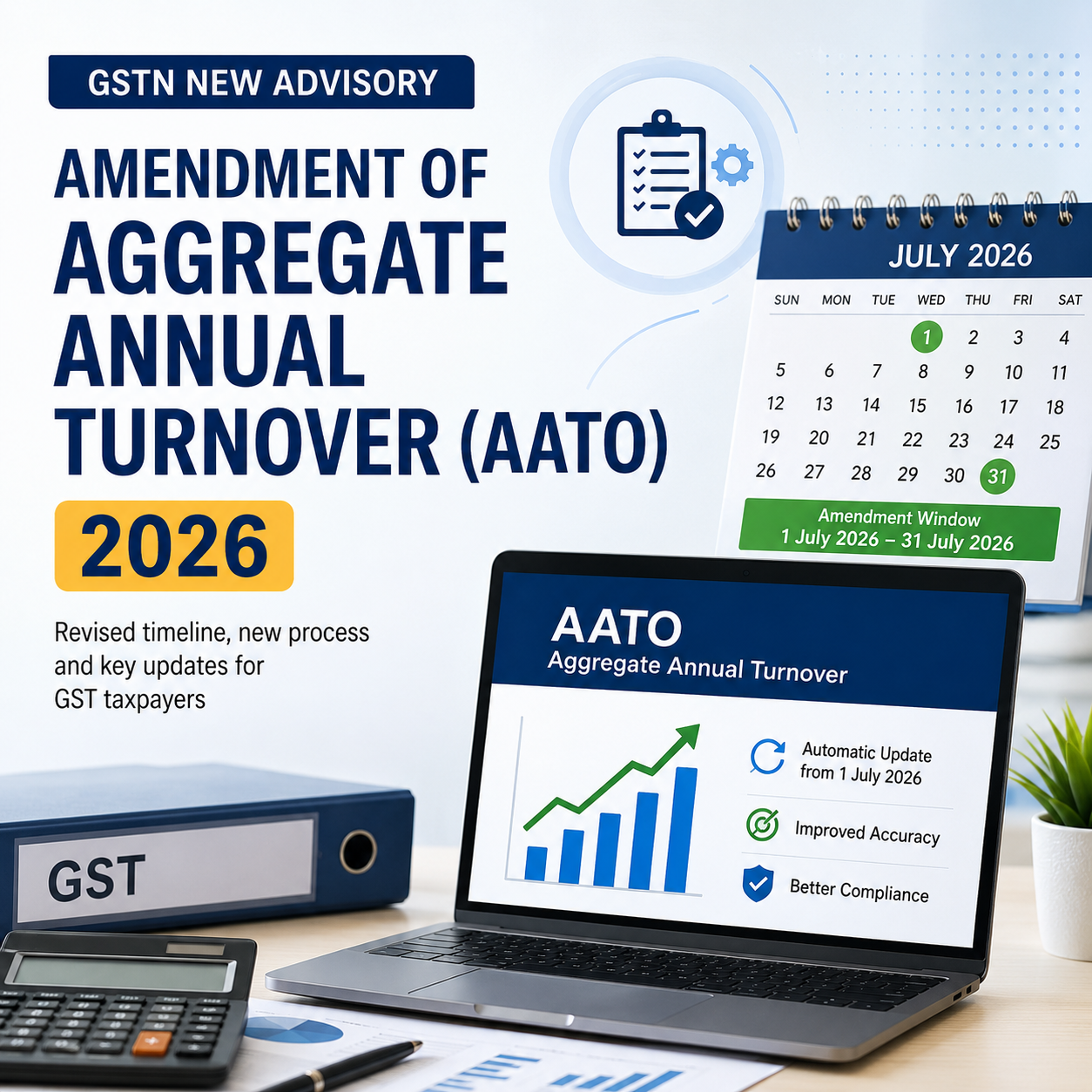
2026 GST Update: Changes to Aggregate Annual Turnover (AATO) Amendment Process
The Goods and Services Tax Network (GSTN) has released a new advisory on 1 July 2026 announcing a revised schedule for amending the Aggregate Annual Turnover (AATO) on the GST Portal.
This update is important for all GST-registered taxpayers, as the period for requesting AATO amendments for FY 2025-26 has been moved from May to July. The revision is part of a major enhancement to the GST system, enabling the portal to automatically recalculate and update the Aggregate Annual Turnover whenever subsequent GST returns are filed.
In this article, we discuss the meaning of AATO, the reason behind the revised amendment schedule, the updated timeline, and the key actions taxpayers should take before filing an amendment request.
GSTN Updates Timeline for AATO Amendment
The Goods and Services Tax Network (GSTN) has announced a revision in the schedule for amending the Aggregate Annual Turnover (AATO) on the GST Portal. The change is part of a major system upgrade aimed at improving the accuracy of turnover information available to taxpayers.
Previously, taxpayers were allowed to submit AATO amendment requests during the month of May each year. Beginning with FY 2025-26, this schedule has been revised.
Under the new process, taxpayers can submit AATO amendment requests from 1 July 2026 to 31 July 2026.
The revised timeline coincides with the launch of an enhanced GSTN system that will automatically recalculate and update a taxpayer’s Aggregate Annual Turnover whenever pending or future GST returns are filed, reducing the need for manual corrections.
What is Aggregate Annual Turnover (AATO)?
Aggregate Annual Turnover (AATO) represents the total value of a taxpayer’s supplies across India based on a single PAN during a financial year.
Generally, AATO includes:
- Taxable outward supplies
- Exempt supplies
- Export supplies
- Inter-State supplies
However, the following are excluded from AATO:
- GST collected on outward supplies
- Inward supplies that are liable to Reverse Charge
The AATO displayed on the GST Portal plays a vital role in determining several compliance requirements, including:
- Eligibility under the QRMP Scheme
- Applicability of e-Invoicing
- E-Way Bill compliance
- GST return filing obligations
- Other system-based validations under GST
Since several GST compliances depend on this figure, maintaining an accurate AATO is essential.
Reason Behind the Revised Amendment Schedule
GSTN has introduced this change as part of a system enhancement designed to automate the updating of Aggregate Annual Turnover.
Under the earlier mechanism, if taxpayers filed pending GST returns after the AATO had already been calculated, the turnover reflected on the portal could become outdated or inaccurate.
With the upgraded functionality:
- Aggregate Annual Turnover will be refreshed automatically whenever pending or subsequent GST returns are filed.
- The requirement for manual amendments will be considerably reduced.
- Turnover figures will remain consistent across different GST modules.
- System validations will rely on more accurate and updated turnover data.
- Overall accuracy and efficiency of the GST Portal will improve.
As these enhancements are being implemented from 1 July 2026, the AATO amendment window has also been shifted accordingly.
Revised AATO Amendment Schedule for FY 2025-26
| Activity | Updated Timeline |
|---|---|
| Submission of AATO Amendment Request by Taxpayer | 1 July 2026 to 31 July 2026 |
| Verification by Jurisdictional Tax Officer | 1 August 2026 to 15 August 2026 |
Earlier Process vs Revised Process
| Particular | Earlier Procedure | Revised Procedure |
| Amendment Window | During May | 1 July to 31 July |
| Officer Verification | After May | 1 August to 15 August |
| Automatic AATO Update | Not Available | Available from 1 July 2026 |
This revision represents one of the most significant improvements made by GSTN to the AATO amendment process since the feature was introduced. By integrating automatic turnover updates with GST return filing, the new system is expected to reduce errors, improve data consistency, and simplify GST compliance for taxpayers.
Earlier GSTN Advisory Continues Until FY 2024-25
GSTN has stated that the latest advisory should be read along with its earlier notification issued on 2 May 2022, which introduced the facility for taxpayers to amend their Aggregate Annual Turnover (AATO) during the month of May each year.
The procedure prescribed under the 2022 advisory remained applicable up to FY 2024-25. However, starting from FY 2025-26, taxpayers will need to follow the newly revised amendment schedule announced by GSTN.
Who Should Review Their AATO?
All GST-registered taxpayers are advised to verify the Aggregate Annual Turnover displayed on the GST Portal, especially in the following situations:
- GST returns were filed after the close of the financial year.
- There was a delay in filing GSTR-1 or GSTR-3B.
- The turnover figures were modified after the original filings.
- The business turnover is close to a compliance threshold under GST.
- The turnover shown on the GST Portal does not match the books of accounts.
Reviewing the AATO in such cases helps avoid compliance issues arising from incorrect turnover data.
Steps to Amend AATO on the GST Portal
Once the amendment facility becomes available, taxpayers can follow these steps:
- Sign in to the GST Portal.
- Open the Aggregate Annual Turnover (AATO) amendment option.
- Check the turnover value automatically generated by the system.
- Update the turnover amount if any correction is required.
- Submit the amendment request within the specified time period.
After submission, the amendment request will be forwarded to the concerned jurisdictional tax officer for verification and approval.
Key Points Taxpayers Should Keep in Mind
- The AATO amendment window for FY 2025-26 will remain open only from 1 July 2026 to 31 July 2026.
- Requests filed after the closing date may not be considered.
- Jurisdictional tax officers will verify amendment applications between 1 August and 15 August 2026.
- Taxpayers should carefully confirm the accuracy of the turnover before submitting any request.
- Incorrect AATO details may affect eligibility under various GST provisions and compliance requirements.
Assistance for Technical Issues
If taxpayers encounter any technical difficulty while using the AATO amendment facility, GSTN has advised them to submit a grievance through the Self-Service Portal available on the GST Portal.
To ensure quicker resolution, the grievance should include complete information along with any relevant supporting documents or screenshots.
Significance of the Latest Advisory
While the advisory does not introduce any amendments to the GST law itself, it brings an important procedural change to the management of Aggregate Annual Turnover.
The introduction of automatic AATO updates is expected to minimize manual corrections, improve the accuracy of turnover data, and ensure that the figures displayed on the GST Portal remain synchronized with the latest GST return filings.
Taxpayers should therefore review their AATO during the revised amendment period and make any necessary corrections before 31 July 2026.
Frequently Asked Questions (FAQs)
Q1. What is the revised period for amending AATO for FY 2025-26?
Taxpayers can submit AATO amendment requests from 1 July 2026 to 31 July 2026.
Q2. Why has GSTN changed the amendment schedule?
The timeline has been revised because GSTN is introducing an upgraded system that automatically updates Aggregate Annual Turnover whenever pending or future GST returns are filed.
Q3. When will amendment requests be verified by tax authorities?
Jurisdictional tax officers will examine and verify AATO amendment requests between 1 August 2026 and 15 August 2026.
Q4. Does the revised schedule apply to FY 2024-25?
No. The previous amendment window during May continues to apply up to FY 2024-25. The revised July timeline is effective from FY 2025-26 onwards.
Q5. Why is maintaining an accurate AATO important?
Aggregate Annual Turnover is used to determine eligibility for several GST compliance requirements, including the QRMP Scheme, e-Invoicing, E-Way Bill provisions, and various system-driven validations. Keeping the AATO accurate helps ensure smooth GST compliance.