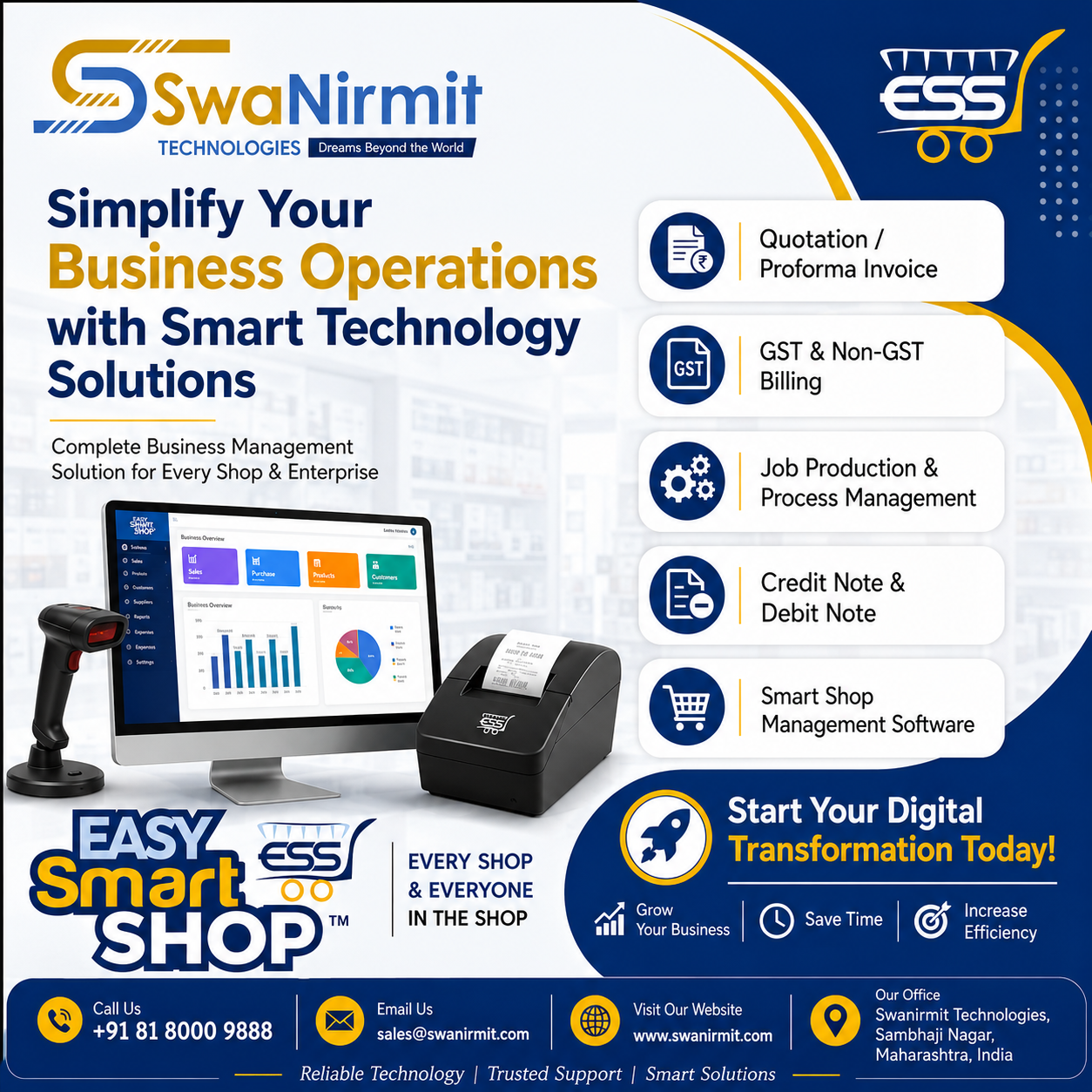
Easy Smart Shop Purchase Management: Simplify Your Business Purchase Process

Easy Smart Shop Purchase Management: Simplify Your Business Purchase Process

Managing purchases efficiently is one of the most important parts of running a successful business. Manual purchase entries, supplier records, invoice tracking, and stock updates can take valuable time and may lead to errors.

Easy Smart Shop Purchase Management Software by SwaNirmit Technologies helps businesses manage their complete purchase process in a simple, organized, and efficient way.


What is Purchase Management in Easy Smart Shop?

Purchase Management in Easy Smart Shop is a smart solution designed to manage all purchase-related activities from a single platform.

It helps businesses maintain supplier details, record purchase invoices, update stock automatically, and keep complete purchase transaction history.

With this system, businesses can easily control purchasing activities and improve overall efficiency.


Key Features of Easy Smart Shop Purchase Management

1. Easy Purchase Entry

Create and manage purchase entries quickly with complete details.

The Purchase Entry module allows you to record:

  • Purchase Date
  • Supplier Name
  • Invoice Number
  • Item Details
  • Quantity
  • Purchase Rate
  • Discount
  • GST Details
  • Total Purchase Amount

This helps maintain accurate purchase records.


2. Supplier Management

Manage complete supplier information in one place.

You can maintain:

  • Supplier Name
  • Address
  • Contact Number
  • Email Details
  • GST Number
  • Purchase History

This makes supplier communication and tracking easier.


3. GST Purchase Management

Easy Smart Shop supports GST-based purchase transactions.

It manages:

  • HSN Code
  • GST Rate
  • CGST
  • SGST
  • IGST
  • Taxable Amount
  • Total Invoice Amount

Businesses can maintain proper GST purchase records easily.


4. Automatic Stock Update

Whenever a purchase entry is created, stock quantity gets updated automatically.

Benefits:

✔ Real-time Stock Availability
✔ Better Inventory Control
✔ Avoid Stock Shortage
✔ Easy Product Tracking


5. Purchase Invoice Management

Maintain all purchase invoices digitally.

You can track:

  • Invoice Details
  • Purchase Amount
  • Supplier Balance
  • Payment Status

This helps businesses manage their accounts more effectively.


6. Purchase Reports & Tracking

Easy Smart Shop helps generate useful purchase information for better decision-making.

Track:

  • Purchase History
  • Supplier Transactions
  • Item Purchase Details
  • Payment Records

Benefits of Easy Smart Shop Purchase Management

✔ Reduces Manual Work
✔ Saves Business Time
✔ Improves Purchase Accuracy
✔ Maintains Complete Records
✔ Helps Manage Suppliers Easily
✔ Provides Better Business Control


Why Businesses Choose Easy Smart Shop

Easy Smart Shop is designed for retailers, wholesalers, traders, and enterprises who want a simple yet powerful solution to manage their daily business operations.

With advanced purchase management features, businesses can improve productivity and focus on growth.


SwaNirmit Technologies – Smart Business Solutions

SwaNirmit Technologies provides reliable software solutions that help businesses move towards digital transformation.

Our goal is to provide easy, efficient, and smart technology solutions for every business.

📍 SwaNirmit Technologies
Chhatrapati Sambhaji Nagar, Maharashtra, India

📞 +91 81 8000 9888
📧 sales@swanirmit.com
🌐 www.swanirmit.com

Easy Smart Shop – Smart Management for Every Shop & Enterprise

Credit Note Module – EASY Smart Shop ERP Complete Guide What is a Credit Note?

Credit Note Module – EASY Smart Shop ERP Complete Guide
What is a Credit Note?

A Credit Note is a document issued to a customer when the company needs to reduce the invoice amount due to reasons like:

Sales Return
Post Sale Discount
Invoice Correction
Service Issue
Other adjustments

In EASY Smart Shop ERP, the Credit Note module helps manage customer returns, discounts, and invoice adjustments easily.

1) How to Open Credit Note Module?

Go to:

Sales → Credit Note

The Credit Note Entry screen will open.

2) Credit Note Entry Screen Details
A) Select Customer / Supplier

At the top:

Select Customer or Supplier

Select the required customer.

After selecting customer, you can check details using:

Customer Details Button

3) Customer Details Window

Customer information can be entered:

Name

Enter Customer Name

Address

Enter Customer Address

Email

Enter Customer Email ID

Contact

Enter Mobile Number

GST No.

Enter Customer GST Number

State

Select Customer State

Example:

27 – Maharashtra

Click:

OK

to save details.

4) Credit Note Date

Credit Note Date

Shows the date on which Credit Note is created.

Example:

23-Jun-2026

5) Credit Note Number

Enter or generate Credit Note Number.

It is used for tracking and reporting purposes.

6) Credit Note Type

There are two options:

1) Sales Return

Used when customer returns purchased items.

Example:

Customer purchased a printer and returned it.

2) Discount

Used when discount is provided after sales.

Example:

Giving ₹500 discount after invoice generation.

7) GST Reason Selection

Select the reason for creating Credit Note.

Available options:

01 – Sales Return

For returned goods.

02 – Post Sale Discount

For discount provided after sale.

03 – Deficiency in Services

For service-related issues.

04 – Correction in Invoice

To correct invoice mistakes.

05 – Change in POS

For change in Place of Supply.

06 – Finalization of Provisional Assessment
07 – Others

For other reasons.

8) Reference Invoice Selection

If Credit Note is created against an old invoice:

Click:

Select Reference Invoice

Select the invoice.

The system will fetch invoice details automatically.

9) Invoice Number & Invoice Date

After selecting reference invoice:

Invoice Number
Invoice Date

will be displayed automatically.

10) Remark / Reason

Enter the reason for Credit Note.

Examples:

“Material Returned Due To Damage”

or

“Discount Given As Per Customer Request”

11) Item Selection

Select items from:

Select Items

Example:

Printer
CCTV Camera
Cable
Software
12) Item Details

After selecting an item, details will appear:

Unit

PCS / Nos / Box

Description

Item Name

GST Rate %

GST Percentage

HSN

HSN Code

CGST Rate

Central GST Rate

SGST Rate

State GST Rate

IGST Rate

Integrated GST Rate

Item Type

Item Category

13) Quantity & Rate Details

Enter:

Return Quantity

Quantity returned by customer

Rate

Item selling rate

Discount %

Discount percentage (if applicable)

Amount

Total item amount

14) Add Item

After entering item details:

Click:

Add Item

The item will be added to the Credit Note list.

15) Credit Note Calculation

The system calculates:

Taxable Amount

Amount before GST

CGST

Central GST amount

SGST

State GST amount

IGST

Integrated GST amount

Tax Amount

Total GST

Total Amount

Final Credit Note value

Round Up

Rounding adjustment

Credit Note Amount

Final credit amount given to customer

16) Save Credit Note

After checking all details:

Click:

Save (F5)

Credit Note will be generated.

17) Print & Email Options

Available options:

Print (F6)

Print Credit Note

Print Preview (F7)

Check preview before printing

E-Mail Invoice (F8)

Send Credit Note through email


18) Credit Note Management

To view previous Credit Notes:

Open:

Credit Note Management

Select:

From Date
To Date
Customer

Click:

View

The list shows:

Credit Note ID
Invoice Date
Customer Name
Credit Note Number
Total Amount
Invoice Number
Updated By
19) Additional Options
New Credit Note

Create new Credit Note

Edit Credit Note

Modify existing Credit Note

Export Excel

Export Credit Note report into Excel

Print

Print report

Benefits of Credit Note Module in EASY Smart Shop ERP

✅ Manage Sales Returns easily
✅ GST compliant Credit Notes
✅ Invoice correction facility
✅ Customer balance adjustment
✅ Automatic GST calculation
✅ Easy reporting
✅ Excel export facility

EASY Smart Shop ERP Credit Note Module makes Sales Return, Discount Management, and Invoice Adjustments simple, accurate, and faster.

Why Smart Businesses Are Switching to Easy Smart Shop Software

In today’s digital world, businesses are growing rapidly and customer expectations are increasing every day. Managing billing, inventory, accounting, and daily operations manually is no longer practical for modern businesses.

Many businesses still face common problems like:

❌ Slow Billing Process
❌ Stock Management Confusion
❌ Manual Accounting Errors
❌ Difficulty in Tracking Outstanding Payments
❌ Time-Consuming Report Preparation
❌ Lack of Proper Business Analysis

These problems not only waste valuable time but also affect overall business growth and customer satisfaction.

To solve these challenges, Swanirmit Technologies proudly presents Easy Smart Shop Software — a complete smart business management solution designed to simplify and modernize your business operations.

Our software helps businesses manage all important activities from one secure and easy-to-use platform.

✨ Key Features of Easy Smart Shop Software:

✅ GST & Non-GST Billing
Generate fast, accurate, and professional invoices with complete GST support.

✅ Inventory & Stock Management
Track stock availability, product movement, and low stock alerts easily.

✅ Purchase & Sales Management
Maintain complete records of purchases, sales, returns, and transactions.

✅ Accounting & Ledger Reports
Get accurate financial reports including ledgers, profit reports, payment reports, and balance summaries.

✅ Barcode Billing Support
Increase billing speed and reduce manual errors with barcode scanning.

✅ Customer & Supplier Management
Manage customer records, supplier details, payment history, and outstanding balances professionally.

✅ Multi User Access
Allow multiple staff members to use the software securely with role-based permissions.

✅ Daily, Monthly & Yearly Reports
Analyze your business performance with smart reports and business analytics.

✅ Data Backup & Security
Protect your valuable business data with secure backup and recovery options.

✅ User-Friendly Interface
Simple and easy-to-use software suitable for every business owner and staff member.

💡 Why Businesses Prefer Easy Smart Shop Software?

✔ Faster Billing & Better Customer Service
✔ Improved Stock Control
✔ Reduced Manual Work
✔ Better Financial Management
✔ Professional Business Reports
✔ Increased Productivity
✔ Smart & Modern Business Operations
✔ Time & Cost Saving

Our software is suitable for:

🏪 Retail Shops
🛒 Super Markets
👕 Garments & Footwear Stores
📱 Mobile & Electronics Shops
⚙ Hardware & Electrical Businesses
🪑 Furniture Shops
🏭 Manufacturing Units
🖨 Printing Press
📦 Wholesale Businesses
🔧 Job Work Industries
and many more…

One of our biggest strengths is continuous improvement. We regularly provide software updates, new features, improved performance, and modern business tools to keep your business future-ready.

🎯 Our Mission:
To make business management faster, smarter, easier, and completely professional for every business owner.

If you want to upgrade your business with smart technology and professional management solutions, Easy Smart Shop Software is the perfect choice.

📞 Contact Us Today: +91 8180009888

🌐 www.easysmartshop.com
🌐 www.swanirmit.com

Grow smarter with Easy Smart Shop Software by SwaNirmit Technologies.

Easy Smart Shop Software – Complete Business Management Solution for Modern Businesses

In today’s fast-growing and competitive business world, managing daily operations manually is becoming difficult and time-consuming. Every business requires fast billing, accurate stock management, proper accounting, and professional reporting to run smoothly and efficiently.

To solve these challenges, SwaNirmit Technologies proudly presents Easy Smart Shop Software — a smart, reliable, and complete business management solution designed for modern businesses.

Whether you run a retail shop, supermarket, manufacturing unit, medical store, or wholesale business, Easy Smart Shop Software helps you manage your entire business digitally from one powerful platform.


Why Businesses Need Smart Management Software

Traditional business management methods often create problems such as:

  • Slow billing process
  • Stock mismatch and inventory errors
  • Difficulty in maintaining accounts
  • Manual report preparation
  • Outstanding payment tracking issues
  • Data loss and security risks

A professional business software solution helps businesses save time, reduce errors, improve productivity, and make better business decisions.

Easy Smart Shop Software is specially developed to make daily business operations simple, fast, and professional.


Key Features of Easy Smart Shop Software

GST & Non-GST Billing

Generate professional invoices quickly with GST and Non-GST billing support.

Fast Invoice Printing

Create and print invoices instantly to improve customer service and reduce billing time.

Inventory & Stock Management

Track available stock, low stock alerts, purchase entries, and product management easily.

Purchase & Sales Management

Manage all purchase and sales activities from one system with complete records.

Customer & Supplier Management

Maintain customer and supplier information with transaction history and balance tracking.

Accounting & Ledger Reports

Get accurate accounting reports including ledgers, profit reports, balance summaries, and more.

Outstanding & Payment Tracking

Track pending payments, customer dues, and supplier outstanding reports easily.

Barcode Support

Faster product billing and inventory handling using barcode scanning support.

Multi-User Access

Allow multiple staff members to work securely with role-based access.

Reports & Business Analytics

Generate daily, monthly, and yearly reports to analyze business performance effectively.

Job Work & Production Management

Manage manufacturing, production, and job work operations professionally.

Data Backup & Security

Keep your important business data secure with backup and recovery options.

User-Friendly Interface

Simple and easy-to-use design suitable for all business owners and staff.

Custom Print Formats

Customize invoices and print formats according to your business requirements.


Businesses That Can Use Easy Smart Shop Software

Our software is suitable for various business types, including:

  • Retail Shops
  • Super Markets
  • Grocery / Kirana Stores
  • Garments & Footwear Shops
  • Mobile & Electronics Stores
  • Hardware & Electrical Businesses
  • Furniture Shops
  • Printing Press
  • Manufacturing Units
  • Wholesale Businesses
  • Job Work Industries
  • And many more…

Continuous Updates & New Features

Technology changes rapidly, and businesses need modern solutions to stay ahead in the market.

One of the biggest strengths of Easy Smart Shop Software is continuous improvement. We regularly provide:

  • New features
  • Software updates
  • Improved reports
  • Better performance
  • Latest business tools
  • Modern billing solutions

This keeps your business software future-ready and efficient.


Benefits of Using Easy Smart Shop Software

✔ Faster Billing Process
✔ Better Stock Control
✔ Professional Business Management
✔ Reduced Manual Work
✔ Accurate Accounting
✔ Improved Customer Service
✔ Secure Business Data
✔ Time & Cost Saving
✔ Increased Business Productivity


Our Mission

At SwaNirmit Technologies, our mission is simple:

To make business management smarter, faster, easier, and completely professional for every business owner.

We believe every business deserves reliable software that helps them grow confidently in the digital era.


Contact Us

If you are looking for a complete business management software solution, Easy Smart Shop Software is the perfect choice for your business.

📞 Mobile: +91 8180009888

🌐 Easy Smart Shop Official Website

🌐 SwaNirmit Technologies Official Website

Start managing your business smarter with Easy Smart Shop Software today!

Start Fresh This Financial Year – No More Billing Errors!

नवीन आर्थिक वर्ष म्हणजे व्यवसायासाठी एक fresh start. नवीन goals, नवीन planning आणि growth साठी नवीन दिशा. पण जर तुमच्या billing system मध्ये अजूनही चुका होत असतील, तर हे तुमच्या business growth साठी मोठं अडथळा ठरू शकतं.

👉 म्हणूनच, या financial year मध्ये एक smart decision घ्या – No More Billing Errors!


⚠️ Billing Errors तुमच्या Business ला कसा नुकसान करतात?

Manual billing किंवा outdated system वापरत असाल तर खालील समस्या येऊ शकतात:

  • ❌ Wrong calculations
  • ❌ GST filing errors
  • ❌ Duplicate / missing entries
  • ❌ Stock mismatch
  • ❌ Customer trust कमी होणे

या छोट्या चुका भविष्यात मोठ्या financial loss मध्ये बदलू शकतात.


🚀 Solution – Smart Billing Software

आजच्या digital युगात billing software हा luxury नाही, तर necessity आहे.

✔️ Error-Free Billing

Software automatically calculations करतो, त्यामुळे mistakes होण्याची शक्यता जवळजवळ शून्य होते.

✔️ Fast & Professional Invoices

काही सेकंदात professional bills तयार करा.

✔️ GST Ready System

Automatic GST reports आणि filing साठी complete support.

✔️ Real-Time Reports

Sales, profit, stock – सगळं एका click मध्ये track करा.

✔️ Easy Stock Management

Low stock alerts, inventory tracking सगळं सोपं होतं.


💡 Why This Financial Year is the Right Time to Upgrade?

  • 📅 New beginning = Better system
  • 📊 Clean accounting start
  • 💼 Professional business image
  • 📈 Faster growth & better control

🏪 कोणासाठी उपयुक्त?

  • Retail Shops
  • Wholesale Businesses
  • Supermarkets
  • Medical Stores
  • Service Providers

📢 Make the Smart Move Today!

या नवीन financial year मध्ये तुमचा business upgrade करा आणि billing mistakes ला कायमचा goodbye द्या 👋

👉 Smart बना, Digital बना!


📞 Contact Us

📱 8180009888
🌐 www.easysmartshop.com
📧 sales@swanirmit.com

बिलिंग सॉफ्टवेयर क्या है?

बिलिंग सॉफ्टवेयर क्या है और आपके बिज़नेस के लिए क्यों जरूरी है?

आज के डिजिटल दौर में हर छोटे-बड़े व्यवसाय के लिए बिलिंग सॉफ्टवेयर एक जरूरी टूल बन चुका है। पहले जहां लोग हाथ से बिल बनाते थे, वहीं अब सॉफ्टवेयर की मदद से कुछ ही सेकंड में प्रोफेशनल बिल तैयार किया जा सकता है।

💡 बिलिंग सॉफ्टवेयर क्या है?

बिलिंग सॉफ्टवेयर एक ऐसा डिजिटल टूल है जो आपके बिज़नेस के बिल, इनवॉइस और पेमेंट रिकॉर्ड को ऑटोमेट करता है।

यह सॉफ्टवेयर आपकी सेल्स, कस्टमर और टैक्स से जुड़ी सभी जानकारी को एक जगह सुरक्षित रखता है।


🚀 बिलिंग सॉफ्टवेयर के मुख्य फीचर्स

  • ✅ GST के अनुसार बिल बनाना
  • ✅ ऑटोमैटिक टैक्स कैलकुलेशन
  • ✅ कस्टमर और प्रोडक्ट मैनेजमेंट
  • ✅ इनवॉइस टेम्पलेट्स
  • ✅ पेमेंट ट्रैकिंग (Cash, UPI, Card)
  • ✅ सेल्स और रिपोर्ट्स

इन फीचर्स की मदद से आपका पूरा बिज़नेस आसानी से मैनेज हो जाता है।


🎯 बिलिंग सॉफ्टवेयर के फायदे

1. समय और मेहनत की बचत

सभी बिल ऑटोमेटिक बनते हैं, जिससे मैनुअल काम खत्म हो जाता है।

2. गलतियों में कमी

ऑटोमेशन के कारण कैलकुलेशन में गलती की संभावना कम हो जाती है।

3. प्रोफेशनल बिलिंग

आप अपने ग्राहकों को सुंदर और ब्रांडेड इनवॉइस दे सकते हैं।

4. टैक्स और GST आसान

बिलिंग सॉफ्टवेयर खुद ही GST रिपोर्ट तैयार कर देता है।

5. बिज़नेस ग्रोथ में मदद

रिपोर्ट्स और डेटा से आपको सही निर्णय लेने में मदद मिलती है।


📊 फ्री vs पेड बिलिंग सॉफ्टवेयर

फ्री सॉफ्टवेयर पेड सॉफ्टवेयर
बेसिक फीचर्स एडवांस फीचर्स
लिमिटेड इनवॉइस अनलिमिटेड बिलिंग
कम रिपोर्ट्स डिटेल्ड एनालिटिक्स
छोटे बिज़नेस के लिए ग्रोइंग बिज़नेस के लिए
Attention – Advisory on IMS

Oct 14th, 2024


      • Invoice Management System (IMS) is made available to taxpayers from Today, 14th Oct, 2024. The new system shall facilitate taxpayers in matching their records/invoices vis a vis issued by their suppliers for availing the correct Input Tax Credit (ITC). Taxpayers can make use of this system to take action on the invoices reflecting on IMS from 14th Oct, 2024. The first GSTR-2B would be generated for the return period Oct’24 on 14thNovember, 2024 considering action taken on Invoice Management System. It may be noted that it is not mandatory to take action on invoices in IMS dashboard for GSTR-2B generation.


Thanking You,
Team GSTN

GST Invoicing Rules Updated: Time Limit for RCM Invoices Effective November 2024

New GST Invoicing Rules: CBIC Introduces Rule 47A and Amends Rule 46 of CGST Rules

The Central Board of Indirect Taxes and Customs (CBIC) has issued Notification No. 20/2024 – Central Tax on October 8, 2024, introducing key changes to the Central Goods and Services Tax (CGST) Rules, 2017. These changes will be effective from November 1, 2024, and primarily concern the introduction of Rule 47A, the omission of the second proviso in Rule 46, and amendments to the third proviso of Rule 46. These changes aim to streamline the invoicing process, particularly for transactions under the Reverse Charge Mechanism (RCM).


Key Changes Introduced

1. Insertion of Rule 47A: Time Limit for Issuing Tax Invoices

With the insertion of Rule 47A, a time limit has been set for issuing tax invoices where the recipient is required to issue the invoice. This rule primarily impacts transactions under the Reverse Charge Mechanism (RCM), where the recipient, rather than the supplier, is liable to pay tax.Rule 47A reads as follows:

“Notwithstanding anything contained in rule 47, where an invoice referred to in rule 46 is required to be issued under clause (f) of sub-section (3) of section 31 by a registered person, who is liable to pay tax under sub-section (3) or sub-section (4) of section 9, he shall issue the said invoice within a period of thirty days from the date of receipt of the said supply of goods or services, or both, as the case may be.”

This rule ensures that invoices under RCM must be raised within 30 days of receiving goods or services, thereby offering clarity to businesses regarding the time frame for compliance.


2. Amendment to Rule 46: Omission of the Second Proviso

The second proviso in Rule 46 has been omitted. This omission helps streamline the rules and remove any redundant provisions.

  • Before: The rule contained a second proviso after clause (s).
  • After: The second proviso is now omitted, making the rule more concise and removing unnecessary language.

3. Amendment to the Third Proviso in Rule 46

The third proviso in Rule 46 has been amended for better clarity and language structure. Specifically, the phrase “Provided also that in the case of” has been replaced with “Provided further that in the case of”.

This change is primarily structural, intended to harmonize the structure of the provisos in Rule 46.


Comparative Overview: Before and After Amendments

Provision Before After
Rule 47A (New) Not applicable (no such provision existed before) Time limit of 30 days for issuing tax invoice by the recipient under RCM, effective from November 1, 2024.
Omission of Second Proviso in Rule 46 Second proviso existed after clause (s) in Rule 46. Second proviso has been omitted to streamline the rule.
Amendment to Third Proviso in Rule 46 “Provided also that in the case of…” “Provided further that in the case of…” (structural change for better clarity)

Example: Impact of Rule 47A on Reverse Charge Invoices

Under the Reverse Charge Mechanism (RCM), the liability to pay GST shifts from the supplier to the recipient. With the introduction of Rule 47A, a registered person liable to pay tax under sub-section (3) or (4) of section 9 (i.e., under RCM) must issue a tax invoice within 30 days of receiving the goods or services.

For example:

  • Scenario: A company, XYZ Ltd., receives legal services from a lawyer, which falls under the RCM category.
  • Action Before: There was no specific rule governing the time frame for issuing the invoice by XYZ Ltd. under RCM.
  • Action After (Rule 47A): XYZ Ltd. must issue the tax invoice within 30 days of receiving the legal services.

This rule ensures that tax compliance timelines are clearly defined, preventing delays in invoicing and potential penalties.

Note : 

The CBIC’s introduction of Rule 47A and the amendments to Rule 46 aim to create a more structured and organized framework for invoicing under GST, particularly concerning the Reverse Charge Mechanism (RCM). These amendments have the following implications:

  1. Clarity for Businesses: The time limit for issuing invoices under RCM is now clearly defined, making it easier for businesses to comply.
  2. Streamlined Rules: By omitting the second proviso and refining the language in the third proviso, the CGST Rules are more concise, reducing potential confusion.
  3. Coherent Structure: The harmonization of language and structure in Rule 46 and the addition of Rule 47A contribute to a more organized legal framework under the GST regime.

These changes are expected to improve overall compliance and reduce legal ambiguities, benefiting both businesses and tax authorities.

CBIC_notified_the_Central_Goods_and_Services_Tax_Second_Amendment_Rules_2024
Understanding GSTR-1: A Guide to Filing GST Returns

What is GST?

GST, or Goods and Services Tax, is a comprehensive indirect tax that has been implemented in India to replace multiple taxes levied by the central and state governments. It is a destination-based tax that aims to streamline the taxation system and reduce the cascading effect of taxes on goods and services.

The introduction of GST in India marked a significant shift in the country’s taxation landscape. Prior to its implementation, the tax structure in India was complex and convoluted, with a plethora of indirect taxes levied at various stages of the supply chain. This resulted in a cascading effect, where taxes were levied on top of taxes, leading to inflated prices for consumers and hindering the growth of businesses.
The GST regime sought to address these challenges by introducing a unified tax system that would subsume various indirect taxes such as excise duty, service tax, value-added tax (VAT), and central sales tax (CST), among others. By consolidating these taxes into a single tax, GST aimed to simplify the tax structure, make it more transparent, and eliminate the cascading effect.
Under the GST system, all goods and services are classified into different tax slabs based on their nature and value. These tax slabs include 0%, 5%, 12%, 18%, and 28%. Additionally, certain goods and services are exempted from GST or are subject to a special rate. This classification ensures that goods and services are taxed at the appropriate rate, based on their essentiality and luxury quotient.
The implementation of GST also brought about a significant change in the way businesses operate. Previously, businesses had to comply with multiple tax laws and maintain separate records for each tax. With GST, businesses are required to maintain a single set of records, file consolidated returns, and comply with a standardized set of rules and regulations. This has not only simplified the compliance process but has also reduced the administrative burden on businesses.
Moreover, GST has also facilitated the seamless movement of goods across state borders. Prior to GST, the movement of goods from one state to another was subject to various entry taxes and octroi duties, leading to delays and increased costs. With the introduction of GST, these barriers have been eliminated, and the process of inter-state movement of goods has become more efficient.
In addition to its impact on businesses, GST has also had a direct impact on consumers. With the elimination of the cascading effect of taxes, the prices of goods and services have become more competitive. This has resulted in a reduction in the overall tax burden on consumers and has made several goods and services more affordable.
Overall, the implementation of GST in India has been a significant step towards creating a unified and simplified tax system. It has not only streamlined the taxation process but has also contributed to the ease of doing business in the country. With its benefits of transparency, efficiency, and reduced tax burden, GST has emerged as a game-changer in India’s taxation landscape.

Submitting a GST return is a crucial step for businesses operating in countries that have implemented the Goods and Services Tax (GST) system. The GST return serves as a means for businesses to provide accurate and transparent information about their financial activities to the tax authorities. This information includes details such as sales, purchases, output tax, input tax, and any adjustments or corrections that need to be made.

When preparing a GST return, businesses need to ensure that the information provided is accurate and complete. Any errors or omissions can result in penalties and additional scrutiny from the tax authorities. Therefore, it is essential for businesses to maintain proper records and keep track of all their financial transactions.

The frequency at which a business needs to file GST returns depends on the regulations of the specific country. Some countries require monthly returns, while others may have quarterly or annual filing requirements. Regardless of the frequency, it is important for businesses to meet the deadlines set by the tax authorities to avoid any penalties or fines.

Once the GST return is filed, the tax authorities will review the information provided and assess the amount of tax payable or refundable. This assessment is based on the taxable income and expenses reported by the business. If there are any discrepancies or inconsistencies in the return, the tax authorities may request additional information or conduct an audit to verify the accuracy of the reported figures.

It is worth noting that GST returns can be complex and time-consuming to prepare, especially for businesses with a large number of transactions. To simplify the process, many businesses use accounting software or hire professional accountants to handle their GST compliance. These tools and services can help ensure that the GST return is prepared accurately and in accordance with the applicable regulations.

In conclusion, a GST return is a vital document that businesses must submit to fulfill their tax compliance obligations. It requires businesses to provide detailed information about their financial activities, and any errors or omissions can result in penalties. Therefore, businesses should prioritize maintaining accurate records and meeting the filing deadlines to avoid any issues with the tax authorities.

GSTR-1

GSTR-1 is a crucial component of the Goods and Services Tax (GST) regime, designed to streamline the taxation process and ensure transparency in the Indian economy. As per the GST law, registered taxpayers are required to file this return on a monthly or quarterly basis, depending on their turnover. This return serves as a comprehensive record of the outward supplies of goods or services made by the taxpayer during a specific period.

When it comes to filing GSTR-1, accuracy and timeliness are of utmost importance. It is essential for businesses to diligently report all their sales transactions in a structured manner, providing detailed information about the nature of the supplies, the corresponding tax rates, and the applicable taxes. By doing so, businesses contribute to the creation of a robust database that aids in the calculation of tax liabilities and facilitates seamless tax administration.

The GSTR-1 return is divided into several sections, each catering to different types of supplies. Taxpayers are required to furnish information about their outward supplies made to registered persons (B2B transactions), supplies made to unregistered persons (B2C transactions), and exports. Additionally, they need to report any amendments or modifications made to previously filed returns, if applicable.

One of the primary objectives of GSTR-1 is to enable the reconciliation of data between the supplier and the recipient. By providing accurate and complete information about their outward supplies, businesses allow the recipients to claim input tax credit (ITC) and ensure that the tax credits availed by them are valid and legitimate. This helps in minimizing tax evasion and maintaining the integrity of the GST system.

Furthermore, GSTR-1 plays a crucial role in facilitating the auto-population of data in the recipient’s GSTR-2A, which is a read-only return reflecting the inward supplies as per the supplier’s GSTR-1. This auto-population feature ensures that the recipient has access to the necessary information for claiming ITC and reduces the chances of errors or discrepancies in the tax credit reconciliation process.

It is important for businesses to understand the significance of GSTR-1 and comply with the filing requirements within the stipulated deadlines. Failure to file or incorrect reporting can attract penalties and may lead to compliance issues. Therefore, businesses should maintain proper records, adopt efficient accounting systems, and stay updated with the latest GST regulations to ensure seamless compliance with GSTR-1 and other GST returns.

Benefits of filing GSTR-1 on time

Filing GSTR-1 on time not only helps taxpayers avoid penalties but also offers several other benefits. Firstly, it ensures that the taxpayer’s records are up to date and accurate, reflecting the correct details of outward supplies. This is crucial for maintaining transparency and avoiding any discrepancies or mismatches in the data provided by the recipient in their GSTR-2A.

Secondly, timely filing of GSTR-1 allows taxpayers to claim input tax credit (ITC) on the GST paid on their purchases. The ITC can be claimed only if the supplier has filed their GSTR-1 and the recipient has reconciled the data in their GSTR-2A. Failing to file GSTR-1 on time may result in the recipient being unable to claim the ITC, leading to increased tax liability.

Additionally, filing GSTR-1 within the due dates ensures that the taxpayer’s compliance rating remains intact. The compliance rating is an important factor considered by businesses, as it reflects their adherence to tax regulations. A good compliance rating can enhance the taxpayer’s reputation and credibility, making it easier to secure business contracts and loans.

Moreover, timely filing of GSTR-1 helps in avoiding any unnecessary scrutiny or audits from the tax authorities. By submitting accurate and complete information in the return, taxpayers reduce the chances of being flagged for further investigation. This saves them from the hassle and potential penalties associated with tax audits.

In conclusion, GSTR-1 is a critical return form that requires timely and accurate filing. It not only helps the government reconcile data but also ensures that taxpayers can claim input tax credit and maintain their compliance rating. By understanding the details and requirements of GSTR-1, taxpayers can fulfill their obligations and reap the benefits of timely compliance.