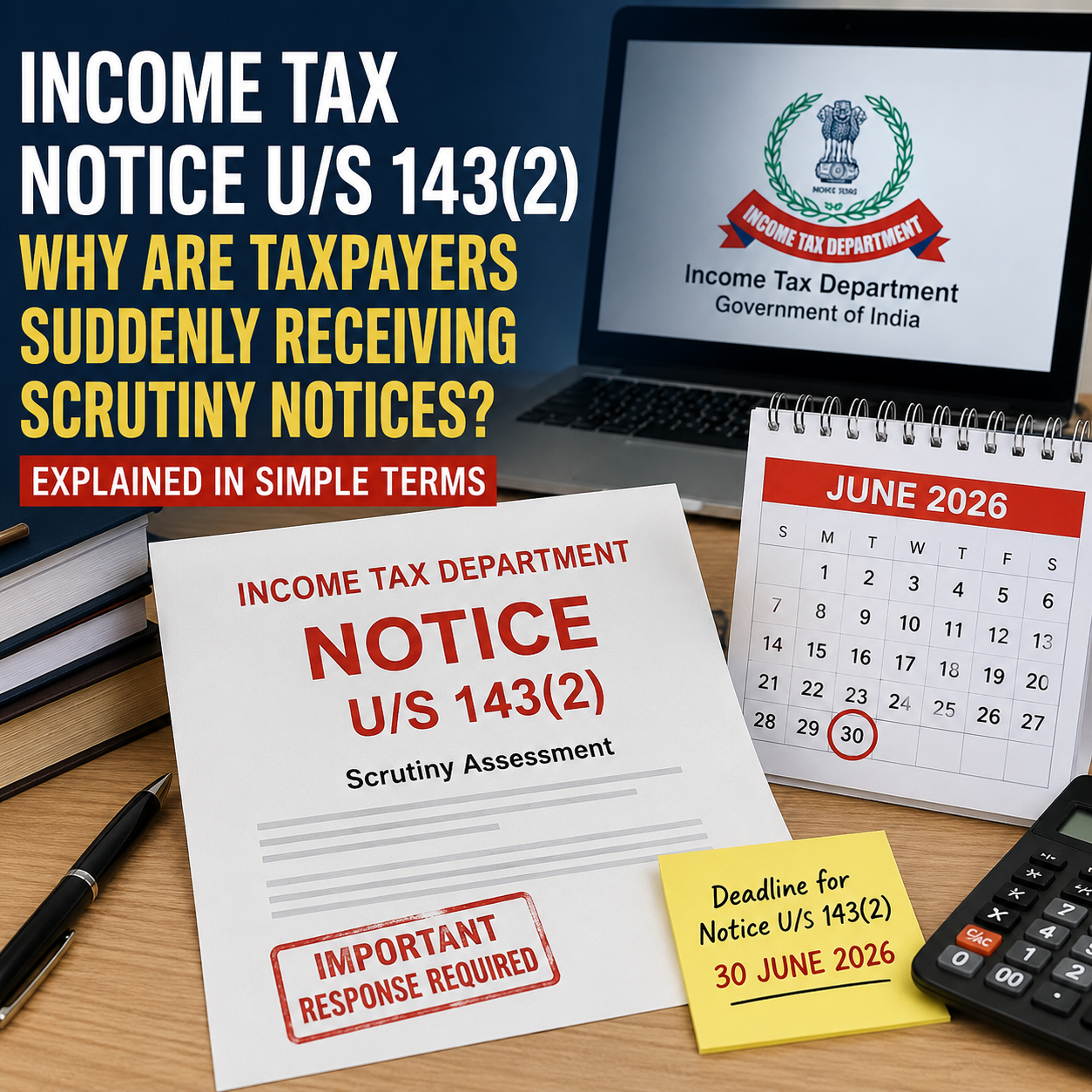
Income Tax Scrutiny Notices Under Section 143(2) Issued in June 2026: What Taxpayers Should Know

Why Are Taxpayers Receiving Section 143(2) Notices Across India?

In recent days, a large number of taxpayers have reported receiving notices under Section 143(2) of the Income-tax Act from the Income Tax Department.

For many, receiving any communication from the department immediately creates anxiety. Reports and discussions on social media have further fuelled concerns, with claims that scrutiny notices are being issued to a significant number of taxpayers.

This has left many wondering:

“I filed my Income Tax Return several months ago. Why have I received a notice only now?”

It is one of the most common questions taxpayers are asking.

The reason is linked to a specific statutory time limit prescribed under the Income-tax Act for issuing scrutiny notices—a provision that many taxpayers are unaware of.

Before assuming the worst, it is important to understand why these notices are being issued, what they actually mean, and whether you need to take any immediate action.

Why Are So Many Section 143(2) Notices Being Issued?

Many taxpayers are unaware that the Income Tax Department has a legally prescribed time limit for issuing scrutiny notices. Such notices cannot be sent at any time after a return is filed.

For Assessment Year (AY) 2025-26, the last date for issuing a notice under Section 143(2) is:

30 June 2026

This deadline plays a significant role in the recent increase in scrutiny notices.

If the Department decides to examine a return filed for AY 2025-26, the notice must be issued on or before this date. As the deadline approaches, the Department completes its risk assessment and selects eligible cases for detailed verification, resulting in a higher number of notices being issued during June 2026.


What Is a Notice Under Section 143(2)?

A notice under Section 143(2) is issued when the Income Tax Department chooses an Income Tax Return for a detailed review.

The purpose of the scrutiny is to verify whether:

  • Income has been reported correctly.
  • Deductions claimed are eligible.
  • Exemptions have been claimed as per law.
  • Capital gains have been computed accurately.
  • The information reported in the return matches the data available with the Department.

Receiving such a notice does not mean that the taxpayer has concealed income or committed tax evasion. It simply indicates that the Department requires additional information or supporting documents before completing the assessment.


Why Has Your Return Been Selected for Scrutiny?

Many taxpayers believe that once their return is processed, the matter is closed. However, the Income Tax Department now relies on advanced technology, including data analytics and AI-based risk assessment, to identify cases requiring further verification.

Information from multiple sources is compared before a return is selected for scrutiny.

1. Differences Between AIS, Form 26AS and ITR

One of the most common reasons for scrutiny is inconsistency between:

  • Annual Information Statement (AIS)
  • Form 26AS
  • Income Tax Return (ITR)

Even minor mismatches may trigger further examination.

2. High-Value Financial Transactions

The Department receives information relating to various significant transactions, such as:

  • Large cash deposits
  • Purchase or sale of immovable property
  • High-value investments
  • Significant credit card payments
  • Foreign remittances

If these transactions are not consistent with the income reported, the return may be selected for scrutiny.

3. Incorrect Reporting of Capital Gains

Taxpayers who have sold assets such as:

  • Land
  • Residential property
  • Commercial property
  • Shares
  • Mutual funds

may receive scrutiny notices if capital gains have not been disclosed or calculated correctly.

4. Large Refund Claims or Questionable Deductions

Returns claiming substantial tax refunds or unusually high deductions and exemptions are often subjected to additional verification before refunds are processed.

5. Business Losses or Unusual Profit Patterns

Businesses reporting:

  • Heavy losses
  • Exceptionally low profits
  • Large expense claims
  • Significant deductions

may attract closer examination by the Department.

6. Foreign Income and Overseas Assets

The Department has strengthened monitoring of taxpayers having:

  • Foreign bank accounts
  • Overseas investments
  • Foreign income
  • International financial transactions

Incomplete or incorrect reporting of such information may result in scrutiny.


Does a Section 143(2) Notice Mean You Have Violated Tax Laws?

No.

Receiving a scrutiny notice should not be interpreted as evidence of tax evasion or wrongdoing.

It simply means that the Income Tax Department wishes to verify certain details mentioned in your return.

Every year, many honest taxpayers receive scrutiny notices and complete the assessment successfully by submitting the required documents and explanations.


What Should You Do After Receiving a Notice?

Most scrutiny assessments are now conducted online through the Faceless Assessment system.

The general process includes:

Step 1: Log in to the Income Tax e-Filing Portal.

Step 2: Read the notice carefully along with any questionnaire issued.

Step 3: Gather all relevant documents and records.

Step 4: Upload your response through the e-Proceedings facility.

Step 5: Ensure that the response is submitted before the due date mentioned in the notice.

In most cases, the entire communication takes place electronically.


Documents That May Be Required

Depending on the issues involved, the Department may request documents such as:

  • Bank account statements
  • Property purchase agreements
  • Sale deeds
  • Capital gains calculations
  • Books of account
  • GST records
  • Loan confirmations
  • Investment proofs
  • Details of foreign assets
  • Income-related supporting documents

The exact list of documents varies according to the facts of each case.


Can You Ignore a Section 143(2) Notice?

No.

Ignoring a scrutiny notice can have serious consequences, including:

  • Best Judgment Assessment
  • Addition of income
  • Additional tax demand
  • Interest liability
  • Penalty proceedings

It is therefore essential to review the notice carefully and submit an appropriate response within the prescribed time.


Important Deadline

Particulars Details
Financial Year 2024-25
Assessment Year 2025-26
Last Date for Issue of Notice under Section 143(2) 30 June 2026

This statutory deadline is the primary reason for the noticeable increase in scrutiny notices during June 2026.


Key Takeaway

If you have received a notice under Section 143(2), there is no need to panic.

A scrutiny notice does not automatically indicate tax evasion or any irregularity. In many cases, it is issued simply because the Department requires additional verification before completing the assessment.

The recent surge in notices is mainly due to the statutory deadline of 30 June 2026 for issuing scrutiny notices for AY 2025-26.

Read the notice carefully, collect the necessary documents, respond accurately within the prescribed timeline, and seek professional assistance if required. Prompt compliance and proper documentation are the best way to ensure a smooth scrutiny process.


Frequently Asked Questions (FAQs)

Is a notice under Section 143(2) a cause for concern?

It should be taken seriously, but receiving the notice does not automatically mean that you have violated any tax provisions.

Why are many taxpayers receiving these notices in June 2026?

The Income Tax Department must issue scrutiny notices for AY 2025-26 on or before 30 June 2026, which explains the increase in notices during this period.

Are scrutiny assessments conducted online?

Yes. Most scrutiny proceedings are handled electronically through the Faceless Assessment system.

Can I appoint a Chartered Accountant to handle my case?

Yes. A Chartered Accountant or any authorised representative can assist you in preparing and submitting responses during the scrutiny proceedings.

What should I do immediately after receiving the notice?

Log in to the Income Tax e-Filing Portal, review the notice carefully, collect all relevant supporting documents, and submit your response within the specified deadline.
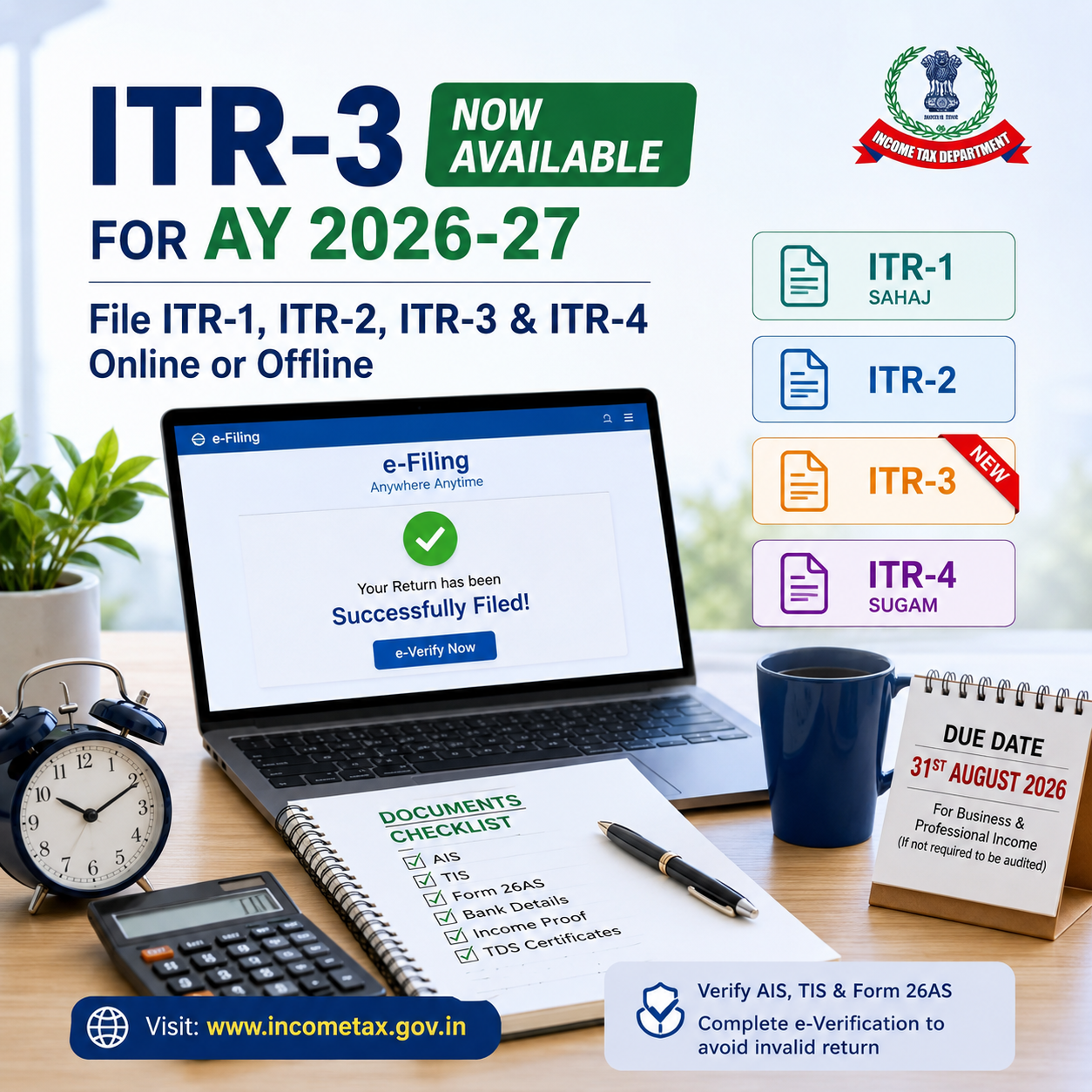

Income Tax Department Enables ITR-3 for AY 2026-27; ITR-1 to ITR-4 Ready for Filing

ITR-3 Now Available for AY 2026-27: Online Filing & Excel Utility Released

The Income Tax Department has officially activated both the Online Filing Facility and Excel Utility for ITR-3 for Assessment Year (AY) 2026-27. This marks a significant milestone for taxpayers who were waiting for the ITR-3 form to become available before submitting their Income Tax Returns.

Previously, the department had already enabled ITR-1, ITR-2, and ITR-4 in both online and offline modes. However, many taxpayers—including business owners, professionals, freelancers, traders, and individuals earning business or professional income—were unable to file their returns because ITR-3 had not yet been released.

With ITR-3 now available, the majority of individual taxpayers can begin filing their Income Tax Returns for AY 2026-27 without any further delay.

Taxpayers can access the filing portal by visiting www.incometax.gov.in.

Extended Due Date for Certain ITR-3 Filers

Individuals filing ITR-3 who earn income from business or profession and are not required to get their accounts audited can file their Income Tax Return up to 31st August 2026.

Who Should File ITR-3?

ITR-3 is applicable to Individuals and Hindu Undivided Families (HUFs) having income from business or profession, including:

  • Proprietorship business
  • Professional practice
  • Freelancing services
  • Share trading and Futures & Options (F&O) transactions
  • Commission or brokerage income
  • Business income along with income from other sources

In general, taxpayers earning income under the head “Profits and Gains of Business or Profession” should file ITR-3, unless they choose the presumptive taxation scheme and qualify to file ITR-4.

Who Should File ITR-1?

ITR-1 (Sahaj) is meant for resident individuals who satisfy the prescribed conditions and generally have:

  • Income from salary or pension
  • Income from one house property
  • Income from other sources, such as interest
  • Total income within the prescribed eligibility limits

    Who Should File ITR-2?

    ITR-2 is meant for Individuals and Hindu Undivided Families (HUFs) who do not earn income from business or profession but have income from one or more of the following sources:

    • Capital gains arising from the sale of shares, mutual funds, or immovable property.
    • Income from more than one house property.
    • Ownership of foreign assets or receipt of foreign income.
    • Total income that exceeds the eligibility criteria prescribed for filing ITR-1.

      Who Should File ITR-3?

      ITR-3 is designed for Individuals and Hindu Undivided Families (HUFs) earning income from a business or profession. It is generally applicable to taxpayers such as:

      • Proprietors running a business.
      • Professionals, including doctors, lawyers, architects, and chartered accountants.
      • Consultants providing professional services.
      • Freelancers earning income from independent assignments.
      • Traders dealing in shares, Futures & Options (F&O), and other derivatives.
      • Individuals having business or professional income along with salary, capital gains, house property income, or income from other sources.

      Documents Required Before Filing Your Income Tax Return

      To ensure a smooth and accurate filing process, taxpayers should keep the following documents readily available:

      • PAN Card
      • Aadhaar Card
      • Form 16 (where applicable)
      • Form 26AS
      • Annual Information Statement (AIS)
      • Taxpayer Information Summary (TIS)
      • Bank account details
      • Capital gains statements
      • Interest certificates from banks and financial institutions
      • Business financial statements and books of accounts (where applicable)

      Verify AIS, TIS and Form 26AS Before Filing

      Before submitting the Income Tax Return, taxpayers should carefully reconcile the information available in:

      • Annual Information Statement (AIS)
      • Taxpayer Information Summary (TIS)
      • Form 26AS

      These records provide details of various financial transactions, including:

      • Interest income
      • Dividend income
      • Share market transactions
      • Mutual fund investments and redemptions
      • Sale or purchase of property
      • Tax Deducted at Source (TDS)
      • Specified high-value financial transactions

      Matching these details with the information reported in your return helps avoid discrepancies. Any inconsistency may lead to notices from the Income Tax Department, defective return processing, or additional compliance requirements.

      E-Verification is Compulsory

      Filing the Income Tax Return is only one part of the process. Taxpayers must also complete the e-verification of the return within the prescribed time limit.

      A return that is not e-verified within the specified period may be treated as invalid under the provisions of the Income-tax Act, resulting in the return being considered as not filed.

      ITR-3 Now Available Along with ITR-1, ITR-2 & ITR-4

      The launch of ITR-3 for AY 2026-27 has provided significant relief to business owners, professionals, freelancers, traders, and other taxpayers who were waiting for the form to become available before filing their Income Tax Returns.

      With ITR-1, ITR-2, ITR-3, and ITR-4 now enabled in both online and offline modes, the majority of taxpayers can move forward with filing their returns for the current assessment year.

      Before Filing

      • Review AIS (Annual Information Statement)

      • Verify TIS (Taxpayer Information Summary)

      • Reconcile details with Form 26AS

2 Mandatory Documents You Should Not Miss While Filing ITR in 2026

Ignoring these documents while filing your Income Tax Return can lead to mismatches, defective returns, refund delays, or even income tax notices. Today, the Income Tax Department receives financial data directly from employers, banks, mutual funds, stock brokers, property registrars, GST systems, and other reporting agencies.

Many taxpayers still assume that ITR filing only means entering salary figures and submitting the return. However, the tax system is now highly data-driven and automated. Even a small mismatch between your filed return and the information available with the department may trigger scrutiny or notices.

Why Verifying Form 26AS and AIS is Now Mandatory Before Filing ITR

With the Income Tax Department using advanced data analytics and automated verification systems, taxpayers can no longer afford to file returns without checking their reported financial data. Two documents have now become extremely important before filing any Income Tax Return for AY 2026–27:

  • Form 26AS
  • Annual Information Statement (AIS)

Ignoring these documents while filing your ITR may result in:

  • mismatch notices,
  • defective return notices,
  • refund delays,
  • scrutiny proceedings,
  • or even reassessment notices.

Therefore, every taxpayer should carefully reconcile both Form 26AS and AIS before submitting the return.

What is Form 26AS?

Form 26AS is a consolidated tax statement linked to your PAN. It contains tax-related information reported against your PAN during the financial year.

It generally includes:

  • TDS deducted by employer,
  • TDS on bank interest,
  • TCS collected,
  • advance tax paid,
  • self-assessment tax paid,
  • refund details,
  • and certain specified high-value transactions.

In simple terms, Form 26AS reflects the taxes already deposited with the government in your name.

If you claim TDS in your ITR that is not appearing in Form 26AS, your refund may get reduced or the department may issue a mismatch communication.

What is AIS (Annual Information Statement)?

AIS is now one of the most powerful information-reporting tools used by the Income Tax Department.

Compared to Form 26AS, AIS is far more detailed and comprehensive. It may contain information relating to:

  • salary income,
  • savings account interest,
  • fixed deposit interest,
  • dividend income,
  • stock market transactions,
  • mutual fund investments,
  • property purchase or sale,
  • foreign remittances,
  • GST turnover,
  • credit card payments,
  • and several other financial activities.

AIS collects data from multiple reporting entities and enables the department to compare your actual financial transactions with the income disclosed in your ITR.  This means that if your AIS reflects higher income or financial transactions than what you report in your return, the chances of receiving an income tax notice increase significantly.

Why Ignoring AIS and Form 26AS is Dangerous in 2026

Earlier, many taxpayers used to file their Income Tax Returns based only on Form 16 or basic bank statements. However, the Income Tax Department now relies heavily on advanced reporting and automated verification systems such as:

  • AIS (Annual Information Statement),
  • TIS (Taxpayer Information Summary),
  • Form 26AS,
  • SFT reporting,
  • PAN-based analytics,
  • and AI-driven data matching systems.

As a result, even small mismatches can now get automatically flagged by the department’s systems.

For example:

  • unreported bank interest,
  • ignored mutual fund redemptions,
  • missed dividend income,
  • or mismatch in stock trading turnover

may trigger notices at a later stage.

This is why blindly filing ITR without checking AIS and Form 26AS has become increasingly risky in 2026.


Common Mistakes Taxpayers Make

1. Ignoring Bank Interest

Many taxpayers forget to disclose:

  • savings account interest,
  • fixed deposit interest,
  • recurring deposit interest.

However, banks report this information directly to the department, and it generally appears in AIS.


2. Ignoring Share Market Transactions

Even if the profit amount is small, stock brokers report:

  • share sale transactions,
  • F&O turnover,
  • mutual fund redemptions.

If these transactions appear in AIS but are not properly disclosed in the ITR, taxpayers may later receive notices.


3. Claiming Incorrect TDS

Some taxpayers claim TDS based only on Form 16 without verifying whether the TDS actually appears in Form 26AS.

If TDS is missing in Form 26AS:

  • refund processing may get delayed,
  • or tax credit may be denied.

4. Filing ITR Before AIS Gets Fully Updated

Many taxpayers rush to file their ITR in May itself. However, AIS data may still be under updation by reporting entities during the early filing season.

As a result:

  • revised AIS entries may appear later,
  • creating mismatches with the already-filed return.

This is one of the major reasons tax professionals often advise taxpayers not to file returns too early without proper reconciliation.


Difference Between AIS and Form 26AS

Particulars Form 26AS AIS
TDS Details Yes Yes
Tax Payments Yes Yes
Bank Interest Limited Detailed
Share Transactions Limited Detailed
Mutual Fund Transactions Limited Yes
Property Transactions Limited Yes
Foreign Remittances No Yes
Financial Analytics No Extensive

What Happens if a Mismatch is Found?

If the department identifies mismatches between:

  • ITR filed,
  • AIS data,
  • and Form 26AS,

taxpayers may receive:

  • compliance notices,
  • defective return notices,
  • refund withholding,
  • reassessment notices,
  • or demand notices.

In several cases, these notices are generated automatically by the system without manual intervention.


How to Safely File ITR in 2026

Before filing your return, taxpayers should:

  • download and review AIS carefully,
  • verify Form 26AS,
  • match salary details with Form 16,
  • reconcile bank interest,
  • verify mutual fund and share transactions,
  • confirm all TDS entries,
  • and check high-value transactions properly.

If incorrect information appears in AIS, taxpayers can also submit feedback through the Income Tax portal.


Important Practical Advice

AIS is not always perfectly accurate. Sometimes:

  • duplicate entries,
  • incorrect reporting,
  • or wrong transaction classifications

may appear in the statement.

Therefore, taxpayers should not blindly copy AIS data into the ITR either. Proper reconciliation and verification remain extremely important.

At the same time, completely ignoring AIS and Form 26AS is one of the biggest mistakes taxpayers make during ITR filing.


Conclusion

In 2026, filing an Income Tax Return without checking Form 26AS and AIS can be highly risky because the Income Tax Department now uses advanced analytics, PAN-based reporting, and automated mismatch detection systems.

These two documents have effectively become the backbone of accurate and safe ITR filing.

Therefore, before submitting your Income Tax Return, every taxpayer should:

  • âś… verify AIS carefully,
  • âś… check Form 26AS properly,
  • âś… reconcile all income and financial transactions,
  • âś… confirm TDS and tax payment details,
  • âś… and ensure accurate reporting in the ITR.