
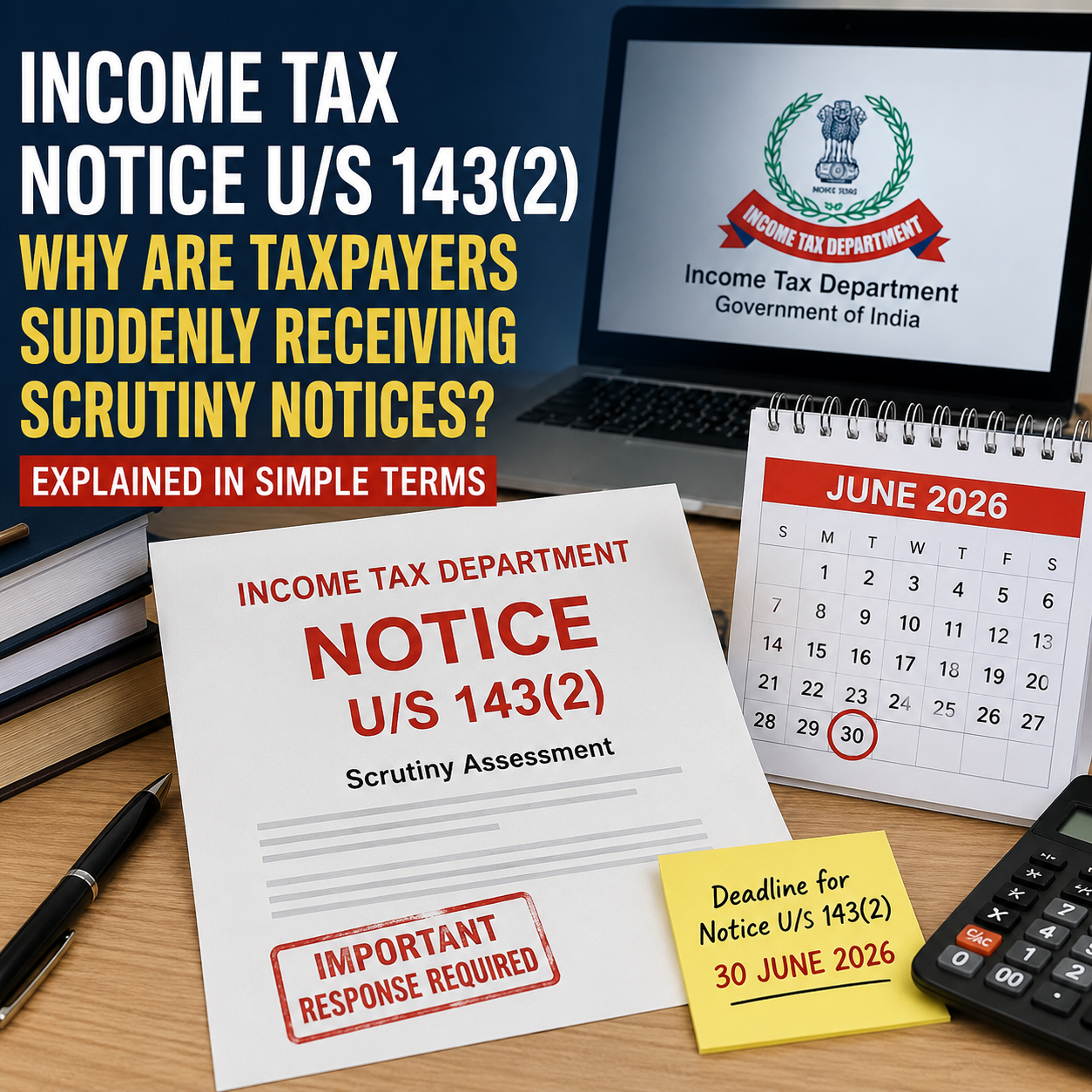

Income Tax Scrutiny Notices Under Section 143(2) Issued in June 2026: What Taxpayers Should Know
Why Are Taxpayers Receiving Section 143(2) Notices Across India?
In recent days, a large number of taxpayers have reported receiving notices under Section 143(2) of the Income-tax Act from the Income Tax Department.
For many, receiving any communication from the department immediately creates anxiety. Reports and discussions on social media have further fuelled concerns, with claims that scrutiny notices are being issued to a significant number of taxpayers.
This has left many wondering:
“I filed my Income Tax Return several months ago. Why have I received a notice only now?”
It is one of the most common questions taxpayers are asking.
The reason is linked to a specific statutory time limit prescribed under the Income-tax Act for issuing scrutiny notices—a provision that many taxpayers are unaware of.
Before assuming the worst, it is important to understand why these notices are being issued, what they actually mean, and whether you need to take any immediate action.
Why Are So Many Section 143(2) Notices Being Issued?
Many taxpayers are unaware that the Income Tax Department has a legally prescribed time limit for issuing scrutiny notices. Such notices cannot be sent at any time after a return is filed.
For Assessment Year (AY) 2025-26, the last date for issuing a notice under Section 143(2) is:
30 June 2026
This deadline plays a significant role in the recent increase in scrutiny notices.
If the Department decides to examine a return filed for AY 2025-26, the notice must be issued on or before this date. As the deadline approaches, the Department completes its risk assessment and selects eligible cases for detailed verification, resulting in a higher number of notices being issued during June 2026.
What Is a Notice Under Section 143(2)?
A notice under Section 143(2) is issued when the Income Tax Department chooses an Income Tax Return for a detailed review.
The purpose of the scrutiny is to verify whether:
- Income has been reported correctly.
- Deductions claimed are eligible.
- Exemptions have been claimed as per law.
- Capital gains have been computed accurately.
- The information reported in the return matches the data available with the Department.
Receiving such a notice does not mean that the taxpayer has concealed income or committed tax evasion. It simply indicates that the Department requires additional information or supporting documents before completing the assessment.
Why Has Your Return Been Selected for Scrutiny?
Many taxpayers believe that once their return is processed, the matter is closed. However, the Income Tax Department now relies on advanced technology, including data analytics and AI-based risk assessment, to identify cases requiring further verification.
Information from multiple sources is compared before a return is selected for scrutiny.
1. Differences Between AIS, Form 26AS and ITR
One of the most common reasons for scrutiny is inconsistency between:
- Annual Information Statement (AIS)
- Form 26AS
- Income Tax Return (ITR)
Even minor mismatches may trigger further examination.
2. High-Value Financial Transactions
The Department receives information relating to various significant transactions, such as:
- Large cash deposits
- Purchase or sale of immovable property
- High-value investments
- Significant credit card payments
- Foreign remittances
If these transactions are not consistent with the income reported, the return may be selected for scrutiny.
3. Incorrect Reporting of Capital Gains
Taxpayers who have sold assets such as:
- Land
- Residential property
- Commercial property
- Shares
- Mutual funds
may receive scrutiny notices if capital gains have not been disclosed or calculated correctly.
4. Large Refund Claims or Questionable Deductions
Returns claiming substantial tax refunds or unusually high deductions and exemptions are often subjected to additional verification before refunds are processed.
5. Business Losses or Unusual Profit Patterns
Businesses reporting:
- Heavy losses
- Exceptionally low profits
- Large expense claims
- Significant deductions
may attract closer examination by the Department.
6. Foreign Income and Overseas Assets
The Department has strengthened monitoring of taxpayers having:
- Foreign bank accounts
- Overseas investments
- Foreign income
- International financial transactions
Incomplete or incorrect reporting of such information may result in scrutiny.
Does a Section 143(2) Notice Mean You Have Violated Tax Laws?
No.
Receiving a scrutiny notice should not be interpreted as evidence of tax evasion or wrongdoing.
It simply means that the Income Tax Department wishes to verify certain details mentioned in your return.
Every year, many honest taxpayers receive scrutiny notices and complete the assessment successfully by submitting the required documents and explanations.
What Should You Do After Receiving a Notice?
Most scrutiny assessments are now conducted online through the Faceless Assessment system.
The general process includes:
Step 1: Log in to the Income Tax e-Filing Portal.
Step 2: Read the notice carefully along with any questionnaire issued.
Step 3: Gather all relevant documents and records.
Step 4: Upload your response through the e-Proceedings facility.
Step 5: Ensure that the response is submitted before the due date mentioned in the notice.
In most cases, the entire communication takes place electronically.
Documents That May Be Required
Depending on the issues involved, the Department may request documents such as:
- Bank account statements
- Property purchase agreements
- Sale deeds
- Capital gains calculations
- Books of account
- GST records
- Loan confirmations
- Investment proofs
- Details of foreign assets
- Income-related supporting documents
The exact list of documents varies according to the facts of each case.
Can You Ignore a Section 143(2) Notice?
No.
Ignoring a scrutiny notice can have serious consequences, including:
- Best Judgment Assessment
- Addition of income
- Additional tax demand
- Interest liability
- Penalty proceedings
It is therefore essential to review the notice carefully and submit an appropriate response within the prescribed time.
Important Deadline
| Particulars | Details |
|---|---|
| Financial Year | 2024-25 |
| Assessment Year | 2025-26 |
| Last Date for Issue of Notice under Section 143(2) | 30 June 2026 |
This statutory deadline is the primary reason for the noticeable increase in scrutiny notices during June 2026.
Key Takeaway
If you have received a notice under Section 143(2), there is no need to panic.
A scrutiny notice does not automatically indicate tax evasion or any irregularity. In many cases, it is issued simply because the Department requires additional verification before completing the assessment.
The recent surge in notices is mainly due to the statutory deadline of 30 June 2026 for issuing scrutiny notices for AY 2025-26.
Read the notice carefully, collect the necessary documents, respond accurately within the prescribed timeline, and seek professional assistance if required. Prompt compliance and proper documentation are the best way to ensure a smooth scrutiny process.
Frequently Asked Questions (FAQs)
Is a notice under Section 143(2) a cause for concern?
It should be taken seriously, but receiving the notice does not automatically mean that you have violated any tax provisions.
Why are many taxpayers receiving these notices in June 2026?
The Income Tax Department must issue scrutiny notices for AY 2025-26 on or before 30 June 2026, which explains the increase in notices during this period.
Are scrutiny assessments conducted online?
Yes. Most scrutiny proceedings are handled electronically through the Faceless Assessment system.
Can I appoint a Chartered Accountant to handle my case?
Yes. A Chartered Accountant or any authorised representative can assist you in preparing and submitting responses during the scrutiny proceedings.
What should I do immediately after receiving the notice?
Log in to the Income Tax e-Filing Portal, review the notice carefully, collect all relevant supporting documents, and submit your response within the specified deadline.