

Income Tax Rules 2026: Major Changes, Updated ITR Forms, Exemption Limits & PDF Overview
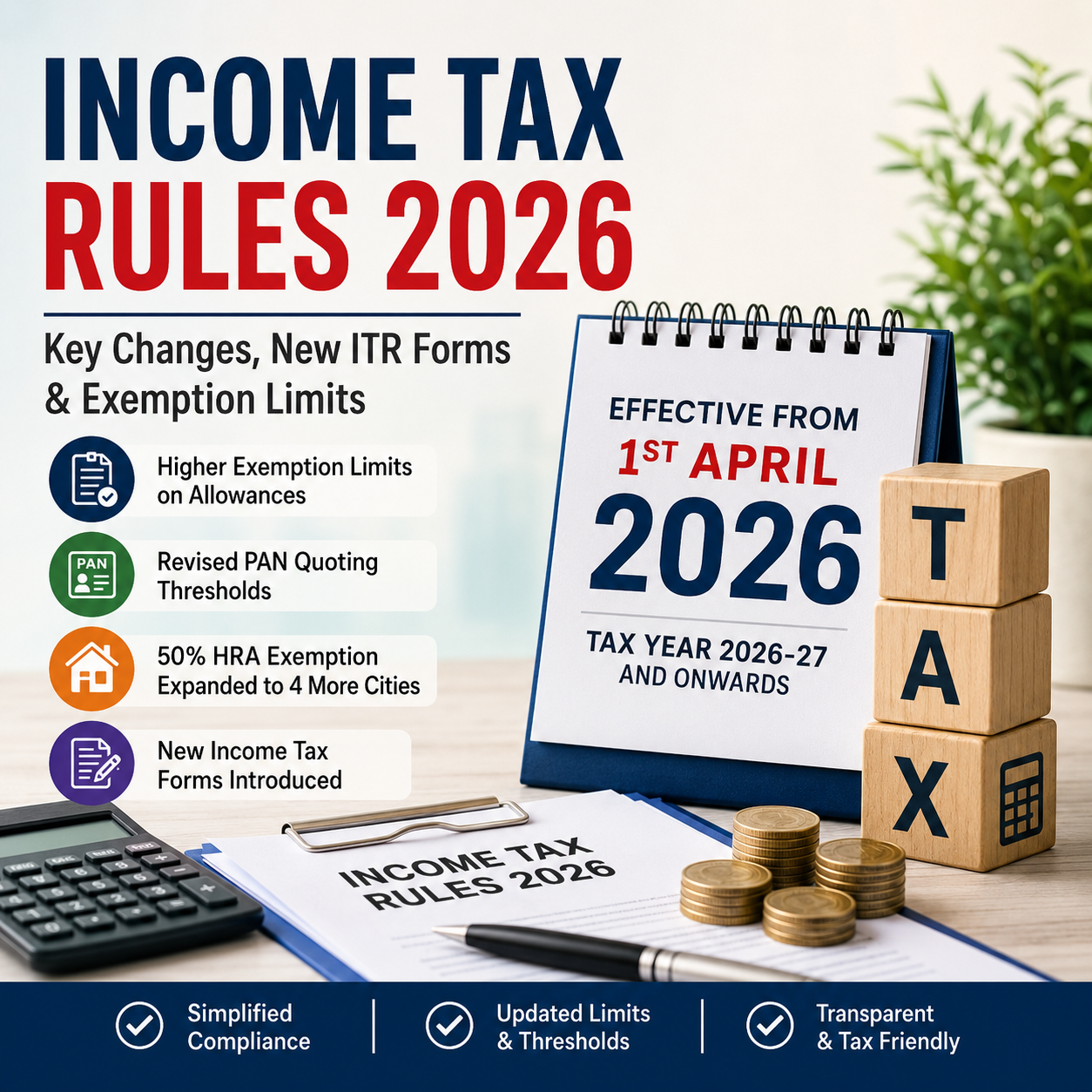
The Income Tax Rules 2026 have replaced the decade-old Income Tax Rules 1962 with effect from 1st April 2026 and will apply from Tax Year 2026–27 onwards. These new rules operationalise the Income Tax Act 2025 by revising exemption limits for allowances, updating PAN quoting thresholds, extending the 50% HRA exemption to four additional cities, and introducing new income tax forms.
Income Tax Rules 2026 – Latest Update
The CBDT has issued a notification correcting several minor drafting errors and terminology issues in the new Income Tax Rules 2026. However, these corrections do not result in any major impact on income computation or tax calculations.
New Income Tax Rules – Overview
- The Income Tax Rules 2026 replace the Income Tax Rules 1962 from 1st April 2026 for Tax Year 2026–27 onwards.
- Exemption limits for several allowances such as children education, hostel, meals, and gifts have been substantially increased to align with current inflation and living costs.
- The benefit of 50% HRA exemption has been extended to 8 cities, with Bengaluru, Pune, Hyderabad, and Ahmedabad newly added under the old tax regime.
- PAN quoting thresholds for high-value transactions such as property purchases, cash deposits, and vehicle transactions have been revised.
What are the Income Tax Rules 2026?
The Income Tax Rules 2026 are the procedural and operational rules notified by the Central Board of Direct Taxes (CBDT) under Section 533 of the Income Tax Act 2025. These rules replace the Income Tax Rules 1962 and contain more than 333 rules dealing with forms, procedures, compliance requirements, valuation methods, and reporting obligations applicable from 1st April 2026.
The provisions of the new rules will apply to income earned during Tax Year 2026–27 and later years. For income earned during FY 2025–26 (AY 2026–27), the provisions of the Income Tax Act 1961 and Income Tax Rules 1962 will continue to apply.
Income Tax Rules 2026 PDF Download
The PDF version of the Income Tax Rules 2026 can be downloaded from the official Income Tax Department website.
Effective Date of the New Rules
The Income Tax Rules 2026 will become effective from 1st April 2026 along with the implementation of the Income Tax Act 2025. Both the Act and the Rules will apply from Tax Year 2026–27 onwards.
Key Changes in Income Tax Rules 2026
1. Revised Allowance & Perquisite Valuation Rules
One of the most awaited reforms under the new rules is the revision of allowance and perquisite valuation limits in line with modern salary structures and inflation.
| Item | Earlier Limit | Revised Limit (2026 Rules) |
|---|---|---|
| Children Education Allowance | Rs. 100 per month per child | Rs. 3,000 per month per child |
| Hostel Allowance | Rs. 300 per month per child | Rs. 9,000 per month per child |
| Free Meals | Rs. 50 per meal | Rs. 200 per meal |
| Non-cash Gifts | Rs. 5,000 annually | Rs. 15,000 annually |
| Car Lease (<1.6L engine) | Rs. 1,800 + Rs. 900 driver | Rs. 5,000 + Rs. 3,000 driver |
| Car Lease (>1.6L engine) | Rs. 2,400 + Rs. 900 driver | Rs. 7,000 + Rs. 3,000 driver |
| Overseas Medical Treatment | Exempt if income below Rs. 2 lakh | Exempt if income below Rs. 8 lakh |
These revised limits significantly improve the practical usefulness of exemptions available to salaried employees.
2. PAN Quoting Requirement Changes
The monetary thresholds for mandatory PAN quoting in certain transactions have been revised under the new rules.
| Nature of Transaction | Existing Limit | New 2026 Limit |
|---|---|---|
| Purchase/Sale of Motor Vehicle | All vehicles except two-wheelers | Above Rs. 5 lakh (including motorcycles, excluding tractors) |
| Hotel/Restaurant Cash Payment | Above Rs. 50,000 | Above Rs. 1 lakh |
| Life Insurance Premium | Above Rs. 50,000 annually | PAN required at account relationship stage |
| Immovable Property Transactions | Above Rs. 10 lakh | Above Rs. 20 lakh |
| Cash Withdrawals | Rs. 20 lakh annually | Rs. 10 lakh annually |
| Cash Deposits | Above Rs. 50,000 in a day | Above Rs. 10 lakh annually |
3. HRA Exemption Expanded to More Cities
The new rules now extend the 50% House Rent Allowance exemption category to the following additional cities:
- Bengaluru
- Pune
- Hyderabad
- Ahmedabad
With this change, the total number of cities eligible for the 50% HRA exemption rises to eight. Previously, only Mumbai, Delhi, Chennai, and Kolkata qualified for this benefit.
However, HRA exemption continues to remain available only under the Old Tax Regime.
4. Introduction of New Income Tax Forms
Several income tax forms have been renamed or consolidated under the new framework.
Major changes include:
- Form 16 renamed as Form 130
- Form 15G and Form 15H merged into Form 121
- Form 26AS renamed as Form 168
5. Other Important Changes
Additional amendments have also been introduced for SFT reporting and digital compliance requirements.
| Item | Old Provision | New 2026 Provision |
|---|---|---|
| Property SFT Reporting Limit | Rs. 30 lakh | Rs. 45 lakh |
| Books of Accounts for Professionals | Manual books permitted | Mandatory digital books |
| CBDC (e-Rupee) | No recognition | Recognised as valid electronic payment mode |
Impact on Salaried Employees
The Income Tax Rules 2026 are expected to have a major impact on salaried taxpayers due to the sharp increase in exemption limits for allowances and perquisites.
Benefits such as:
- Rs. 3,000 education allowance,
- Rs. 9,000 hostel allowance,
- Rs. 200 meal exemption,
can significantly reduce taxable salary under the Old Tax Regime.
As a result, salaried individuals may need to reassess their salary structure and compare both tax regimes carefully before selecting the most beneficial option.
Impact on Businesses
The new rules introduce a more technology-driven and compliance-oriented tax ecosystem for businesses.
Businesses may now need to:
- maintain digital books of accounts,
- strengthen payroll and reporting systems,
- improve disclosure mechanisms,
- and adapt to faceless and automated tax administration systems.
While these changes enhance transparency and standardisation, they may also increase compliance costs and reporting obligations.
Impact on NRIs
For NRIs, the Income Tax Rules 2026 introduce clearer compliance standards and stricter disclosure requirements.
Important areas affected include:
- residential status determination,
- foreign income reporting,
- disclosure of overseas assets,
- taxation of digital and global income,
- and DTAA-related compliance.
Although digital systems and simplified procedures may improve ease of filing, NRIs will need to maintain proper documentation to avoid penalties and disputes.
Old Tax Regime vs New Tax Regime – Which May Be Better?
The ideal tax regime will continue to depend on the taxpayer’s income level and available deductions/exemptions.
With the revised exemption limits for allowances and perquisites, the Old Tax Regime could become more attractive for many salaried employees who receive structured salary benefits.
Taxpayers who previously found the old regime less beneficial may now see lower taxable income due to these enhanced exemption limits, making the old regime comparatively more tax-efficient in certain cases.