Senior Citizens Get Special Tax Advantages in 2026

Senior Citizens in India: Comprehensive Tax & Financial Benefits Guide 2026

The Government of India acknowledges the lifelong contribution of senior citizens and, in return, extends a broad set of tax concessions, exemptions, compliance relaxations, banking advantages, and lifestyle-related benefits to ensure financial stability and dignity during retirement.

This detailed guide explains 30+ benefits and features available to senior and super senior citizens in India for FY 2025–26 / AY 2026–27.


1. Definition of Senior Citizen Under Income Tax Law

As per the Income Tax Act:

  • Senior Citizen: Resident individual aged 60 years or more but below 80 years

  • Super Senior Citizen: Resident individual aged 80 years or above

  • Specified Senior Citizen (Section 194P): Resident aged 75 years or above, earning only pension and interest from the same bank, and eligible for exemption from filing ITR


2. Income Tax Slabs – New Tax Regime (FY 2025–26)

The New Tax Regime, which is now the default option, applies equally to all taxpayers, including senior citizens:

Total Income Tax Rate
Up to ₹4,00,000 Nil
₹4,00,001 – ₹8,00,000 5%
₹8,00,001 – ₹12,00,000 10%
₹12,00,001 – ₹16,00,000 15%
₹16,00,001 – ₹20,00,000 20%
₹20,00,001 – ₹24,00,000 25%
Above ₹24,00,000 30%

Taxpayers may still opt for the old tax regime if it offers better savings.


3. Zero Tax on Income Up to ₹12.75 Lakh – Major Relief

Under the New Regime:

  • Standard deduction on salary/pension: ₹75,000

  • Taxable income up to ₹12,00,000

  • Section 87A rebate applicable

As a result, a senior citizen earning up to ₹12.75 lakh from pension/salary pays zero income tax, making the new regime highly beneficial for retirees.


4. Higher Basic Exemption Under Old Tax Regime

Those opting for the old regime enjoy enhanced exemption limits:

Category Exemption Limit
General taxpayer ₹2,50,000
Senior Citizen (60–79 years) ₹3,00,000
Super Senior Citizen (80+ years) ₹5,00,000

5. Section 80TTB – Deduction on Interest Income

Senior citizens can claim a deduction up to ₹50,000 on interest earned from:

  • Savings bank accounts

  • Fixed & recurring deposits

  • Post office schemes

  • Co-operative bank deposits

This benefit is exclusive to senior citizens and replaces Section 80TTA.


6. Section 80D – Health Insurance & Medical Expenses

To reduce healthcare costs, senior citizens are eligible for:

  • ₹50,000 deduction for health insurance premium

  • Medical expenses allowed if insurance is not taken

  • Additional deduction for premiums paid for dependent parents


7. Section 80DDB – Deduction for Specified Diseases

For treatment of serious ailments such as cancer, kidney failure, Parkinson’s disease, etc., senior citizens can claim:

  • Deduction up to ₹1,00,000, subject to conditions and certification


8. No Advance Tax Liability (Section 207)

Senior citizens are not required to pay advance tax if:

  • They do not have business income, and

  • Their income consists only of pension and interest

This also protects them from interest under Sections 234B and 234C.


9. Relaxations in ITR Filing

Offline ITR Filing

Super senior citizens may file paper returns (ITR-1 or ITR-4) instead of mandatory e-filing.

Section 194P – ITR Filing Exemption

Eligible residents aged 75+ earning only pension and bank interest are not required to file ITR, as the bank computes and deducts tax.


10. TDS Benefits & Form 15H

  • Form 15H can be submitted to avoid TDS if total tax liability is nil

  • TDS threshold on interest income increased to ₹1,00,000 per year

  • No TDS on bank/post office interest up to this limit


11. Enhanced Family Pension Exemption

Under the new regime:

  • Exemption increased to ₹25,000 per year

  • Allowed as lower of one-third of pension or ₹25,000


12. LTCG Benefits on Equity Investments

Senior citizens enjoy:

  • Basic exemption adjustment up to ₹4,00,000

  • Additional ₹1,50,000 LTCG exemption

  • Effectively, LTCG up to ₹1.5 lakh can be tax-free


13. Reverse Mortgage – Capital Gains Exemption

Amounts received through reverse mortgage of a residential property:

  • Are not treated as transfer

  • Hence, no capital gains tax applies


14. Higher Interest Rates on Senior Citizen FDs

Banks generally offer:

  • Additional 0.50% interest for senior citizens

  • Up to 0.75% extra for super senior citizens


15. Senior Citizen Savings Scheme (SCSS)

Key features:

  • Eligibility: Age 60+

  • Maximum investment: ₹30 lakh

  • Quarterly interest payout (rate as notified)

  • Eligible for Section 80C deduction

  • Backed by Government of India


16. Other Social, Banking & Lifestyle Benefits

Senior citizens also enjoy several non-tax advantages, including:

  • Railway & state transport concessions

  • Airline fare discounts

  • Healthcare priority & hospital rebates

  • Enhanced Ayushman Bharat coverage

  • Doorstep banking services (age 70+)

  • Property tax & stamp duty rebates (state-wise)

  • Telecom concessions

  • State-sponsored old-age pension schemes


Conclusion

For FY 2026, senior citizens in India benefit from a strong combination of:

✔ Lower tax burden
✔ Simplified compliance
✔ Higher exemptions and deductions
✔ Secure investment options
✔ Banking and lifestyle privileges

These measures collectively aim to ensure financial independence, stability, and improved quality of life after retirement.

New Banking and Cash Transaction Rules from 2026

🇮🇳 Introduction – Why Banking Transactions Deserve More Attention Today

In a rapidly digitising India, almost every financial move—personal or professional—passes through the banking system. Whether it’s UPI collections, cash deposits, fixed deposits, or GST-related receipts, banks today function not just as facilitators but also as statutory reporting entities.

A common misconception among taxpayers is that only very large or suspicious transactions attract scrutiny from the Income Tax Department.
However, this assumption is incorrect.

Even regular, everyday transactions—if misunderstood, misclassified, or improperly reported—can:

  • Get reported under Specified Financial Transactions (SFT)

  • Reflect in AIS / Form 26AS

  • Trigger income-tax notices

  • Result in bank account restrictions

  • Create GST registration or compliance complications

The purpose of this article/video is not to alarm, but to educate and empower.

In this guide, we clearly explain:

  • Banking transaction limits applicable for 2026

  • Transactions that are most likely to attract scrutiny

  • Rules related to cash, UPI, fixed deposits, and withdrawals

  • How bank activity links with Income Tax and GST

  • Practical steps to remain compliant and notice-free

If you carefully apply the compliance tips shared towards the end, you can manage your finances legally, confidently, and without unnecessary tax anxiety.


1️⃣ Banking Transaction Modes & Applicable Limits

🟦 UPI (Unified Payments Interface)

UPI remains India’s most popular digital payment method.

  • Standard daily limit: ₹1,00,000 per user

  • Per-transaction limit: Generally ₹1 lakh (varies by bank)

  • Higher limits: Up to ₹5 lakh per day for specific categories such as education, healthcare, government payments, and capital market transactions (effective 15 September 2025)

💡 Banks may impose lower internal limits—always verify with your bank.


🟦 IMPS (Immediate Payment Service)

  • Usually capped at ₹5 lakh per day per account

  • Available 24×7, making it suitable for urgent, higher-value transfers (subject to bank limits)


🟦 NEFT (National Electronic Funds Transfer)

  • Minimum: ₹1

  • No statutory maximum limit

  • Banks may set daily caps

  • Suitable for large-value transfers without UPI/IMPS restrictions


🟦 RTGS (Real-Time Gross Settlement)

  • Minimum transaction value: ₹2 lakh

  • No upper limit prescribed

  • Best for very high-value, time-sensitive transfers


2️⃣ Cash Transactions & Deposit Rules

🔸 Cash Deposit Reporting (SFT)

Banks and financial institutions are required to report:

  • ₹10 lakh or more cash deposits in a savings account in a financial year

  • ₹50 lakh or more cash deposits in a current account

  • ₹10 lakh or more in fixed deposits during a financial year

👉 This does not mean tax is levied automatically, but the transaction is reported and may be examined.


🔸 Cash Receipt Restrictions – Section 269ST

  • Receiving ₹2 lakh or more in cash from a single person:

    • In one day, or

    • In a single transaction, or

    • For one occasion/event
      is prohibited.

💡 Penalty can be equal to the cash amount received.


🔸 Cash Loans & Repayments – Sections 269SS & 269T

  • Acceptance or repayment of loans/deposits in cash above ₹20,000 is not allowed.

  • Penalty equals the amount involved.


3️⃣ TDS on Cash Withdrawals – Section 194N

This provision discourages excessive cash usage and promotes transparency.

🧾 TDS Applicability on Cash Withdrawals

ITR Filing Status Withdrawal Limit TDS Rate
ITR filed for last 3 AYs Above ₹1 crore 2%
ITR not filed for last 3 AYs Above ₹20 lakh 2% up to ₹1 crore, 5% thereafter

📌 Limits apply per bank, calculated cumulatively for the financial year.


4️⃣ Specified Financial Transactions (SFT)

Banks report high-value transactions such as:

  • Cash deposits crossing prescribed limits

  • Large or unusual digital inflows/outflows

These details appear in AIS and Form 26AS and must align with your ITR disclosures.


5️⃣ GST Linkage With Bank Accounts

🟡 GST Registration Threshold

  • Goods: ₹40 lakh

  • Services: ₹20 lakh

If bank receipts exceed these limits, GST registration becomes mandatory.

⚠️ Non-linking of bank account on GST portal within 30 days may lead to GST suspension.


6️⃣ Mandatory Disclosures in ITR & GST

📌 Income Tax Return

  • All bank accounts must be disclosed

  • Unexplained SFT entries can trigger notices

📌 GST Portal

  • Primary bank account linking is compulsory

  • Non-compliance can result in registration suspension


7️⃣ Business Cash Payment Restriction – Section 40A(3)

  • Cash expenses exceeding ₹10,000 per person per day are not deductible

  • Encourages digital payments and proper documentation


8️⃣ Practical Tips to Stay Notice-Free

✅ Maintain separate accounts for business and personal use
✅ Reconcile UPI inflows with business records
✅ Avoid unnecessary cash transactions
✅ File ITR regularly to benefit from higher withdrawal thresholds
✅ Maintain documentation for all large-value transactions


🧠 Key Takeaways

  • Know your banking limits and comply with them

  • Large cash dealings attract reporting and penalties

  • Regular ITR filing provides tangible compliance benefits

  • GST-bank linkage is critical for business continuity

  • Proper record-keeping is your best defence against notices

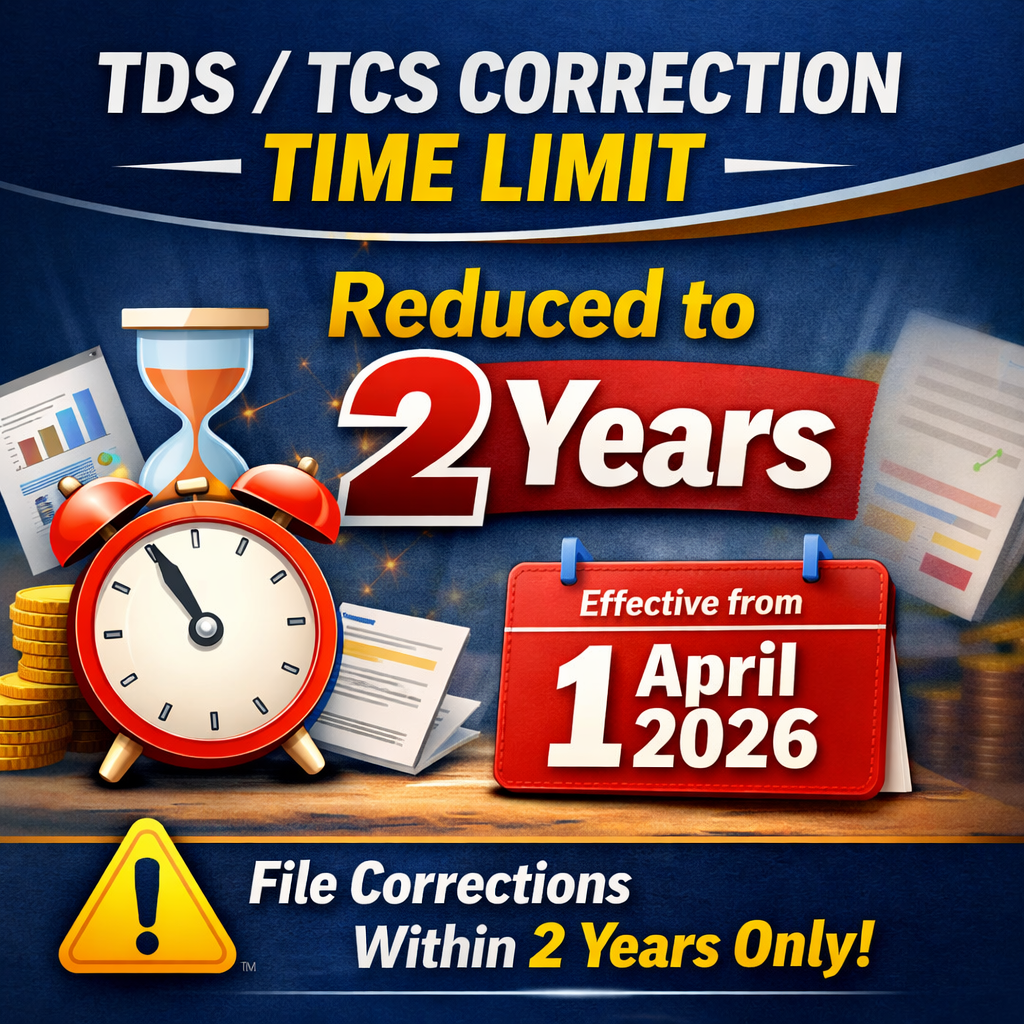
New Regulations for TDS Return Rectification Applicable from 01-04-2026

TDS / TCS Correction Statements: Time Limit Cut Down to 2 Years (Effective 01 April 2026)

🔔 What’s the Latest Change?

The Income Tax Department has introduced a major compliance reform by reducing the time limit for filing TDS and TCS correction statements to just 2 years, applicable from 1 April 2026.

Until now, deductors had the flexibility to revise old TDS/TCS returns even after many years. This long-standing practice will no longer be permitted.


⏳ Key Change Explained: Old Rule vs New Rule

🔙 Earlier Position (Before 01.04.2026)

  • No strict statutory deadline for filing correction statements

  • Corrections were practically allowed up to 7 years or more

  • Deductors commonly rectified:

    • Incorrect PAN details

    • Challan mapping errors

    • Short or excess deduction

    • Late reporting issues

  • Corrections were accepted even after several years

🔜 New Rule (From 01.04.2026)

  • Correction statements allowed only within 2 years

  • The 2-year period will be calculated from:

    • End of the relevant financial year

  • No correction will be permitted beyond this period

  • This is a strict and absolute deadline, not extendable in any case


📅 Last Opportunity for Old TDS/TCS Periods

Correction statements for the following quarters will be allowed only up to 31 March 2026:

  • Q4 of FY 2018–19

  • Q1 to Q4 of FY 2019–20 to FY 2022–23

  • Q1 to Q3 of FY 2023–24

⚠️ From 1 April 2026 onwards, the TRACES portal will permanently block corrections for these periods.


❌ Impact of Missing the 2-Year Deadline

Failure to file corrections within the prescribed time may result in:

  • ❌ Permanent denial of correction facility

  • ❌ Loss of TDS/TCS credit for deductees in Form 26AS / AIS

  • ❌ Disputes with employees, vendors, or contractors

  • ❌ Penalties ranging from ₹10,000 to ₹1,00,000

  • ❌ Higher compliance and audit risks

  • ❌ Interest liability and possible disallowance of expenses


✅ Reason Behind This Amendment

The department aims to promote:

  • Timely reconciliation of data

  • Faster and accurate credit to deductees

  • Reduced backlog of old corrections

  • Lower litigation and disputes

  • A shift towards real-time, technology-driven compliance

This change reflects a move towards strict timelines and disciplined reporting.


🧾 Best Practices Suggested by the Department

  • Regularly use TRACES utilities and validation tools

  • Track defaults and mismatches frequently

  • File correction statements immediately upon detecting errors

  • Train staff on the revised timelines

  • Adopt a preventive compliance approach


📌 Action Checklist for Deductors & Tax Professionals

✔ Review all pending TDS/TCS correction requirements
✔ Resolve old mismatches before 31 March 2026
✔ Strengthen internal review and control systems
✔ Inform clients and staff about the 2-year non-negotiable limit

GSTN issues comprehensive FAQ compilation on GSTR-9/9C for FY 2024-25

What’s New?

GSTN has issued a Consolidated set of FAQs for GSTR-9 and GSTR-9C for FY 2024-25 to assist taxpayers in accurately filing their Annual Return and Reconciliation Statement.

This consolidated document brings together FAQs earlier released on:

  • 16 October 2025

  • 4 December 2025

To simplify compliance, GSTN has now made all clarifications available in one single document on the GST portal.

👉 Download the Consolidated FAQs here
👉 Click here to enroll in the Practical GSTR-9/9C Course


📌 Objective of the Consolidated FAQs

The consolidated FAQs are intended to:

  • Address frequently asked questions and common errors in GSTR-9 and GSTR-9C filing

  • Offer clear guidance on reporting turnover, tax liability, ITC, amendments, and reversals

  • Minimise filing mistakes that could result in notices, mismatches, or departmental scrutiny

Bogus Claims पर CBDT की बड़ी पहल | करदाताओं को भेजे गए SMS-Email नोटिस

CBDT Flags Surge in Fake Deduction Claims: What Taxpayers Must Know

1. Context of the CBDT Press Release

The Income Tax Department has recently detected a sharp rise in incorrect and fraudulent claims of deductions and exemptions being reported in Income-tax Returns (ITRs). Investigations suggest that many of these claims were routed through intermediaries and agents operating nationwide on a commission-driven model.

In response, the Central Board of Direct Taxes (CBDT) has issued a firm advisory, cautioning taxpayers against such practices and urging them to voluntarily rectify incorrect claims.

2. Meaning of Bogus Deduction Claims

Bogus deduction claims are deductions or exemptions wrongly availed without actual eligibility, solely to reduce tax liability.

As per the CBDT, the most common areas of misuse include:

  • Donations made to Registered Unrecognised Political Parties (RUPPs)
  • Contributions shown to certain charitable institutions or trusts
  • Claims lacking genuine receipts or documentary evidence
  • Deductions backed by fabricated or altered documents

In several instances, intermediaries lured taxpayers with promises of inflated refunds in return for commissions.

3. Patterns and Methods Identified by the Department

Through investigation and data analysis, the Department uncovered that:

  • Several RUPPs were either inactive or completely non-operational
  • Many entities existed only on paper, with fake or unverifiable addresses
  • Funds were moved through dummy or layered bank accounts
  • Donation receipts were issued without any real charitable or political work
  • These entries were later used by individuals and companies to suppress taxable income

Search and survey operations have already been conducted, and substantial incriminating evidence has been seized.

4. Deployment of Data Analytics and AI

The CBDT has upgraded its compliance framework using technology-led tools.

Key developments include:

  • Use of advanced data analytics and AI-based risk assessment
  • Cross-verification of data from:
    • Income-tax returns
    • Donation disclosures
    • Bank transaction records
    • Registration details of recipient entities
  • Identification of high-risk behavioural trends among taxpayers

As a result, both genuine mistakes and deliberate misreporting are now easier to detect.

5. Provisions Under Scrutiny

The press release highlights close monitoring of deductions claimed under Section 80G of the Income-tax Act, 1961, which allows tax benefits for donations to approved institutions.

Other donation-related deduction provisions may also be examined if irregularities are noticed.

6. SMS and Email Alerts to Taxpayers

As part of a taxpayer-centric initiative, CBDT has rolled out a Targeted NUDGE Campaign.

Under this campaign:

  • Taxpayers suspected of claiming incorrect deductions are receiving
    • SMS notifications
    • Email advisories
  • These alerts are being sent from 12 December 2025 onwards
  • Messages are delivered to registered mobile numbers and email addresses

The intent is corrective—not punitive—at this stage.

7. Chance to Rectify Through Revised or Updated Returns

CBDT has clarified that:

  • Many taxpayers have already revised their returns for AY 2025–26
  • Others have opted to file Updated Returns for earlier assessment years

Taxpayers are being encouraged to:

  • Withdraw incorrect deduction claims
  • Pay due tax along with applicable interest
  • Avoid penalties and prosecution

This reflects the government’s philosophy of “trust first, enforce later.”

8. Risks of Ignoring the Advisory

Failure to act on the advisory may lead to:

  • Selection of cases for scrutiny assessments
  • Levy of penalties for under-reporting or misreporting income
  • Initiation of prosecution in serious or repeat cases
  • Action against intermediaries facilitating fraudulent claims

Ignoring the warning can therefore result in severe financial and legal consequences.

9. Immediate Steps for Taxpayers

Taxpayers should promptly:

  • Re-examine their ITRs, especially donation-related deductions
  • Verify the legitimacy of donee organisations, including approval status
  • Ensure possession of valid and authentic receipts
  • File a Revised or Updated Return if any error is discovered
  • Update correct contact details on the Income Tax Portal
  • Steer clear of agents offering “guaranteed refunds”

10. Final Message

The CBDT’s advisory serves both as a warning and an opportunity.

Only claim deductions you are genuinely eligible for.
Temporary gains through fake refunds can invite long-term legal trouble.

With technology-driven monitoring now firmly in place, tax evasion through bogus deductions is no longer hidden or risk-free.

CBDT detects fake claims related to political and charitable donations

The Central Board of Direct Taxes (CBDT) has detected large-scale misuse of income tax deductions claimed for political and charitable donations. On Saturday, the board said it has identified widespread fraudulent claims linked to such contributions and has initiated a targeted outreach campaign from December 12, urging taxpayers to recheck their returns and voluntarily withdraw incorrect claims.

According to the CBDT, several taxpayers had claimed deductions for donations made to Registered Unrecognised Political Parties (RUPPs) that were later found to be inactive, non-compliant in filing returns, or not engaged in any genuine political activity.

Investigations by the Income Tax Department also revealed the involvement of intermediaries who filed tax returns containing false claims of deductions and exemptions under the Income Tax Act, often in exchange for commissions. These intermediaries allegedly issued fake donation receipts, allowing taxpayers to unlawfully reduce their tax liability and claim illegitimate refunds. Action has already been initiated against such entities.

Further follow-up searches uncovered evidence of fictitious donations and bogus Corporate Social Responsibility (CSR) claims made by companies. Authorities also found indications that certain entities were being used as channels for routing funds, including suspected hawala transactions and cross-border remittances. Proceedings against these intermediaries are currently underway.

Using data analytics, the CBDT identified taxpayers who had availed themselves of such suspicious donations and transactions. When contacted, many of them failed to provide adequate evidence to prove the genuineness of their claims. As a result, several taxpayers have already revised their returns for the current assessment year 2025–26 and filed updated returns for earlier years.

To facilitate voluntary compliance, the CBDT has launched a “nudge” campaign, offering taxpayers an opportunity to correct their returns without coercive action. SMS and email advisories are being sent to identified taxpayers from December 12 on their registered contact details. The board has also advised taxpayers to ensure that their mobile numbers and email addresses are updated to avoid missing official communications.

Income Tax Act 2025: Gift Tax Provisions, Exempt Relatives and Gifts

Gift Tax under the New Income Tax Act, 2025: Tax-Free Gifts and Relatives Explained

The New Income Tax Act, 2025 introduces Section 92, which governs the taxation of gifts received by individuals, Hindu Undivided Families (HUFs), and other persons. This provision replaces the earlier Section 56(2)(x) of the Income Tax Act, 1961 and offers a more organised and comprehensive framework for taxing gifts involving money, movable assets and immovable property.

In India, every gift is not taxable. Whether a gift attracts tax depends on several factors, including:

  • The value of the gift

  • The relationship between the giver and the recipient

  • The nature of the asset received

  • The occasion on which the gift is received (marriage, inheritance, will, etc.)

This guide explains the scope of Section 92, covering taxable situations, exemptions, valuation rules, clubbing provisions and practical examples.


Meaning of Gift under Section 92

Under Section 92, a gift includes money, movable property or immovable property received:

  • Without consideration, or

  • For inadequate consideration

If the value of such gift exceeds ₹50,000, it becomes taxable as income, unless it qualifies for an exemption specified under Section 92(3).


When Are Gifts Taxable? (Section 92(2)(m))

1. Monetary Gifts from Non-Relatives

If total cash or monetary gifts received from non-relatives exceed ₹50,000 in a financial year, the entire amount becomes taxable.

Example:
₹20,000 from one friend + ₹40,000 from another friend
Total = ₹60,000 → Fully taxable


2. Immovable Property (Land or Building)

a) Received without consideration
If the stamp duty value (SDV) exceeds ₹50,000, the entire SDV is taxable.

b) Received for inadequate consideration
The difference between SDV and actual consideration is taxable if it exceeds:

  • ₹50,000, or

  • 10% of consideration (whichever is higher)

Example:
SDV: ₹50 lakh
Purchase price: ₹44 lakh
Difference: ₹6 lakh → Taxable


3. Movable Property (Jewellery, Shares, Bullion, Crypto, etc.)

a) Without consideration
If fair market value (FMV) exceeds ₹50,000, the full FMV is taxable.

b) With inadequate consideration
If FMV minus consideration exceeds ₹50,000, the difference is taxable.

Example:
Jewellery FMV ₹2,00,000 bought for ₹1,30,000
Difference ₹70,000 → Taxable


Gifts That Are Fully Exempt (Section 92(3))

A. Gifts from Relatives (No Limit)

For individuals, “relative” includes:

  • Spouse

  • Parents, grandparents and other lineal ascendants

  • Children, grandchildren and other lineal descendants

  • Siblings of self, spouse or parents

  • Lineal ascendants/descendants of spouse

  • Spouses of all the above relatives

For HUFs, any member of the HUF is treated as a relative.

👉 Gifts from relatives are fully exempt, irrespective of amount.


B. Gifts Received on Marriage of the Individual

All gifts received on the occasion of one’s own marriage are tax-free, regardless of value or source.
This exemption does not apply to anniversaries or relatives’ marriages.


C. Gifts Received through Will or Inheritance

Assets received by way of inheritance or under a will are completely exempt from tax.


D. Gifts in Contemplation of Death

Gifts given in anticipation of the donor’s death are exempt.


E. Gifts from Local Authorities

Exempt as per Schedule III.


F. Gifts from Registered Charitable or Non-Profit Institutions

Allowed under Section 355(g), subject to prescribed conditions.


G. Transactions Not Regarded as Transfer (Section 70)

Gifts arising from amalgamation, demerger or business restructuring are exempt.


H. Gifts to Trusts for Benefit of Relatives

Transfers made to trusts exclusively for relatives’ benefit are tax-free.


Special Provisions for Immovable Property (Section 92(4))

If the agreement date and registration date differ, the stamp duty value as on the agreement date may be considered, provided payment is made through banking or digital modes.

If stamp duty value is disputed, the Assessing Officer may refer valuation to a Valuation Officer.


Assets Covered under “Property” (Section 92(5)(f))

  • Land or building

  • Shares and securities

  • Jewellery

  • Paintings, sculptures, artworks

  • Archaeological collections

  • Bullion

  • Virtual Digital Assets (cryptocurrency, NFTs)


Clubbing of Income from Gifted Assets

While Section 92 taxes the receipt of gifts, income generated from gifted assets is taxed under clubbing provisions.

Example:
Cash gifted to spouse → Gift exempt
Interest earned → Clubbed in donor’s income

Similar rules apply to gifts to minor children.


Employer Gifts

Gifts from employers are taxed as salary perquisites.
Only long-service awards up to ₹5,000 are exempt.


Capital Gains on Sale of Gifted Property

  • Cost of acquisition = FMV considered at time of gift

  • Holding period starts from date of receipt


Documentation for Gifts

Acceptable proof includes:

  • Bank transfer records

  • Gift deed (optional but advisable)

  • Marriage invitation and gift list

  • Photographs and source explanation


Practical Examples

  • Gift from father ₹10 lakh → Exempt

  • Jewellery from friend ₹1 lakh → Taxable

  • Flat from paternal uncle → Exempt

  • Cash gift on marriage ₹5 lakh → Exempt

  • Undervalued land purchase → Difference taxable since she is the spouse of the father under the Income Tax Act.
    Accordingly, any gift received from her is fully exempt from tax, irrespective of the amount.

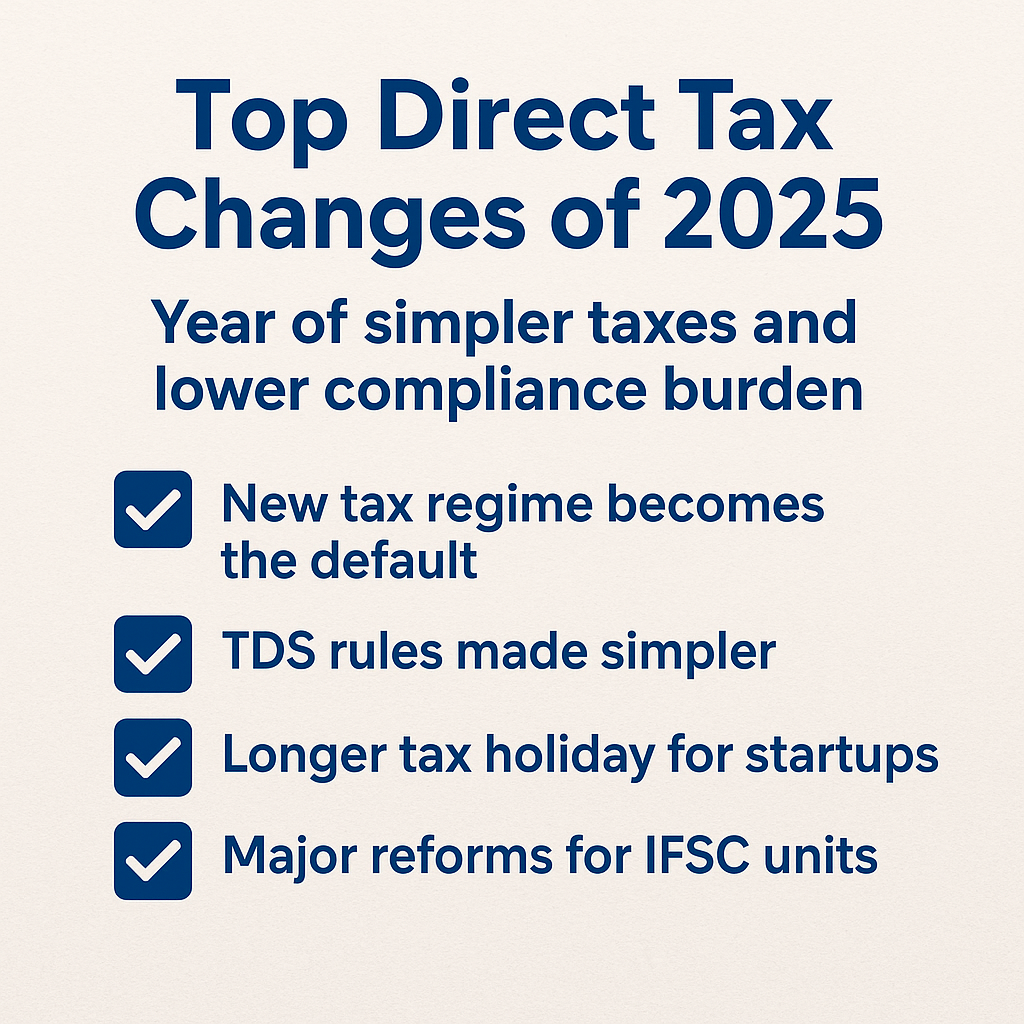
Direct Tax Changes in 2025: Simplification and Reduced Compliance Take Centre Stage

India’s direct tax framework underwent several significant changes in 2025 as the government prioritised tax simplification, eased compliance requirements, and sought to encourage higher consumer spending. The reforms—ranging from an overhauled personal tax regime and simplified TDS provisions to an extended tax holiday for startups and greater clarity on capital gains—have had a wide-ranging impact across the economy.

New tax regime made the default option

The most notable reform was the decision to make the new tax regime under Section 115BAC the default choice for taxpayers. The basic exemption limit was increased to ₹4 lakh, while the rebate under Section 87A was enhanced, effectively making income up to ₹12 lakh tax-free.

Experts say the impact of this shift is already being felt. According to them, the simplified slab structure and higher rebate have raised disposable incomes, providing a clear boost to consumption-driven sectors such as manufacturing and construction.

Simplified TDS framework

Budget 2025 introduced meaningful changes to the Tax Deduction at Source (TDS) provisions under the Income Tax Act, 1961, with the objective of easing compliance for individuals and businesses. TDS rules were streamlined and threshold limits enhanced, significantly lowering the compliance burden for small taxpayers and enterprises. In addition, the turnover limit for presumptive taxation under Section 44AD was increased to ₹3 crore, offering MSMEs greater flexibility and reduced administrative overheads.

Extended tax holiday for startups

The 2025 Budget also prolonged the 100 per cent profit-linked tax deduction for eligible startups, allowing them to claim the benefit for any three years within their first ten years of operation. This incentive has now been extended until April 1, 2030. The extended timeline is expected to support startups in navigating initial loss-making years and improve their ability to attract investment.

Key reforms for IFSC entities

The Finance Act, 2025 rolled out a series of tax incentives for units operating in the International Financial Services Centre (IFSC). Offshore funds and exchange-traded funds (ETFs) are now permitted to relocate to IFSC without triggering adverse tax consequences. Additionally, non-residents trading in offshore or over-the-counter derivatives through IFSC platforms will be eligible for tax exemptions. Tax incentives for IFSC units have also been extended up to March 31, 2030.

A significant amendment was also made to deemed dividend provisions. Inter-company loans will no longer be classified as deemed dividends when the lending entity is a finance company or an IFSC-based finance unit. According to Ananthapadmanabhan, this change has prompted large corporate groups to consider moving treasury operations to India, as the clarity around treasury-related lending removes a key area of concern.

Removal of equalisation levy

Under the Finance Act, 2025, the government abolished the equalisation levy on digital advertising with effect from April 1, 2025. This step has simplified the tax framework for multinational technology companies operating in India.

Taking an overall view, Ananthapadmanabhan said the reforms have strengthened the foundation for sustained, demand-driven economic growth, which is also evident in the sharp rise in GDP growth to 8.2 per cent in the second quarter of FY26.

GST inversion leading to input credit buildup, fertiliser industry urges clarification: FAI chief

New Delhi [India], December 10 (ANI): The Fertiliser Association of India (FAI) has sought key GST clarifications to ease financial pressure on the fertiliser sector, flagging that tax rate inversion is continuing to result in the accumulation of input tax credits.

Speaking to ANI, FAI Chairman S. Sankarasubramanian said the industry has been urging the government to align GST rates on key raw materials such as ammonia and sulphuric acid with the 5 per cent tax applicable on finished fertiliser products. He said this alignment would help reduce production costs and improve the competitiveness of fertiliser manufacturers, particularly in the phosphatic segment.

While recent GST reforms have offered some relief, Sankarasubramanian noted that they have not fully resolved the issue of unutilised credits.

“At present, phosphatic fertilisers attract GST at 5 per cent, while several inputs were earlier taxed at 18 per cent and have now been corrected to 5 per cent. Despite this reduction, a structural inversion remains because fertiliser prices include a subsidy component that falls outside the GST value. This leads to continued accumulation of input tax credit,” he explained.

Finished phosphatic and potassic (P&K) fertilisers are taxed at 5 per cent, whereas major inputs such as ammonia and sulphuric acid were taxed at higher rates. Combined with subsidies not forming part of the GST supply value, this mismatch has resulted in large volumes of blocked ITC, straining working capital and affecting industry efficiency.

Speaking on the sidelines of the FAI Annual Seminar 2025, the FAI Chairman welcomed the recent changes introduced by the finance ministry.

“The reduction of GST on raw materials like ammonia and sulphuric acid from 18 per cent to 5 per cent has helped ease the problem of credit accumulation,” he said, while adding that the core imbalance between input and output taxation still persists.

He said the industry has consistently sought government intervention and has approached the finance ministry through the Department of Fertilisers, requesting a mechanism to refund accumulated input tax credit for phosphatic fertilisers. “We are hopeful that this issue will be addressed soon,” he said.

On subsidy reforms, Sankarasubramanian welcomed the government’s proposal to move towards direct benefit transfer (DBT) to farmers instead of routing subsidies through fertiliser manufacturers.

“Under the existing DBT framework, subsidies are paid to the industry while farmers receive fertilisers at subsidised prices,” he said.

He added that the Department of Fertilisers is planning pilot projects in select states and districts. “We have read about the recent announcement. Pilot trials are likely to be conducted in some states in South India and a few districts. This could be a game changer,” he said.

According to him, the move would give farmers greater choice and control. “It places decision-making power directly in the hands of farmers regarding the fertilisers they use. As an industry, we support this initiative and welcome the government’s approach,” Sankarasubramanian said. (ANI)

ICAI advertising reforms and global networking rules cleared to strengthen domestic firms

The Institute of Chartered Accountants of India (ICAI) has cleared a wide-ranging set of regulatory reforms designed to reinforce domestic chartered accountancy firms. The measures include a relaxation of long-standing advertising norms and the introduction of a structured framework to enable international collaborations.

Addressing the media after the 447th Council meeting, ICAI President CA Charanjot Singh Nanda said the decisions reflect evolving market dynamics and professional needs. “These changes update the regulatory architecture and offer greater certainty to firms navigating a rapidly transforming business environment,” he said. ICAI Vice President CA Prasanna Kumar D was also present during the briefing.

Advertising Norms Liberalised After Years

The Council approved amendments to the Advertisement and Website Guidelines under the revised 13th edition of the Code of Ethics, which will take effect from April 1, 2026. The revised rules allow a wider range of advertising formats, enhanced descriptive content, and the use of push notifications for non-exclusive services such as consultancy and accounting.

In a key change, ICAI-registered network firms will now be allowed to operate their own websites, a move expected to improve outreach, branding, and coordination within professional networks.

According to Nanda, these revisions align existing norms with contemporary digital practices and provide firms with greater flexibility to communicate their services.

Framework for International Networking and Partnerships

Among the most significant decisions was the approval of the ICAI (Global Networking) Guidelines, 2025. These guidelines establish a formal mechanism for Indian firms, domestic networks, and ICAI-registered consulting entities to collaborate with overseas firms.

ICAI said the framework is aimed at empowering mid-sized and growing firms by facilitating access to global expertise, technology, and cross-border opportunities, while ensuring transparency through defined disclosure and compliance requirements.

Adoption of Updated Global Ethical Standards

The Council also adopted the 2024 Code of Ethics issued by the International Ethics Standards Board for Accountants (IESBA), introducing stricter norms on auditor independence.

Notable provisions include restrictions on audit firms undertaking Public Interest Entity (PIE) audits if they have rendered conflicting non-assurance services, expanded applicability of Non-Compliance with Laws and Regulations (NOCLAR) requirements to all listed entities and their key subsidiaries, and the inclusion of ethical standards for sustainability assurance engagements.

Additionally, the list of permitted Management Consultancy and Other Services has been widened to cover emerging areas such as artificial intelligence-related work, forensic accounting, and social-impact evaluations. The Council also recommended that audit fees be received only through banking or digital modes.

UDIN Milestone Achieved

ICAI said the issuance of Unique Document Identification Numbers (UDINs) crossed the 10-crore mark during the year, calling it a significant milestone in strengthening document authentication and professional transparency.

WOFA 2.0 Scheduled for 2026

The Institute further announced that the second edition of the World Forum of Accountants (WOFA 2.0) will be held from January 30 to February 1, 2026, at the India Expo Centre in Greater Noida. The event is expected to attract over 20,000 participants from more than 40 countries.