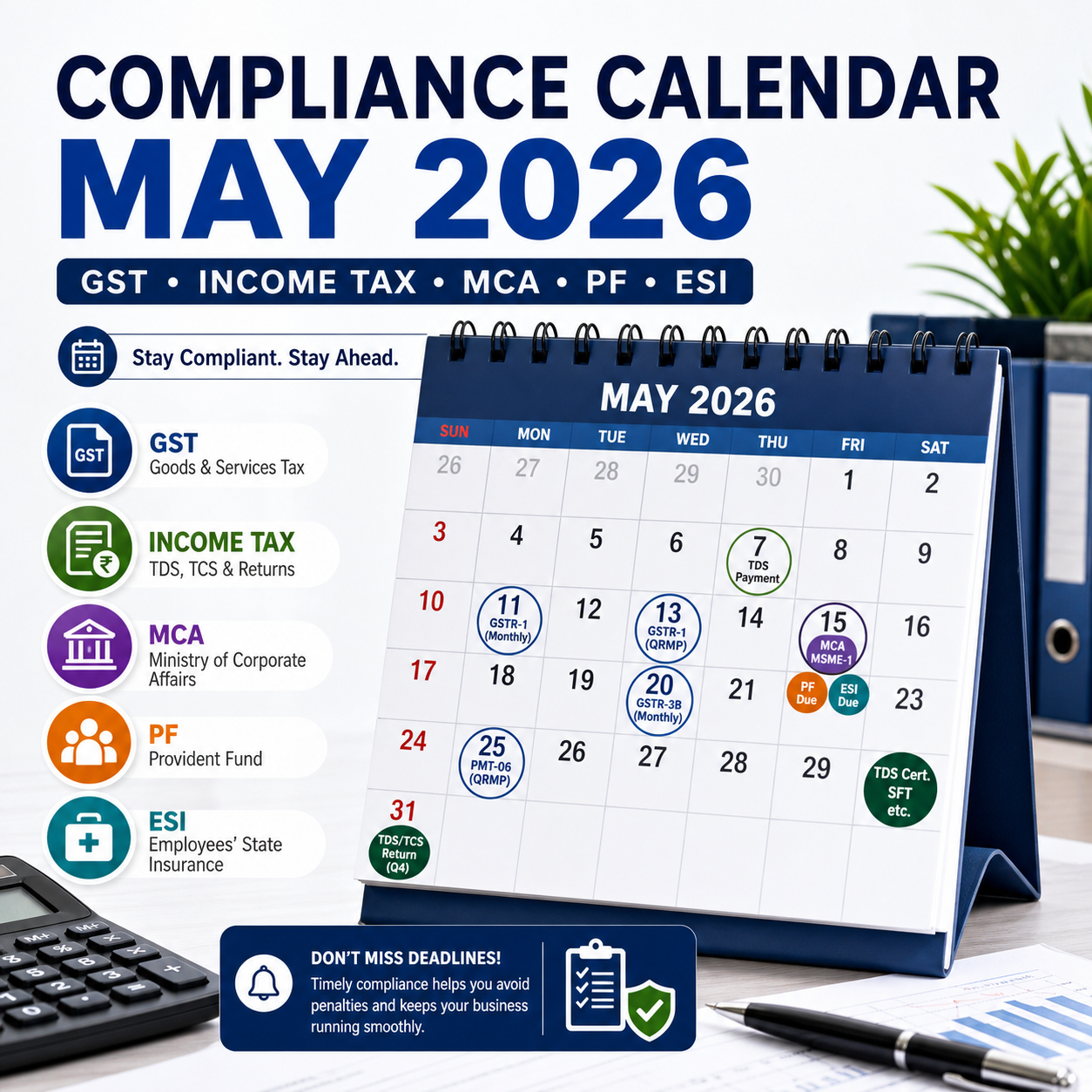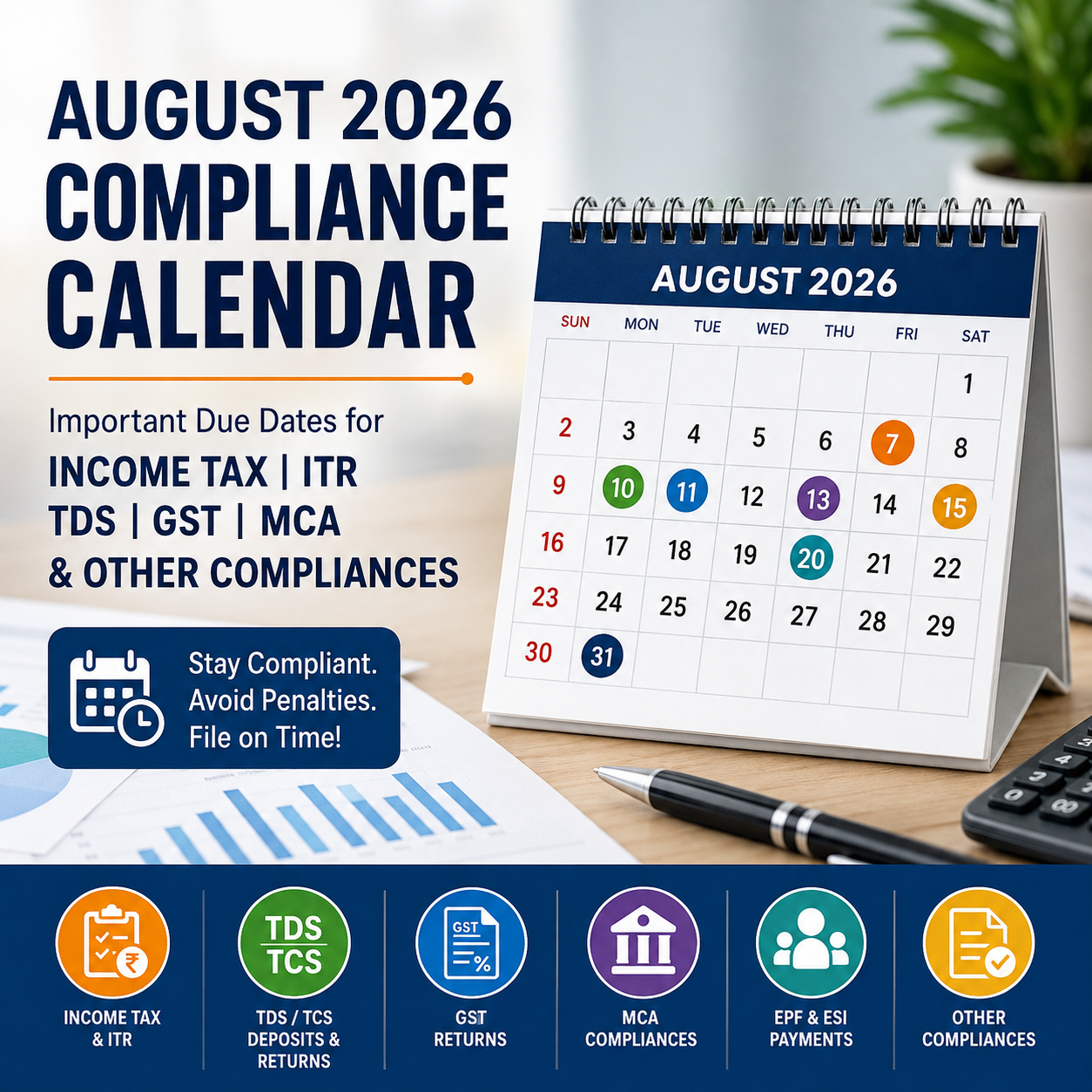
Compliance Due Dates & Key Filings for April 2026

With the start of the new financial year FY 2026–27, April emerges as a critical month for compliance from both Income Tax and GST perspectives. Businesses, professionals, and tax practitioners must stay on top of key deadlines to avoid interest, penalties, and potential notices.

πŸ—“οΈ Compliance Timeline & Important Dates for April 2026

April sets the tone for the entire financial year, making it essential to ensure:

  • Timely GST return filings (GSTR-1, GSTR-3B, etc.)
  • Deposit of TDS/TCS within due dates
  • Proper documentation and reconciliation of transactions
  • Early planning for advance tax and regulatory compliances

    Compliance Calendar – April 2026 (Complete Guide)

    https://images.openai.com/static-rsc-4/zXx9R0Y3W9RUTZri8CNntnZVqNTyeeWaYbeqWgVw8F3TLlO_GHcXgBncfAoWH43AbADbv78IYLSabfRTGA9fEgD-xO0n-SJ3D6ULQMaUmt4QAKQlI0x8r-T4EFtzBNkVQV9FQ990xijfmRpgavEmqr80sNwaY-tQpvQMyDo1IvpjIfJY1aPprLDmTkDx0iKO?purpose=fullsize
    https://images.openai.com/static-rsc-4/5Sl9naNGQCWstT78h1FiYaDiANVfxgH0JlReCDdri6QF_oznPgLttDBFsDWUKCdZ53Rw6iAQF_k0eyedImpjMj0rjF15RFuL9EfaBfihQWI8g96gBjTn-bpgu96QURONSAX5wr3geZ6kK6ZgsqZsYyG7xIw1nFSZrQ232_O57aODHG0DQDQKnhyfhCnVUVdf?purpose=fullsize
    https://images.openai.com/static-rsc-4/KxcvggfFVwOL7SNUbELL82f31HbUhT3sQMB5m-hL8Z0rezQvAeLhdUBz6tyoJMGYoATEIlnMM8yXx-5qDe5tvUjV4_e3B4HVdqNjEu--W1S8D32OwNPXc_dR3A5tvh_NOAUeZBL4x-nHqvQ90ged6okgq9RU9YU2wVFUBaUiKfwojG8kYJNQkLP2JOaABOeO?purpose=fullsize
    5

    This article provides a comprehensive compliance calendar for April 2026, covering GST, Income Tax (TDS/TCS), PF, ESI, MCA, and other key regulatory requirements.


    πŸ”° Important Update from 1 April 2026

    With the beginning of FY 2026–27, several critical changes come into effect:

    • Reset of aggregate turnover under GST
    • Adoption of a new invoice series
    • Applicability of provisions under the Income Tax Act, 2025
    • Revised TDS/TCS rates (where applicable)
    • Start of a fresh compliance cycle for all taxpayers

    πŸ’° Income Tax Compliance (TDS/TCS)

    πŸ“Œ 7 April 2026

    • Deposit of TCS for March 2026
    • Submission of declarations (Form 27C)

    πŸ“Œ 14 April 2026

    • Issue of TDS certificates:
      • Form 16B (property)
      • Form 16C (rent)
      • Other applicable certificates

    πŸ“Œ 30 April 2026

    • Deposit of TDS for March (non-government deductors)
    • Filing of:
      • Form 26QB (property transactions)
      • Form 26QC (rent payments)
      • Form 26QD (specified payments)

    πŸ“Š GST Compliance

    April is a high-volume GST compliance month due to both monthly and quarterly filings:

    πŸ“Œ 10 April 2026

    • GSTR-7 (TDS under GST)
    • GSTR-8 (E-commerce operators)

    πŸ“Œ 11 April 2026

    • GSTR-1 (Monthly – March 2026)

    πŸ“Œ 13 April 2026

    • GSTR-1 (QRMP – Jan–Mar quarter)
    • GSTR-5 (Non-resident taxable persons)
    • GSTR-6 (Input Service Distributor)

    πŸ“Œ 18 April 2026

    • CMP-08 (Composition scheme)

    πŸ“Œ 20 April 2026

    • GSTR-3B (Monthly filers)

    πŸ“Œ 22 & 24 April 2026

    • GSTR-3B (QRMP scheme)

    πŸ“Œ 25 April 2026

    • ITC-04 (Job work return)

    πŸ“Œ 28 April 2026

    • GSTR-11 (UIN holders)

    πŸ“Œ 30 April 2026

    • GSTR-4 (Annual return for composition dealers – FY 2025–26)

    πŸ‘¨β€πŸ’Ό PF & ESI Compliance

    πŸ“Œ 15 April 2026

    • Deposit of Provident Fund (PF)
    • Filing of ECR (Electronic Challan-cum-Return)
    • Deposit of ESI contributions

    🏒 MCA / Companies Act Compliance

    While April has no major fixed ROC due dates, it remains important for:

    • Planning annual compliance strategy
    • Conducting the first Board Meeting (if applicable)
    • Reviewing statutory registers and disclosures

    🌍 Other Key Compliance

    πŸ“Œ 7 April 2026

    • Filing of ECB-2 Return (foreign borrowings under FEMA)

    πŸ“Œ 15 April 2026

    • Submission of Form 15CC (foreign remittance compliance)

    βœ… Final Takeaway

    April is not just the start of a new financial yearβ€”it’s a foundation month for compliance discipline. Staying updated with deadlines across GST, Income Tax, and other laws helps:

    • Avoid penalties and interest
    • Ensure smooth operations
    • Build a strong compliance track record for the year ahead
January 2026: Complete Compliance & Filing Schedule for Businesses

January marks more than just the start of a new calendar yearβ€”it is also one of the busiest compliance months for businesses, professionals, and employers. A tight cluster of statutory obligations such as GST returns, TDS filings, PF-ESI contributions, and MCA compliances leaves little room for error. Missing even one due date can trigger late fees, interest, penalties, or system-generated notices.

As we enter January 2026, the compliance environment continues to become more stringent, backed by tighter deadlines, automated checks, and enhanced portal validations. To help businesses, taxpayers, and professionals stay on track, this article provides a comprehensive, date-wise compliance calendar for January 2026, covering GST, Income Tax, TDS/TCS, PF, ESI, and MCA requirementsβ€”all consolidated in one place.


GST Compliance

Due Date | Return/Form | Period | Applicability
7 January 2026 | GSTR-7 | December 2025 | GST TDS deductors
7 January 2026 | GSTR-8 | December 2025 | E-commerce operators
11 January 2026 | GSTR-1 | December 2025 | Monthly outward supply filers
20 January 2026 | GSTR-3B | December 2025 | Monthly GST return
22/24 January 2026 | GSTR-3B (QRMP) | Oct–Dec 2025 | Based on state category
20 January 2026 | GSTR-5A | December 2025 | OIDAR service providers

GST Composition Scheme
18 January 2026 | CMP-08 | Oct–Dec 2025


TDS/TCS & Income-Tax Compliances

Monthly TDS/TCS Payment
7 January 2026 – Deposit of TDS/TCS for December 2025
(Generally payable by the 7th of the following month)

Quarterly TDS/TCS Returns
15 January 2026 | Form 27EQ (TCS) | Oct–Dec 2025
31 January 2026 | Forms 24Q, 26Q, 27Q | Oct–Dec 2025

Income-Tax Update
As per CBDT indications, new ITR forms and procedures under the simplified Income-tax framework are expected to be notified by January 2026, ahead of implementation from 1 April 2026.


PF & ESI Compliance

15 January 2026
β€’ EPF contribution payment & return – December 2025
β€’ ESI contribution payment & return – December 2025

(PF and ESI dues are generally payable by the 15th of the subsequent month.)


MCA / ROC Filings

31 January 2026
β€’ Filing of Annual Returns and Financial Statements for FY 2024-25
β€’ Ensure timely submission of AOC-4 and MGT-7 within the extended timeline

LLPs should also verify due dates for Form 11 and other applicable ROC filings based on entity-specific requirements.


Other Important Statutory Compliances

Professional Tax (PT)
Generally payable by 31 January 2026 for December 2025 salary deductions (state-specific rules apply).

Advance Tax
No advance tax installment is due in January; the next installment falls in March 2026.


Consequences of Delayed Compliance – Quick Snapshot

β€’ GST: Late fees and interest on net tax liability
β€’ TDS/TCS: Interest and penalties for late payment or return filing
β€’ PF/ESI: Interest and statutory damages under respective laws


In today’s technology-driven compliance framework, delays rarely go unnoticed. GST filings, TDS payments, PF-ESI contributions, and MCA submissions are closely monitored through integrated systems. Timely compliance is no longer optionalβ€”it is essential.

Use this January 2026 Compliance Calendar as a ready reference, plan your filings in advance, and complete all obligations well before due dates. Staying proactive today helps avoid financial exposure, legal complications, and unnecessary stress in the future.

More Time for Compliance! MCA Annual Filing Date Extended

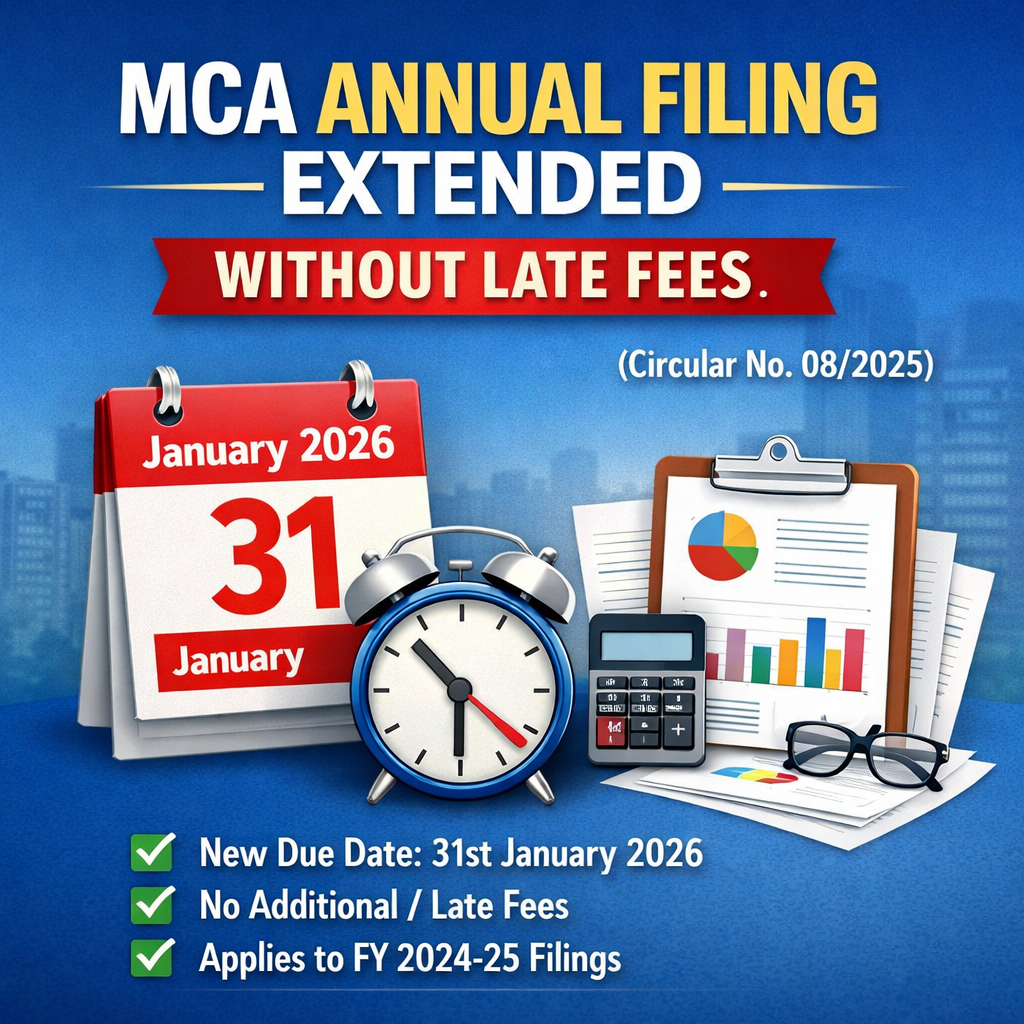
MCA Annual Filing Deadline Extended Without Late Fees

(General Circular No. 08/2025 dated 30 December 2025)

The Ministry of Corporate Affairs (MCA) has provided significant compliance relief by issuing General Circular No. 08/2025 dated 30 December 2025, extending the timeline for filing Annual Returns and Financial Statements for FY 2024-25 without charging any additional (late) fees.

This extension comes as a major relief for companies, directors, and compliance professionals (CA/CS/CMA) who were unable to complete their annual filings within the original statutory deadlines.


1. Context of the MCA Circular

Earlier, MCA had released General Circular No. 06/2025 dated 17 October 2025, granting partial relaxation from additional fees for certain annual filings. Following continued representations from stakeholders and considering genuine practical challenges, MCA has now further extended this relaxation through Circular No. 08/2025, with approval from the Competent Authority.


2. Revised Due Date – Major Relief

βœ… New final date: 31 January 2026

Companies may now file their annual compliance forms for FY 2024-25 up to 31 January 2026 without incurring any additional fees.

⚠️ This relief applies only to the waiver of late fees. Normal filing fees, wherever applicable, must still be paid.


3. MCA Forms Covered Under the Extension

The waiver applies to the following e-forms related to Annual Returns and Financial Statements for FY 2024-25:

πŸ“„ Annual Return Forms

  • MGT-7

  • MGT-7A (OPC and related entities)

πŸ“Š Financial Statement Forms

  • AOC-4

  • AOC-4 XBRL

  • AOC-4 CFS

  • AOC-4 CFS NBFC (Ind AS)

  • AOC-4 NBFC (Ind AS)


4. Meaning of β€œWithout Additional Fees”

  • No late fee or additional fee will be levied if the above forms are filed on or before 31 January 2026.

  • Filings made after this date will attract normal additional fees and penalties as prescribed under the Companies Act, 2013.

  • This is a one-time compliance relaxation and should be utilized prudently.


5. Key Clarifications

πŸ“Œ Only the filing deadline has been extended; all statutory requirements, disclosures, and certifications remain unchanged.
πŸ“Œ The circular does not grant immunity from penalties for any other violations under the Companies Act.
πŸ“Œ The benefit is restricted strictly to FY 2024-25 and does not apply to previous years.


6. Who Stands to Gain the Most?

This extension is particularly helpful for:

  • Companies affected by audit delays

  • Entities facing MCA portal or technical issues

  • Start-ups, SMEs, and NBFCs

  • Professionals managing large volumes of annual filings

  • Companies seeking to avoid substantial late fees and penal exposure


7. Recommended Action Points

βœ” Identify pending MGT-7 / MGT-7A / AOC-4 filings for FY 2024-25
βœ” Finalise accounts and obtain necessary approvals immediately
βœ” Avoid last-minute filing to prevent portal congestion
βœ” Ensure correctness of data to avoid future notices
βœ” Maintain proof of filing completed before 31 January 2026


Final Takeaway

31 January 2026 is the last and final opportunity to complete MCA Annual Filings for FY 2024-25 without incurring additional fees. Missing this deadline may lead to substantial late fees and penal consequences for both the company and its officers.

This MCA relaxation should be viewed as a valuable compliance window, not a reason to delay further.

Why 31 December Is So Important for Professionals and Businesses

31st December 2025 is far more than just the close of the calendar year.
It marks one of the most crucial compliance cut-off dates under GST, Income Tax, and MCA regulations for FY 2024-25 / AY 2025-26.

For Chartered Accountants, tax consultants, business owners, companies, and professionals, overlooking this deadline can lead to loss of refunds, late fees, penalties, and long-term litigation exposure.

Let us break down why this single date carries such immense importance.


πŸ”΄ 1. Deadline for Filing GSTR-9 (GST Annual Return) – FY 2024-25

GSTR-9 is the annual GST return that provides a consolidated view of:

  • Outward supplies

  • Inward supplies

  • Input Tax Credit (ITC) claimed

  • Taxes paid

  • Year-end adjustments

Important points to note:

  • 31st December 2025 is the statutory due date for filing GSTR-9 for FY 2024-25

  • Filing is optional for taxpayers with AATO up to β‚Ή2 crore

  • Once submitted, GSTR-9 cannot be revised

This return plays a key role in:

  • GST scrutiny proceedings

  • Departmental notices

  • ITC verification and reconciliation

Who needs to be especially cautious?

  • Businesses with multiple amendments during the year

  • Taxpayers who rectified FY 2024-25 errors in FY 2025-26

  • Taxpayers facing ITC mismatches with GSTR-2B


πŸ”΄ 2. Due Date for Filing GSTR-9C (GST Reconciliation Statement)

GSTR-9C is a reconciliation statement comparing:

  • Audited financial statements

  • GSTR-9 annual return

Key highlights:

  • Applicable to taxpayers whose turnover exceeds the prescribed audit limit

  • 31st December 2025 is the final due date

  • Although now self-certified, it remains a high-risk compliance document

Any mismatch may trigger:

  • GST audits

  • Demand notices

  • Interest and penalty proceedings


πŸ”΄ 3. Final Date to File Belated or Revised ITR – AY 2025-26

This is one of the most overlooked yet most critical year-end deadlines.

What closes on 31st December 2025?

  • Filing of Belated Income Tax Returns

  • Filing of Revised Income Tax Returns

Why this date is crucial:

  • It is the last chance for non-filers to submit their return

  • Errors in earlier returns can no longer be corrected after this date

  • Unclaimed income tax refunds may lapse permanently

Who should be extra alert?

  • Salaried individuals awaiting refunds

  • Professionals and freelancers with TDS deductions

  • Businesses that filed incorrect or incomplete returns earlier

  • Taxpayers who have received CPC intimations or mismatch notices

    πŸ”΄ 4. MCA Annual Compliance – Extended Due Date up to 31st December 2025

    The Ministry of Corporate Affairs (MCA) has permitted companies to complete their annual compliance filings for FY 2024-25 on or before 31st December 2025.

    Forms included:

    • AOC-4 – Filing of financial statements

    • MGT-7 / MGT-7A – Annual return

    Why this deadline matters:

    • Filing within the extended timeline helps avoid substantial additional fees

    • Failure to comply may result in:

      • Monetary penalties on the company

      • Personal penalties on directors

      • Long-term risk of director disqualification


    πŸ”΄ 5. PAN–Aadhaar Linking – Practical Year-End Implications

    While PAN–Aadhaar linking requirements differ based on taxpayer categories, 31st December 2025 effectively serves as a practical deadline to ensure:

    • Hassle-free income tax return filing

    • Timely processing of tax refunds

    • Prevention of PAN becoming inoperative for income tax purposes

    Taxpayers with pending PAN–Aadhaar linkage issues frequently encounter:

    • Delays or blockage of refunds

    • Difficulties in filing returns

    • Increased scrutiny, notices, and compliance-related delays

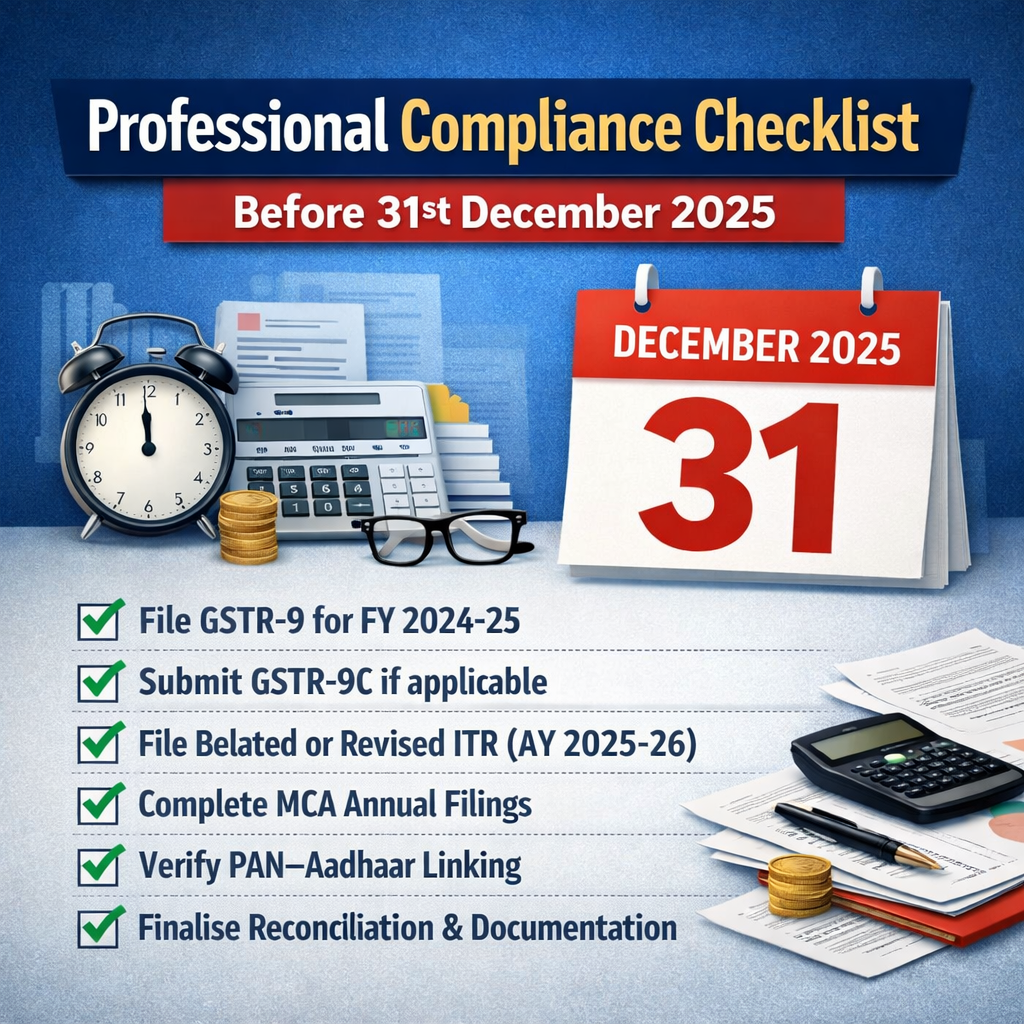
      πŸ“Œ Professional Compliance Checklist – Tasks to Complete Before 31st December 2025

      βœ” Ensure filing of GSTR-9 for FY 2024-25
      βœ” Submit GSTR-9C wherever reconciliation requirements apply
      βœ” File belated or revised Income Tax Returns for AY 2025-26
      βœ” Complete MCA annual compliances, including AOC-4 and MGT-7 / MGT-7A
      βœ” Confirm and regularise PAN–Aadhaar linkage status
      βœ” Finalise reconciliations, verifications, and supporting documentation