GST Latest Update: IMS Offline Tool Comes into Effect

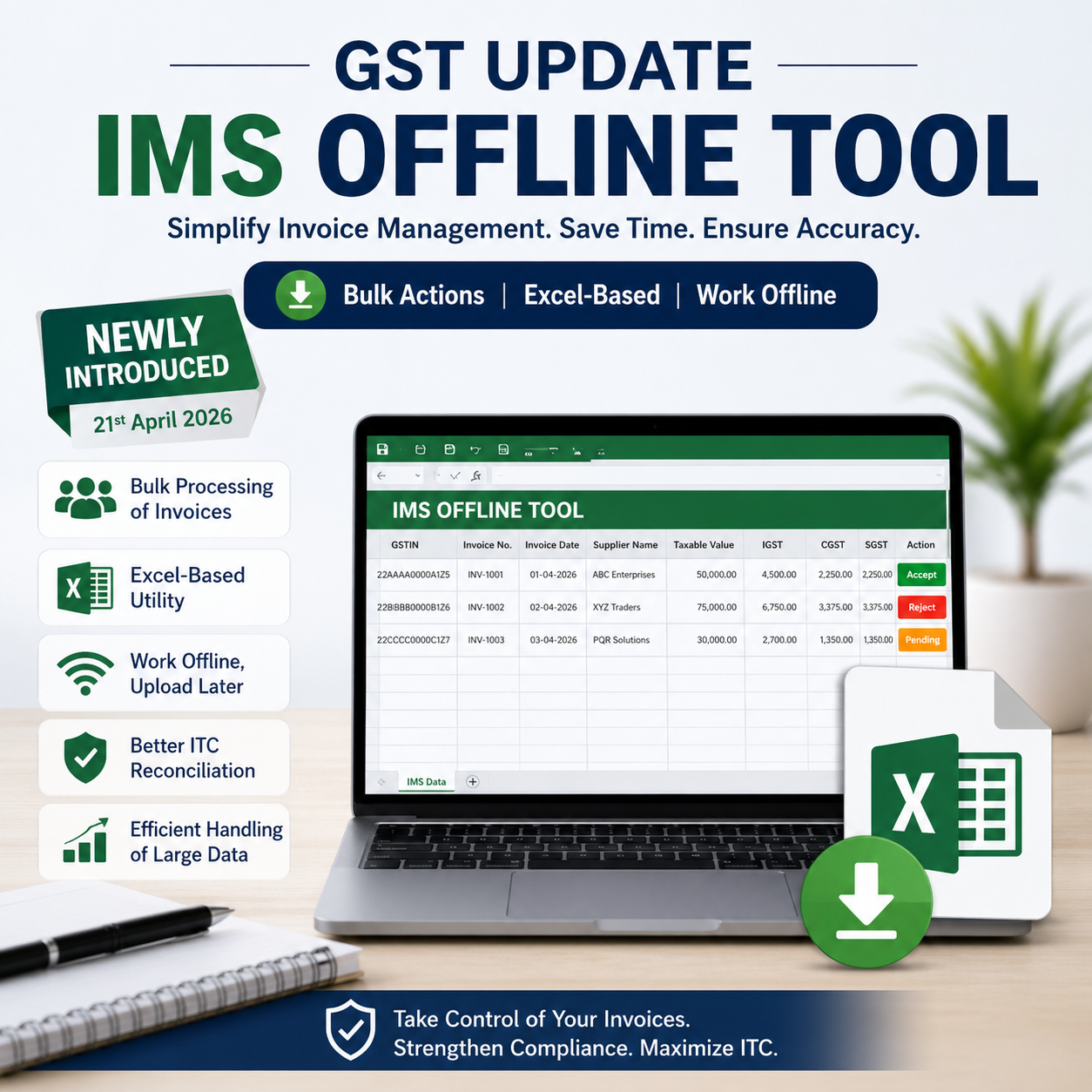
In a major move to enhance GST compliance efficiency, the GST Network (GSTN) rolled out the IMS (Invoice Management System) Offline Tool on 21st April 2026. This initiative is designed to simplify invoice-level activities for taxpayers and improve the reconciliation process.

Background – What is IMS?

The Invoice Management System (IMS) was introduced on the GST portal starting from the October 2024 tax period. Its key objective is to provide taxpayers with greater control over their inward supplies (purchase invoices) reflected in the system.

Under IMS, taxpayers can review and take appropriate action on invoices uploaded by suppliers through:

  • GSTR-1
  • GSTR-1A
  • IFF (Invoice Furnishing Facility)

Available Actions in IMS include:
✔️ Accept invoice
❌ Reject invoice
⏳ Keep invoice pending

This system plays a vital role in Input Tax Credit (ITC) reconciliation by ensuring that ITC is claimed only on valid and verified invoices, thereby improving overall compliance accuracy.

What’s New? – IMS Offline Tool

To enhance usability and address practical challenges faced by taxpayers, the GST Network (GSTN) has introduced the IMS Offline Tool.

📌 Key Highlight:
👉 Excel-based utility (MS Excel format)
👉 Designed for ease of use and bulk processing


🎯 Key Features of IMS Offline Tool

1️⃣ Bulk Processing of Invoices

Previously, taxpayers were required to take action on invoices individually through the GST portal.

Now:
👉 Download invoice data
👉 Take action in bulk (Accept / Reject / Pending)
👉 Upload the updated file back to the portal

📌 This is a significant time-saving feature, especially for:

  • Large businesses
  • Professionals managing multiple clients

2️⃣ Excel-Based Utility (User-Friendly)

The tool is built on MS Excel, making it:

  • Easy to understand
  • Familiar for accountants and tax professionals
  • Usable without advanced technical knowledge

3️⃣ Offline Working Capability

👉 No need for continuous internet access

You can:

  • Work offline
  • Review invoices carefully
  • Upload once the process is complete

📌 This helps reduce:

  • Dependency on the GST portal
  • Last-minute filing stress

4️⃣ Improved ITC Reconciliation

While IMS already supports ITC validation, the offline tool further enhances the process.

👉 Reconciliation becomes:

  • Faster
  • More accurate
  • Less prone to errors

5️⃣ Efficient Handling of Large Data

For taxpayers dealing with high volumes of invoices:

👉 The tool ensures:

  • Smooth data handling
  • Reduced issues related to portal lag

⚠️ Important Points to Note

  • The IMS Offline Tool is optional but highly recommended
  • Final upload must be completed on the GST portal
  • Careful review before uploading is essential
  • Incorrect actions may impact ITC eligibility
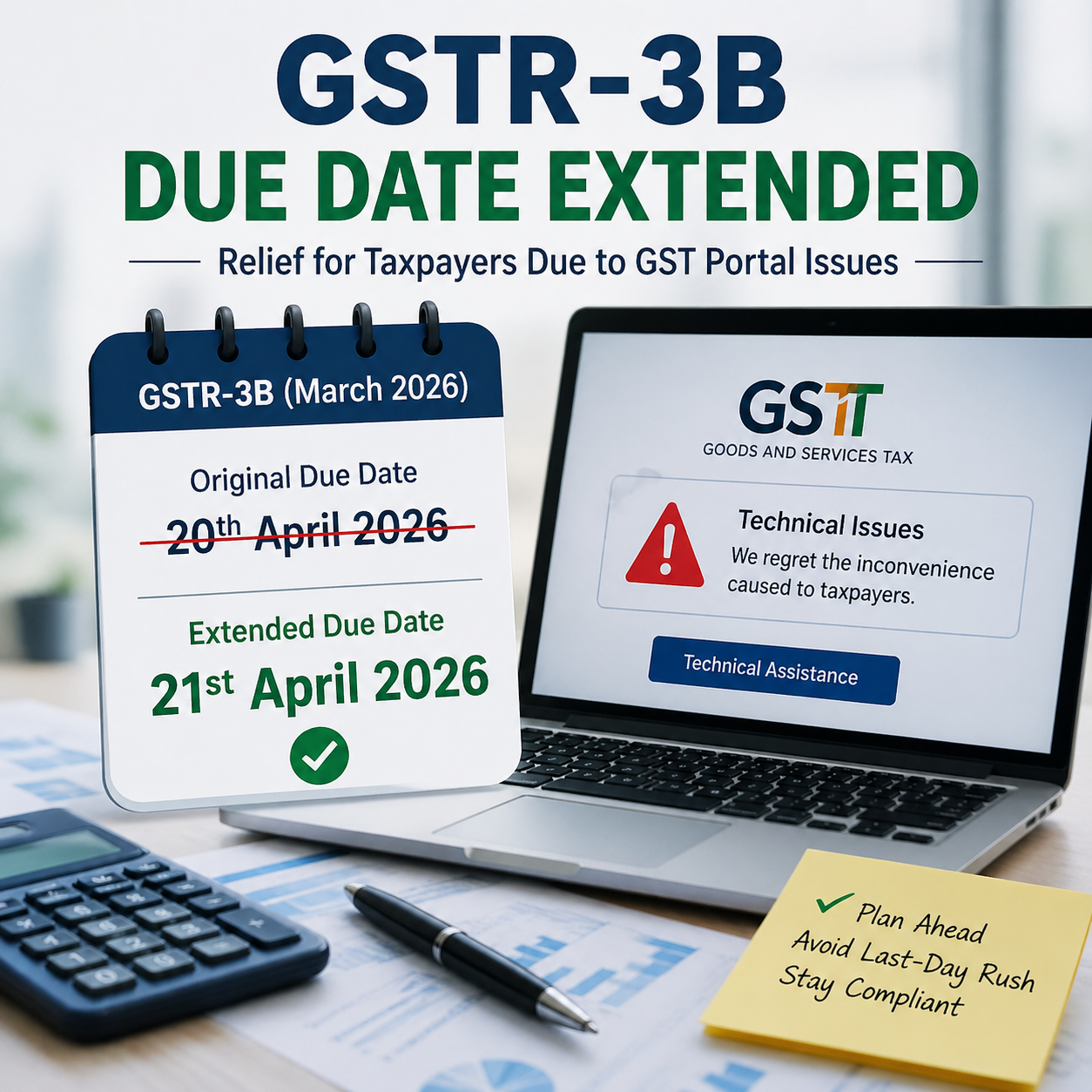
GSTR-3B Filing Gets Extension – Know the Updated Due Date

The GST Network (GSTN) has recently acknowledged the technical glitches encountered by taxpayers on the GST portal during the final day of GSTR-3B filing for March 2026, along with providing technical support.

📌 Background of the Issue

As per the regular GST compliance schedule, the due date for filing GSTR-3B (monthly return) for March 2026 was 20th April 2026.

However, on the due date, a significant number of taxpayers and professionals experienced serious technical difficulties on the GST portal, such as:

  • Inability to log in to the portal
  • Errors while saving or submitting returns
  • Payment failures
  • Portal slowdown or complete downtime
  • Delay in receiving OTPs

These disruptions created genuine challenges in timely compliance, especially considering that filing volume peaks on the last day.


⚠️ GSTN Response

In response to the widespread issues, the GST Network (GSTN) acknowledged the technical glitches and expressed regret for the inconvenience caused to taxpayers.

This is not the first instance—GSTN has previously issued advisories and provided interim solutions whenever system-related issues impacted return filing.


✅ Due Date Extended

Considering the genuine hardship faced by taxpayers, the authorities extended the due date for filing GSTR-3B:

  • Original Due Date: 20th April 2026
  • Extended Due Date: 21st April 2026

This extension provided taxpayers with an additional day to complete their filing without incurring late fees or interest.


📊 Practical Impact for Taxpayers

1. Relief from Late Fees & Interest
Late filing of GSTR-3B attracts:

  • Late fees
  • Interest at 18% per annum on tax liability

The extension ensured taxpayers could comply without additional financial burden.

2. Recognition of System-Based Challenges
The decision reflects the government’s acknowledgment of real-time portal issues, reinforcing trust in the GST compliance framework.

3. Reminder on Last-Day Filing Risks
This situation highlights an important compliance lesson:

  • Avoid last-day filing
  • Maintain buffer time for unexpected technical issues

📌 Important Professional Insight

  • Extensions are case-specific and not automatic
  • They apply only when technical issues are officially acknowledged by GSTN
  • Taxpayers should not assume similar relief in future periods

🧾 Conclusion

The extension of the GSTR-3B due date to 21st April 2026 provided much-needed relief to taxpayers affected by portal-related issues.

At the same time, it serves as a practical reminder to:
✔ Plan compliance activities in advance
✔ Avoid last-day filing rush
✔ Stay updated with GSTN advisories and updates

GST Update: Issue of Wrong Interest Calculation in GSTR-3B Returns

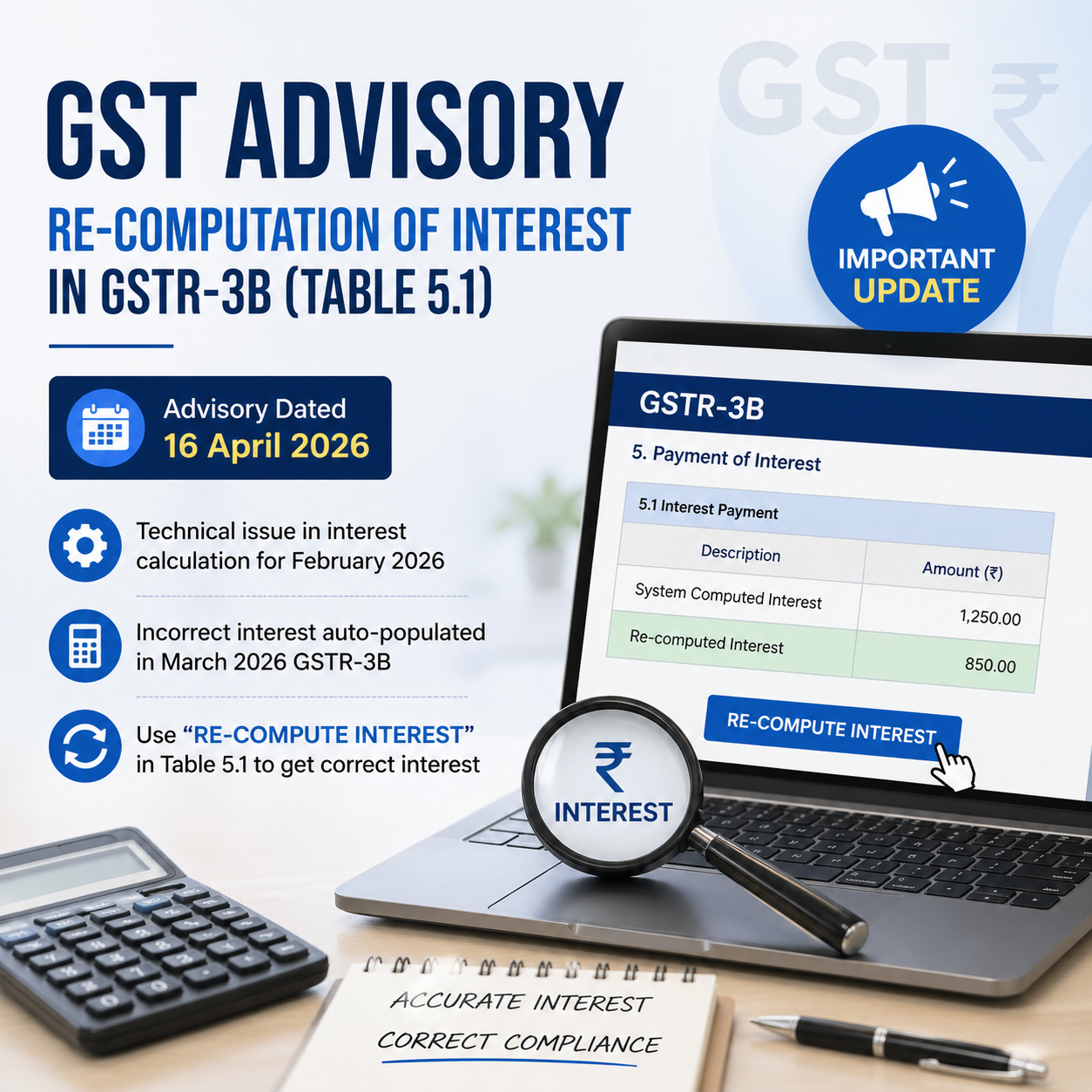
The GSTN has released a significant advisory dated 16 April 2026 regarding the recalculation of interest under Table 5.1 of GSTR-3B. The advisory highlights a technical issue where the system-generated interest for February 2026 was incorrectly computed and subsequently auto-populated in the March 2026 GSTR-3B for certain taxpayers.

This update is important for taxpayers to ensure accurate self-assessment of interest liability and to avoid excess payments or potential future disputes.

👉 Click here to download the advisory


🔍 System-Generated Interest – Working Mechanism

As a facilitation feature, the GST portal provides an automated system to compute interest on delayed filing of GSTR-3B. The system:

  • Calculates interest based on:
    • Tax liability discharged
    • Details reported in the “Tax Liability Breakup, As Applicable” table
  • The computed interest is:
    • Auto-populated in Table 5.1
    • Collected in the subsequent GSTR-3B return period

👉 This mechanism is similar to late fee computation, which is also calculated after filing and reflected in the next return cycle.


📄 Where to Verify Interest Calculation

Taxpayers can review the detailed interest computation through the System Generated GSTR-3B PDF.

🔎 Navigation Path:
Login → Return Dashboard → Select Return Period → GSTR-3B → Prepare Online → System Generated GSTR-3B PDF

This document provides a complete breakup of the interest calculation and should always be checked before filing.


⚠️ Issue Identified for February 2026

GSTN has identified that, due to a technical glitch:

  • Interest for February 2026
  • Reflected in March 2026 GSTR-3B (Table 5.1)

👉 May have been incorrectly computed for certain taxpayers.


❗ Root Cause

The issue arose because the system did not consider the benefit of the minimum balance available in the Electronic Cash Ledger, as required under:

👉 Rule 88B(1) proviso of the CGST Rules, 2017


🛠️ GSTN Solution – Recompute Interest

To address this issue, the GST portal has introduced a functionality to recompute interest.

👉 Steps to follow:

  • Navigate to Table 5.1 of GSTR-3B
  • Click on the “RE-COMPUTE INTEREST” button

The system will:

  • Recalculate interest using updated parameters
  • Consider the correct Electronic Cash Ledger balance

The revised interest amount will be reflected in the updated System Generated GSTR-3B PDF.

GST अपील प्रक्रिया में समस्या? GSTN ने जारी की गाइडलाइन

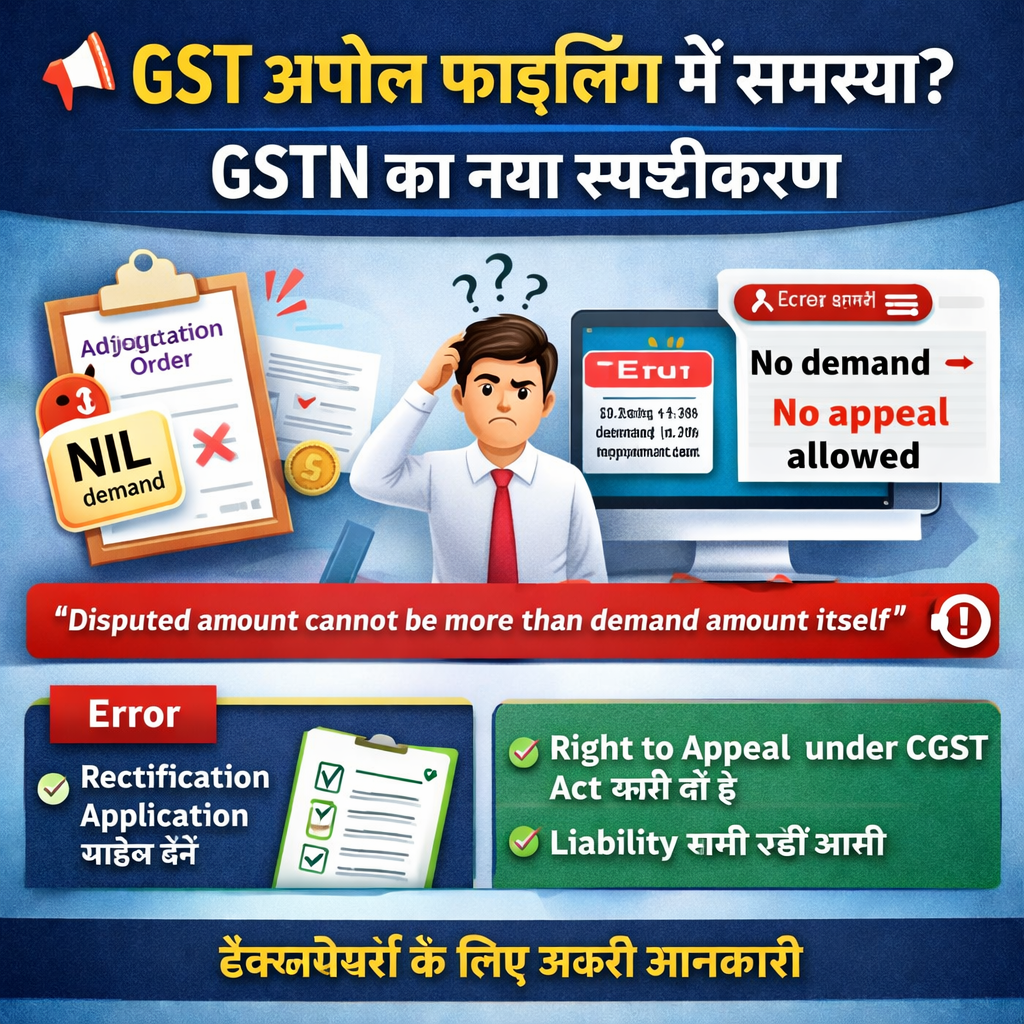
📢 GST अपील फाइलिंग में समस्या? जानें पूरा मामला और समाधान

GSTN ने हाल ही में एक महत्वपूर्ण समस्या पर ध्यान दिलाया है, जिसका सामना कई टैक्सपेयर्स GST पोर्टल पर अपील फाइल करते समय कर रहे हैं।


⚠️ समस्या क्या है?

कुछ मामलों में टैक्सपेयर्स adjudication order के खिलाफ appeal (APL-01) फाइल नहीं कर पा रहे हैं क्योंकि:

👉 ऑर्डर में Demand = NIL दिख रहा है
👉 जबकि वास्तव में टैक्स liability पर विवाद अभी भी मौजूद है


🔍 यह स्थिति कब उत्पन्न होती है?

यह समस्या आमतौर पर तब होती है जब:

  • टैक्सपेयर SCN (Show Cause Notice) स्टेज पर पेमेंट कर देता है
  • लेकिन यह पेमेंट liability स्वीकार किए बिना किया गया होता है
  • फिर भी अधिकारी इसे final discharge मान लेते हैं
  • और ऑर्डर में NIL demand दिखा देते हैं

⚙️ GST पोर्टल पर सिस्टम व्यवहार (DCR Mechanism)

जब भी demand order पास होता है:

  • एक Demand ID जनरेट होती है
  • यह Demand and Collection Register (DCR) में रिकॉर्ड होती है

👉 अगर demand NIL है:

  • सिस्टम इसे zero liability मान लेता है

🚫 असली समस्या (Appeal Filing Error)

जब आप Form APL-01 से अपील फाइल करते हैं:

👉 पोर्टल एरर देता है:
“Disputed amount cannot be more than demand amount itself”

📌 कारण:

  • Demand = NIL
  • इसलिए सिस्टम अपील ब्लॉक कर देता है

👉 सरल शब्दों में:
No demand = No appeal (technical issue)


⚖️ कानूनी स्थिति (बहुत महत्वपूर्ण)

GST Network (GSTN) ने स्पष्ट किया है:

✔ SCN स्टेज पर पेमेंट = liability स्वीकार करना नहीं है
✔ टैक्सपेयर को अपील का पूरा अधिकार है

👉 लागू कानून:
Section 107 of CGST Act, 2017

📌 महत्वपूर्ण बात:

  • पेमेंट कई बार pressure / compliance / litigation avoid करने के लिए किया जाता है
  • यह अपील का अधिकार खत्म नहीं करता

🛠️ GSTN द्वारा सुझाया गया समाधान

इस समस्या को हल करने के लिए GSTN ने एक स्पष्ट प्रक्रिया बताई है:

✅ Step-by-Step Solution

1. Rectification Application फाइल करें

  • GST पोर्टल पर rectification का विकल्प इस्तेमाल करें

2. Adjudicating Authority से संपर्क करें

  • स्पष्ट करें कि:
    • liability स्वीकार नहीं की गई थी
    • demand सही तरीके से निर्धारित की जाए

3. Rectification Order प्राप्त करें

  • संशोधित ऑर्डर में सही demand दिखनी चाहिए

4. फिर Appeal (APL-01) फाइल करें

  • demand अपडेट होने के बाद
  • निर्धारित समय सीमा के अंदर
GST New Valuation Rules Effective 1 February 2026: Tax Applicability Shifted to MRP

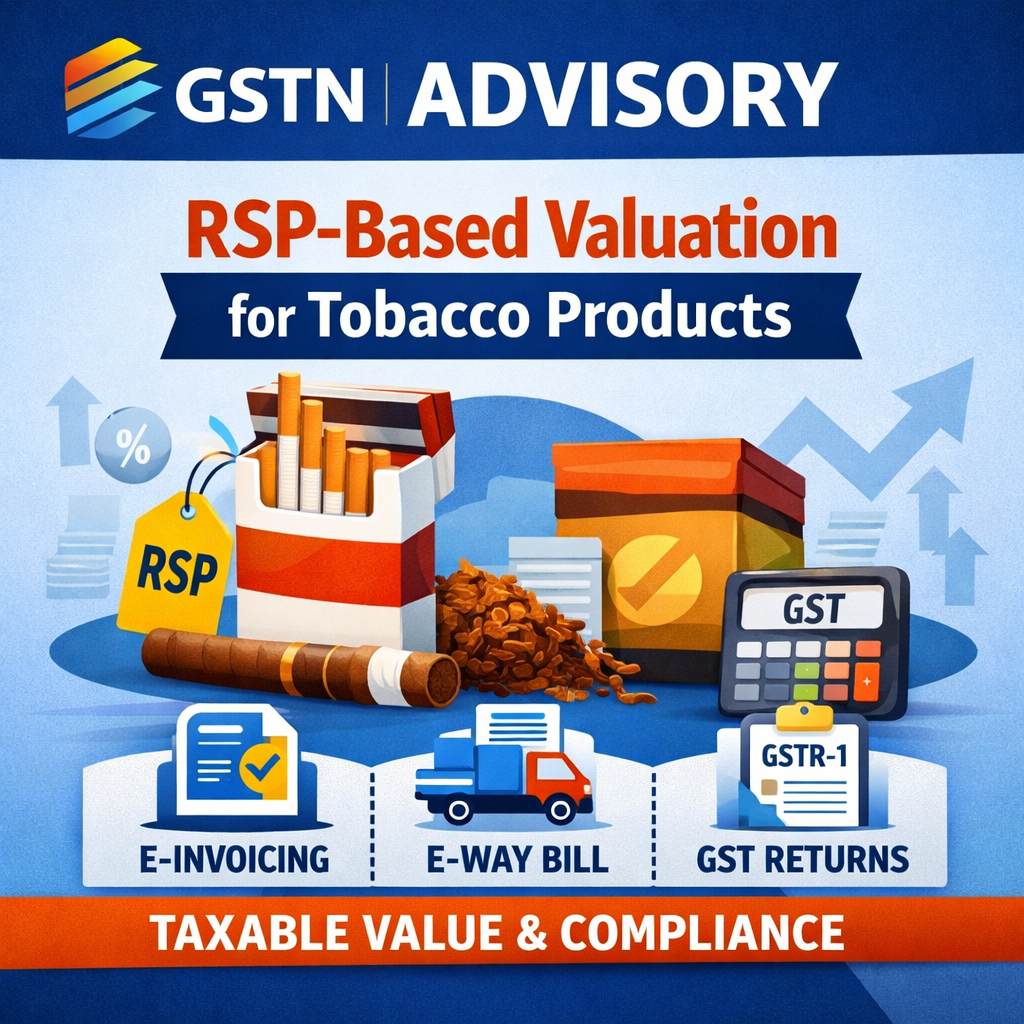
GSTN Advisory on RSP-Based Valuation for Notified Tobacco Goods

Clarification on Reporting Taxable Value and Tax Liability

The GST Network (GSTN) has issued an important advisory clarifying the manner of reporting taxable value and tax liability for notified tobacco goods taxed under RSP-based valuation. The clarification covers reporting requirements across e-Invoice, e-Way Bill, and GST returns (GSTR-1 / GSTR-1A / IFF).

This update is critical for manufacturers, wholesalers, distributors, and all taxpayers dealing in tobacco products notified for valuation based on Retail Sale Price (RSP).


1. Background: RSP-Based Valuation under GST

Under GST provisions, certain notified goods—particularly tobacco products—are subject to tax based on the Retail Sale Price (RSP) printed on the package, after allowing the prescribed abatement, rather than the actual transaction value.

In essence:

  • GST is not calculated on invoice value

  • GST is calculated on RSP minus notified abatement

  • This method is mandated under Section 15(4) of the CGST Act, read with relevant notifications


2. Objective of the GSTN Advisory

The advisory has been issued to:

  • Ensure consistent reporting of taxable value under RSP-based valuation

  • Prevent mismatches between reported value and tax liability

  • Align data reported in e-Invoice, e-Way Bill, and GST returns

  • Minimise system-generated notices and scrutiny due to incorrect valuation


3. Key Clarification by GSTN

(A) Taxable Value to be Reported

For notified tobacco goods covered under RSP-based valuation:

  • Taxable value must be the RSP-based value (after abatement)

  • Transaction value or invoice value must not be treated as taxable value

This principle applies uniformly across:

  • e-Invoice

  • e-Way Bill

  • GSTR-1 / GSTR-1A

  • Invoice Furnishing Facility (IFF)


4. Reporting in e-Invoice

While generating e-Invoices for notified tobacco goods:

  • The taxable value field must reflect:

    • RSP

    • Less: notified abatement

    • Resulting assessable value

  • GST rate and tax amount must be computed on this RSP-based taxable value

  • A difference between invoice value and taxable value is legally permissible

Common error to avoid:
Reporting transaction value as taxable value in the e-Invoice, leading to incorrect tax calculation.


5. Reporting in e-Way Bill

For e-Way Bill generation:

  • Taxable value must strictly follow RSP-based valuation

  • Auto-populated values from e-Invoice should not be incorrectly modified

  • Discrepancies between e-Invoice and e-Way Bill data may trigger system alerts


6. Reporting in GSTR-1 / GSTR-1A / IFF

In GST returns:

  • Outward supply details must reflect RSP-based taxable value and correct tax liability

  • This ensures accurate reflection in the recipient’s GSTR-2B

  • Prevents mismatch between tax paid and supplies reported

  • IFF filers must also strictly adhere to this valuation method


7. Impact on Taxpayers

This advisory directly affects:

  • Tobacco manufacturers

  • Cigarette traders

  • Wholesalers and distributors of notified tobacco goods

Incorrect reporting may result in:

  • System-generated notices

  • Return mismatches

  • Audit and assessment issues

  • Demand for differential tax along with interest and penalties


8. Recommended Action Points

Taxpayers should immediately:
✔ Review ERP and billing system configurations
✔ Ensure RSP-based valuation logic is correctly implemented
✔ Train accounting and compliance teams
✔ Reconcile taxable value across e-Invoice, e-Way Bill, and GSTR-1 / IFF
✔ Refer to the detailed GSTN advisory for technical guidance


Conclusion

The GSTN advisory dated 23 January 2026 provides crucial clarity on compliance requirements for notified tobacco goods under RSP-based valuation. Accurate reporting of taxable value across all GST systems is essential to avoid disputes and ensure seamless compliance.

Taxpayers are advised to promptly align their invoicing and return-filing processes with this clarification to remain fully GST-compliant.

GSTN issues comprehensive FAQ compilation on GSTR-9/9C for FY 2024-25

What’s New?

GSTN has issued a Consolidated set of FAQs for GSTR-9 and GSTR-9C for FY 2024-25 to assist taxpayers in accurately filing their Annual Return and Reconciliation Statement.

This consolidated document brings together FAQs earlier released on:

  • 16 October 2025

  • 4 December 2025

To simplify compliance, GSTN has now made all clarifications available in one single document on the GST portal.

👉 Download the Consolidated FAQs here
👉 Click here to enroll in the Practical GSTR-9/9C Course


📌 Objective of the Consolidated FAQs

The consolidated FAQs are intended to:

  • Address frequently asked questions and common errors in GSTR-9 and GSTR-9C filing

  • Offer clear guidance on reporting turnover, tax liability, ITC, amendments, and reversals

  • Minimise filing mistakes that could result in notices, mismatches, or departmental scrutiny