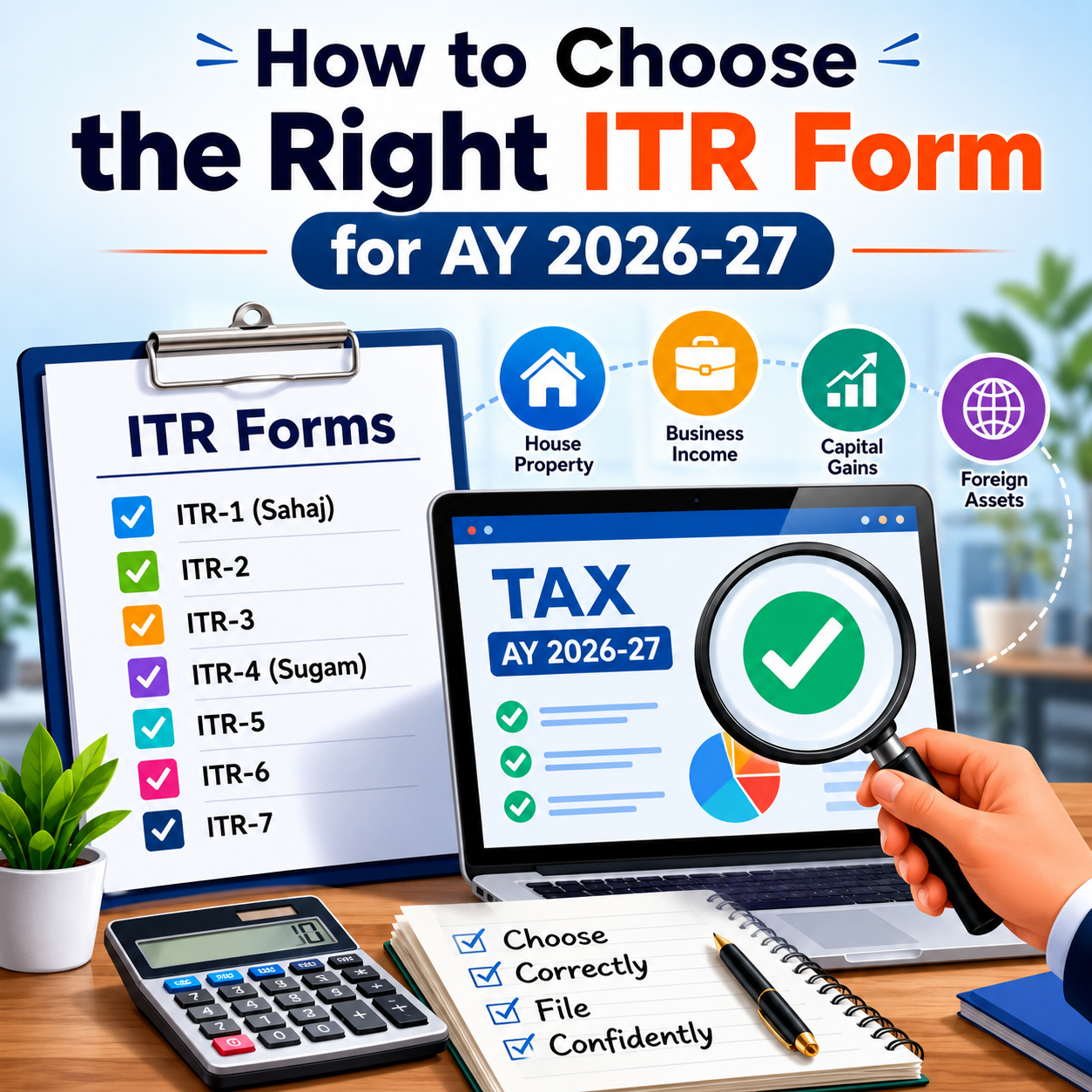
When Will the Income Tax Portal Open for ITR Filing 2026?

AY 2026-27 ITR Filing Latest Update: Expected Start Dates, Utility Release & Key Information

The biggest question among taxpayers right now is: “When will ITR filing start for AY 2026-27?” With the beginning of Financial Year 2025-26 and ongoing discussions around the new Income Tax framework, taxpayers are eagerly waiting for the Income Tax Department to activate the online filing utilities for Assessment Year 2026-27.

The positive news is that the Income Tax Department has already notified multiple ITR forms for AY 2026-27, which means the filing season has officially commenced from a legal standpoint. However, actual filing for most taxpayers will begin only after the online utilities and portal filing systems become fully operational.


Have ITR Forms for AY 2026-27 Been Notified?

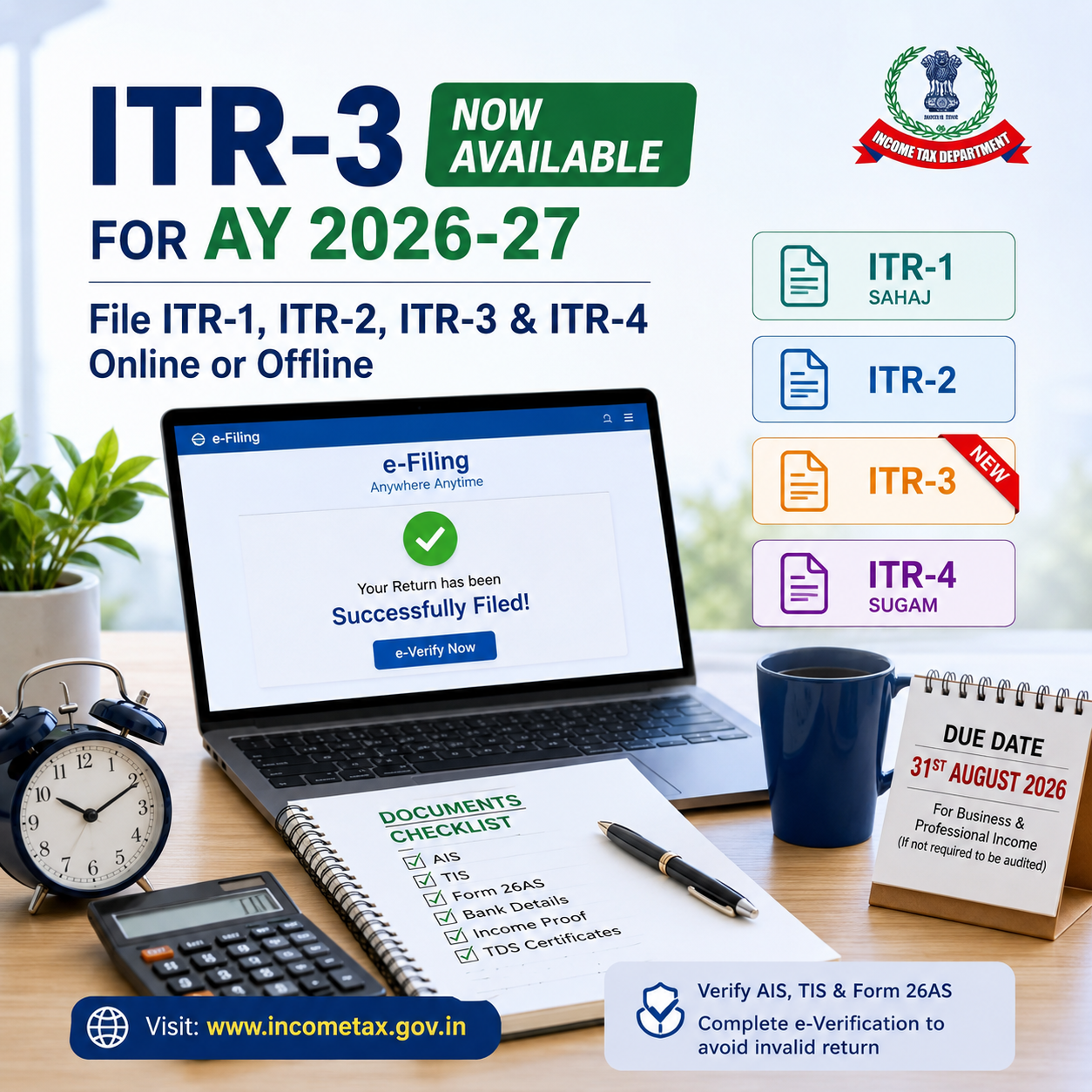
Yes. The CBDT has already notified important ITR forms for AY 2026-27, including:

  • ITR-1
  • ITR-2
  • ITR-3
  • ITR-4

The newly notified forms also contain several important changes, such as:

  • Separate reporting of F&O and intraday trading income
  • Additional capital gain disclosures
  • Buyback loss reporting requirements
  • Enhanced foreign asset disclosures
  • Simplified eligibility conditions in certain forms

Although the forms are officially notified, taxpayers are still waiting for:

  • Online utility activation
  • JSON schema integration
  • Prefilled return updates
  • AIS/TIS synchronization
  • Stable portal functionality

Has ITR Filing Started on the Income Tax Portal?

Currently, the forms have been released, but filing utilities for all taxpayer categories are not completely live yet. Tax professionals and taxpayers are actively monitoring utility releases because practical filing starts only after:

  • Online utility activation
  • Offline utility release
  • Validation schema updates by the department

Many taxpayers expected filing to begin from 1 April 2026 itself, but utility rollout has been gradual.


Expected Dates for ITR Utility Activation – AY 2026-27

Based on previous years’ trends and the current pace of utility releases, the expected timeline may be:

ITR Form Expected Utility / Filing Activation
ITR-1 Mid May to Late May 2026
ITR-2 Late May to Early June 2026
ITR-3 June 2026
ITR-4 Mid May to Late May 2026

The Income Tax portal’s utility download section already reflects phased releases and updates for several forms, indicating that activation is underway.

In practice, salaried taxpayers usually prefer filing only after:

  • Form 16 issuance
  • AIS updates completion
  • Prefilled data stabilization

Therefore, even if utilities become available in May 2026, many taxpayers may choose to file from June onwards for smoother processing.


Why Is There Delay in ITR Utility Activation?

Several reasons are contributing to the delayed rollout of utilities this year:

✔️ Changes in ITR Forms

The introduction of additional disclosure requirements has increased validation complexity.

✔️ Transition Towards New Tax Framework

AY 2026-27 represents a transitional phase with multiple structural compliance changes under the revised tax framework.

✔️ AIS / TIS Integration

The department now heavily relies on integrated reporting systems such as:

  • AIS
  • TIS
  • Form 26AS
  • SFT reporting
  • Broker transaction data
  • GST-linked analytics

As a result, utility validation and synchronization take more time.

✔️ Enhanced Reporting Requirements

Taxpayers having:

  • Capital gains
  • F&O income
  • Foreign assets
  • High-value transactions

may face additional disclosure and verification requirements this year.


Should Taxpayers File ITR Immediately After Utilities Go Live?

Not necessarily.

Experts generally recommend waiting until:

  • AIS/TIS data is fully updated
  • Form 16 is issued
  • Form 26AS is reconciled
  • Utilities become stable

During the initial days after utility release, taxpayers often face:

  • Validation errors
  • Portal glitches
  • JSON/schema mismatches

Therefore, unless an urgent refund claim is involved, filing after the utilities stabilize is generally considered safer.


Important Due Dates for AY 2026-27

Taxpayer Category Due Date
ITR-1 & ITR-2 (Non-audit cases) 31 July 2026
ITR-3 & ITR-4 (Non-audit cases) 31 August 2026
Audit Cases 31 October 2026
Transfer Pricing Cases 30 November 2026

Important Guidance for Taxpayers Before Filing ITR for AY 2026-27

Before submitting the Income Tax Return for AY 2026-27, taxpayers should carefully:

  • verify AIS and Form 26AS details,
  • check whether all TDS credits are correctly reflected,
  • reconcile capital gain statements,
  • confirm reporting of bank interest income, and
  • thoroughly review prefilled information available on the portal.

Filing the return hastily without proper verification may lead to issues such as:

  • defective return notices,
  • delay in processing of refunds,
  • income mismatch notices, or
  • future reassessment proceedings.

ITR filing utilities for AY 2026-27 are expected to become fully operational gradually during May and June 2026 as the Income Tax Department releases utilities in phases. Although the ITR forms have already been officially notified, taxpayers are still waiting for stable online utilities and complete portal activation across all return categories.

For salaried individuals, large-scale filing activity is expected to pick up mainly after:

  • issuance of Form 16,
  • completion of AIS updates, and
  • stabilization of filing utilities.
All About TDS: Payment Procedures, Due Dates & Forms under Old vs Revised Income Tax Act, 2025

What is TDS? (Concept)

TDS (Tax Deducted at Source) refers to a system where tax is deducted by the payer at the time of making specified payments and then remitted to the government.

👉 Objective of TDS:

  • Collection of tax at the point of income generation
  • Prevention of tax evasion
  • Ensuring steady inflow of revenue to the government

👉 Tax Credit Available To Taxpayer In:

  • Form 26AS
  • Annual Information Statement (AIS)

🔄 Key Change from 1 April 2026 (New Income Tax Act, 2025)

Structural Transformation

Old Income Tax Act, 1961 New Income Tax Act, 2025
Multiple sections (192, 194 series) Consolidated framework
Complicated structure Simplified approach
Dispersed provisions Centralized system

👉 New Section Mapping:

  • Section 392 → TDS on Salary
  • Section 393 → TDS on Other Payments

✔️ The core concept remains unchanged, but the structure is simplified.


📅 TDS Payment Due Dates

Monthly Due Dates

Particular Due Date
TDS deducted during any month 7th of the following month
TDS deducted in March 30th April (next financial year)

👉 Example:

  • TDS deducted in April → Pay by 7 May
  • TDS deducted in March → Pay by 30 April

✔️ No change under the new Act.


⚠️ Special Case – Government Deductors

  • Payment required on the same day (through book entry)
  • For March deductions → 7 April

⚠️ Interest on Delay

Default Type Interest Rate
Failure to deduct TDS 1% per month
Delay in deposit 1.5% per month

📊 TDS Return Filing Due Dates (FY 2026–27)

Quarter Period Due Date
Q1 Apr – Jun 2026 31 July 2026
Q2 Jul – Sep 2026 31 Oct 2026
Q3 Oct – Dec 2026 31 Jan 2027
Q4 Jan – Mar 2027 31 May 2027

✔️ Filing timeline remains unchanged under the new law.


📄 TDS Return Forms

🔄 A. Quarterly TDS Returns

Purpose Old Form New Form (2025 Act)
Salary TDS 24Q Form 138
Non-salary (Resident) 26Q Form 140
Non-resident payments 27Q Form 142 / 144
TCS Return 27EQ Form 143

✔️ Only form numbers changed; compliance process remains same.


🔄 B. TDS Certificates

Purpose Old Form New Form
Salary Form 16 Form 130
Non-salary Form 16A Form 131

🔄 C. Declaration Forms

Purpose Old Forms New Form
Declaration for non-deduction of TDS 15G / 15H Form 121

✔️ Significant simplification introduced.


🔄 D. Challan-cum-Statement (Major Change)

Earlier Forms New Unified Form
26QB (Property)
26QC (Rent)
26QD (Contract)
26QE (Crypto)
👉 Merged Form 141

✔️ Four separate forms are now consolidated into a single form.


⏱️ Special Cases – Different Deadlines

Nature of Transaction Applicable Form Due Date
Property transactions Form 141 Within 30 days
Rent payments (Individual) Form 141 Within 30 days
Contract/Professional (Individual) Form 141 Within 30 days
Cryptocurrency transactions Form 141 Within 30 days

⚠️ Penalties & Consequences

📌 Late Filing Fee

  • ₹200 per day
  • Maximum penalty limited to the amount of TDS
Latest TDS Rates Table – Financial Year 2026–27

TDS Rates Comparison Chart for FY 2026–27 (Old vs New Act with Section Codes)                                                       TDS provisions have been updated in the Income Tax Act, 2025. Below is a detailed rate chart with old section references and corresponding new section codes.

TDS Rate Chart – FY 2026–27

(Old Act vs New Income Tax Act, 2025 – Sections & Codes)

With the implementation of the Income Tax Act, 2025, TDS provisions have been restructured and renumbered. While most rates and thresholds remain largely unchanged, the section references have shifted significantly.

Below is a comprehensive comparative chart mapping old sections with new section codes, along with applicable thresholds and TDS rates.


👤 Payment to Residents

Nature of Payment Old Section New Section (2025 Act) Threshold Rate
Salary 192 392(1) Basic exemption Slab
EPF Withdrawal 192A 392(7) ₹50,000 10%
Interest on Securities 193 393(1) Table Sl. 5(i) ₹10,000 10%
Dividend 194 393(1) Table Sl. 7 ₹10,000 (Individual) 10%
Interest (Senior Citizen) 194A 393(1) Table 5(ii)(D)(a) ₹1,00,000 10%
Interest (Others) 194A 393(1) Table 5(ii)(D)(b) ₹50,000 10%
Insurance Commission 194D 393(1) Table 1(i) ₹20,000 2% / 10%
Commission/Brokerage 194H 393(1) Table 1(ii) ₹20,000 2%
Rent (General) 194I 393(1) Table 2(i) ₹50,000 2%
Rent (Machinery) 194I 393(1) Table 2(ii)(D)(a) ₹50,000 2%
Rent (Land/Building) 194I 393(1) Table 2(ii)(D)(b) ₹50,000 10%
Purchase of Immovable Property 194-IA 393(1) Table 3(i) ₹50 lakh 1%
Compensation on Acquisition 194LA 393(1) Table 3(ii) ₹5 lakh 10%
Mutual Fund Income 194K 393(1) Table 4(i) ₹10,000 10%
Business Trust Income 194LBA 393(1) Table 4(ii) Nil 10%
Investment Fund Income 194LBB 393(1) Table 4(iii) Nil 10%
Securitisation Trust Income 194LBC 393(1) Table 4(iv) Nil 10%

🏢 Contract / Professional / Business Payments

Nature Old Section New Section Threshold Rate
Contractor (Individual/HUF) 194C 393(1) Table 6(i)(D)(a) ₹30,000 / ₹1 lakh 1%
Contractor (Others) 194C 393(1) Table 6(i)(D)(b) ₹30,000 / ₹1 lakh 2%
Individual/HUF paying Contractor/Professional 194M 393(1) Table 6(ii) ₹50 lakh 2%
Technical Services / Royalty 194J 393(1) Table 6(iii)(D)(a) ₹50,000 2%
Professional Services 194J 393(1) Table 6(iii)(D)(b) ₹50,000 10%
Director Remuneration 194J 393(1) Table 6(iii)(D)(b) No limit 10%

🔄 Special Transactions

Nature Old Section New Section Threshold Rate
Purchase of Goods 194Q 393(1) Table 8(ii) ₹50 lakh 0.10%
Benefit/Perquisite 194R 393(1) Table 8(iv) ₹20,000 10%
E-commerce Operator 194O 393(1) Table 8(v) ₹5 lakh (Ind/HUF) 0.10%
Virtual Digital Assets (Non-Individual) 194S 393(1) Table 8(vi) ₹10,000 1%
VDA (Individual/HUF) 194S 393(1) Table 8(vi) ₹50,000 1%
Life Insurance (Taxable Portion) 194DA 393(1) Table 8(i) ₹1,00,000 2%

🌍 Non-Resident Payments

Nature Old Section New Section Rate
General Payment to Non-resident 195 393(2) As per Act/DTAA
Interest on Foreign Loan 194LC 393(2) Table 2 5%
Infra Debt Fund 194LB 393(2) Table 5 5%
Rupee Bonds (IFSC pre-2023) 194LC 393(2) Table 4E(a) 4%
Rupee Bonds (post-2023) 194LC 393(2) Table 4E(b) 9%
Investment Fund Income 194LBB 393(2) Table 8 10% / 30%
Securitisation Trust 194LBC 393(2) Table 9 10% / 30%
Mutual Fund Units 196A 393(2) Table 10 20%
Units (Sec 208) 196A 393(2) Table 11 10%
LTCG (Units) 196A 393(2) Table 12 12.5%
Bonds / GDR Interest 196C 393(2) Table 13 10%
LTCG (Bonds/GDR) 196C 393(2) Table 14 12.5%
Securities Income 196D 393(2) Table 15 20%

🎯 Winnings / High-Rate TDS

Nature Old Section New Section Threshold Rate
Lottery / Puzzle 194B 393(3) Table 1 ₹10,000 30%
Online Gaming 194BA 393(3) Table 2 No limit 30%
Horse Race 194BB 393(3) Table 3 ₹10,000 30%
Lottery Commission 194G 393(3) Table 4 ₹20,000 2%

💵 TDS on Cash Withdrawal

Nature Old Section New Section Threshold Rate
Co-operative Society 194N 393(3) Table 5D(a) ₹3 crore 2%
Others 194N 393(3) Table 5D(b) ₹1 crore 2%

⚠️ Important Note – Section 397 (PAN Not Furnished)

If PAN is not provided, TDS will be higher of:

  • Applicable rate, or
  • 20%

📌 Disclaimer

The contents of this article are for general informational purposes only and intended to provide a quick reference to TDS rates. Readers are advised to verify provisions with the Income Tax Act, applicable rules, notifications, and official government sources before making any financial or compliance decisions.

May 2026 Statutory Compliance Calendar – GST, Income Tax, MCA, PF & ESI

Compliance Calendar – May 2026 (GST, Income Tax, MCA, PF & ESI)

May 2026 is a crucial compliance month as it primarily covers filings related to April 2026, along with significant quarterly Income Tax obligations. Keeping track of due dates is essential to avoid interest charges, late fees, and penalties. Below is a structured overview of all major compliances.


Income Tax Compliance – May 2026

This month includes both monthly TDS deposit requirements and quarterly TDS return filings.

📊 Key Income Tax Due Dates

Due Date Compliance Particulars
7 May 2026 TDS Payment Deposit of TDS deducted for April 2026
31 May 2026 TDS Return (Q4) Filing of TDS returns for Jan–Mar 2026
31 May 2026 Form 16A Issuance Issue of TDS certificates (non-salary cases)

💡 Important Points

  • Delay in TDS deposit attracts interest at 1% / 1.5% per month
  • From this period, TDS compliance follows provisions of the Income Tax Act, 2025 (new sections applicable)
  • Late filing of TDS returns results in a penalty of ₹200 per day

🔷 GST Compliance – May 2026

📊 GST Due Dates (for April 2026 period)

Due Date Return Applicability
10 May 2026 GSTR-7 GST TDS filers
10 May 2026 GSTR-8 E-commerce operators (TCS)
11 May 2026 GSTR-1 Monthly return for outward supplies
13 May 2026 GSTR-6 Input Service Distributors (ISD)
20 May 2026 GSTR-3B Regular monthly taxpayers
20 May 2026 GSTR-5 Non-resident taxable persons
20 May 2026 GSTR-5A OIDAR service providers

🔶 QRMP Scheme

Taxpayers under the QRMP scheme are not required to file GSTR-3B for April in May.

Due Date Compliance
25 May 2026 PMT-06

PF & ESI Compliance – May 2026

Employers are required to fulfill monthly labour law compliances within prescribed timelines.

📊 PF & ESI Due Dates

Due Date Compliance Particulars
15 May 2026 PF Payment EPF contribution for April 2026
15 May 2026 ESI Payment ESI contribution for April 2026

💡 Important Points

  • Contributions include both employer and employee shares
  • Delay results in interest and penalties (damages)
  • PF return (ECR) must be filed along with the payment

MCA (ROC) Compliance – May 2026

MCA compliances are event-based rather than periodic.

📊 Key MCA Filings

Event Form Timeline
Allotment of Shares PAS-3 Within 30 days
Board Resolution Filing MGT-14 Within 30 days
Director Appointment/Resignation DIR-12 Within 30 days
Incorporation Filings Various Forms As applicable

💡 Important Points

  • No fixed monthly deadlines
  • Non-compliance can lead to significant penalties for both the company and its directors
  • Annual filings (AOC-4, MGT-7) are separate and not part of May compliance

Practical Compliance Focus – May 2026

May also plays a key role in financial year transition and reconciliation activities:

  • ✅ Reconciliation of GST data with books (impact of April opening balances)
  • ✅ Q4 TDS reconciliation prior to return filing
  • ✅ Salary and payroll verification, including PF & ESI alignment
  • ✅ Preparation for the upcoming Income Tax Return (ITR) filing season
ITR Filing Exemption for Senior Citizens in 2026

In 2026, certain senior citizens may be exempt from filing an Income Tax Return (ITR), but only if specific conditions are satisfied. Under the applicable provisions, a resident individual aged 75 years or above may not be required to file an ITR if their income is limited and falls within a prescribed scope. This relaxation aims to ease the compliance burden for elderly taxpayers who have straightforward sources of income.

To avail this exemption, the senior citizen’s income must be restricted to pension and interest income. Importantly, the interest should be earned from the same bank where the pension is received. In such cases, the bank assumes responsibility for computing the individual’s total income. It takes into account eligible deductions and rebate, determines the final tax liability, and deducts the appropriate amount of TDS. The senior citizen is required to submit a prescribed declaration to the bank, after which the entire tax compliance is managed at the bank level, eliminating the need to file an ITR separately.

However, this exemption is not universally applicable and must be evaluated carefully. If the individual has any additional income—such as rental income, capital gains, business or professional income, or dividend income—the benefit will not be available, and filing of an ITR becomes mandatory. Likewise, if interest income is earned from multiple banks or the required declaration is not properly submitted, the exemption cannot be claimed.

Explore More

  • Capital Gains Calculator
  • Tax Advisory Services
  • Senior Citizen Taxation

It is important to note that this benefit is strictly limited to individuals who are 75 years of age or older. Senior citizens between 60 and 74 years do not qualify for this exemption and must file their Income Tax Return if their income exceeds the basic exemption limit or if any other filing criteria are applicable.

From a practical standpoint, even when a person is eligible for this exemption, filing an ITR may still be advantageous in certain situations. For instance, if excess TDS has been deducted and a refund needs to be claimed, or when an ITR is required as proof of income for purposes such as loan applications, visa processing, or financial documentation, voluntarily filing the return can be beneficial.

In summary, while the ITR filing exemption offers meaningful relief to eligible senior citizens, it is available only under specific and well-defined conditions. Hence, it is crucial to carefully assess income sources and eligibility requirements before choosing not to file an ITR, in order to avoid any future compliance concerns.

Major Benefits for Senior Citizens Effective from 1 April 2026

Effective from 1 April 2026, it becomes important for senior citizens to clearly understand the applicable income tax provisions in order to manage their finances efficiently and stay compliant with legal requirements. Most senior citizens depend on income sources such as pension, interest, rent, or investments. Having proper knowledge of tax rules helps in minimizing tax liability and avoiding unnecessary notices or scrutiny.

👴 Who qualifies as a Senior Citizen?

Category Age Criteria
Normal Individual Below 60 years
Senior Citizen 60 – 79 years
Super Senior Citizen 80 years and above

👉 Important Note:
These benefits are available only to resident individuals. Non-resident individuals (NRIs) are not eligible for these specific benefits.

Under the new tax regime, which continues as the default option, the basic exemption limit is ₹4 lakh.

💰 Tax Slabs – New Tax Regime (Default)

Income Range Tax Rate
Up to ₹4,00,000 Nil
₹4,00,001 – ₹8,00,000 5%
₹8,00,001 – ₹12,00,000 10%
₹12,00,001 – ₹16,00,000 15%
₹16,00,001 – ₹20,00,000 20%
₹20,00,001 – ₹24,00,000 25%
Above ₹24,00,000 30%

In addition, a rebate under section 87A (read with section 156 provisions) ensures that if the total income does not exceed ₹12 lakh, the tax liability on normal income can effectively become zero.

However, this rebate does not apply to income taxed at special rates, such as short-term capital gains under section 111A, long-term capital gains, lottery winnings, or income from virtual digital assets.

Under the old tax regime, senior citizens benefit from a higher basic exemption limit of ₹3 lakh, while super senior citizens enjoy an exemption limit of ₹5 lakh.

The tax structure under the old regime is:

  • 5% on income above the exemption limit up to ₹5 lakh
  • 20% on income between ₹5 lakh and ₹10 lakh
  • 30% on income above ₹10 lakh

A rebate under section 87A is also available for income up to ₹5 lakh. Additionally, deductions under sections such as 80C and 80D are available, which may make the old regime beneficial in certain cases.

Although individuals with income below the exemption limit are generally not required to file an Income Tax Return (ITR), there are certain situations where filing becomes mandatory regardless of income level.

📄 When is ITR Filing Mandatory?

Even if income is below the exemption limit, filing is compulsory in the following cases:

  • High TDS or TCS has been deducted
  • Savings account deposits exceed ₹50 lakh
  • Current account transactions exceed ₹1 crore
  • Business turnover exceeds ₹60 lakh
  • Professional receipts exceed ₹10 lakh
  • Foreign travel expenses exceed ₹2 lakh
  • Electricity expenses exceed ₹1 lakh
  • Ownership of foreign assets or earning foreign income

One of the key reliefs available to senior citizens is exemption from payment of advance tax. Individuals aged 60 years or above, who do not have income from business or profession, are not required to pay advance tax. However, if they do have such income and their tax liability exceeds ₹10,000, advance tax provisions will apply.

With regard to interest income, senior citizens benefit from a higher threshold for TDS, generally up to ₹1 lakh per financial year. However, it is important to note that non-deduction of TDS does not mean the income is tax-free. Such income must still be disclosed in the ITR and is taxable as per slab rates.

A major compliance update is the introduction of Form 121, which replaces the earlier Forms 15G and 15H. This form allows taxpayers to declare that their income is below the taxable limit, thereby avoiding unnecessary TDS deductions. This facility is applicable only when the actual tax liability is nil.

There is also a special provision for individuals aged 75 years and above. If their income consists only of pension and interest, and both are received in a single specified bank account, they may be exempt from filing an ITR. In such cases, the bank calculates total income, applies eligible deductions and rebates, deducts the tax, and issues a certificate. This benefit is subject to strict conditions, including having no other source of income.

Another important concept is marginal relief, which ensures that if income slightly exceeds the rebate threshold (for example, ₹12 lakh under the new regime), the additional tax payable does not exceed the additional income earned. This prevents an excessive increase in tax burden due to minor income changes.

In terms of house property, taxpayers are now allowed to treat up to two properties as self-occupied without paying tax on notional rent. This is beneficial for individuals who own multiple houses that are not rented out.

For rental income, if the monthly rent does not exceed ₹50,000 (₹6 lakh annually), tenants are not required to deduct TDS, which simplifies compliance.

Recent procedural changes include an extension of the ITR filing due date for non-audit cases to 31 August, while revised returns can be filed up to 31 March of the assessment year, subject to applicable late fees.

Taxpayers can also file an updated return (ITR-U) within four years from the end of the relevant assessment year, although this involves payment of additional tax ranging from 25% to 70% depending on the delay.

In cases involving the purchase of immovable property from non-residents, compliance has been simplified by removing the requirement to obtain a TAN. Tax can now be deducted using PAN, reducing procedural burden.

Overall, the income tax system has become increasingly digital and data-driven. Financial transactions, income details, and tax deductions are tracked through systems such as the Annual Information Statement (AIS) and matched with ITR filings. Therefore, it is crucial for taxpayers to maintain consistency in their financial records and declarations.

Conclusion:
While the tax framework offers several benefits and relaxations for senior citizens, it also demands transparency and accurate reporting. By staying informed, maintaining proper documentation, and complying with deadlines, senior citizens can efficiently manage their tax responsibilities and avoid complications with tax authorities.

GST Latest Update: IMS Offline Tool Comes into Effect

In a major move to enhance GST compliance efficiency, the GST Network (GSTN) rolled out the IMS (Invoice Management System) Offline Tool on 21st April 2026. This initiative is designed to simplify invoice-level activities for taxpayers and improve the reconciliation process.

Background – What is IMS?

The Invoice Management System (IMS) was introduced on the GST portal starting from the October 2024 tax period. Its key objective is to provide taxpayers with greater control over their inward supplies (purchase invoices) reflected in the system.

Under IMS, taxpayers can review and take appropriate action on invoices uploaded by suppliers through:

  • GSTR-1
  • GSTR-1A
  • IFF (Invoice Furnishing Facility)

Available Actions in IMS include:
✔️ Accept invoice
❌ Reject invoice
⏳ Keep invoice pending

This system plays a vital role in Input Tax Credit (ITC) reconciliation by ensuring that ITC is claimed only on valid and verified invoices, thereby improving overall compliance accuracy.

What’s New? – IMS Offline Tool

To enhance usability and address practical challenges faced by taxpayers, the GST Network (GSTN) has introduced the IMS Offline Tool.

📌 Key Highlight:
👉 Excel-based utility (MS Excel format)
👉 Designed for ease of use and bulk processing


🎯 Key Features of IMS Offline Tool

1️⃣ Bulk Processing of Invoices

Previously, taxpayers were required to take action on invoices individually through the GST portal.

Now:
👉 Download invoice data
👉 Take action in bulk (Accept / Reject / Pending)
👉 Upload the updated file back to the portal

📌 This is a significant time-saving feature, especially for:

  • Large businesses
  • Professionals managing multiple clients

2️⃣ Excel-Based Utility (User-Friendly)

The tool is built on MS Excel, making it:

  • Easy to understand
  • Familiar for accountants and tax professionals
  • Usable without advanced technical knowledge

3️⃣ Offline Working Capability

👉 No need for continuous internet access

You can:

  • Work offline
  • Review invoices carefully
  • Upload once the process is complete

📌 This helps reduce:

  • Dependency on the GST portal
  • Last-minute filing stress

4️⃣ Improved ITC Reconciliation

While IMS already supports ITC validation, the offline tool further enhances the process.

👉 Reconciliation becomes:

  • Faster
  • More accurate
  • Less prone to errors

5️⃣ Efficient Handling of Large Data

For taxpayers dealing with high volumes of invoices:

👉 The tool ensures:

  • Smooth data handling
  • Reduced issues related to portal lag

⚠️ Important Points to Note

  • The IMS Offline Tool is optional but highly recommended
  • Final upload must be completed on the GST portal
  • Careful review before uploading is essential
  • Incorrect actions may impact ITC eligibility
Income Tax Rules 2026: Major Changes, Updated ITR Forms, Exemption Limits & PDF Overview

The Income Tax Rules 2026 have replaced the decade-old Income Tax Rules 1962 with effect from 1st April 2026 and will apply from Tax Year 2026–27 onwards. These new rules operationalise the Income Tax Act 2025 by revising exemption limits for allowances, updating PAN quoting thresholds, extending the 50% HRA exemption to four additional cities, and introducing new income tax forms.

Income Tax Rules 2026 – Latest Update

The CBDT has issued a notification correcting several minor drafting errors and terminology issues in the new Income Tax Rules 2026. However, these corrections do not result in any major impact on income computation or tax calculations.

New Income Tax Rules – Overview

  • The Income Tax Rules 2026 replace the Income Tax Rules 1962 from 1st April 2026 for Tax Year 2026–27 onwards.
  • Exemption limits for several allowances such as children education, hostel, meals, and gifts have been substantially increased to align with current inflation and living costs.
  • The benefit of 50% HRA exemption has been extended to 8 cities, with Bengaluru, Pune, Hyderabad, and Ahmedabad newly added under the old tax regime.
  • PAN quoting thresholds for high-value transactions such as property purchases, cash deposits, and vehicle transactions have been revised.

What are the Income Tax Rules 2026?

The Income Tax Rules 2026 are the procedural and operational rules notified by the Central Board of Direct Taxes (CBDT) under Section 533 of the Income Tax Act 2025. These rules replace the Income Tax Rules 1962 and contain more than 333 rules dealing with forms, procedures, compliance requirements, valuation methods, and reporting obligations applicable from 1st April 2026.

The provisions of the new rules will apply to income earned during Tax Year 2026–27 and later years. For income earned during FY 2025–26 (AY 2026–27), the provisions of the Income Tax Act 1961 and Income Tax Rules 1962 will continue to apply.

Income Tax Rules 2026 PDF Download

The PDF version of the Income Tax Rules 2026 can be downloaded from the official Income Tax Department website.

Effective Date of the New Rules

The Income Tax Rules 2026 will become effective from 1st April 2026 along with the implementation of the Income Tax Act 2025. Both the Act and the Rules will apply from Tax Year 2026–27 onwards.

Key Changes in Income Tax Rules 2026

1. Revised Allowance & Perquisite Valuation Rules

One of the most awaited reforms under the new rules is the revision of allowance and perquisite valuation limits in line with modern salary structures and inflation.

Item Earlier Limit Revised Limit (2026 Rules)
Children Education Allowance Rs. 100 per month per child Rs. 3,000 per month per child
Hostel Allowance Rs. 300 per month per child Rs. 9,000 per month per child
Free Meals Rs. 50 per meal Rs. 200 per meal
Non-cash Gifts Rs. 5,000 annually Rs. 15,000 annually
Car Lease (<1.6L engine) Rs. 1,800 + Rs. 900 driver Rs. 5,000 + Rs. 3,000 driver
Car Lease (>1.6L engine) Rs. 2,400 + Rs. 900 driver Rs. 7,000 + Rs. 3,000 driver
Overseas Medical Treatment Exempt if income below Rs. 2 lakh Exempt if income below Rs. 8 lakh

These revised limits significantly improve the practical usefulness of exemptions available to salaried employees.

2. PAN Quoting Requirement Changes

The monetary thresholds for mandatory PAN quoting in certain transactions have been revised under the new rules.

Nature of Transaction Existing Limit New 2026 Limit
Purchase/Sale of Motor Vehicle All vehicles except two-wheelers Above Rs. 5 lakh (including motorcycles, excluding tractors)
Hotel/Restaurant Cash Payment Above Rs. 50,000 Above Rs. 1 lakh
Life Insurance Premium Above Rs. 50,000 annually PAN required at account relationship stage
Immovable Property Transactions Above Rs. 10 lakh Above Rs. 20 lakh
Cash Withdrawals Rs. 20 lakh annually Rs. 10 lakh annually
Cash Deposits Above Rs. 50,000 in a day Above Rs. 10 lakh annually

3. HRA Exemption Expanded to More Cities

The new rules now extend the 50% House Rent Allowance exemption category to the following additional cities:

  • Bengaluru
  • Pune
  • Hyderabad
  • Ahmedabad

With this change, the total number of cities eligible for the 50% HRA exemption rises to eight. Previously, only Mumbai, Delhi, Chennai, and Kolkata qualified for this benefit.

However, HRA exemption continues to remain available only under the Old Tax Regime.

4. Introduction of New Income Tax Forms

Several income tax forms have been renamed or consolidated under the new framework.

Major changes include:

  • Form 16 renamed as Form 130
  • Form 15G and Form 15H merged into Form 121
  • Form 26AS renamed as Form 168

5. Other Important Changes

Additional amendments have also been introduced for SFT reporting and digital compliance requirements.

Item Old Provision New 2026 Provision
Property SFT Reporting Limit Rs. 30 lakh Rs. 45 lakh
Books of Accounts for Professionals Manual books permitted Mandatory digital books
CBDC (e-Rupee) No recognition Recognised as valid electronic payment mode

Impact on Salaried Employees

The Income Tax Rules 2026 are expected to have a major impact on salaried taxpayers due to the sharp increase in exemption limits for allowances and perquisites.

Benefits such as:

  • Rs. 3,000 education allowance,
  • Rs. 9,000 hostel allowance,
  • Rs. 200 meal exemption,

can significantly reduce taxable salary under the Old Tax Regime.

As a result, salaried individuals may need to reassess their salary structure and compare both tax regimes carefully before selecting the most beneficial option.

Impact on Businesses

The new rules introduce a more technology-driven and compliance-oriented tax ecosystem for businesses.

Businesses may now need to:

  • maintain digital books of accounts,
  • strengthen payroll and reporting systems,
  • improve disclosure mechanisms,
  • and adapt to faceless and automated tax administration systems.

While these changes enhance transparency and standardisation, they may also increase compliance costs and reporting obligations.

Impact on NRIs

For NRIs, the Income Tax Rules 2026 introduce clearer compliance standards and stricter disclosure requirements.

Important areas affected include:

  • residential status determination,
  • foreign income reporting,
  • disclosure of overseas assets,
  • taxation of digital and global income,
  • and DTAA-related compliance.

Although digital systems and simplified procedures may improve ease of filing, NRIs will need to maintain proper documentation to avoid penalties and disputes.

Old Tax Regime vs New Tax Regime – Which May Be Better?

The ideal tax regime will continue to depend on the taxpayer’s income level and available deductions/exemptions.

With the revised exemption limits for allowances and perquisites, the Old Tax Regime could become more attractive for many salaried employees who receive structured salary benefits.

Taxpayers who previously found the old regime less beneficial may now see lower taxable income due to these enhanced exemption limits, making the old regime comparatively more tax-efficient in certain cases.

GSTR-3B Filing Gets Extension – Know the Updated Due Date

The GST Network (GSTN) has recently acknowledged the technical glitches encountered by taxpayers on the GST portal during the final day of GSTR-3B filing for March 2026, along with providing technical support.

📌 Background of the Issue

As per the regular GST compliance schedule, the due date for filing GSTR-3B (monthly return) for March 2026 was 20th April 2026.

However, on the due date, a significant number of taxpayers and professionals experienced serious technical difficulties on the GST portal, such as:

  • Inability to log in to the portal
  • Errors while saving or submitting returns
  • Payment failures
  • Portal slowdown or complete downtime
  • Delay in receiving OTPs

These disruptions created genuine challenges in timely compliance, especially considering that filing volume peaks on the last day.


⚠️ GSTN Response

In response to the widespread issues, the GST Network (GSTN) acknowledged the technical glitches and expressed regret for the inconvenience caused to taxpayers.

This is not the first instance—GSTN has previously issued advisories and provided interim solutions whenever system-related issues impacted return filing.


✅ Due Date Extended

Considering the genuine hardship faced by taxpayers, the authorities extended the due date for filing GSTR-3B:

  • Original Due Date: 20th April 2026
  • Extended Due Date: 21st April 2026

This extension provided taxpayers with an additional day to complete their filing without incurring late fees or interest.


📊 Practical Impact for Taxpayers

1. Relief from Late Fees & Interest
Late filing of GSTR-3B attracts:

  • Late fees
  • Interest at 18% per annum on tax liability

The extension ensured taxpayers could comply without additional financial burden.

2. Recognition of System-Based Challenges
The decision reflects the government’s acknowledgment of real-time portal issues, reinforcing trust in the GST compliance framework.

3. Reminder on Last-Day Filing Risks
This situation highlights an important compliance lesson:

  • Avoid last-day filing
  • Maintain buffer time for unexpected technical issues

📌 Important Professional Insight

  • Extensions are case-specific and not automatic
  • They apply only when technical issues are officially acknowledged by GSTN
  • Taxpayers should not assume similar relief in future periods

🧾 Conclusion

The extension of the GSTR-3B due date to 21st April 2026 provided much-needed relief to taxpayers affected by portal-related issues.

At the same time, it serves as a practical reminder to:
✔ Plan compliance activities in advance
✔ Avoid last-day filing rush
✔ Stay updated with GSTN advisories and updates

GST Update: Issue of Wrong Interest Calculation in GSTR-3B Returns

The GSTN has released a significant advisory dated 16 April 2026 regarding the recalculation of interest under Table 5.1 of GSTR-3B. The advisory highlights a technical issue where the system-generated interest for February 2026 was incorrectly computed and subsequently auto-populated in the March 2026 GSTR-3B for certain taxpayers.

This update is important for taxpayers to ensure accurate self-assessment of interest liability and to avoid excess payments or potential future disputes.

👉 Click here to download the advisory


🔍 System-Generated Interest – Working Mechanism

As a facilitation feature, the GST portal provides an automated system to compute interest on delayed filing of GSTR-3B. The system:

  • Calculates interest based on:
    • Tax liability discharged
    • Details reported in the “Tax Liability Breakup, As Applicable” table
  • The computed interest is:
    • Auto-populated in Table 5.1
    • Collected in the subsequent GSTR-3B return period

👉 This mechanism is similar to late fee computation, which is also calculated after filing and reflected in the next return cycle.


📄 Where to Verify Interest Calculation

Taxpayers can review the detailed interest computation through the System Generated GSTR-3B PDF.

🔎 Navigation Path:
Login → Return Dashboard → Select Return Period → GSTR-3B → Prepare Online → System Generated GSTR-3B PDF

This document provides a complete breakup of the interest calculation and should always be checked before filing.


⚠️ Issue Identified for February 2026

GSTN has identified that, due to a technical glitch:

  • Interest for February 2026
  • Reflected in March 2026 GSTR-3B (Table 5.1)

👉 May have been incorrectly computed for certain taxpayers.


❗ Root Cause

The issue arose because the system did not consider the benefit of the minimum balance available in the Electronic Cash Ledger, as required under:

👉 Rule 88B(1) proviso of the CGST Rules, 2017


🛠️ GSTN Solution – Recompute Interest

To address this issue, the GST portal has introduced a functionality to recompute interest.

👉 Steps to follow:

  • Navigate to Table 5.1 of GSTR-3B
  • Click on the “RE-COMPUTE INTEREST” button

The system will:

  • Recalculate interest using updated parameters
  • Consider the correct Electronic Cash Ledger balance

The revised interest amount will be reflected in the updated System Generated GSTR-3B PDF.