
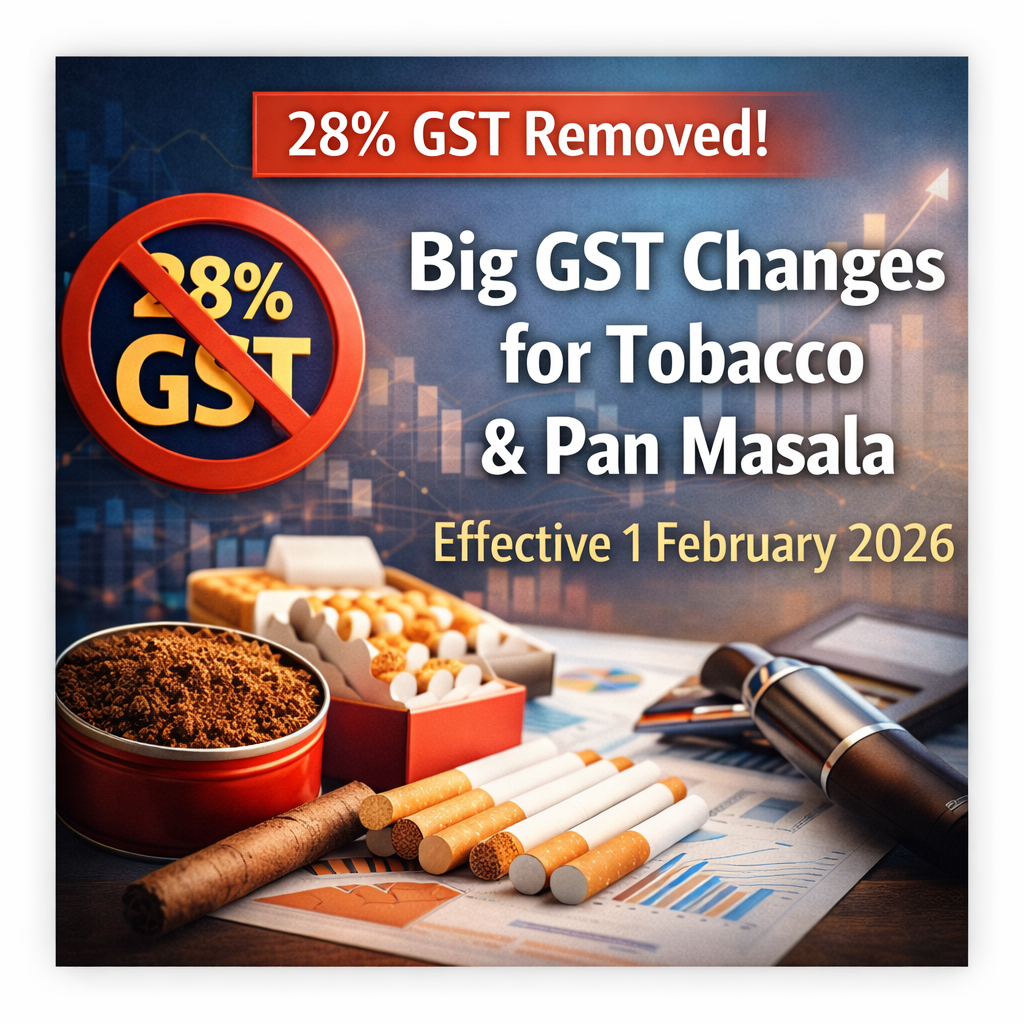

GST Update: 28% Tax Scrapped on Tobacco & Pan Masala Under New Notifications
GST Notifications Covered
-
Notification No. 19/2025 – Central Tax (Rate)
-
Notification No. 20/2025 – Central Tax
-
Notification No. 19/2025 – Central Tax
(All applicable from 1 February 2026)
1. Background & Policy Rationale
For many years, products such as tobacco, pan masala and cigarettes were subject to 28% GST along with Compensation Cess, and in some cases additional levies like excise duty or NCCD. This multi-layered tax structure led to valuation disputes, litigation, and frequent cases of undervaluation.
With the compensation cess regime approaching its end, the Government has rolled out a comprehensive GST reset for sin goods. Through a coordinated set of three notifications, changes have been introduced covering:
-
GST rates
-
Valuation mechanism
-
Statutory backing under section 15(5) of the CGST Act
2. Notification No. 19/2025 – Central Tax (Rate)
GST Rate Rationalisation
Key Changes
-
The 28% GST slab is withdrawn for tobacco and pan masala.
-
Biris are specifically taxed at 18% GST.
-
All other tobacco-related products are now subject to 40% GST (20% CGST + 20% SGST), including:
-
Pan masala
-
Unmanufactured tobacco and tobacco refuse
-
Cigarettes, cigars and cheroots
-
Manufactured tobacco (excluding biris)
-
Heated tobacco and nicotine inhalation products such as vapes
-
-
The earlier 14% GST schedule is deleted.
Significance
-
Signals a clear exit from the 28% + Compensation Cess framework.
-
Consolidates taxation into higher GST slabs to ensure revenue stability.
-
Reflects policy intent to discourage consumption while safeguarding tax collections.
📄 Source: Notification No. 19/2025 – Central Tax (Rate)
3. Notification No. 20/2025 – Central Tax
Shift to MRP / Retail Sale Price–Based Valuation
Introduction of Rule 31D
For specified tobacco and pan masala products, GST valuation will no longer be based on transaction value.
Value of supply = Retail Sale Price (RSP/MRP) minus GST
Products Covered
The valuation change applies to the same product categories covered under the rate notification, excluding biris.
Key Valuation Provisions
-
RSP includes all taxes, duties, cess and surcharges.
-
Where multiple MRPs are printed, the highest MRP will apply.
-
Any increase in MRP at any stage becomes the taxable value.
-
If different MRPs are declared for different regions, valuation will be based on the area-specific MRP.
Rule 86B Relaxation (ITC Payment Restriction)
-
Traders (non-manufacturers) dealing in these goods are exempt from the 99% cash payment restriction, provided GST has been paid by the supplier on an RSP basis.
Significance
-
Effectively eliminates undervaluation.
-
Aligns GST valuation with the earlier excise-style MRP regime.
-
Guarantees minimum assured tax realisation.
📄 Source: Notification No. 20/2025 – Central Tax
4. Notification No. 19/2025 – Central Tax
Legal Backing under Section 15(5)
This notification amends Notification No. 49/2023–Central Tax to formally notify goods whose value shall be determined under section 15(5) of the CGST Act.
Key Purpose
-
Specifies tobacco and pan masala products bearing RSP as goods subject to special valuation rules.
-
Overrides transaction-value-based valuation.
Importance
-
Provides statutory authority to Rule 31D.
-
Minimises valuation disputes and litigation risks.
-
Ensures uniform nationwide application.
📄 Source: Notification No. 19/2025 – Central Tax
5. How the Three Notifications Operate Together
| Aspect | CT (Rate) 19/2025 | CT 20/2025 | CT 19/2025 |
|---|---|---|---|
| Focus | Rate restructuring | Valuation & ITC | Legal authority |
| Core Change | 28% slab removed | MRP-based valuation | Section 15(5) coverage |
| Goods | Tobacco, pan masala, vapes | Same goods | Same goods |
| Outcome | Higher GST slabs | No undervaluation | Strong legal backing |
6. Practical Impact on Stakeholders
Manufacturers
-
Pricing must be strictly aligned with declared MRP.
-
Any MRP increase results in higher GST liability.
-
ERP, invoicing and compliance systems require updates for tax back-calculation.
Traders & Distributors
-
Relief from Rule 86B restrictions where suppliers pay GST on RSP basis.
-
Must ensure MRP compliance throughout the supply chain.
Tax Professionals
-
Clear shift from transaction-value disputes to MRP-based certainty.
-
Critical advisory role in pricing, packaging, valuation and compliance reviews.