New Income Tax Slab Rates in Budget 2026: FY 2026-27 (AY 2027-28), ITR Deadlines & TDS/TCS Rules

Key Income Tax & ITR Updates – Budget 2026

  • No change in income tax slab rates under either tax regime.

  • Simplified ITR forms will be introduced shortly to ease compliance.

📅 Revised ITR Due Dates (Non-Audit Cases)

  • Business & Trust cases: Due date extended from 31 July to 31 August

  • Other non-audit cases: Due date continues to be 31 July

🔁 Revised Return – Section 139(5)

  • Time limit to file a revised return extended from 31 December to 31 March of the relevant assessment year.

🔄 TDS & TCS Updates

  • TDS and TCS rates rationalised to reduce complexity and mismatches.

🏠 Property Purchase from NRI – Key Relief

  • TAN requirement removed for buyers of property from an NRI.

  • A PAN-based challan system has been introduced for payment of TDS, simplifying the compliance process.

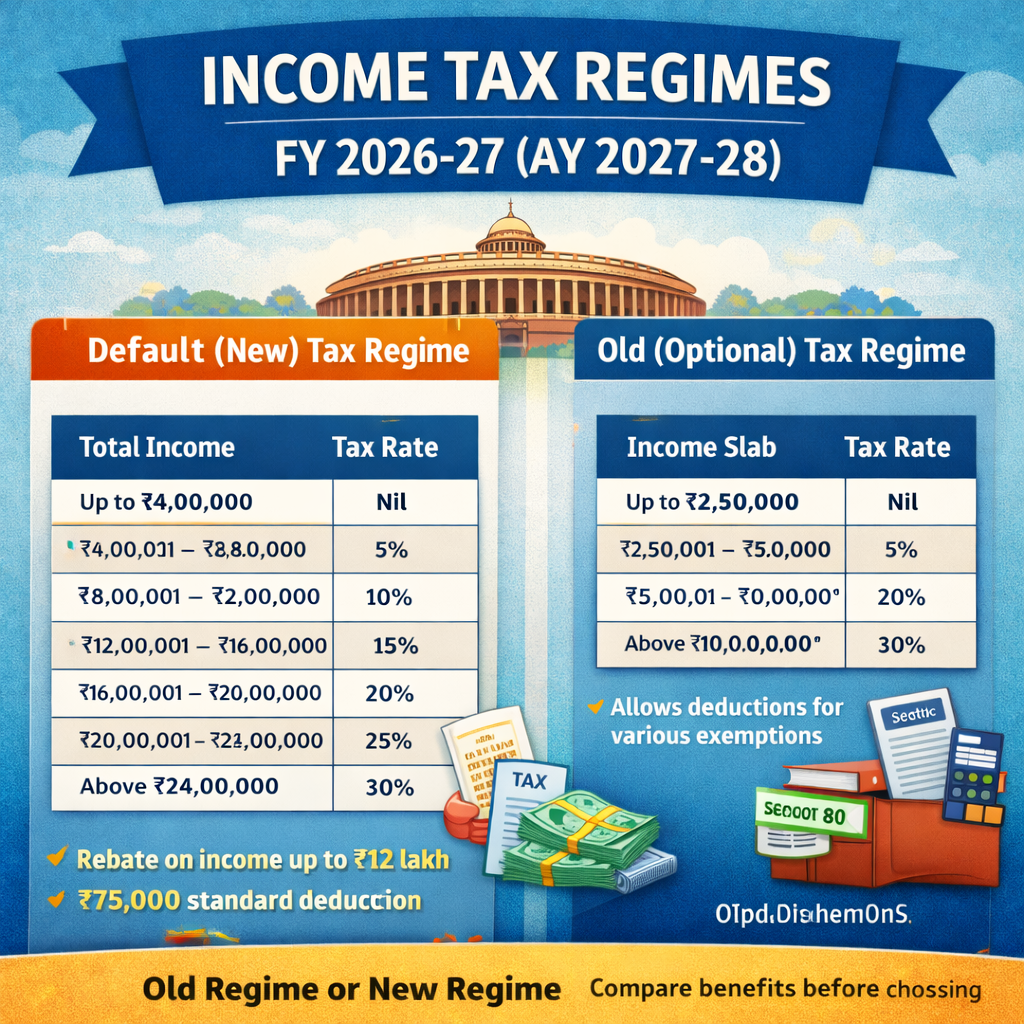
    Income Tax Slab Rates – Default (New) Tax Regime

    The following income tax slab rates will apply to individuals opting for the default new tax regime for FY 2026-27 (AY 2027-28):

    Total Income Tax Rate
    Up to ₹4,00,000 Nil
    ₹4,00,001 – ₹8,00,000 5%
    ₹8,00,001 – ₹12,00,000 10%
    ₹12,00,001 – ₹16,00,000 15%
    ₹16,00,001 – ₹20,00,000 20%
    ₹20,00,001 – ₹24,00,000 25%
    Above ₹24,00,000 30%

    These slab rates apply uniformly to all individuals, including salaried taxpayers, with no age-based differentiation.


    Key Features of the New Tax Regime

    1️⃣ Rebate under Section 87A

    Budget 2026 has enhanced tax relief through Section 87A:

    • Individuals with net taxable income up to ₹12,00,000 are eligible for a 100% tax rebate.

    • Consequently, the total tax liability becomes NIL for such taxpayers under the default regime.

    • This change significantly improves affordability for middle-income earners.

    2️⃣ Standard Deduction for Salaried Taxpayers

    • Salaried individuals can claim a standard deduction of ₹75,000 under the new tax regime.

    • Because of this deduction, effective tax-free income can extend up to ₹12.75 lakh.

    • This makes the default regime even more beneficial for salaried employees.


    Old Tax Regime (Optional)

    The old tax regime continues as an optional choice and follows a different slab structure. It allows various deductions and exemptions, such as HRA, Section 80C, Section 80D, and others.

    Income Tax Slabs under the Old Regime

    Income Slab Tax Rate
    Up to ₹2,50,000 Nil
    ₹2,50,001 – ₹5,00,000 5%
    ₹5,00,001 – ₹10,00,000 20%
    Above ₹10,00,000 30%

    While deductions are permitted under the old regime, it does not provide the higher rebate threshold available under the new tax regime. As a result, it may be less beneficial for taxpayers with limited deductions.


    Which Tax Regime Is Better for You?

    • Taxpayers with minimal deductions or exemptions may benefit more from the new default tax regime due to lower slab rates, higher rebate, and standard deduction.

    • Taxpayers who claim substantial deductions, such as housing loan interest, insurance premiums, and eligible investments, may still find the old regime more suitable.

    • It is advisable to perform a comparative tax calculation before choosing the appropriate regime.

Updated Income Tax Slabs Applicable for FY 2025–26 (AY 2026–27)

Complete Overview of Income Tax Slabs, Rebate, Standard Deduction, Surcharge & Cess

The Government has retained the New Tax Regime as the default option and further streamlined the income tax slab structure to offer greater relief to middle-income taxpayers. For Financial Year 2025–26 (Assessment Year 2026–27), the revised framework emphasizes higher basic exemption limits, an enhanced rebate, and a standard deduction for salaried individuals, making the regime more taxpayer-friendly.

This article provides a comprehensive explanation of the latest income tax slab rates, along with details on the rebate under Section 87A, standard deduction, health and education cess, applicable surcharge, and the categories of taxpayers to whom these provisions apply.

1. New Income Tax Slab Rates – FY 2025–26 (AY 2026–27)

Under the New Tax Regime, income is taxed at progressive slab rates as outlined below:

Total Income Applicable Tax Rate
Up to ₹4,00,000 Nil
₹4,00,001 – ₹8,00,000 5%
₹8,00,001 – ₹12,00,000 10%
₹12,00,001 – ₹16,00,000 15%
₹16,00,001 – ₹20,00,000 20%
₹20,00,001 – ₹24,00,000 25%
Above ₹24,00,000 30%

👉 Note: Income tax is calculated slab-wise, meaning each portion of income is taxed at the applicable rate, not the entire income at one single rate.


2. Income Up to ₹4,00,000 – No Tax Liability

For FY 2025–26, the basic exemption limit under the New Tax Regime stands at ₹4,00,000.
Accordingly, individuals whose total taxable income does not exceed ₹4 lakh are not required to pay any income tax.


3. Rebate Under Section 87A – Significant Relief

Eligibility Criteria

  • Available only to Resident Individual taxpayers

  • Applicable exclusively under the New Tax Regime

Rebate Provisions

  • If taxable income does not exceed ₹12,00,000

  • 100% rebate of tax payable is allowed

  • Maximum rebate amount: ₹60,000

👉 As a result, income up to ₹12 lakh becomes effectively tax-free under the New Regime.

Practical Clarification

  • Tax is first computed as per slab rates

  • If the calculated tax liability is ₹60,000 or less, the rebate completely offsets it

  • Net tax payable becomes Nil


4. Standard Deduction of ₹75,000

Who Can Claim?

  • Salaried employees

  • Pensioners

Deduction Amount

  • A flat standard deduction of ₹75,000 is available under the New Tax Regime

Tax Impact

Due to this deduction:

  • A salaried individual earning up to ₹12,75,000

  • After deducting ₹75,000, taxable income becomes ₹12,00,000

  • 👉 No income tax is payable

This significantly enhances the attractiveness of the New Regime for salaried taxpayers who do not rely heavily on deductions.


5. Health and Education Cess

  • 4% Health and Education Cess

  • Levied on income tax plus surcharge, if any

  • Applicable to all categories of taxpayers without exception


6. Surcharge on Higher Income Levels

Surcharge is levied when total income crosses ₹50 lakh, as per the following structure:

Total Income Surcharge Rate
₹50 lakh – ₹1 crore 10%
₹1 crore – ₹2 crore 15%
₹2 crore – ₹5 crore 25%
Above ₹5 crore 37%

Marginal Relief

Marginal relief is available to ensure that the additional tax payable due to surcharge does not exceed the additional income earned over the threshold limit.


7. Applicability of These Provisions

Applicable To

  • Resident Individuals

  • Salaried taxpayers

  • Pensioners

  • Professionals and business owners opting for the New Tax Regime

Not Applicable / Points of Caution

  • Non-resident individuals (Section 87A rebate not available)

  • Taxpayers with income taxed at special rates (such as lottery winnings or certain capital gains)

  • Individuals who claim substantial deductions under the Old Regime (80C, HRA, housing loan interest, etc.)


8. New Tax Regime vs Old Tax Regime – Practical Comparison

The New Tax Regime is more suitable if:

  • You have minimal deductions

  • You are a salaried taxpayer with a simple salary structure

  • Your annual income is around ₹12–13 lakh

The Old Tax Regime may be preferable if:

  • You claim major deductions under sections 80C, 80D, HRA, or home loan interest

  • You have substantial tax-saving investments

👉 Tip: Always compute tax liability under both regimes before filing your Income Tax Return to choose the most beneficial option.