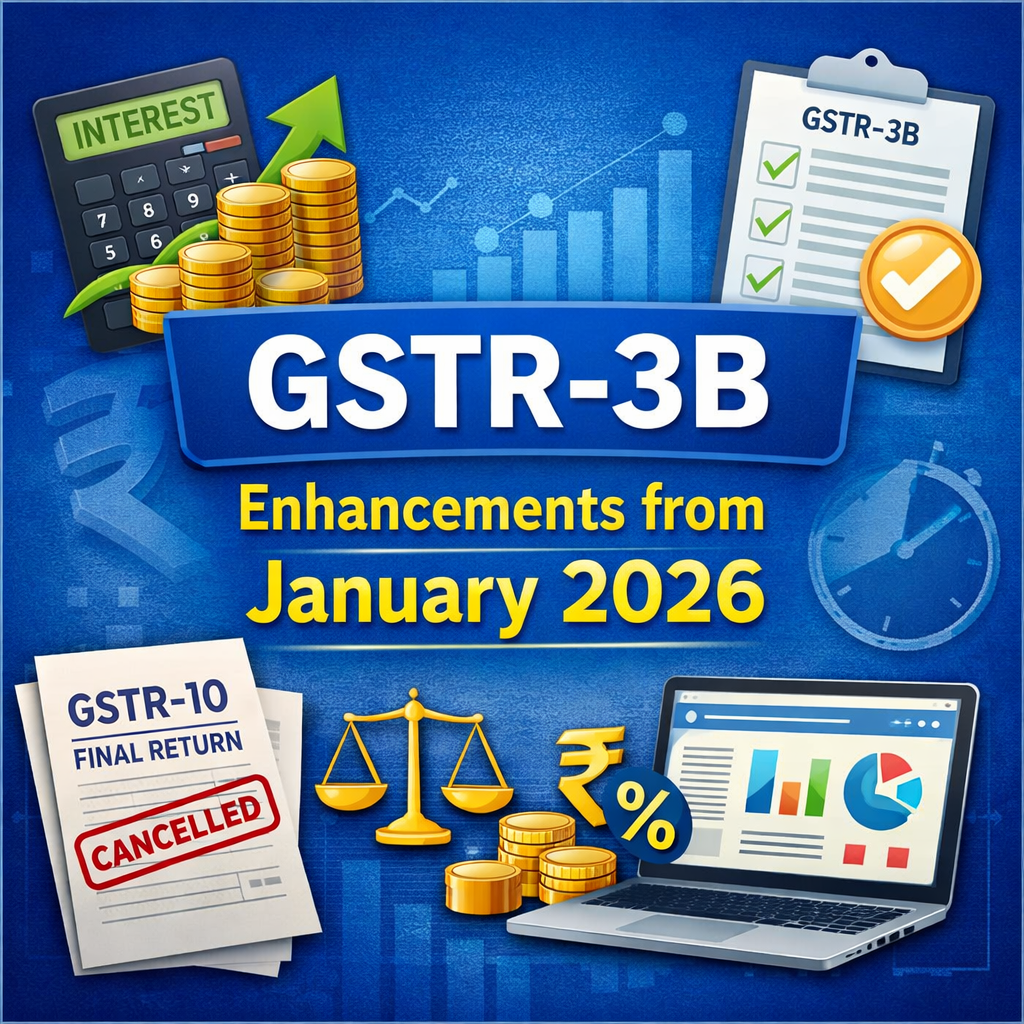
GST Advisory on GSTR-3B Updates Applicable from February 2026

Advisory on Interest Collection and Related Enhancements in GSTR-3B

GSTR-3B Filing Service

It is hereby informed that from January-2026 period onwards, few enhancements have been made in filing of GSTR-3B. For detailed advisory, kindly click on the link given below:

https://tutorial.gst.gov.in/downloads/news/advisory_on_interest_calculator.pdfThanks,
Team GSTN


The GST Network has issued an important advisory titled “Advisory on Interest Collection and Related Enhancements in GSTR-3B”, bringing multiple system-level changes in the filing of Form GSTR-3B, effective from the January-2026 tax period onwards.

These changes primarily focus on:

  • Revised interest computation methodology
  • System-driven population of tax liability breakup
  • Flexibility in ITC cross-utilisation
  • Interest recovery in GSTR-10 for cancelled registrations

The enhancements aim to align portal functionality with Section 50 of the CGST Act, 2017 and Rule 88B of the CGST Rules, 2017, while reducing disputes and ensuring fair interest computation.


Update in Interest Computation for GSTR-3B (Table 5.1)

1.1 What Has Changed from January-2026?

From the January-2026 tax period onwards, the interest calculation in Table 5.1 of GSTR-3B has been enhanced to provide relief to taxpayers by factoring in the minimum cash balance available in the Electronic Cash Ledger (ECL).

This change is made in line with the proviso to Rule 88B(1) of the CGST Rules, 2017.

➡️ Practical impact:
If a taxpayer had sufficient cash balance lying in the Electronic Cash Ledger from the due date of return till the actual date of tax payment (offset), interest will not be charged on that portion.


Applicability Timeline

  • Applicable for delayed GSTR-3B returns of January-2026
  • Interest will be auto-populated in February-2026 GSTR-3B

Revised Interest Computation Formula

Interest = (Net Tax Liability – Minimum Cash Balance in ECL from due date to date of debit)
× (Number of days delayed ÷ 365)
× Applicable Interest Rate

Tax Planning Service

Key Takeaway

Earlier, interest was calculated on the entire net cash liability. Now, idle cash balance already available with the Government is reduced before interest computation — a major relief for compliant taxpayers.


System-Computed Interest in Table 5.1 – Now Non-Editable

Non-Editable Downward

From January-2026 onwards:

Taxpayer Education Course
  • Interest auto-populated in Table 5.1 will be non-editable downward
  • Taxpayers cannot reduce the system-computed interest

Upward Modification Allowed

  • Auto-populated interest represents minimum interest payable
  • Taxpayers must self-assess their correct interest liability
  • Upward modification is permitted, if required

➡️ Compliance Note:
Responsibility of correct interest payment continues to rest with the taxpayer, despite system computation.


Auto-Population of Tax Liability Breakup Table in GSTR-3B

What Is the Tax Liability Breakup Table?

This table captures:

  • Supplies pertaining to previous tax periods
  • Reported in current period
  • For which tax is being paid now

New Enhancement from January-2026

The GST Portal will auto-populate the Tax Liability Breakup Table based on:

  • Document dates
  • Supplies reported in:
    • GSTR-1
    • GSTR-1A
    • IFF
  • Pertaining to earlier tax periods
  • Where tax liability is discharged in current GSTR-3B

Objective of This Enhancement

  • Accurate period-wise allocation of tax
  • Correct interest computation as per proviso to Section 50 of CGST Act
  • Reduction in manual errors and litigation

Important Characteristics

  • Auto-populated values are suggestive in nature
  • Taxpayers may revise the figures upwards
  • Downward revision may attract scrutiny

Navigation Path on Portal

Login → GSTR-3B Dashboard → Table 6.1 (Payment of Tax) → Tax Liability Breakup


Update in Table 6.1 – Suggestive Cross-Utilisation of ITC

Change in ITC Utilisation Logic

From January-2026 onwards:

  • Once IGST ITC is fully exhausted
  • The portal will allow payment of IGST liability
  • Using CGST and SGST ITC in any sequence

Benefit to Taxpayers

  • Increased flexibility
  • Reduced working capital blockage
  • Alignment with judicial interpretations on ITC utilisation

Collection of Interest in GSTR-10 for Cancelled Taxpayers

New Provision Introduced

For cancelled GST registrations:

  • If the last applicable GSTR-3B is filed after due date
  • Interest on delayed filing shall be:
    • Levied
    • Collected through Final Return (GSTR-10)

Practical Implication

Taxpayers can no longer avoid interest liability merely because registration is cancelled. Interest compliance is now linked to GSTR-10 filing.


Overall Impact & Professional Analysis

Area Impact
Interest Computation Fair, cash-balance adjusted
Editability System minimum enforced
Tax Liability Allocation Automated & document-driven
ITC Utilisation Flexible & taxpayer-friendly
Cancelled Registrations Interest leakage plugged

The January-2026 enhancements in GSTR-3B mark a significant shift towards system-driven, legally aligned GST compliance. While automation reduces errors, self-assessment responsibility remains intact. Taxpayers and professionals must closely monitor cash ledger balances, document dates, and interest computation, especially in delayed filings and past-period adjustments.
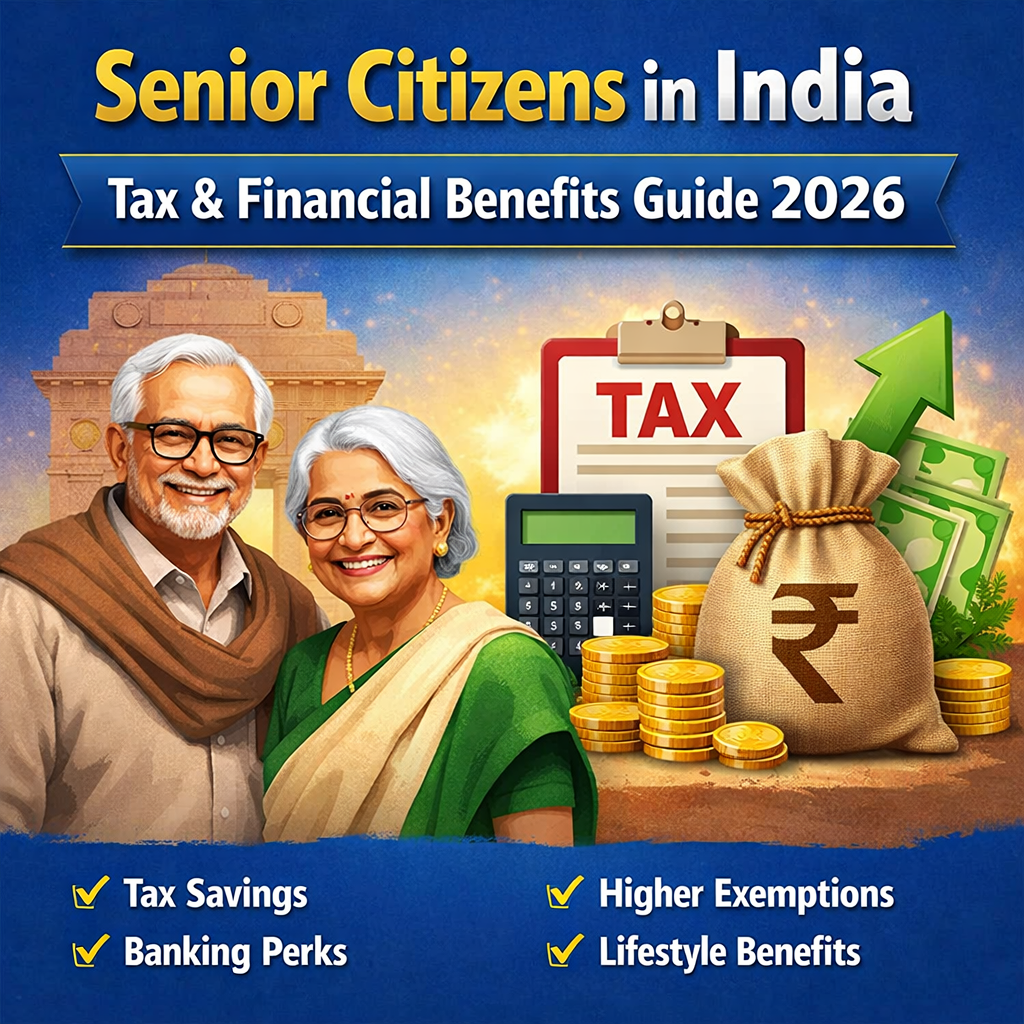
Senior Citizens Get Special Tax Advantages in 2026

Senior Citizens in India: Comprehensive Tax & Financial Benefits Guide 2026

The Government of India acknowledges the lifelong contribution of senior citizens and, in return, extends a broad set of tax concessions, exemptions, compliance relaxations, banking advantages, and lifestyle-related benefits to ensure financial stability and dignity during retirement.

This detailed guide explains 30+ benefits and features available to senior and super senior citizens in India for FY 2025–26 / AY 2026–27.


1. Definition of Senior Citizen Under Income Tax Law

As per the Income Tax Act:

  • Senior Citizen: Resident individual aged 60 years or more but below 80 years

  • Super Senior Citizen: Resident individual aged 80 years or above

  • Specified Senior Citizen (Section 194P): Resident aged 75 years or above, earning only pension and interest from the same bank, and eligible for exemption from filing ITR


2. Income Tax Slabs – New Tax Regime (FY 2025–26)

The New Tax Regime, which is now the default option, applies equally to all taxpayers, including senior citizens:

Total Income Tax Rate
Up to ₹4,00,000 Nil
₹4,00,001 – ₹8,00,000 5%
₹8,00,001 – ₹12,00,000 10%
₹12,00,001 – ₹16,00,000 15%
₹16,00,001 – ₹20,00,000 20%
₹20,00,001 – ₹24,00,000 25%
Above ₹24,00,000 30%

Taxpayers may still opt for the old tax regime if it offers better savings.


3. Zero Tax on Income Up to ₹12.75 Lakh – Major Relief

Under the New Regime:

  • Standard deduction on salary/pension: ₹75,000

  • Taxable income up to ₹12,00,000

  • Section 87A rebate applicable

As a result, a senior citizen earning up to ₹12.75 lakh from pension/salary pays zero income tax, making the new regime highly beneficial for retirees.


4. Higher Basic Exemption Under Old Tax Regime

Those opting for the old regime enjoy enhanced exemption limits:

Category Exemption Limit
General taxpayer ₹2,50,000
Senior Citizen (60–79 years) ₹3,00,000
Super Senior Citizen (80+ years) ₹5,00,000

5. Section 80TTB – Deduction on Interest Income

Senior citizens can claim a deduction up to ₹50,000 on interest earned from:

  • Savings bank accounts

  • Fixed & recurring deposits

  • Post office schemes

  • Co-operative bank deposits

This benefit is exclusive to senior citizens and replaces Section 80TTA.


6. Section 80D – Health Insurance & Medical Expenses

To reduce healthcare costs, senior citizens are eligible for:

  • ₹50,000 deduction for health insurance premium

  • Medical expenses allowed if insurance is not taken

  • Additional deduction for premiums paid for dependent parents


7. Section 80DDB – Deduction for Specified Diseases

For treatment of serious ailments such as cancer, kidney failure, Parkinson’s disease, etc., senior citizens can claim:

  • Deduction up to ₹1,00,000, subject to conditions and certification


8. No Advance Tax Liability (Section 207)

Senior citizens are not required to pay advance tax if:

  • They do not have business income, and

  • Their income consists only of pension and interest

This also protects them from interest under Sections 234B and 234C.


9. Relaxations in ITR Filing

Offline ITR Filing

Super senior citizens may file paper returns (ITR-1 or ITR-4) instead of mandatory e-filing.

Section 194P – ITR Filing Exemption

Eligible residents aged 75+ earning only pension and bank interest are not required to file ITR, as the bank computes and deducts tax.


10. TDS Benefits & Form 15H

  • Form 15H can be submitted to avoid TDS if total tax liability is nil

  • TDS threshold on interest income increased to ₹1,00,000 per year

  • No TDS on bank/post office interest up to this limit


11. Enhanced Family Pension Exemption

Under the new regime:

  • Exemption increased to ₹25,000 per year

  • Allowed as lower of one-third of pension or ₹25,000


12. LTCG Benefits on Equity Investments

Senior citizens enjoy:

  • Basic exemption adjustment up to ₹4,00,000

  • Additional ₹1,50,000 LTCG exemption

  • Effectively, LTCG up to ₹1.5 lakh can be tax-free


13. Reverse Mortgage – Capital Gains Exemption

Amounts received through reverse mortgage of a residential property:

  • Are not treated as transfer

  • Hence, no capital gains tax applies


14. Higher Interest Rates on Senior Citizen FDs

Banks generally offer:

  • Additional 0.50% interest for senior citizens

  • Up to 0.75% extra for super senior citizens


15. Senior Citizen Savings Scheme (SCSS)

Key features:

  • Eligibility: Age 60+

  • Maximum investment: ₹30 lakh

  • Quarterly interest payout (rate as notified)

  • Eligible for Section 80C deduction

  • Backed by Government of India


16. Other Social, Banking & Lifestyle Benefits

Senior citizens also enjoy several non-tax advantages, including:

  • Railway & state transport concessions

  • Airline fare discounts

  • Healthcare priority & hospital rebates

  • Enhanced Ayushman Bharat coverage

  • Doorstep banking services (age 70+)

  • Property tax & stamp duty rebates (state-wise)

  • Telecom concessions

  • State-sponsored old-age pension schemes


Conclusion

For FY 2026, senior citizens in India benefit from a strong combination of:

✔ Lower tax burden
✔ Simplified compliance
✔ Higher exemptions and deductions
✔ Secure investment options
✔ Banking and lifestyle privileges

These measures collectively aim to ensure financial independence, stability, and improved quality of life after retirement.