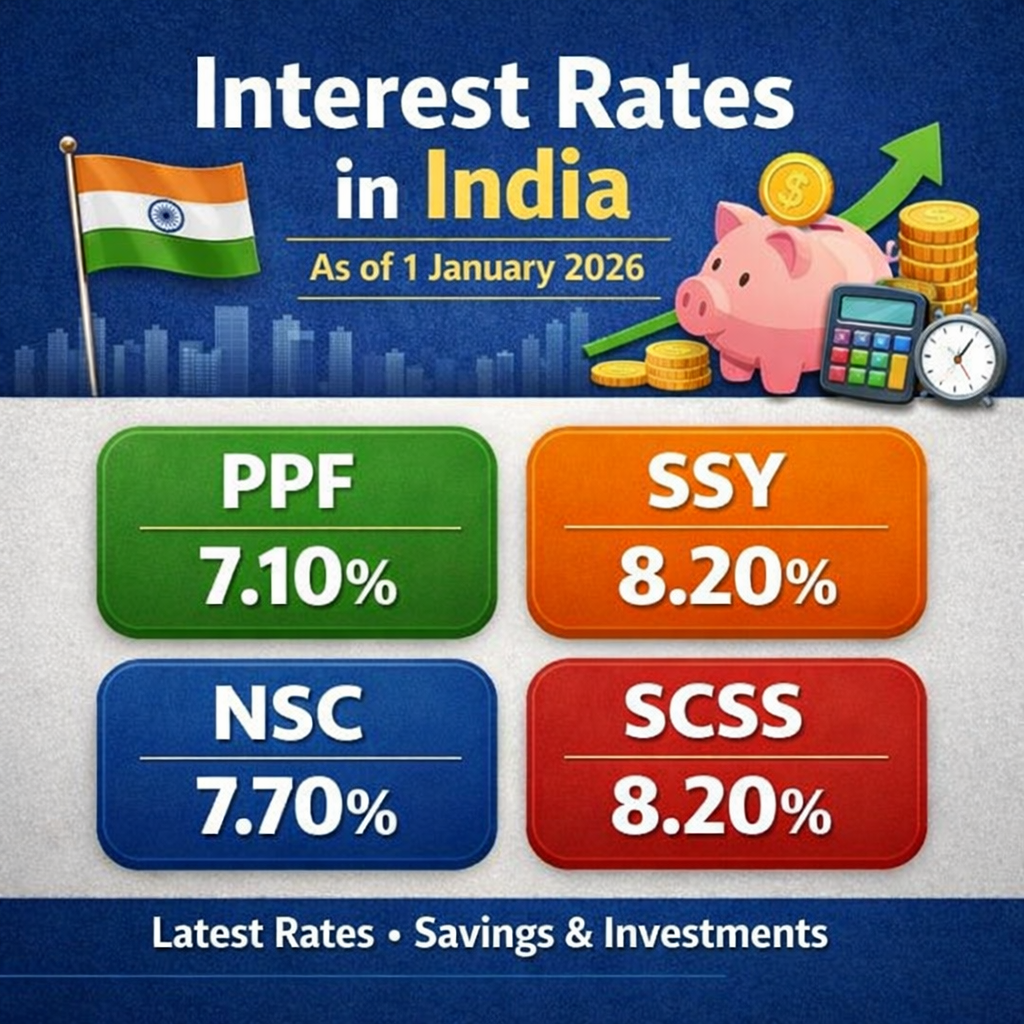
Interest Rates Updated: Effective from 1 January 2026

Interest Rates in India as on 1 January 2026

With effect from 1 January 2026, the Government of India has kept interest rates unchanged for most popular small savings and post office schemes for the January–March 2026 quarter. The rates continue at the same levels as the October–December 2025 quarter, offering stability and certainty to savers, retirees, and long-term investors.

Below is a detailed overview of the prevailing interest rates across key savings instruments in India.


1. Small Savings & Post Office Schemes (Jan–Mar 2026)

Government-backed small savings schemes continue to offer fixed, risk-free returns, along with tax benefits under the Income Tax Act.

Scheme Interest Rate (% p.a.) Key Features
Public Provident Fund (PPF) 7.10% Annual compounding; fully tax-free
National Savings Certificate (NSC) 7.70% 5-year maturity; eligible under Section 80C
Sukanya Samriddhi Yojana (SSY) 8.20% High return; tax-free; girl child scheme
Senior Citizen Savings Scheme (SCSS) 8.20% Quarterly interest payout
Kisan Vikas Patra (KVP) 7.50% Doubles in ~115 months
Post Office Savings Account 4.00% High liquidity
Time Deposit – 1 Year 6.90% Fixed tenure
Time Deposit – 2 Years 7.00% Fixed tenure
Time Deposit – 3 Years 7.10% Fixed tenure
Time Deposit – 5 Years 7.50% Long-term savings
Recurring Deposit – 5 Years 6.70% Monthly deposits
Monthly Income Scheme (MIS) 7.40% Regular monthly income

📌 Note: All above rates remain unchanged for the Jan–Mar 2026 quarter as per the Finance Ministry’s notification.


2. Public Provident Fund (PPF)

  • Interest Rate: 7.10% per annum

  • Tenure: 15 years (extendable in 5-year blocks)

  • Compounding: Annually

  • Tax Benefits:

    • Contribution eligible under Section 80C

    • Interest and maturity proceeds are fully exempt

PPF continues to be one of India’s most trusted long-term, tax-efficient savings options.


3. Sukanya Samriddhi Yojana (SSY)

  • Interest Rate: 8.20% p.a.

  • Target Group: Girl child

  • Investment Limit: ₹250 to ₹1.5 lakh per year

  • Tax Treatment: EEE (Exempt–Exempt–Exempt)

SSY currently offers one of the highest risk-free returns among government schemes, making it ideal for long-term goals like education and marriage.


4. National Savings Certificate (NSC)

  • Interest Rate: 7.70% p.a.

  • Maturity: 5 years

  • Tax Benefit: Eligible under Section 80C

  • Interest Taxation: Taxable, payable at maturity

NSC remains popular for investors seeking assured returns with tax-saving benefits.


5. Senior Citizen Savings Scheme (SCSS)

  • Interest Rate: 8.20% p.a.

  • Eligibility: Individuals aged 60 years and above

  • Interest Payment: Quarterly

  • Tax Benefit: Eligible under Section 80C

SCSS is well-suited for retirees seeking stable and regular income.


6. Post Office Time Deposits & MIS

Post Office deposits function similarly to bank fixed deposits but carry sovereign guarantee.

  • 1-Year TD: 6.90%

  • 2-Year TD: 7.00%

  • 3-Year TD: 7.10%

  • 5-Year TD: 7.50%

  • 5-Year RD: 6.70%

  • MIS: 7.40%

  • Savings Account: 4.00%

These options are useful for conservative investors and laddered investment strategies.


7. Bank Fixed Deposits (FDs)

Bank FD rates are not government-notified and differ based on bank policy and tenure.

Recent trends (late December 2025):

  • Leading banks such as SBI and HDFC Bank have marginally reduced FD rates on select tenures.

  • Typical general FD rates range between 6.40% to 7.00%.

  • Senior citizens usually receive ~0.50% extra.

  • Interest income is taxable, and TDS applies if annual interest exceeds ₹50,000.

📌 Investors should always check bank-specific FD rates before investing.


8. National Pension System (NPS)

Unlike fixed-interest schemes, NPS delivers market-linked returns.

  • Expected Long-Term Returns: ~8%–10% (variable)

  • Tax Benefits:

    • Up to ₹1.5 lakh under Section 80C

    • Additional ₹50,000 under Section 80CCD(1B)

NPS is suitable for retirement planning but should be chosen based on risk appetite and investment horizon.


Summary – Interest Rates as of 1 January 2026

Scheme Rate (% p.a.) Key Advantage
PPF 7.10% Tax-free maturity
NSC 7.70% 80C benefit
SSY 8.20% Highest small savings rate
SCSS 8.20% Regular income
KVP 7.50% Capital doubling
Post Office TD (5 yr) 7.50% Government guarantee
MIS 7.40% Monthly income
Savings Account 4.00% Liquidity
Bank FDs ~6.40–7.00% Bank-specific
NPS ~8–10% Market-linked growth
Senior Citizens Get Special Tax Advantages in 2026

Senior Citizens in India: Comprehensive Tax & Financial Benefits Guide 2026

The Government of India acknowledges the lifelong contribution of senior citizens and, in return, extends a broad set of tax concessions, exemptions, compliance relaxations, banking advantages, and lifestyle-related benefits to ensure financial stability and dignity during retirement.

This detailed guide explains 30+ benefits and features available to senior and super senior citizens in India for FY 2025–26 / AY 2026–27.


1. Definition of Senior Citizen Under Income Tax Law

As per the Income Tax Act:

  • Senior Citizen: Resident individual aged 60 years or more but below 80 years

  • Super Senior Citizen: Resident individual aged 80 years or above

  • Specified Senior Citizen (Section 194P): Resident aged 75 years or above, earning only pension and interest from the same bank, and eligible for exemption from filing ITR


2. Income Tax Slabs – New Tax Regime (FY 2025–26)

The New Tax Regime, which is now the default option, applies equally to all taxpayers, including senior citizens:

Total Income Tax Rate
Up to ₹4,00,000 Nil
₹4,00,001 – ₹8,00,000 5%
₹8,00,001 – ₹12,00,000 10%
₹12,00,001 – ₹16,00,000 15%
₹16,00,001 – ₹20,00,000 20%
₹20,00,001 – ₹24,00,000 25%
Above ₹24,00,000 30%

Taxpayers may still opt for the old tax regime if it offers better savings.


3. Zero Tax on Income Up to ₹12.75 Lakh – Major Relief

Under the New Regime:

  • Standard deduction on salary/pension: ₹75,000

  • Taxable income up to ₹12,00,000

  • Section 87A rebate applicable

As a result, a senior citizen earning up to ₹12.75 lakh from pension/salary pays zero income tax, making the new regime highly beneficial for retirees.


4. Higher Basic Exemption Under Old Tax Regime

Those opting for the old regime enjoy enhanced exemption limits:

Category Exemption Limit
General taxpayer ₹2,50,000
Senior Citizen (60–79 years) ₹3,00,000
Super Senior Citizen (80+ years) ₹5,00,000

5. Section 80TTB – Deduction on Interest Income

Senior citizens can claim a deduction up to ₹50,000 on interest earned from:

  • Savings bank accounts

  • Fixed & recurring deposits

  • Post office schemes

  • Co-operative bank deposits

This benefit is exclusive to senior citizens and replaces Section 80TTA.


6. Section 80D – Health Insurance & Medical Expenses

To reduce healthcare costs, senior citizens are eligible for:

  • ₹50,000 deduction for health insurance premium

  • Medical expenses allowed if insurance is not taken

  • Additional deduction for premiums paid for dependent parents


7. Section 80DDB – Deduction for Specified Diseases

For treatment of serious ailments such as cancer, kidney failure, Parkinson’s disease, etc., senior citizens can claim:

  • Deduction up to ₹1,00,000, subject to conditions and certification


8. No Advance Tax Liability (Section 207)

Senior citizens are not required to pay advance tax if:

  • They do not have business income, and

  • Their income consists only of pension and interest

This also protects them from interest under Sections 234B and 234C.


9. Relaxations in ITR Filing

Offline ITR Filing

Super senior citizens may file paper returns (ITR-1 or ITR-4) instead of mandatory e-filing.

Section 194P – ITR Filing Exemption

Eligible residents aged 75+ earning only pension and bank interest are not required to file ITR, as the bank computes and deducts tax.


10. TDS Benefits & Form 15H

  • Form 15H can be submitted to avoid TDS if total tax liability is nil

  • TDS threshold on interest income increased to ₹1,00,000 per year

  • No TDS on bank/post office interest up to this limit


11. Enhanced Family Pension Exemption

Under the new regime:

  • Exemption increased to ₹25,000 per year

  • Allowed as lower of one-third of pension or ₹25,000


12. LTCG Benefits on Equity Investments

Senior citizens enjoy:

  • Basic exemption adjustment up to ₹4,00,000

  • Additional ₹1,50,000 LTCG exemption

  • Effectively, LTCG up to ₹1.5 lakh can be tax-free


13. Reverse Mortgage – Capital Gains Exemption

Amounts received through reverse mortgage of a residential property:

  • Are not treated as transfer

  • Hence, no capital gains tax applies


14. Higher Interest Rates on Senior Citizen FDs

Banks generally offer:

  • Additional 0.50% interest for senior citizens

  • Up to 0.75% extra for super senior citizens


15. Senior Citizen Savings Scheme (SCSS)

Key features:

  • Eligibility: Age 60+

  • Maximum investment: ₹30 lakh

  • Quarterly interest payout (rate as notified)

  • Eligible for Section 80C deduction

  • Backed by Government of India


16. Other Social, Banking & Lifestyle Benefits

Senior citizens also enjoy several non-tax advantages, including:

  • Railway & state transport concessions

  • Airline fare discounts

  • Healthcare priority & hospital rebates

  • Enhanced Ayushman Bharat coverage

  • Doorstep banking services (age 70+)

  • Property tax & stamp duty rebates (state-wise)

  • Telecom concessions

  • State-sponsored old-age pension schemes


Conclusion

For FY 2026, senior citizens in India benefit from a strong combination of:

✔ Lower tax burden
✔ Simplified compliance
✔ Higher exemptions and deductions
✔ Secure investment options
✔ Banking and lifestyle privileges

These measures collectively aim to ensure financial independence, stability, and improved quality of life after retirement.