
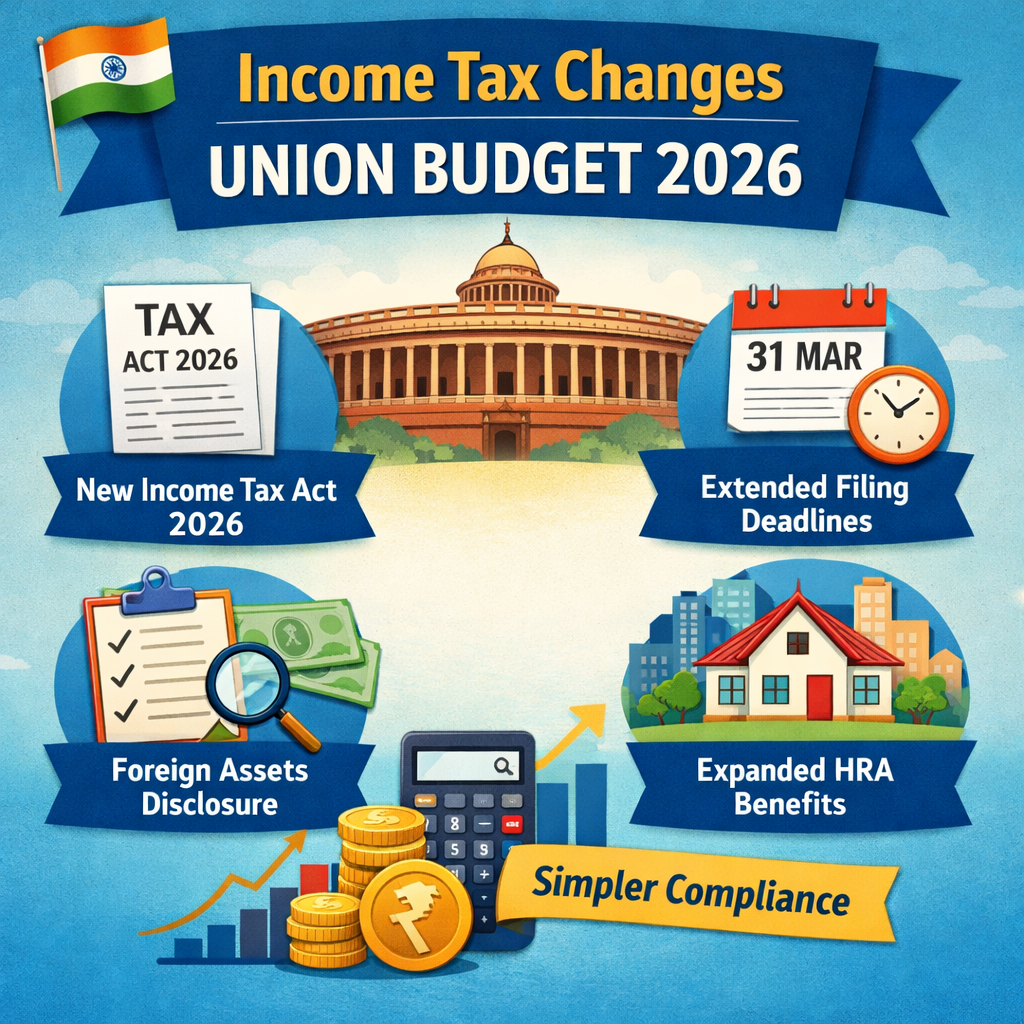
Income Tax Changes Announced in Union Budget 2026
Direct Tax Proposals in Budget 2026 – Key Highlights
In Union Budget 2026, the Government has announced a wide-ranging and future-oriented set of Direct Tax reforms aimed at simplifying tax laws, reducing disputes, improving compliance, and enhancing India’s appeal as a global investment destination. These measures signal a decisive shift from a complex, enforcement-driven regime to a trust-based, technology-enabled, and taxpayer-friendly tax system, aligned with the vision of Viksit Bharat.
1. New Income-tax Act, 2025 – A Structural Overhaul
One of the most significant announcements in Budget 2026 is the replacement of the Income-tax Act, 1961 with the Income-tax Act, 2025, effective from 1 April 2026.
The new legislation is designed to:
-
Be substantially shorter and simpler, with fewer sections and chapters
-
Use clear and unambiguous language to minimise interpretational disputes
-
Be easier for taxpayers and tax authorities to understand and implement
Simplified Income-tax Rules and redesigned return forms will be notified shortly, enabling individuals to comply without professional assistance.
2. Taxpayer Relief & Ease of Living Measures
The Budget introduces multiple measures to address long-standing taxpayer concerns:
MACT Interest Exemption
-
Interest awarded by the Motor Accident Claims Tribunal (MACT) to individuals will be fully exempt from tax.
-
No TDS will apply, irrespective of the amount received.
Rationalisation of TCS under LRS
-
TCS on overseas tour packages reduced to 2% (from 5% / 20%), without any threshold.
-
TCS on education and medical remittances under LRS reduced from 5% to 2%.
Clarity on TDS for Manpower Supply
-
Manpower supply services classified as contractor payments.
-
TDS rate capped at 1% / 2%, eliminating ambiguity and litigation.
Automated Lower / Nil TDS Certificates
-
Eligible small taxpayers can obtain lower or nil TDS certificates through an automated, rule-based system without Assessing Officer interaction.
Simplification of Form 15G / 15H
-
Depositories authorised to accept declarations centrally and share them with multiple companies, reducing repetitive filings.
3. Rationalised Return Filing Timelines
To ease compliance pressure:
-
Belated and revised returns can now be filed up to 31 March (earlier 31 December) on payment of a nominal fee.
-
Staggered ITR due dates introduced:
-
ITR-1 & ITR-2 (Individuals): 31 July
-
Non-audit cases and trusts: 31 August
-
4. Relief for Property Transactions Involving NRIs
For purchase of immovable property from a non-resident:
-
Resident buyers are no longer required to obtain a TAN.
-
TDS can be deposited using a PAN-based challan, similar to resident transactions.
5. One-Time Foreign Asset Disclosure Scheme (FAST-DS, 2026)
A special 6-month disclosure window has been introduced for genuine hardship cases involving small taxpayers.
Category A
-
Undisclosed foreign income / assets up to ₹1 crore
-
Payment of:
-
30% tax
-
30% additional tax (in lieu of penalty)
-
-
Immunity from prosecution granted
Category B
-
Foreign assets up to ₹5 crore
-
One-time fee of ₹1 lakh
-
Full immunity from penalty and prosecution
Immunity from prosecution is also retrospectively extended for non-immovable foreign assets up to ₹20 lakh.
6. Rationalisation of Penalty & Prosecution Regime
Key reforms include:
-
Assessment and penalty proceedings to be concluded through a single consolidated order
-
No interest on penalty amounts during pendency of first appeal
-
Pre-deposit for appeal reduced from 20% to 10%, limited to core tax demand
Updated Returns Post Reassessment
-
Taxpayers can file updated returns even after reassessment initiation by paying an additional 10% tax.
Penalty to Fee Conversion
-
Certain technical defaults (audit, TP report, SFT) converted into fee-based non-criminal defaults.
Decriminalisation Measures
-
Minor offences punishable only with fines
-
Maximum imprisonment reduced to two years
-
Penalties graded based on tax evasion quantum
7. Targeted Tax Relief for Cooperatives
-
Deduction extended to supply of cattle feed and cotton seed by primary cooperatives
-
Inter-cooperative dividend income allowed as deduction under the new tax regime
-
Three-year dividend exemption for notified national cooperative federations, subject to redistribution
8. IT Sector Boost & Transfer Pricing Certainty
-
IT and IT-enabled services consolidated under “Information Technology Services”
-
Uniform safe harbour margin of 15.5%
-
Threshold enhanced from ₹300 crore to ₹2,000 crore
-
Automated safe harbour approvals valid for 5 years
-
Fast-track unilateral APA with targeted 2-year resolution
9. Measures to Attract Global Business & Talent
-
Tax holiday till 2047 for foreign cloud service providers using Indian data centres
-
15% safe harbour margin for data-centre support entities
-
5-year tax exemption for non-residents supplying capital goods to bonded zone manufacturers
-
Exemption of global income for foreign experts residing in India up to 5 years
-
MAT exemption for non-residents taxed on presumptive basis
10. Tax Administration Reforms
-
ICDS to be merged with Ind-AS from FY 2027-28
-
Definition of “accountant” rationalised to support global expansion of Indian advisory firms
11. Other Key Direct Tax Measures
-
Buyback taxation shifted to capital gains for all shareholders
-
Additional tax for promoters to prevent arbitrage
-
TCS on liquor, scrap and minerals reduced to 2%; tendu leaves from 5% to 2%
-
STT increased on futures and options
-
MAT to become final tax from 1 April 2026, rate reduced to 14%, with limited MAT credit set-off
Conclusion
The Direct Tax proposals in Budget 2026 mark a bold move towards simplicity, certainty, and trust-based taxation. With a new Income-tax Act, substantial compliance relief, rationalised penalties, and strong incentives for investment and global integration, the reforms aim to strike a balance between revenue mobilisation and taxpayer confidence, supporting long-term economic growth.