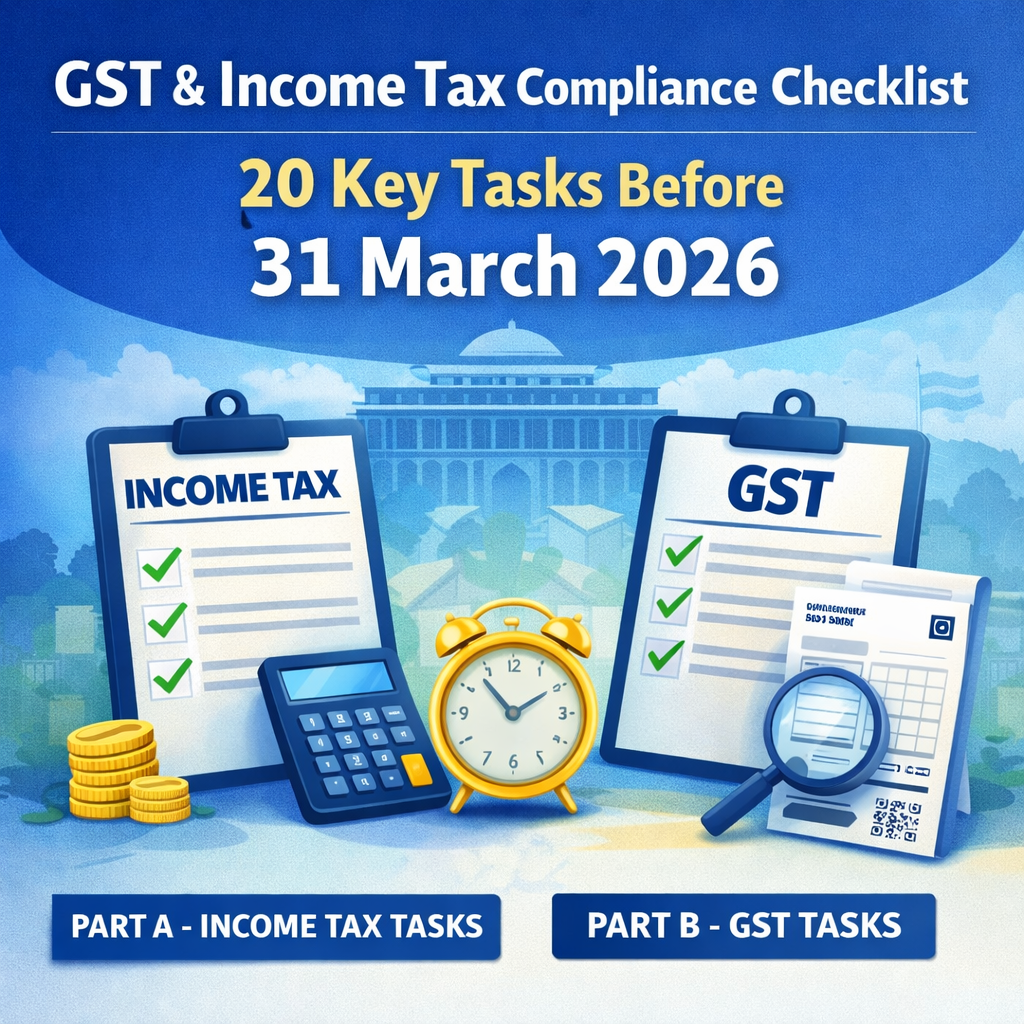
GST and Income Tax Checklist: 20 Key Compliances Before 31 March 2026
GST & Income Tax Year-End Compliance Guide
With the financial year 2025–26 drawing to a close, 31st March 2026 becomes a critical deadline for businesses, professionals, exporters, and salaried taxpayers.
Several tax planning measures, compliance requirements, and strategic decisions must be finalised before the year ends. Failure to act within the prescribed timelines may result in additional tax burden, penalties, interest costs, or loss of eligible benefits.
Below is a comprehensive checklist to help you stay compliant and tax-efficient before the financial year
PART A – INCOME TAX ACTION POINTS BEFORE 31 MARCH 2026
1️⃣ Advance Tax Payment (Where Applicable)
If your total tax liability for FY 2025–26 exceeds ₹10,000:
-
Ensure the final instalment of advance tax (due on 15 March) has been paid
-
Reassess whether any shortfall exists
-
Clear remaining dues before 31 March to minimise interest under Sections 234B and 234C
Timely review can help avoid unnecessary interest costs.
2️⃣ Year-End Tax Planning & Investments
This is the final opportunity in the current financial year to:
-
Invest under Section 80C (LIC, PPF, ELSS, etc.)
-
Pay medical insurance premium under Section 80D
-
Contribute to NPS under Section 80CCD(1B)
-
Optimise HRA and other salary exemptions
-
Make eligible donations under Section 80G
Strategic planning before 31 March can substantially reduce overall tax liability.
3️⃣ TDS Deduction & Deposit Check
Before closing the books:
-
Confirm TDS has been deducted on all applicable payments
-
Review contractor, professional, rent, and commission payments
-
Ensure timely deposit of deducted TDS
Non-compliance may lead to:
-
40% disallowance of expenditure
-
Interest and penalty exposure
Important – Time Limit for Old TDS Corrections:
As per Section 397(3)(f) of the Income-tax Act, 2025, correction statements relating to certain past financial years (FY 2018–19 onwards as specified) will be accepted only up to 31 March 2026. From 1 April 2026, these will become time-barred. Deductors and collectors should take necessary action immediately.
4️⃣ TCS Compliance Review
For persons required to collect TCS:
-
Verify correct collection
-
Deposit any outstanding amount
-
Reconcile TCS figures with books
This is especially important considering revised TCS rates effective from 1 April 2026.
5️⃣ Capital Gains Planning
Before the year ends:
-
Strategically plan sale of shares or property
-
Undertake tax-loss harvesting where beneficial
-
Invest in eligible exemptions under Sections 54, 54F, or 54EC
-
Deposit funds in the Capital Gain Account Scheme, if applicable
Advance planning helps lawfully optimise capital gains tax.
6️⃣ MSME Payment Compliance – Section 43B(h)
Businesses must:
-
Ensure payments to MSME vendors are made within 45 days
Failure to comply may result in disallowance of the expense in FY 2025–26. This is particularly relevant for traders and manufacturers.
7️⃣ Finalisation of Books & Reconciliation
Before 31 March, complete:
-
Bank reconciliations
-
Debtor and creditor confirmations
-
Physical stock verification
-
Cash verification
-
Loan account reconciliation
Proper year-end closure reduces audit observations and scrutiny risks.
8️⃣ Prepare for Income-tax Act, 2025 (Effective 1 April 2026)
From the next financial year:
-
The Income-tax Act, 2025 will replace the existing Act
-
New Income-tax Rules, 2026 will be notified
-
Forms will be renumbered and simplified
Professionals should:
-
Map old provisions with new ones
-
Update compliance trackers
-
Inform and educate clients
-
Upgrade systems and software
Advance preparation in March will prevent confusion in April.
PART B – GST ACTION POINTS BEFORE 31 MARCH 2026
9️⃣ Composition Scheme – Opt In / Opt Out
Eligible taxpayers must:
-
File intimation before 31 March
-
Review turnover limits
-
Ensure readiness for FY 2026–27
The option must be exercised before the new financial year begins.
🔟 Letter of Undertaking (LUT) for Exporters
Exporters should:
-
File fresh LUT for FY 2026–27 before 1 April 2026
-
Verify IEC and GST details
-
Update DSC credentials
Failure to file LUT may require payment of IGST on exports.
1️⃣1️⃣ QRMP Scheme Decision
Taxpayers with turnover up to ₹5 crore:
-
May opt in or opt out of QRMP
-
Decision deadline is 30 April, but review should be done before year-end
Turnover analysis is essential before opting.
1️⃣2️⃣ GTA – Forward Charge or Reverse Charge
Goods Transport Agencies must:
-
File required annexures
-
Choose between Forward Charge Mechanism (FCM) or Reverse Charge Mechanism (RCM)
-
Exercise option within prescribed timelines
This decision impacts tax collection structure for the upcoming year.
1️⃣3️⃣ Hotels – Declaration of Specified Premises
Hotels are required to:
-
Submit Annexure VII
-
Declare specified premises for GST rate determination
This directly affects GST rates applicable in the next financial year.
1️⃣4️⃣ ITC Reconciliation
Before year-end:
-
Match books with GSTR-2B
-
Reconcile GSTR-1 with GSTR-3B
-
Reverse ineligible ITC
-
Follow up with vendors for mismatches
March is ideal for cleaning ITC discrepancies.
1️⃣5️⃣ Review Reverse Charge Liability
Verify whether RCM has been correctly paid and reported for:
-
GTA services
-
Legal services
-
Director remuneration
-
Other notified categories
Ensure correct reporting in GSTR-3B.
1️⃣6️⃣ E-Invoicing Compliance Check
If turnover exceeds prescribed limits:
-
Ensure e-invoicing compliance from 1 April
-
Update ERP systems
-
Generate IRN correctly
Non-compliance attracts substantial penalties.
1️⃣7️⃣ Turnover Assessment for FY 2026–27
Review aggregate turnover to determine:
-
Eligibility for Composition Scheme
-
QRMP eligibility
-
Audit applicability
Proactive review supports smooth compliance next year.
1️⃣8️⃣ Update GST Registration Details
Before year-end, verify:
-
Bank account details
-
Business address
-
Additional place of business
-
Authorised signatory information
Accurate records help avoid future notices.
1️⃣9️⃣ Refund Review (For Exporters)
Exporters should:
-
File pending refund claims
-
Review inverted duty structure claims
-
Ensure documentation is complete
Avoid delaying claims unnecessarily.
2️⃣0️⃣ Clean Compliance Record
Before closing the year:
-
File all pending GST returns
-
Clear late fees
-
Respond to outstanding notices
-
Maintain proper documentation
A clean compliance history reduces risk under the evolving tax regime.
Final Thoughts
31 March 2026 is more than just the end of a financial year. It is:
✔ The final window for tax planning
✔ The deadline for key GST decisions
✔ An opportunity to rectify compliance gaps
✔ The preparation phase for the Income-tax Act, 2025
Ignoring these action points may result in:
-
Higher tax outgo
-
Interest and penalties
-
Loss of eligible benefits
-
Increased compliance burden in the next financial year