
Income Tax Department’s access to emails and social media from April 2026: What you need to know

A message widely circulating on social media claims that from April 1, 2026, the Income Tax Department will be empowered to access citizens’ social media accounts, emails, and other digital platforms to curb tax evasion. The viral claim has generated significant curiosity and concern among taxpayers about whether the tax authorities will actually receive such extensive powers.

In response to the growing confusion, the Press Information Bureau’s (PIB) Fact Check team issued a clarification through a post on X (formerly Twitter) to verify the authenticity of the claim.

What does the viral social media post claim?

According to a post shared by the handle @IndianTechGuide, the Income Tax Department would gain sweeping authority from April 1, 2026, to monitor and access private digital platforms, including emails and social media accounts, as part of efforts to tackle tax evasion.

Can the Income Tax Department access private digital accounts?

The PIB Fact Check team has clarified that the claim is misleading. It stated that the Income Tax Department will not receive any such blanket powers.

As per the clarification, Section 247 of the Income Tax Act, 2025 allows access to digital records only during authorised search and survey operations. Such action can be taken solely when there is credible evidence of significant tax evasion and a formal search operation has been initiated. In the absence of such proceedings, the department has no authority to access a taxpayer’s private digital space.

Can these powers be used for routine assessments?

The PIB further emphasised that these provisions cannot be used for routine tax processing, information gathering, or scrutiny assessments. The powers are strictly intended to combat black money and large-scale tax evasion during search and survey operations and are not applicable to law-abiding taxpayers.

Has the power to seize documents been newly introduced?

The clarification also noted that the authority to seize documents and evidence during search and survey operations has existed since the Income Tax Act, 1961 and is not a new provision under the 2025 Act.

What is black money?

Black money refers to income earned through illegal activities or income on which tax has not been paid. It may arise from legitimate sources that are not disclosed to tax authorities or from inherently illegal activities such as smuggling, illicit trade, counterfeit currency operations, arms trafficking, terrorism financing, and corruption. In essence, black money comprises assets or resources that were neither reported at the time of generation nor disclosed during their possession.
Income Tax Department Alerted 21 Lakh Taxpayers – Did You Receive the SMS? Take Action Immediately

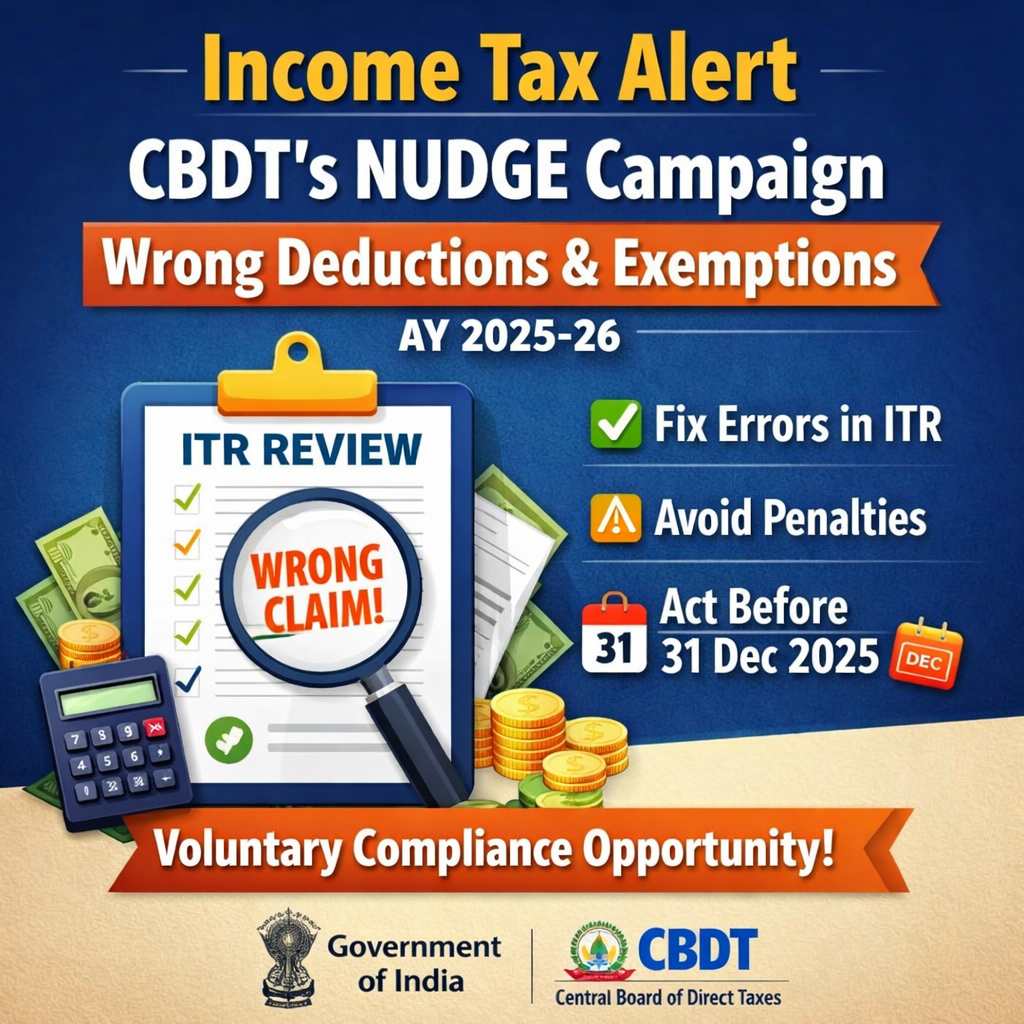
Income Tax Alert: CBDT Launches NUDGE Campaign Against Incorrect Deductions & Exemptions (AY 2025-26)

Government of India | Ministry of Finance | Central Board of Direct Taxes
Press Release | 23 December 2025

The Central Board of Direct Taxes (CBDT) has released a significant advisory calling upon taxpayers to review their Income Tax Returns (ITRs) for Assessment Year 2025-26 and voluntarily rectify any incorrect claims of deductions or exemptions.

This action is part of the Government’s “NUDGE” Campaign (Non-intrusive Usage of Data to Guide and Enable), which focuses on encouraging voluntary tax compliance by using data analytics—without resorting to coercive or intrusive measures.

What Prompted This Action by CBDT?

Using advanced data analytics and risk management tools, the CBDT has detected several instances where taxpayers have made incorrect claims in their Income Tax Returns. These include cases where taxpayers have:

  • Claimed deductions or exemptions that are not legally admissible

  • Reported bogus or questionable donations, particularly to:

    • Registered Unrecognised Political Parties (RUPPs)

  • Quoted incorrect or invalid PAN details of donation recipients

  • Claimed deductions in excess of prescribed limits

  • Incorrectly disclosed exempt income amounts in their ITRs

Such inaccuracies lead to under-reporting of taxable income, making these returns prone to scrutiny.


📩 How Are Taxpayers Being Notified?

Taxpayers identified through this exercise are being informed through:

  • SMS

  • Email

These messages advise taxpayers to:

  • Review their already-filed ITRs

  • Voluntarily correct any errors, if found

⚠️ Important Clarification

This communication is not a statutory notice under the Income Tax Act.
It is an early compliance alert, giving taxpayers a chance to self-correct.


⏰ Deadline to Take Corrective Action

👉 31 December 2025

Before this date, taxpayers may:

  • File a Revised Return, or

  • Submit an Updated Return, wherever permitted

Timely correction can help avoid:

  • Further verification or scrutiny

  • Formal notices

  • Penalties or additional proceedings


📊 CBDT Data Shows Strong Voluntary Compliance

The CBDT has highlighted encouraging results from this approach:

  • Over 21 lakh taxpayers have already:

    • Updated their returns for AYs 2021-22 to 2024-25

    • Paid more than ₹2,500 crore in additional taxes

  • For AY 2025-26 alone, more than 15 lakh revised returns have been filed

These figures demonstrate that voluntary compliance is more effective than coercive enforcement.


✅ What Should Taxpayers Do Now?

Step-by-Step Guidance:

  1. Review your ITR carefully, especially:

    • Chapter VI-A deductions (Sections 80C, 80G, etc.)

    • Exempt income disclosures

  2. Verify supporting documents, such as:

    • Donation receipts

    • PAN details of donees

    • Eligibility criteria for exemptions

  3. If any discrepancy is found:

    • File a Revised or Updated Return

  4. If all claims are accurate and genuine:

    • No further action is required


❌ Who Does Not Need to Worry?

The CBDT has clearly assured that:

Taxpayers who have correctly claimed legitimate deductions and exemptions need not take any action.

Honest taxpayers remain fully safeguarded under this initiative.


📅 What Happens If This Opportunity Is Ignored?

  • Taxpayers may still file an Updated Return from 1 January 2026

  • However:

    • Additional tax liability will arise

    • The risk of future inquiries or assessments increases


🧠 Key Takeaway

The NUDGE Campaign reflects the government’s:

  • Trust-based, taxpayer-friendly approach

  • Emphasis on voluntary compliance

  • Strategic use of technology and data, instead of harassment

New Regulations for TDS Return Rectification Applicable from 01-04-2026

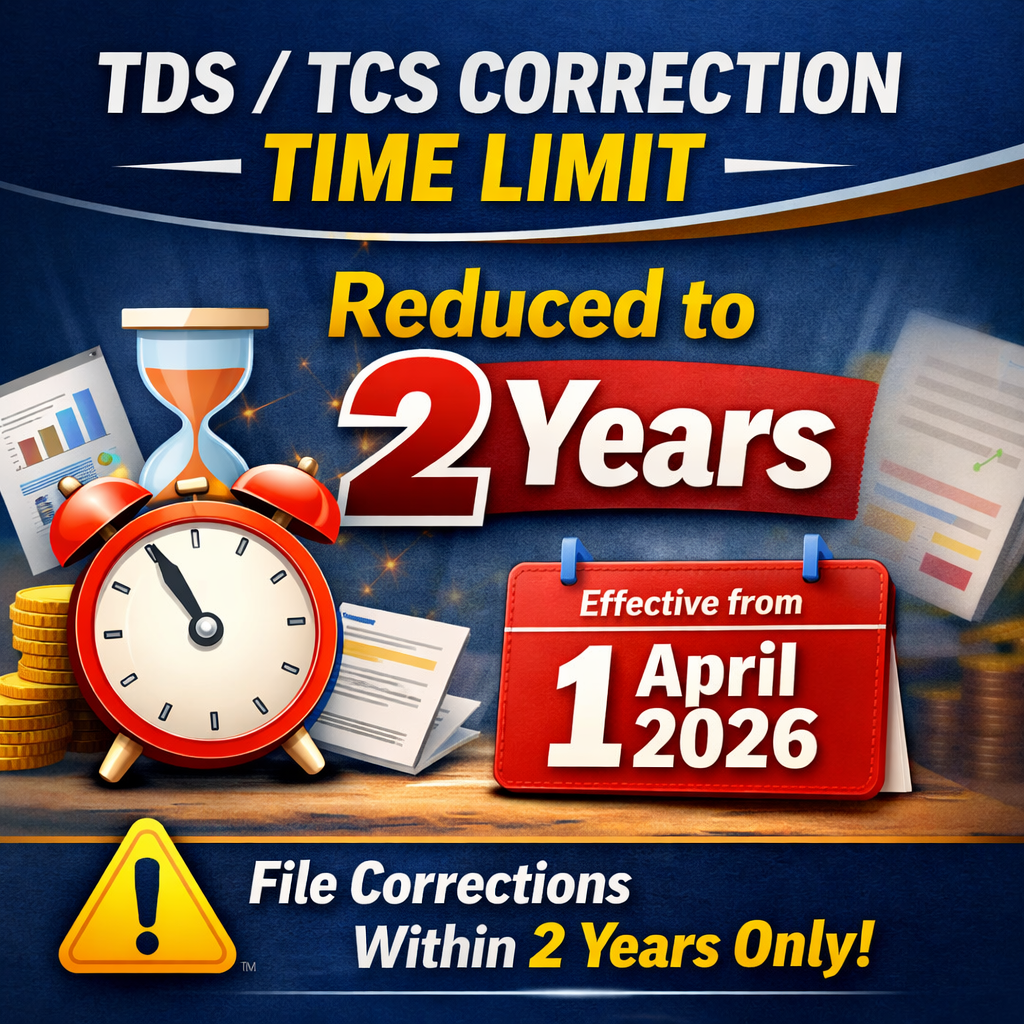
TDS / TCS Correction Statements: Time Limit Cut Down to 2 Years (Effective 01 April 2026)

🔔 What’s the Latest Change?

The Income Tax Department has introduced a major compliance reform by reducing the time limit for filing TDS and TCS correction statements to just 2 years, applicable from 1 April 2026.

Until now, deductors had the flexibility to revise old TDS/TCS returns even after many years. This long-standing practice will no longer be permitted.


⏳ Key Change Explained: Old Rule vs New Rule

🔙 Earlier Position (Before 01.04.2026)

  • No strict statutory deadline for filing correction statements

  • Corrections were practically allowed up to 7 years or more

  • Deductors commonly rectified:

    • Incorrect PAN details

    • Challan mapping errors

    • Short or excess deduction

    • Late reporting issues

  • Corrections were accepted even after several years

🔜 New Rule (From 01.04.2026)

  • Correction statements allowed only within 2 years

  • The 2-year period will be calculated from:

    • End of the relevant financial year

  • No correction will be permitted beyond this period

  • This is a strict and absolute deadline, not extendable in any case


📅 Last Opportunity for Old TDS/TCS Periods

Correction statements for the following quarters will be allowed only up to 31 March 2026:

  • Q4 of FY 2018–19

  • Q1 to Q4 of FY 2019–20 to FY 2022–23

  • Q1 to Q3 of FY 2023–24

⚠️ From 1 April 2026 onwards, the TRACES portal will permanently block corrections for these periods.


❌ Impact of Missing the 2-Year Deadline

Failure to file corrections within the prescribed time may result in:

  • ❌ Permanent denial of correction facility

  • ❌ Loss of TDS/TCS credit for deductees in Form 26AS / AIS

  • ❌ Disputes with employees, vendors, or contractors

  • ❌ Penalties ranging from ₹10,000 to ₹1,00,000

  • ❌ Higher compliance and audit risks

  • ❌ Interest liability and possible disallowance of expenses


✅ Reason Behind This Amendment

The department aims to promote:

  • Timely reconciliation of data

  • Faster and accurate credit to deductees

  • Reduced backlog of old corrections

  • Lower litigation and disputes

  • A shift towards real-time, technology-driven compliance

This change reflects a move towards strict timelines and disciplined reporting.


🧾 Best Practices Suggested by the Department

  • Regularly use TRACES utilities and validation tools

  • Track defaults and mismatches frequently

  • File correction statements immediately upon detecting errors

  • Train staff on the revised timelines

  • Adopt a preventive compliance approach


📌 Action Checklist for Deductors & Tax Professionals

✔ Review all pending TDS/TCS correction requirements
✔ Resolve old mismatches before 31 March 2026
✔ Strengthen internal review and control systems
✔ Inform clients and staff about the 2-year non-negotiable limit