✅ Who is Eligible to File ITR-U? You may file an Updated Return if you need to: Report missed or under-reported income Correct wrong income details Amend an incorrect tax rate Reduce excess loss or depreciation claimed Update wrong deductions or exemptions File a return even if no return was filed earlier

Income-tax law ke andar voluntary compliance ko badhava dene ke liye Updated Return (ITR-U) ka concept laya gaya hai. Iska main objective ye hai ki agar kisi taxpayer se return file karte samay koi income reh gayi ho, galat details report ho gayi ho, ya return file hi nahi hui ho, to wo apni galti khud se sudhaar sake — bas shart ye hai ki uske saath due tax, interest aur additional tax ka payment kiya jaye.

Recent amendments ke baad ITR-U ki time limit aur additional tax structure dono me kaafi bade badlav kiye gaye hain. Is article me updated provisions ko simple language me samjhaya gaya hai.


ITR-U kya hota hai?

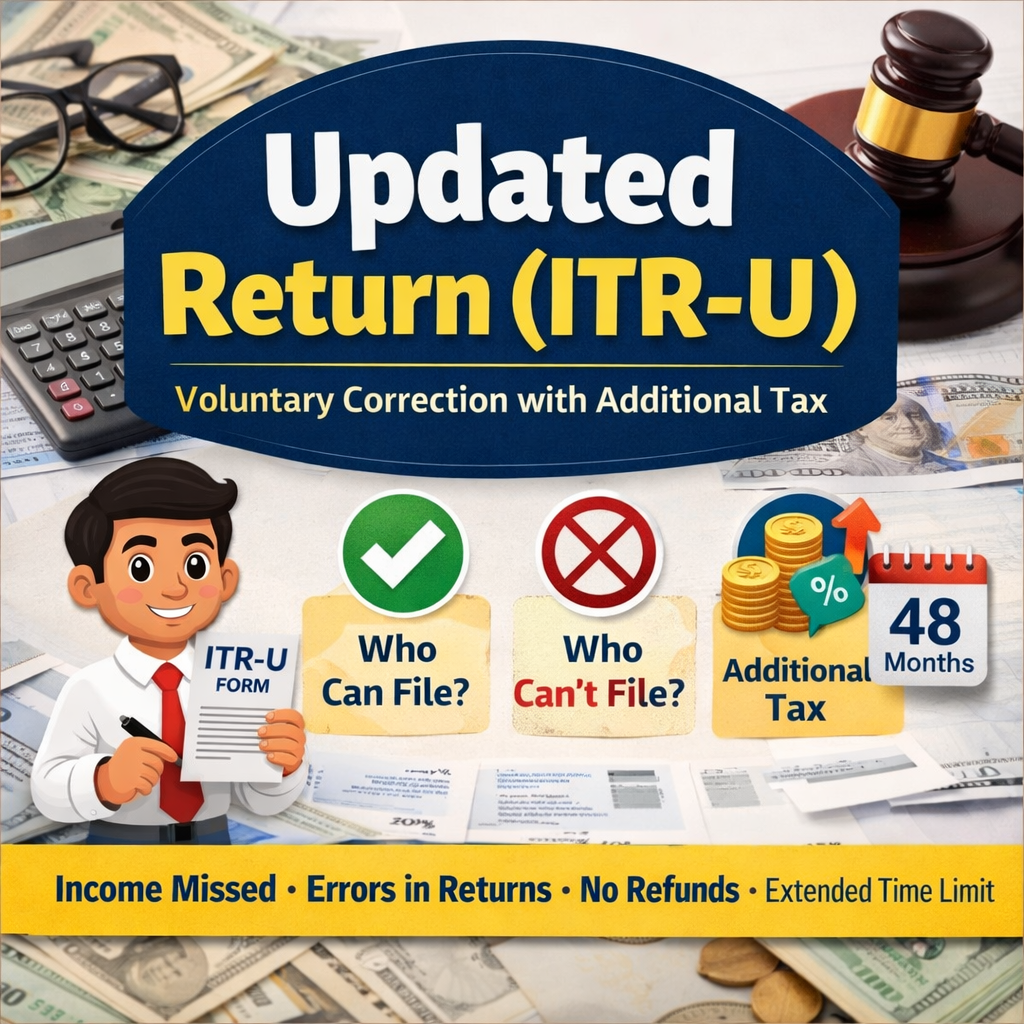
ITR-U (Updated Income-tax Return) ek special return hai jo Income-tax Act ke Section 139(8A) ke tahat file ki jaati hai. Ye tab file hoti hai jab:

  • Pehle file ki hui return me koi income disclose nahi hui ho

  • Income ya details galat report hui ho

  • Taxpayer ne pehle koi return file hi nahi ki ho

👉 Lekin dhyaan rahe, ITR-U sirf tab allowed hai jab usse extra tax payable banta ho.


Kaun ITR-U file kar sakta hai?

Neeche diye gaye taxpayers ITR-U file kar sakte hain:

  • Individual

  • HUF

  • Firm

  • Company

  • AOP / BOI

  • Trust ya anya entities

Aap ITR-U file kar sakte hain agar:

  • Aapne pehle original / belated / revised return file ki ho

  • Ya pehle return file nahi ki ho, lekin ab income disclose karne par tax payable ho raha ho

🔔 Important condition:
Updated return file karne ke baad tax liability increase honi chahiye. Agar tax nil ho ya refund ban raha ho, to ITR-U file nahi ki ja sakti.


Kaun ITR-U file nahi kar sakta?

Nimn situations me ITR-U file karna allowed nahi hai:

  • Agar updated return se:

    • Refund mil raha ho, ya

    • Pehle se due refund ki amount badh rahi ho

  • Agar updated return se:

    • Total tax liability kam ho rahi ho

  • Agar us assessment year ke liye:

    • Search u/s 132

    • Survey (specified cases)

    • Requisition u/s 132A
      jaise proceedings start ho chuki ho

  • Agar taxpayer:

    • Carry forward loss ko increase karna chahta ho
      (loss sirf reduce kiya ja sakta hai, badhaya nahi)


ITR-U file karne ki time limit (Updated Provision)

Purana rule:
ITR-U sirf 24 months ke andar file ki ja sakti thi.

Naya rule (1 April 2025 se effective):
Ab ITR-U 48 months (4 saal) tak file ki ja sakti hai, relevant assessment year ke end se.

Example:

  • Assessment Year: 2024-25

  • AY ka end: 31 March 2025

  • ITR-U ki last date: 31 March 2029

👉 Is extension ka purpose ye hai ki taxpayers ko zyada samay mile voluntarily income disclose karne ke liye.


ITR-U par Additional Tax (Section 140B)

ITR-U file karte waqt taxpayer ko ye payments karni hoti hain:

  • Applicable Income Tax

  • Interest (Section 234A / 234B / 234C, jo bhi apply ho)

  • Additional Income-tax

Additional tax ka calculation Tax + Interest ke total amount par hota hai.


Additional Tax Rates – Updated Structure

ITR-U Filing Period Additional Tax
12 months ke andar 25%
12–24 months 50%
24–36 months 60%
36–48 months 70%

Delay jitna zyada, additional tax utna hi zyada — isliye early compliance financially faydemand hai.


Simple Example

Maan lijiye:

  • Additional tax payable: ₹1,00,000

  • Interest: ₹10,000

  • Total (Tax + Interest): ₹1,10,000

12 months ke andar filing:

  • Additional tax @25% = ₹27,500

  • Total payable = ₹1,37,500

3rd year me filing (24–36 months):

  • Additional tax @60% = ₹66,000

  • Total payable = ₹1,76,000


Important Practical Points

  • ITR-U ka use refund claim ke liye nahi ho sakta

  • Ye facility sirf voluntary disclosure ke liye hai

  • Interest calculation me chhoti si galti additional tax ko bhi badha sakti hai

  • Har assessment year ke liye sirf ek baar ITR-U file ki ja sakti hai

  • Hamesha correct ITR-U form aur latest utility ka hi use karein

Updated Income Tax Slabs Applicable for FY 2025–26 (AY 2026–27)

Complete Overview of Income Tax Slabs, Rebate, Standard Deduction, Surcharge & Cess

The Government has retained the New Tax Regime as the default option and further streamlined the income tax slab structure to offer greater relief to middle-income taxpayers. For Financial Year 2025–26 (Assessment Year 2026–27), the revised framework emphasizes higher basic exemption limits, an enhanced rebate, and a standard deduction for salaried individuals, making the regime more taxpayer-friendly.

This article provides a comprehensive explanation of the latest income tax slab rates, along with details on the rebate under Section 87A, standard deduction, health and education cess, applicable surcharge, and the categories of taxpayers to whom these provisions apply.

1. New Income Tax Slab Rates – FY 2025–26 (AY 2026–27)

Under the New Tax Regime, income is taxed at progressive slab rates as outlined below:

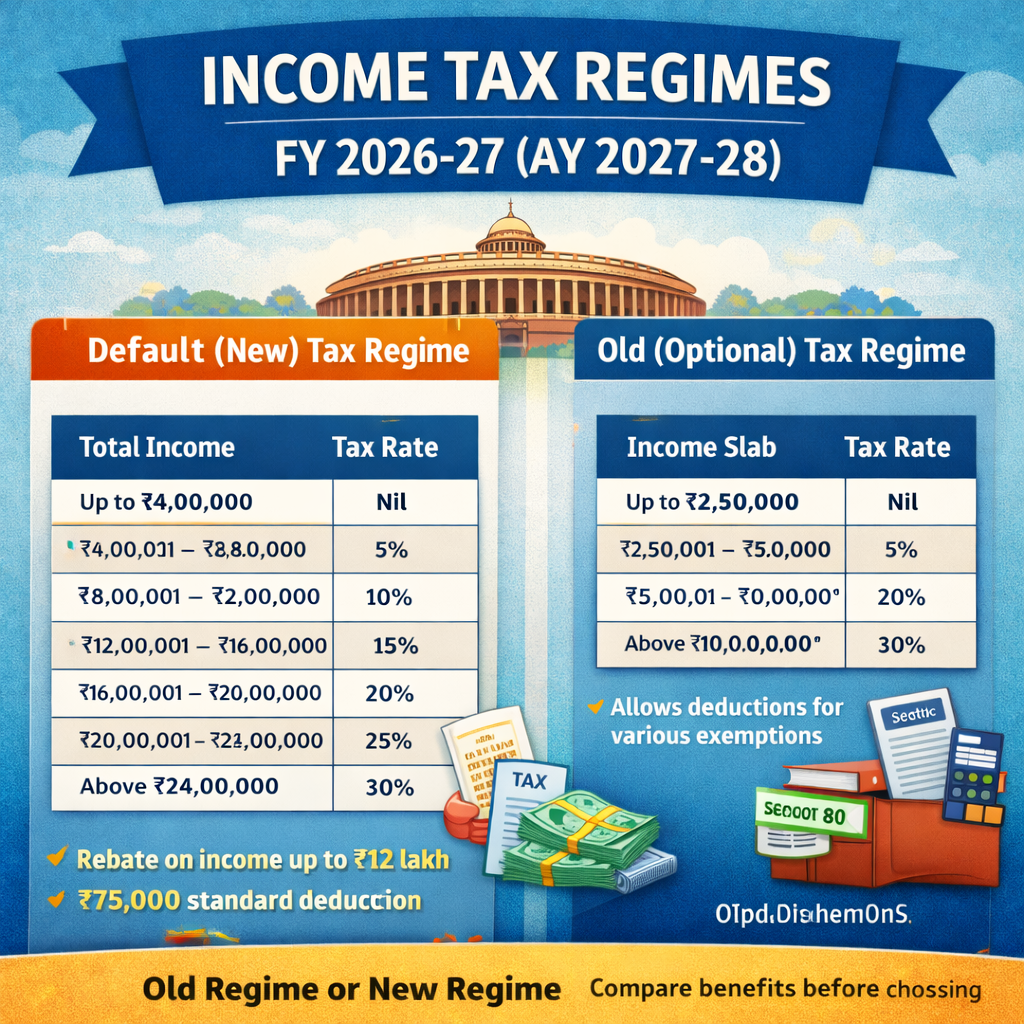
Total Income Applicable Tax Rate
Up to ₹4,00,000 Nil
₹4,00,001 – ₹8,00,000 5%
₹8,00,001 – ₹12,00,000 10%
₹12,00,001 – ₹16,00,000 15%
₹16,00,001 – ₹20,00,000 20%
₹20,00,001 – ₹24,00,000 25%
Above ₹24,00,000 30%

👉 Note: Income tax is calculated slab-wise, meaning each portion of income is taxed at the applicable rate, not the entire income at one single rate.


2. Income Up to ₹4,00,000 – No Tax Liability

For FY 2025–26, the basic exemption limit under the New Tax Regime stands at ₹4,00,000.
Accordingly, individuals whose total taxable income does not exceed ₹4 lakh are not required to pay any income tax.


3. Rebate Under Section 87A – Significant Relief

Eligibility Criteria

  • Available only to Resident Individual taxpayers

  • Applicable exclusively under the New Tax Regime

Rebate Provisions

  • If taxable income does not exceed ₹12,00,000

  • 100% rebate of tax payable is allowed

  • Maximum rebate amount: ₹60,000

👉 As a result, income up to ₹12 lakh becomes effectively tax-free under the New Regime.

Practical Clarification

  • Tax is first computed as per slab rates

  • If the calculated tax liability is ₹60,000 or less, the rebate completely offsets it

  • Net tax payable becomes Nil


4. Standard Deduction of ₹75,000

Who Can Claim?

  • Salaried employees

  • Pensioners

Deduction Amount

  • A flat standard deduction of ₹75,000 is available under the New Tax Regime

Tax Impact

Due to this deduction:

  • A salaried individual earning up to ₹12,75,000

  • After deducting ₹75,000, taxable income becomes ₹12,00,000

  • 👉 No income tax is payable

This significantly enhances the attractiveness of the New Regime for salaried taxpayers who do not rely heavily on deductions.


5. Health and Education Cess

  • 4% Health and Education Cess

  • Levied on income tax plus surcharge, if any

  • Applicable to all categories of taxpayers without exception


6. Surcharge on Higher Income Levels

Surcharge is levied when total income crosses ₹50 lakh, as per the following structure:

Total Income Surcharge Rate
₹50 lakh – ₹1 crore 10%
₹1 crore – ₹2 crore 15%
₹2 crore – ₹5 crore 25%
Above ₹5 crore 37%

Marginal Relief

Marginal relief is available to ensure that the additional tax payable due to surcharge does not exceed the additional income earned over the threshold limit.


7. Applicability of These Provisions

Applicable To

  • Resident Individuals

  • Salaried taxpayers

  • Pensioners

  • Professionals and business owners opting for the New Tax Regime

Not Applicable / Points of Caution

  • Non-resident individuals (Section 87A rebate not available)

  • Taxpayers with income taxed at special rates (such as lottery winnings or certain capital gains)

  • Individuals who claim substantial deductions under the Old Regime (80C, HRA, housing loan interest, etc.)


8. New Tax Regime vs Old Tax Regime – Practical Comparison

The New Tax Regime is more suitable if:

  • You have minimal deductions

  • You are a salaried taxpayer with a simple salary structure

  • Your annual income is around ₹12–13 lakh

The Old Tax Regime may be preferable if:

  • You claim major deductions under sections 80C, 80D, HRA, or home loan interest

  • You have substantial tax-saving investments

👉 Tip: Always compute tax liability under both regimes before filing your Income Tax Return to choose the most beneficial option.

January 2026: Complete Compliance & Filing Schedule for Businesses

January marks more than just the start of a new calendar year—it is also one of the busiest compliance months for businesses, professionals, and employers. A tight cluster of statutory obligations such as GST returns, TDS filings, PF-ESI contributions, and MCA compliances leaves little room for error. Missing even one due date can trigger late fees, interest, penalties, or system-generated notices.

As we enter January 2026, the compliance environment continues to become more stringent, backed by tighter deadlines, automated checks, and enhanced portal validations. To help businesses, taxpayers, and professionals stay on track, this article provides a comprehensive, date-wise compliance calendar for January 2026, covering GST, Income Tax, TDS/TCS, PF, ESI, and MCA requirements—all consolidated in one place.


GST Compliance

Due Date | Return/Form | Period | Applicability
7 January 2026 | GSTR-7 | December 2025 | GST TDS deductors
7 January 2026 | GSTR-8 | December 2025 | E-commerce operators
11 January 2026 | GSTR-1 | December 2025 | Monthly outward supply filers
20 January 2026 | GSTR-3B | December 2025 | Monthly GST return
22/24 January 2026 | GSTR-3B (QRMP) | Oct–Dec 2025 | Based on state category
20 January 2026 | GSTR-5A | December 2025 | OIDAR service providers

GST Composition Scheme
18 January 2026 | CMP-08 | Oct–Dec 2025


TDS/TCS & Income-Tax Compliances

Monthly TDS/TCS Payment
7 January 2026 – Deposit of TDS/TCS for December 2025
(Generally payable by the 7th of the following month)

Quarterly TDS/TCS Returns
15 January 2026 | Form 27EQ (TCS) | Oct–Dec 2025
31 January 2026 | Forms 24Q, 26Q, 27Q | Oct–Dec 2025

Income-Tax Update
As per CBDT indications, new ITR forms and procedures under the simplified Income-tax framework are expected to be notified by January 2026, ahead of implementation from 1 April 2026.


PF & ESI Compliance

15 January 2026
• EPF contribution payment & return – December 2025
• ESI contribution payment & return – December 2025

(PF and ESI dues are generally payable by the 15th of the subsequent month.)


MCA / ROC Filings

31 January 2026
• Filing of Annual Returns and Financial Statements for FY 2024-25
• Ensure timely submission of AOC-4 and MGT-7 within the extended timeline

LLPs should also verify due dates for Form 11 and other applicable ROC filings based on entity-specific requirements.


Other Important Statutory Compliances

Professional Tax (PT)
Generally payable by 31 January 2026 for December 2025 salary deductions (state-specific rules apply).

Advance Tax
No advance tax installment is due in January; the next installment falls in March 2026.


Consequences of Delayed Compliance – Quick Snapshot

GST: Late fees and interest on net tax liability
TDS/TCS: Interest and penalties for late payment or return filing
PF/ESI: Interest and statutory damages under respective laws


In today’s technology-driven compliance framework, delays rarely go unnoticed. GST filings, TDS payments, PF-ESI contributions, and MCA submissions are closely monitored through integrated systems. Timely compliance is no longer optional—it is essential.

Use this January 2026 Compliance Calendar as a ready reference, plan your filings in advance, and complete all obligations well before due dates. Staying proactive today helps avoid financial exposure, legal complications, and unnecessary stress in the future.

Top 10 Changes in GST & Income Tax Applicable from January 1, 2026

Important Tax Compliance Changes from 1 January 2026 – What Every Taxpayer Must Know

The commencement of 1 January 2026 brings significant compliance implications under GST and Income Tax laws in India. Multiple statutory deadlines expire on 31 December 2025, after which several system-driven restrictions, penalties, and consequences automatically come into force.

Failure to act before these cut-off dates may lead to late fees, interest liabilities, denial of Input Tax Credit (ITC), inoperative PAN, suspension of GST registration, and increased tax burden.

This article outlines the key changes effective from 1 January 2026, including several often overlooked but high-risk compliance areas.


1. GSTR-9 / GSTR-9C Due Date Expired – Late Fees Triggered

The last date to file GSTR-9 and GSTR-9C for FY 2024-25 is 31 December 2025.

From 1 January 2026, these returns can still be filed, but mandatory late fees will apply based on turnover slabs.

GSTR-9 Late Fee Structure (Applicable from FY 2022-23 onwards)

Annual Turnover Late Fee per Day (CGST + SGST) Maximum Late Fee
Up to ₹5 crore ₹50 (₹25 + ₹25) 0.04% of turnover
₹5 crore – ₹20 crore ₹100 (₹50 + ₹50) 0.04% of turnover
Above ₹20 crore ₹200 (₹100 + ₹100) 0.05% of turnover

Important Points:

  • Late fees continue to accumulate until the return is filed

  • No automatic waiver is available after the due date

  • GSTR-9C cannot be filed unless GSTR-9 is first filed

  • Late fee for GSTR-9C is ₹200 per day, capped at 0.05% of turnover


2. Belated and Revised ITR Filing Window Closes on 31 December 2025

For FY 2024-25 (AY 2025-26):

  • Belated Return under Section 139(4)

  • Revised Return under Section 139(5)

👉 Both are permitted only up to 31 December 2025.

From 1 January 2026, taxpayers will no longer be allowed to file either a belated or revised return for this financial year.


3. Updated Return Remains the Only Option – At a High Cost

Post 31 December 2025, the only return filing option available is the Updated Return under Section 139(8A).

Key Rules for Updated Returns

  • Can be filed up to 4 years from the end of the relevant assessment year

  • Allowed only in cases of:

    • Omitted income

    • Incorrect claims of exemptions, deductions, or losses

  • Refunds cannot be claimed

  • Losses cannot be carried forward

  • Additional tax payment is mandatory

📌 Updated returns are meant for tax recovery, not routine corrections.


4. PAN Becomes Inoperative If Aadhaar Is Not Linked

Failure to link PAN with Aadhaar results in the PAN becoming inoperative, leading to serious consequences.

Impact of Inoperative PAN

  • Income Tax Return cannot be filed

  • Tax refunds will not be issued

  • TDS will be deducted at higher rates

  • Certain banking transactions may be restricted

  • PAN becomes invalid for GST, investments, loans, and other financial compliance

    5. GSTR-3B Filing to Be Blocked Due to ITC Restrictions from 1 January 2026

    Starting with returns filed for January 2026 onwards, the GST portal will restrict GSTR-3B filing in certain ITC-related mismatch situations.

    ITC Reclaim Ledger Validation

    The amount of ITC reclaimed in Table 4(D)(1) must not exceed:

    • Closing balance of the ITC Reclaim Ledger, plus

    • ITC reversed in Table 4(B)(2) during the current tax period

    Reverse Charge (RCM) Ledger Validation

    ITC claimed under RCM in Table 4A(2) / 4A(3) must not exceed:

    • RCM tax paid and reported in Table 3.1(d), plus

    • Available balance in the RCM Ledger

    Any negative balance in the ITC or RCM ledger will automatically block GSTR-3B filing.


    6. Non-Submission of Bank Details Will Trigger GST Registration Suspension

    As per Rule 10A of the CGST Rules, furnishing bank account details is mandatory:

    • Within 30 days of GST registration, or

    • Before filing GSTR-1 or IFF, whichever occurs first

    Consequences of Non-Compliance

    • GST registration will be system-suspended

    • Taxpayer will be unable to file returns

    • E-way bill generation will be blocked

    • Suspension remains until bank details are updated


    7. GST Returns Older Than Three Years Become Non-Fileable

    A critical but frequently overlooked provision:

    👉 GST returns pending for more than 3 years become time-barred and cannot be filed.

    This restriction applies to:

    • GSTR-1

    • GSTR-3B

    • GSTR-4

    • GSTR-5, 6, 7, 8, and 9

    📌 Once a return becomes time-barred:

    • Related ITC is permanently forfeited

    • Annual return reconciliation becomes impossible

    • Departmental notices and demand proceedings may follow


    8. Reassess Aggregate Annual Turnover (AATO) – GST Registration May Be Required

    At the beginning of a new financial cycle, businesses should recalculate their Aggregate Annual Turnover (AATO).

    GST registration becomes mandatory if AATO exceeds:

    • ₹20 lakh (₹10 lakh for special category states), or

    • ₹40 lakh for goods suppliers, subject to prescribed conditions

    Failure to register can result in:

    • Tax demand along with interest

    • Monetary penalties

    • Denial of ITC to customers, affecting business credibility


    9. Pay Advance Tax by 15 March to Avoid Interest Liability

    Where total tax liability exceeds ₹10,000, payment of advance tax is compulsory.

    • Final instalment due: 15 March (100% of tax liability)

    Non-payment or short payment may attract:

    • Interest under Sections 234B and 234C

    • Additional tax cost even if the ITR is filed within the due date


    10. Regular Monitoring of Income Tax Portal Is Essential

    Taxpayers must frequently review communications available on the Income Tax Portal, including:

    • E-proceedings and notices

    • Intimations under Section 143(1)

    • Defective return alerts

    • Refund adjustments

    • AIS/TIS mismatch communications

    Ignoring portal notices may lead to:

    • Best judgment assessments

    • Withholding of refunds

    • Penalty and prosecution proceedings

CBDT issues statement after Income Tax Department sends SMS to taxpayers

NEW DELHI: The Central Board of Direct Taxes (CBDT) on Tuesday urged taxpayers to voluntarily recheck the deductions and exemptions claimed in their annual income tax returns, after data analysis revealed that a significant number of claims were incorrect or ineligible.

Issuing a clarification following widespread discussion on social media about SMS alerts sent by the Income Tax Department, the CBDT said it has launched a special initiative to prompt taxpayers to review and rectify such claims on their own.

Under this drive, identified taxpayers are being contacted through SMS and email as part of the “Non-intrusive Usage of Data to Guide and Enable (NUDGE)” campaign, encouraging them to correct errors and file revised returns by December 31, 2025.

The CBDT explained that using advanced data analytics under its risk management framework, cases for Assessment Year 2025–26 have been flagged where claims such as bogus donations to Registered Unrecognised Political Parties (RUPPs) or other inadmissible deductions and exemptions appear to have been made. In some instances, incorrect or invalid PAN details of donees were used, or the deduction amounts claimed exceeded permissible limits, said CBDT spokesperson V Rajitha.

Taxpayers have been advised to verify the accuracy of their claims and submit revised returns wherever necessary to avoid further scrutiny.

However, the CBDT clarified that taxpayers whose deductions and exemptions are genuine and fully compliant with the law need not take any action.

Those who miss the December 31, 2025 deadline will still have the option to file an updated return from January 1, 2026, subject to payment of additional tax as prescribed.

The statement added that during FY 2025–26, over 21 lakh taxpayers have already updated their ITRs for assessment years 2021–22 to 2024–25, resulting in the collection of more than ₹2,500 crore. Additionally, more than 15 lakh returns have already been revised for the current assessment year.

Why 31 December Is So Important for Professionals and Businesses

31st December 2025 is far more than just the close of the calendar year.
It marks one of the most crucial compliance cut-off dates under GST, Income Tax, and MCA regulations for FY 2024-25 / AY 2025-26.

For Chartered Accountants, tax consultants, business owners, companies, and professionals, overlooking this deadline can lead to loss of refunds, late fees, penalties, and long-term litigation exposure.

Let us break down why this single date carries such immense importance.


🔴 1. Deadline for Filing GSTR-9 (GST Annual Return) – FY 2024-25

GSTR-9 is the annual GST return that provides a consolidated view of:

  • Outward supplies

  • Inward supplies

  • Input Tax Credit (ITC) claimed

  • Taxes paid

  • Year-end adjustments

Important points to note:

  • 31st December 2025 is the statutory due date for filing GSTR-9 for FY 2024-25

  • Filing is optional for taxpayers with AATO up to ₹2 crore

  • Once submitted, GSTR-9 cannot be revised

This return plays a key role in:

  • GST scrutiny proceedings

  • Departmental notices

  • ITC verification and reconciliation

Who needs to be especially cautious?

  • Businesses with multiple amendments during the year

  • Taxpayers who rectified FY 2024-25 errors in FY 2025-26

  • Taxpayers facing ITC mismatches with GSTR-2B


🔴 2. Due Date for Filing GSTR-9C (GST Reconciliation Statement)

GSTR-9C is a reconciliation statement comparing:

  • Audited financial statements

  • GSTR-9 annual return

Key highlights:

  • Applicable to taxpayers whose turnover exceeds the prescribed audit limit

  • 31st December 2025 is the final due date

  • Although now self-certified, it remains a high-risk compliance document

Any mismatch may trigger:

  • GST audits

  • Demand notices

  • Interest and penalty proceedings


🔴 3. Final Date to File Belated or Revised ITR – AY 2025-26

This is one of the most overlooked yet most critical year-end deadlines.

What closes on 31st December 2025?

  • Filing of Belated Income Tax Returns

  • Filing of Revised Income Tax Returns

Why this date is crucial:

  • It is the last chance for non-filers to submit their return

  • Errors in earlier returns can no longer be corrected after this date

  • Unclaimed income tax refunds may lapse permanently

Who should be extra alert?

  • Salaried individuals awaiting refunds

  • Professionals and freelancers with TDS deductions

  • Businesses that filed incorrect or incomplete returns earlier

  • Taxpayers who have received CPC intimations or mismatch notices

    🔴 4. MCA Annual Compliance – Extended Due Date up to 31st December 2025

    The Ministry of Corporate Affairs (MCA) has permitted companies to complete their annual compliance filings for FY 2024-25 on or before 31st December 2025.

    Forms included:

    • AOC-4 – Filing of financial statements

    • MGT-7 / MGT-7A – Annual return

    Why this deadline matters:

    • Filing within the extended timeline helps avoid substantial additional fees

    • Failure to comply may result in:

      • Monetary penalties on the company

      • Personal penalties on directors

      • Long-term risk of director disqualification


    🔴 5. PAN–Aadhaar Linking – Practical Year-End Implications

    While PAN–Aadhaar linking requirements differ based on taxpayer categories, 31st December 2025 effectively serves as a practical deadline to ensure:

    • Hassle-free income tax return filing

    • Timely processing of tax refunds

    • Prevention of PAN becoming inoperative for income tax purposes

    Taxpayers with pending PAN–Aadhaar linkage issues frequently encounter:

    • Delays or blockage of refunds

    • Difficulties in filing returns

    • Increased scrutiny, notices, and compliance-related delays

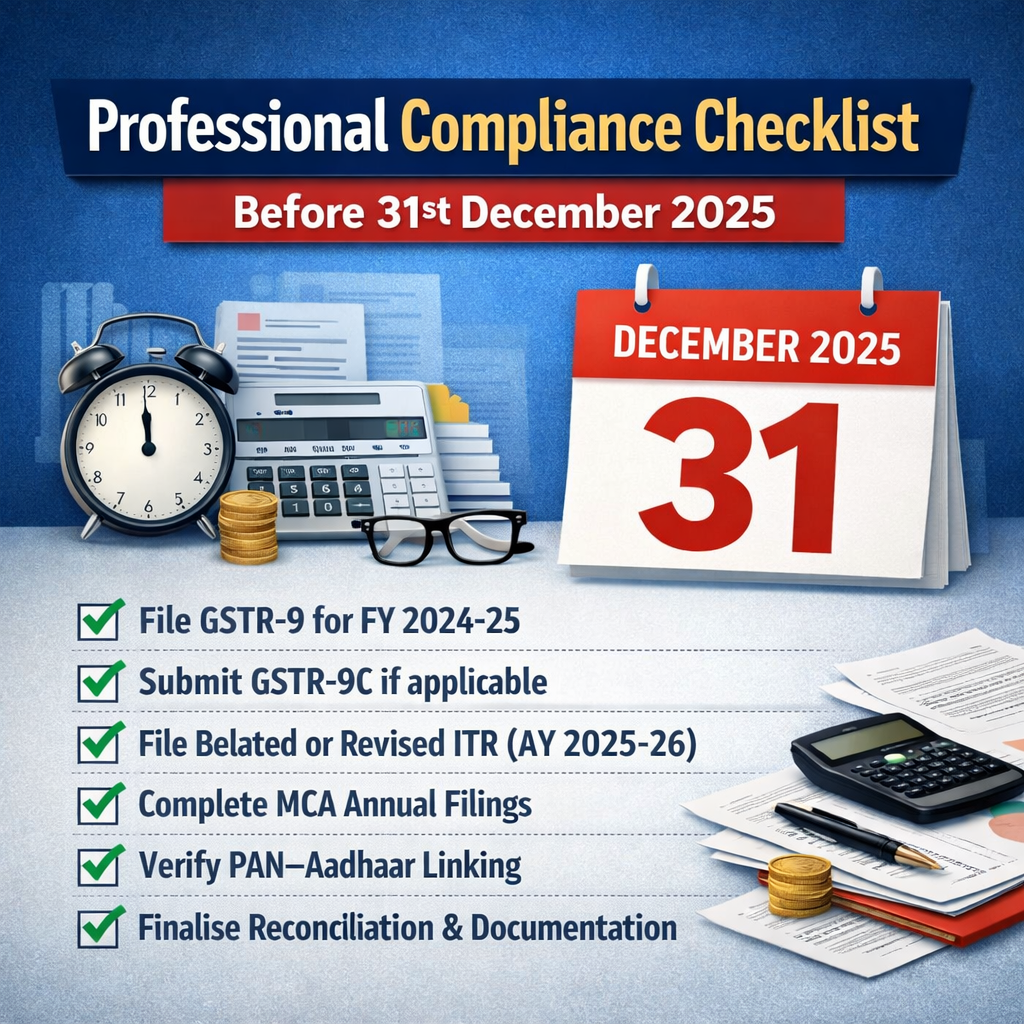
      📌 Professional Compliance Checklist – Tasks to Complete Before 31st December 2025

      ✔ Ensure filing of GSTR-9 for FY 2024-25
      ✔ Submit GSTR-9C wherever reconciliation requirements apply
      ✔ File belated or revised Income Tax Returns for AY 2025-26
      ✔ Complete MCA annual compliances, including AOC-4 and MGT-7 / MGT-7A
      ✔ Confirm and regularise PAN–Aadhaar linkage status
      ✔ Finalise reconciliations, verifications, and supporting documentation

Income Tax Department’s access to emails and social media from April 2026: What you need to know

A message widely circulating on social media claims that from April 1, 2026, the Income Tax Department will be empowered to access citizens’ social media accounts, emails, and other digital platforms to curb tax evasion. The viral claim has generated significant curiosity and concern among taxpayers about whether the tax authorities will actually receive such extensive powers.

In response to the growing confusion, the Press Information Bureau’s (PIB) Fact Check team issued a clarification through a post on X (formerly Twitter) to verify the authenticity of the claim.

What does the viral social media post claim?

According to a post shared by the handle @IndianTechGuide, the Income Tax Department would gain sweeping authority from April 1, 2026, to monitor and access private digital platforms, including emails and social media accounts, as part of efforts to tackle tax evasion.

Can the Income Tax Department access private digital accounts?

The PIB Fact Check team has clarified that the claim is misleading. It stated that the Income Tax Department will not receive any such blanket powers.

As per the clarification, Section 247 of the Income Tax Act, 2025 allows access to digital records only during authorised search and survey operations. Such action can be taken solely when there is credible evidence of significant tax evasion and a formal search operation has been initiated. In the absence of such proceedings, the department has no authority to access a taxpayer’s private digital space.

Can these powers be used for routine assessments?

The PIB further emphasised that these provisions cannot be used for routine tax processing, information gathering, or scrutiny assessments. The powers are strictly intended to combat black money and large-scale tax evasion during search and survey operations and are not applicable to law-abiding taxpayers.

Has the power to seize documents been newly introduced?

The clarification also noted that the authority to seize documents and evidence during search and survey operations has existed since the Income Tax Act, 1961 and is not a new provision under the 2025 Act.

What is black money?

Black money refers to income earned through illegal activities or income on which tax has not been paid. It may arise from legitimate sources that are not disclosed to tax authorities or from inherently illegal activities such as smuggling, illicit trade, counterfeit currency operations, arms trafficking, terrorism financing, and corruption. In essence, black money comprises assets or resources that were neither reported at the time of generation nor disclosed during their possession.

Income Tax Department Alerted 21 Lakh Taxpayers – Did You Receive the SMS? Take Action Immediately

Income Tax Alert: CBDT Launches NUDGE Campaign Against Incorrect Deductions & Exemptions (AY 2025-26)

Government of India | Ministry of Finance | Central Board of Direct Taxes
Press Release | 23 December 2025

The Central Board of Direct Taxes (CBDT) has released a significant advisory calling upon taxpayers to review their Income Tax Returns (ITRs) for Assessment Year 2025-26 and voluntarily rectify any incorrect claims of deductions or exemptions.

This action is part of the Government’s “NUDGE” Campaign (Non-intrusive Usage of Data to Guide and Enable), which focuses on encouraging voluntary tax compliance by using data analytics—without resorting to coercive or intrusive measures.

What Prompted This Action by CBDT?

Using advanced data analytics and risk management tools, the CBDT has detected several instances where taxpayers have made incorrect claims in their Income Tax Returns. These include cases where taxpayers have:

  • Claimed deductions or exemptions that are not legally admissible

  • Reported bogus or questionable donations, particularly to:

    • Registered Unrecognised Political Parties (RUPPs)

  • Quoted incorrect or invalid PAN details of donation recipients

  • Claimed deductions in excess of prescribed limits

  • Incorrectly disclosed exempt income amounts in their ITRs

Such inaccuracies lead to under-reporting of taxable income, making these returns prone to scrutiny.


📩 How Are Taxpayers Being Notified?

Taxpayers identified through this exercise are being informed through:

  • SMS

  • Email

These messages advise taxpayers to:

  • Review their already-filed ITRs

  • Voluntarily correct any errors, if found

⚠️ Important Clarification

This communication is not a statutory notice under the Income Tax Act.
It is an early compliance alert, giving taxpayers a chance to self-correct.


⏰ Deadline to Take Corrective Action

👉 31 December 2025

Before this date, taxpayers may:

  • File a Revised Return, or

  • Submit an Updated Return, wherever permitted

Timely correction can help avoid:

  • Further verification or scrutiny

  • Formal notices

  • Penalties or additional proceedings


📊 CBDT Data Shows Strong Voluntary Compliance

The CBDT has highlighted encouraging results from this approach:

  • Over 21 lakh taxpayers have already:

    • Updated their returns for AYs 2021-22 to 2024-25

    • Paid more than ₹2,500 crore in additional taxes

  • For AY 2025-26 alone, more than 15 lakh revised returns have been filed

These figures demonstrate that voluntary compliance is more effective than coercive enforcement.


✅ What Should Taxpayers Do Now?

Step-by-Step Guidance:

  1. Review your ITR carefully, especially:

    • Chapter VI-A deductions (Sections 80C, 80G, etc.)

    • Exempt income disclosures

  2. Verify supporting documents, such as:

    • Donation receipts

    • PAN details of donees

    • Eligibility criteria for exemptions

  3. If any discrepancy is found:

    • File a Revised or Updated Return

  4. If all claims are accurate and genuine:

    • No further action is required


❌ Who Does Not Need to Worry?

The CBDT has clearly assured that:

Taxpayers who have correctly claimed legitimate deductions and exemptions need not take any action.

Honest taxpayers remain fully safeguarded under this initiative.


📅 What Happens If This Opportunity Is Ignored?

  • Taxpayers may still file an Updated Return from 1 January 2026

  • However:

    • Additional tax liability will arise

    • The risk of future inquiries or assessments increases


🧠 Key Takeaway

The NUDGE Campaign reflects the government’s:

  • Trust-based, taxpayer-friendly approach

  • Emphasis on voluntary compliance

  • Strategic use of technology and data, instead of harassment

New Regulations for TDS Return Rectification Applicable from 01-04-2026

TDS / TCS Correction Statements: Time Limit Cut Down to 2 Years (Effective 01 April 2026)

🔔 What’s the Latest Change?

The Income Tax Department has introduced a major compliance reform by reducing the time limit for filing TDS and TCS correction statements to just 2 years, applicable from 1 April 2026.

Until now, deductors had the flexibility to revise old TDS/TCS returns even after many years. This long-standing practice will no longer be permitted.


⏳ Key Change Explained: Old Rule vs New Rule

🔙 Earlier Position (Before 01.04.2026)

  • No strict statutory deadline for filing correction statements

  • Corrections were practically allowed up to 7 years or more

  • Deductors commonly rectified:

    • Incorrect PAN details

    • Challan mapping errors

    • Short or excess deduction

    • Late reporting issues

  • Corrections were accepted even after several years

🔜 New Rule (From 01.04.2026)

  • Correction statements allowed only within 2 years

  • The 2-year period will be calculated from:

    • End of the relevant financial year

  • No correction will be permitted beyond this period

  • This is a strict and absolute deadline, not extendable in any case


📅 Last Opportunity for Old TDS/TCS Periods

Correction statements for the following quarters will be allowed only up to 31 March 2026:

  • Q4 of FY 2018–19

  • Q1 to Q4 of FY 2019–20 to FY 2022–23

  • Q1 to Q3 of FY 2023–24

⚠️ From 1 April 2026 onwards, the TRACES portal will permanently block corrections for these periods.


❌ Impact of Missing the 2-Year Deadline

Failure to file corrections within the prescribed time may result in:

  • ❌ Permanent denial of correction facility

  • ❌ Loss of TDS/TCS credit for deductees in Form 26AS / AIS

  • ❌ Disputes with employees, vendors, or contractors

  • ❌ Penalties ranging from ₹10,000 to ₹1,00,000

  • ❌ Higher compliance and audit risks

  • ❌ Interest liability and possible disallowance of expenses


✅ Reason Behind This Amendment

The department aims to promote:

  • Timely reconciliation of data

  • Faster and accurate credit to deductees

  • Reduced backlog of old corrections

  • Lower litigation and disputes

  • A shift towards real-time, technology-driven compliance

This change reflects a move towards strict timelines and disciplined reporting.


🧾 Best Practices Suggested by the Department

  • Regularly use TRACES utilities and validation tools

  • Track defaults and mismatches frequently

  • File correction statements immediately upon detecting errors

  • Train staff on the revised timelines

  • Adopt a preventive compliance approach


📌 Action Checklist for Deductors & Tax Professionals

✔ Review all pending TDS/TCS correction requirements
✔ Resolve old mismatches before 31 March 2026
✔ Strengthen internal review and control systems
✔ Inform clients and staff about the 2-year non-negotiable limit