GST Advisory on GSTR-3B Updates Applicable from February 2026
Advisory on Interest Collection and Related Enhancements in GSTR-3B
It is hereby informed that from January-2026 period onwards, few enhancements have been made in filing of GSTR-3B. For detailed advisory, kindly click on the link given below:
https://tutorial.gst.gov.in/downloads/news/advisory_on_interest_calculator.pdfThanks,
Team GSTN
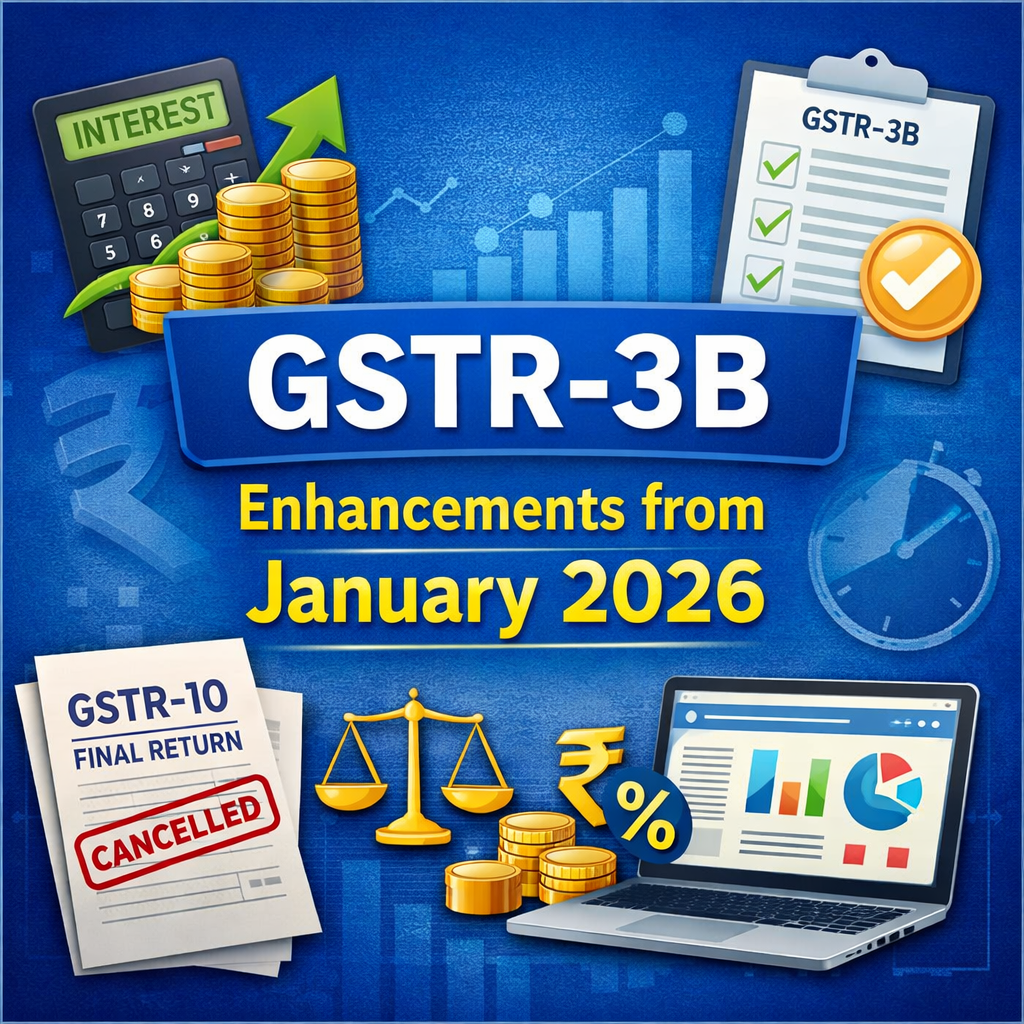
The GST Network has issued an important advisory titled “Advisory on Interest Collection and Related Enhancements in GSTR-3B”, bringing multiple system-level changes in the filing of Form GSTR-3B, effective from the January-2026 tax period onwards.
These changes primarily focus on:
- Revised interest computation methodology
- System-driven population of tax liability breakup
- Flexibility in ITC cross-utilisation
- Interest recovery in GSTR-10 for cancelled registrations
The enhancements aim to align portal functionality with Section 50 of the CGST Act, 2017 and Rule 88B of the CGST Rules, 2017, while reducing disputes and ensuring fair interest computation.
Update in Interest Computation for GSTR-3B (Table 5.1)
1.1 What Has Changed from January-2026?
From the January-2026 tax period onwards, the interest calculation in Table 5.1 of GSTR-3B has been enhanced to provide relief to taxpayers by factoring in the minimum cash balance available in the Electronic Cash Ledger (ECL).
This change is made in line with the proviso to Rule 88B(1) of the CGST Rules, 2017.
 Practical impact:
If a taxpayer had sufficient cash balance lying in the Electronic Cash Ledger from the due date of return till the actual date of tax payment (offset), interest will not be charged on that portion.
Applicability Timeline
- Applicable for delayed GSTR-3B returns of January-2026
- Interest will be auto-populated in February-2026 GSTR-3B
Revised Interest Computation Formula
Interest = (Net Tax Liability – Minimum Cash Balance in ECL from due date to date of debit)
× (Number of days delayed ÷ 365)
× Applicable Interest RateTax Planning Service
Key Takeaway
Earlier, interest was calculated on the entire net cash liability. Now, idle cash balance already available with the Government is reduced before interest computation — a major relief for compliant taxpayers.
System-Computed Interest in Table 5.1 – Now Non-Editable
Non-Editable Downward
From January-2026 onwards:
- Interest auto-populated in Table 5.1 will be non-editable downward
- Taxpayers cannot reduce the system-computed interest
Upward Modification Allowed
- Auto-populated interest represents minimum interest payable
- Taxpayers must self-assess their correct interest liability
- Upward modification is permitted, if required
Compliance Note:
Responsibility of correct interest payment continues to rest with the taxpayer, despite system computation.
Auto-Population of Tax Liability Breakup Table in GSTR-3B
What Is the Tax Liability Breakup Table?
This table captures:
- Supplies pertaining to previous tax periods
- Reported in current period
- For which tax is being paid now
New Enhancement from January-2026
The GST Portal will auto-populate the Tax Liability Breakup Table based on:
- Document dates
- Supplies reported in:
- GSTR-1
- GSTR-1A
- IFF
- Pertaining to earlier tax periods
- Where tax liability is discharged in current GSTR-3B
Objective of This Enhancement
- Accurate period-wise allocation of tax
- Correct interest computation as per proviso to Section 50 of CGST Act
- Reduction in manual errors and litigation
Important Characteristics
- Auto-populated values are suggestive in nature
- Taxpayers may revise the figures upwards
- Downward revision may attract scrutiny
Navigation Path on Portal
Login → GSTR-3B Dashboard → Table 6.1 (Payment of Tax) → Tax Liability Breakup
Update in Table 6.1 – Suggestive Cross-Utilisation of ITC
Change in ITC Utilisation Logic
From January-2026 onwards:
- Once IGST ITC is fully exhausted
- The portal will allow payment of IGST liability
- Using CGST and SGST ITC in any sequence
Benefit to Taxpayers
- Increased flexibility
- Reduced working capital blockage
- Alignment with judicial interpretations on ITC utilisation
Collection of Interest in GSTR-10 for Cancelled Taxpayers
New Provision Introduced
For cancelled GST registrations:
- If the last applicable GSTR-3B is filed after due date
- Interest on delayed filing shall be:
- Levied
- Collected through Final Return (GSTR-10)
Practical Implication
Taxpayers can no longer avoid interest liability merely because registration is cancelled. Interest compliance is now linked to GSTR-10 filing.
Overall Impact & Professional Analysis
| Area | Impact |
|---|---|
| Interest Computation | Fair, cash-balance adjusted |
| Editability | System minimum enforced |
| Tax Liability Allocation | Automated & document-driven |
| ITC Utilisation | Flexible & taxpayer-friendly |
| Cancelled Registrations | Interest leakage plugged |
The January-2026 enhancements in GSTR-3B mark a significant shift towards system-driven, legally aligned GST compliance. While automation reduces errors, self-assessment responsibility remains intact. Taxpayers and professionals must closely monitor cash ledger balances, document dates, and interest computation, especially in delayed filings and past-period adjustments.