GST Advisory on GSTR-3B Updates Applicable from February 2026

Advisory on Interest Collection and Related Enhancements in GSTR-3B

GSTR-3B Filing Service

It is hereby informed that from January-2026 period onwards, few enhancements have been made in filing of GSTR-3B. For detailed advisory, kindly click on the link given below:

https://tutorial.gst.gov.in/downloads/news/advisory_on_interest_calculator.pdfThanks,
Team GSTN


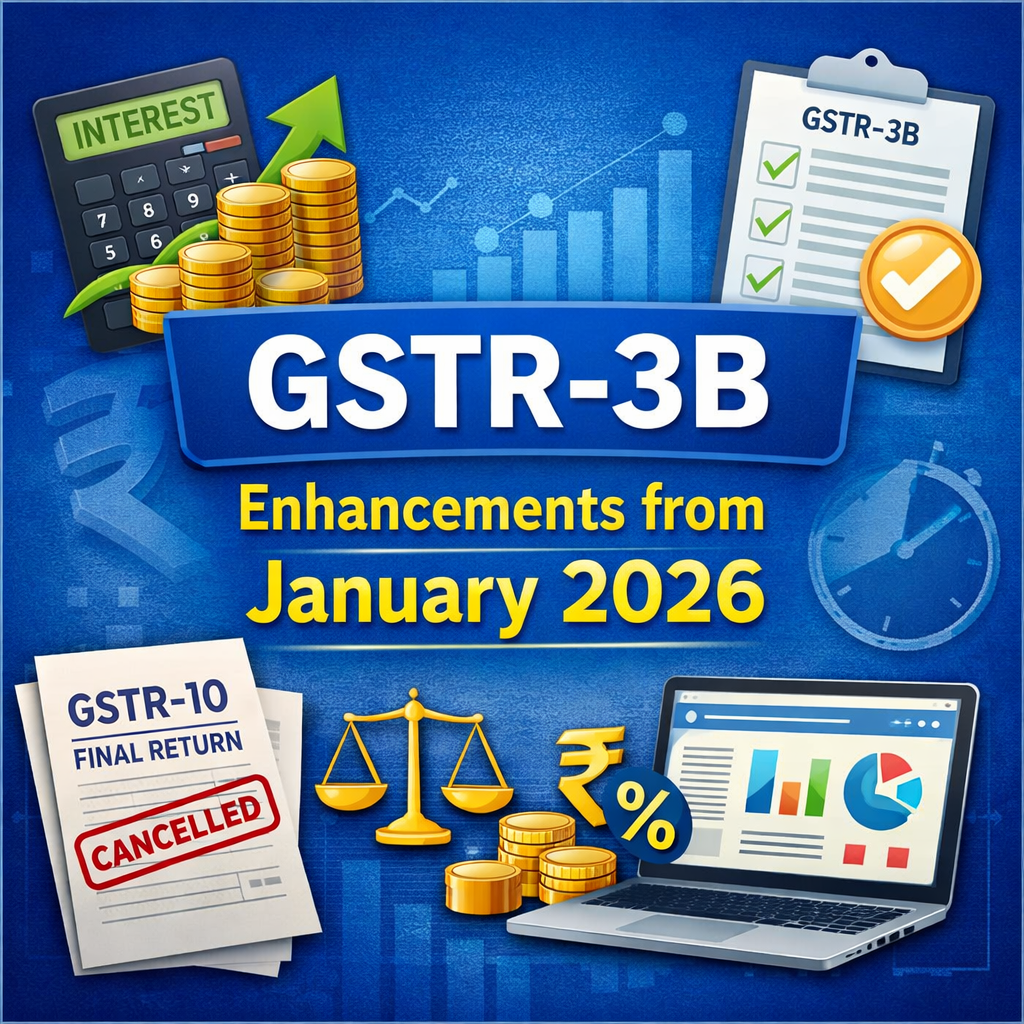
The GST Network has issued an important advisory titled “Advisory on Interest Collection and Related Enhancements in GSTR-3B”, bringing multiple system-level changes in the filing of Form GSTR-3B, effective from the January-2026 tax period onwards.

These changes primarily focus on:

  • Revised interest computation methodology
  • System-driven population of tax liability breakup
  • Flexibility in ITC cross-utilisation
  • Interest recovery in GSTR-10 for cancelled registrations

The enhancements aim to align portal functionality with Section 50 of the CGST Act, 2017 and Rule 88B of the CGST Rules, 2017, while reducing disputes and ensuring fair interest computation.


Update in Interest Computation for GSTR-3B (Table 5.1)

1.1 What Has Changed from January-2026?

From the January-2026 tax period onwards, the interest calculation in Table 5.1 of GSTR-3B has been enhanced to provide relief to taxpayers by factoring in the minimum cash balance available in the Electronic Cash Ledger (ECL).

This change is made in line with the proviso to Rule 88B(1) of the CGST Rules, 2017.

➡️ Practical impact:
If a taxpayer had sufficient cash balance lying in the Electronic Cash Ledger from the due date of return till the actual date of tax payment (offset), interest will not be charged on that portion.


Applicability Timeline

  • Applicable for delayed GSTR-3B returns of January-2026
  • Interest will be auto-populated in February-2026 GSTR-3B

Revised Interest Computation Formula

Interest = (Net Tax Liability – Minimum Cash Balance in ECL from due date to date of debit)
× (Number of days delayed ÷ 365)
× Applicable Interest Rate

Tax Planning Service

Key Takeaway

Earlier, interest was calculated on the entire net cash liability. Now, idle cash balance already available with the Government is reduced before interest computation — a major relief for compliant taxpayers.


System-Computed Interest in Table 5.1 – Now Non-Editable

Non-Editable Downward

From January-2026 onwards:

Taxpayer Education Course
  • Interest auto-populated in Table 5.1 will be non-editable downward
  • Taxpayers cannot reduce the system-computed interest

Upward Modification Allowed

  • Auto-populated interest represents minimum interest payable
  • Taxpayers must self-assess their correct interest liability
  • Upward modification is permitted, if required

➡️ Compliance Note:
Responsibility of correct interest payment continues to rest with the taxpayer, despite system computation.


Auto-Population of Tax Liability Breakup Table in GSTR-3B

What Is the Tax Liability Breakup Table?

This table captures:

  • Supplies pertaining to previous tax periods
  • Reported in current period
  • For which tax is being paid now

New Enhancement from January-2026

The GST Portal will auto-populate the Tax Liability Breakup Table based on:

  • Document dates
  • Supplies reported in:
    • GSTR-1
    • GSTR-1A
    • IFF
  • Pertaining to earlier tax periods
  • Where tax liability is discharged in current GSTR-3B

Objective of This Enhancement

  • Accurate period-wise allocation of tax
  • Correct interest computation as per proviso to Section 50 of CGST Act
  • Reduction in manual errors and litigation

Important Characteristics

  • Auto-populated values are suggestive in nature
  • Taxpayers may revise the figures upwards
  • Downward revision may attract scrutiny

Navigation Path on Portal

Login → GSTR-3B Dashboard → Table 6.1 (Payment of Tax) → Tax Liability Breakup


Update in Table 6.1 – Suggestive Cross-Utilisation of ITC

Change in ITC Utilisation Logic

From January-2026 onwards:

  • Once IGST ITC is fully exhausted
  • The portal will allow payment of IGST liability
  • Using CGST and SGST ITC in any sequence

Benefit to Taxpayers

  • Increased flexibility
  • Reduced working capital blockage
  • Alignment with judicial interpretations on ITC utilisation

Collection of Interest in GSTR-10 for Cancelled Taxpayers

New Provision Introduced

For cancelled GST registrations:

  • If the last applicable GSTR-3B is filed after due date
  • Interest on delayed filing shall be:
    • Levied
    • Collected through Final Return (GSTR-10)

Practical Implication

Taxpayers can no longer avoid interest liability merely because registration is cancelled. Interest compliance is now linked to GSTR-10 filing.


Overall Impact & Professional Analysis

Area Impact
Interest Computation Fair, cash-balance adjusted
Editability System minimum enforced
Tax Liability Allocation Automated & document-driven
ITC Utilisation Flexible & taxpayer-friendly
Cancelled Registrations Interest leakage plugged

The January-2026 enhancements in GSTR-3B mark a significant shift towards system-driven, legally aligned GST compliance. While automation reduces errors, self-assessment responsibility remains intact. Taxpayers and professionals must closely monitor cash ledger balances, document dates, and interest computation, especially in delayed filings and past-period adjustments.

GST New Valuation Rules Effective 1 February 2026: Tax Applicability Shifted to MRP

GSTN Advisory on RSP-Based Valuation for Notified Tobacco Goods

Clarification on Reporting Taxable Value and Tax Liability

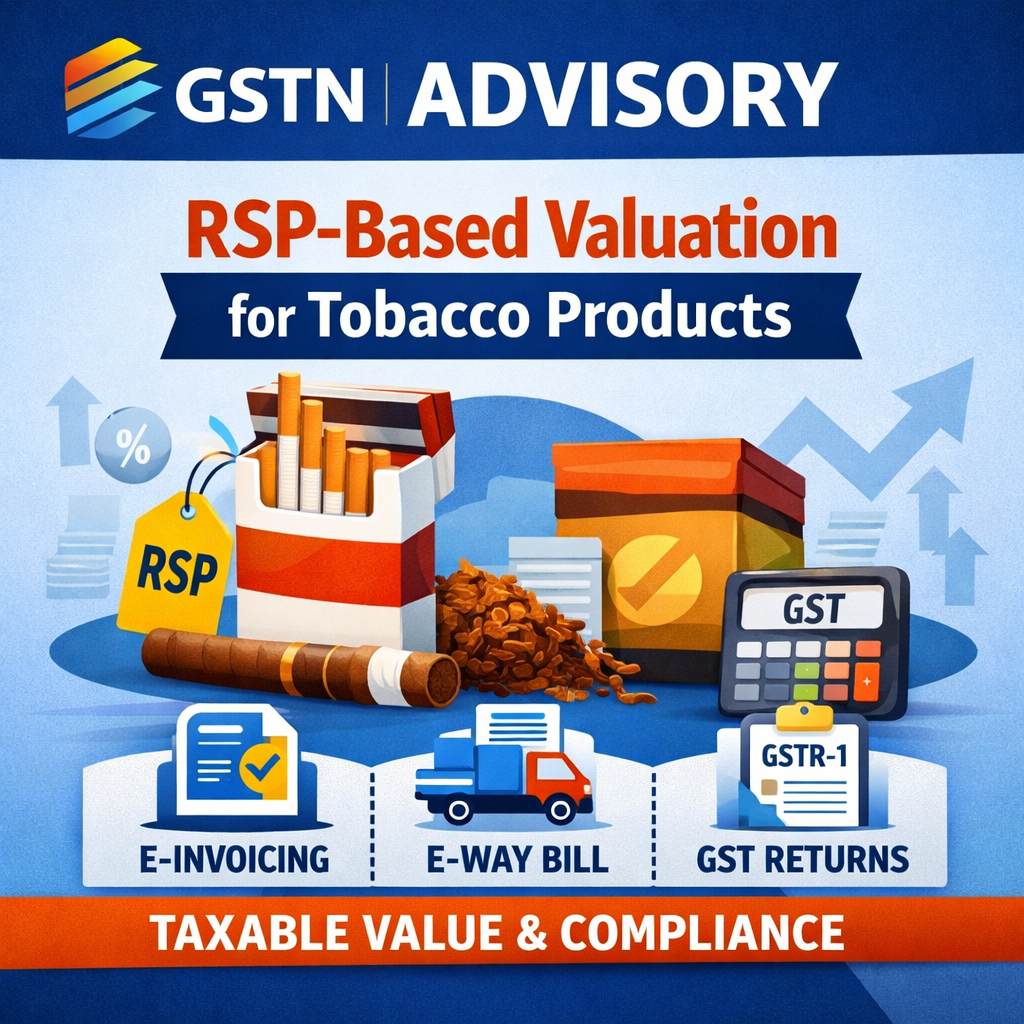
The GST Network (GSTN) has issued an important advisory clarifying the manner of reporting taxable value and tax liability for notified tobacco goods taxed under RSP-based valuation. The clarification covers reporting requirements across e-Invoice, e-Way Bill, and GST returns (GSTR-1 / GSTR-1A / IFF).

This update is critical for manufacturers, wholesalers, distributors, and all taxpayers dealing in tobacco products notified for valuation based on Retail Sale Price (RSP).


1. Background: RSP-Based Valuation under GST

Under GST provisions, certain notified goods—particularly tobacco products—are subject to tax based on the Retail Sale Price (RSP) printed on the package, after allowing the prescribed abatement, rather than the actual transaction value.

In essence:

  • GST is not calculated on invoice value

  • GST is calculated on RSP minus notified abatement

  • This method is mandated under Section 15(4) of the CGST Act, read with relevant notifications


2. Objective of the GSTN Advisory

The advisory has been issued to:

  • Ensure consistent reporting of taxable value under RSP-based valuation

  • Prevent mismatches between reported value and tax liability

  • Align data reported in e-Invoice, e-Way Bill, and GST returns

  • Minimise system-generated notices and scrutiny due to incorrect valuation


3. Key Clarification by GSTN

(A) Taxable Value to be Reported

For notified tobacco goods covered under RSP-based valuation:

  • Taxable value must be the RSP-based value (after abatement)

  • Transaction value or invoice value must not be treated as taxable value

This principle applies uniformly across:

  • e-Invoice

  • e-Way Bill

  • GSTR-1 / GSTR-1A

  • Invoice Furnishing Facility (IFF)


4. Reporting in e-Invoice

While generating e-Invoices for notified tobacco goods:

  • The taxable value field must reflect:

    • RSP

    • Less: notified abatement

    • Resulting assessable value

  • GST rate and tax amount must be computed on this RSP-based taxable value

  • A difference between invoice value and taxable value is legally permissible

Common error to avoid:
Reporting transaction value as taxable value in the e-Invoice, leading to incorrect tax calculation.


5. Reporting in e-Way Bill

For e-Way Bill generation:

  • Taxable value must strictly follow RSP-based valuation

  • Auto-populated values from e-Invoice should not be incorrectly modified

  • Discrepancies between e-Invoice and e-Way Bill data may trigger system alerts


6. Reporting in GSTR-1 / GSTR-1A / IFF

In GST returns:

  • Outward supply details must reflect RSP-based taxable value and correct tax liability

  • This ensures accurate reflection in the recipient’s GSTR-2B

  • Prevents mismatch between tax paid and supplies reported

  • IFF filers must also strictly adhere to this valuation method


7. Impact on Taxpayers

This advisory directly affects:

  • Tobacco manufacturers

  • Cigarette traders

  • Wholesalers and distributors of notified tobacco goods

Incorrect reporting may result in:

  • System-generated notices

  • Return mismatches

  • Audit and assessment issues

  • Demand for differential tax along with interest and penalties


8. Recommended Action Points

Taxpayers should immediately:
✔ Review ERP and billing system configurations
✔ Ensure RSP-based valuation logic is correctly implemented
✔ Train accounting and compliance teams
✔ Reconcile taxable value across e-Invoice, e-Way Bill, and GSTR-1 / IFF
✔ Refer to the detailed GSTN advisory for technical guidance


Conclusion

The GSTN advisory dated 23 January 2026 provides crucial clarity on compliance requirements for notified tobacco goods under RSP-based valuation. Accurate reporting of taxable value across all GST systems is essential to avoid disputes and ensure seamless compliance.

Taxpayers are advised to promptly align their invoicing and return-filing processes with this clarification to remain fully GST-compliant.

Understanding GST Compliance and Reconciliation with Easy Smart Shop Software

GST (Goods and Services Tax) has revolutionized the Indian taxation system since its introduction in 2017. It has simplified the tax structure by replacing multiple indirect taxes with a unified tax regime. To ensure compliance and streamline the tax process, businesses need to understand various aspects of GST, including GSTR-1, GSTR-3B, GST rates, and the importance of reconciling GSTR-2A and GSTR-2B. In this article, we will explore these concepts and how Easy Smart Shop Software can help businesses navigate through the complexities of GST.

GSTR-1: Return for Outward Supplies

GSTR-1 is a monthly or quarterly return that businesses need to file to provide details of their outward supplies of goods or services. It includes information such as the invoice number, taxable value, and GST rate applicable. GSTR-1 is crucial for the recipient to claim input tax credit and for the government to verify the tax liability of the supplier.

GSTR-3B: Summary Return

GSTR-3B is a monthly return that businesses need to file to provide a summary of their sales and purchases. It includes details of the tax liability and input tax credit claimed. GSTR-3B acts as a self-assessment tool for businesses to report their tax liability and pay any outstanding tax dues.

GST Rates

GST rates are categorized into different slabs: 5%, 12%, 18%, and 28%. These rates vary depending on the nature of goods or services. It is essential for businesses to correctly identify the applicable GST rate for their products or services to ensure accurate tax calculation and compliance.

GSTR-2A Reconciliation

GSTR-2A is an auto-generated return that reflects the details of inward supplies of goods or services as uploaded by the supplier. It acts as a ready reckoner for the recipient to verify and reconcile their purchases with the supplier’s data. Reconciliation of GSTR-2A helps in identifying any discrepancies and ensures that the input tax credit claimed is accurate.

GSTR-2B Reconciliation

GSTR-2B is a new form introduced by the government to provide a static view of the inward supplies and input tax credit available. It includes details of the purchases made from registered suppliers and the input tax credit available for utilization. Reconciling GSTR-2B helps businesses in verifying the accuracy of their input tax credit claims and identifying any missed opportunities for claiming credit.

Easy Smart Shop Software: Simplifying GST Compliance

Managing GST compliance and reconciliation can be a daunting task for businesses, especially when dealing with a large volume of transactions. This is where Easy Smart Shop Software comes into play. It is a comprehensive software solution that automates various aspects of GST compliance, making it easier for businesses to stay on top of their tax obligations.

With Easy Smart Shop Software, businesses can generate GSTR-1 and GSTR-3B returns effortlessly. The software ensures accurate calculation of tax liability and input tax credit, minimizing the chances of errors. It also provides real-time updates on the applicable GST rates, ensuring businesses apply the correct rates to their products or services.

The software’s advanced reconciliation features help businesses reconcile their GSTR-2A and GSTR-2B data with ease. It automatically identifies discrepancies, missing invoices, and any potential errors in the input tax credit claimed. This ensures businesses claim the right amount of input tax credit and avoid any penalties or audits.

In conclusion, understanding and complying with GST regulations are crucial for businesses operating in India. By familiarizing themselves with concepts such as GSTR-1, GSTR-3B, GST rates, and reconciling GSTR-2A and GSTR-2B, businesses can ensure accurate tax reporting and minimize compliance risks. Easy Smart Shop Software acts as a reliable tool to simplify GST compliance, making it an essential asset for businesses navigating the complexities of GST.