
🔹 Income Tax Relief for Individuals There may be further rationalisation of income tax slabs, higher basic exemption limits, or enhancements in standard deduction to boost disposable income.
Union Budget 2026 – Overview and Expectations
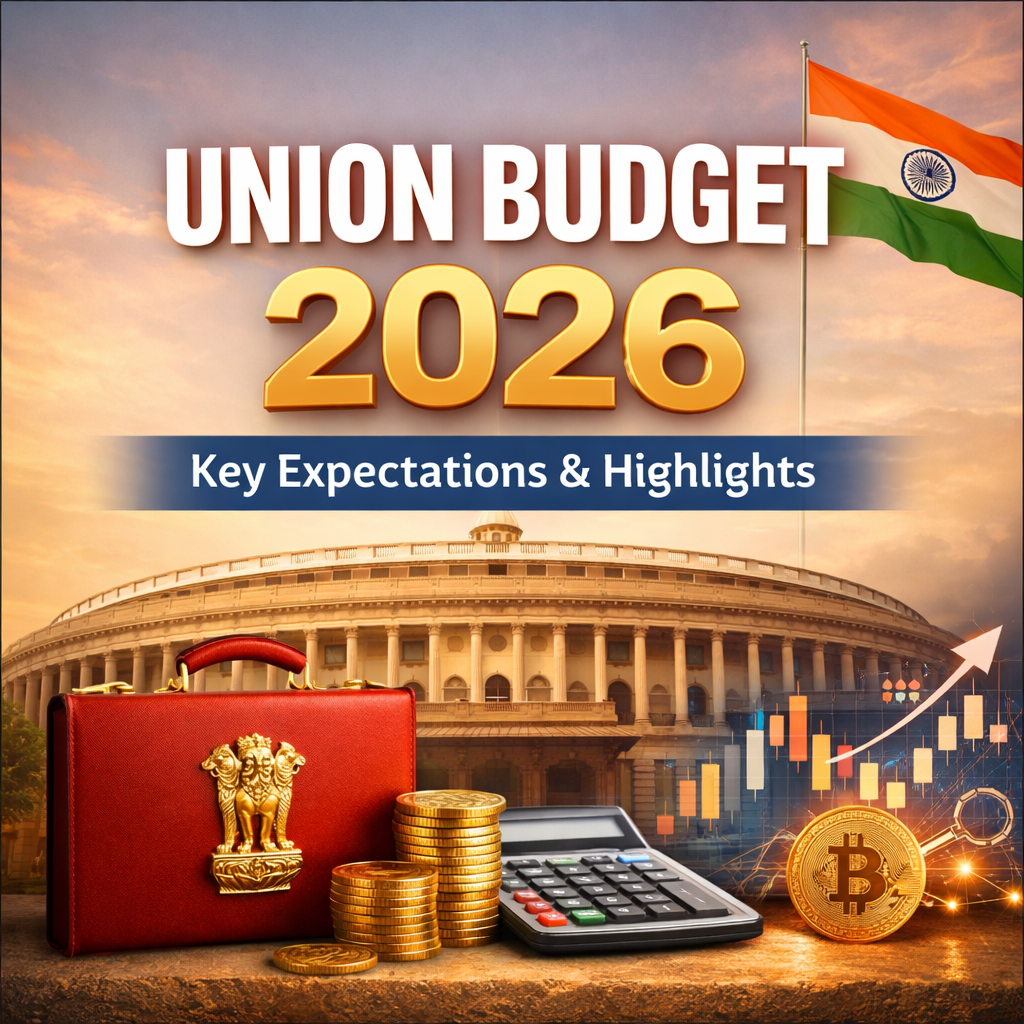
India’s Union Budget 2026 is slated to be presented on 1 February 2026 (Sunday) by the Finance Minister. Although presenting the Budget on a Sunday had earlier triggered discussion, it has now been formally confirmed, and the government is fully prepared for this key fiscal announcement.
This Budget assumes added significance as it follows the introduction of the Income-tax Act, 2025, which focused mainly on simplifying legal language and compliance procedures rather than making major policy changes. As a result, Budget 2026 is expected to carry the primary burden of announcing substantive tax and regulatory reforms.
I. Economic Background & Budget Direction
India’s macroeconomic position remains relatively stable, supported by steady growth, moderated inflation, and sustained investment in infrastructure. Budget 2026 is expected to strike a careful balance between managing fiscal pressures in the short term and driving long-term structural reforms.
The government is likely to continue prioritising capital expenditure, welfare schemes, digital transformation, and regulatory certainty, with focused attention on sectors such as agriculture, healthcare, women empowerment, start-ups, and emerging areas of the new digital economy.
II. Key Expectations from Budget 2026
1. Taxation – Areas of Anticipated Change
Personal Income Tax
Large-scale rate cuts are not widely expected; however, revisions in tax slabs, exemption limits, or thresholds may be introduced to improve household spending power and stimulate consumption.
Capital Gains Tax
Existing capital gains provisions are under review. Rationalisation measures may be announced to improve clarity, simplify compliance, and encourage investment activity.
TDS Simplification
The government may streamline TDS provisions to reduce administrative and compliance challenges faced by businesses and taxpayers.
ESOPs and Foreign Tax Credit
Budget 2026 may bring clarity or relief measures related to ESOP taxation, particularly for employees of multinational companies, along with smoother mechanisms for claiming Foreign Tax Credit.
2. Sectoral and Social Priorities
Women-Centric Initiatives
Expect announcements aimed at improving women’s participation in the workforce, access to finance, skill development, and social security.
Agriculture and Rural Economy
Measures may include enhanced credit availability, farm modernisation programs, and targeted income-support mechanisms for farmers and rural households.
Senior Citizens
The government may extend or enhance benefits related to healthcare, savings, and taxation for senior citizens.
III. Virtual Digital Assets (Cryptocurrency) – Emerging Developments
1. Enhanced Monitoring, AML & KYC Framework
In early January 2026, the Financial Intelligence Unit (FIU) introduced tighter AML and KYC norms for crypto exchanges and VDA service providers. These measures aim to align the crypto ecosystem with mainstream financial regulations and improve traceability. Key elements include:
-
Live selfie verification using liveness detection to prevent misuse of static images or deepfakes
-
Geo-location capture, including latitude, longitude, IP address, date, and time for onboarding and transactions
-
Expanded KYC documentation, requiring PAN plus an additional government-issued ID along with OTP verification
-
Bank account authentication through penny-drop verification
-
Periodic KYC updates, with more frequent reviews for high-risk users
-
Continuous transaction monitoring and reporting of suspicious activities
These steps reflect the government’s intent to curb money laundering, terror financing, fraud, and misuse of anonymous crypto transactions, while strengthening investor confidence and systemic oversight.
2. Crypto Taxation – Industry Expectations
Under the current framework:
-
Gains from VDAs are taxed at a flat 30%, without allowing loss set-off
-
A 1% TDS applies on each transaction, which industry participants argue restricts liquidity and pushes traders to overseas platforms
For Budget 2026, crypto stakeholders are seeking:
-
Reduction in TDS (suggested at 0.01%) to improve market liquidity
-
Permission to offset losses against gains, bringing parity with other asset classes
-
More nuanced tax treatment, possibly based on holding period or integration with slab-based taxation
There is also discussion around establishing a clear regulatory authority structure, potentially involving SEBI for exchange oversight and RBI for cross-border monitoring, subject to Budget and post-Budget policy announcements.
IV. Indirect Tax and Regulatory Environment
GST and Customs
-
Industry is likely to seek GST rate rationalisation and faster processing of refunds
-
Customs duty structures may be reworked to support domestic manufacturing, technology adoption, and exports
Regulatory Coordination
Efforts are ongoing to move toward a single, well-defined regulatory framework for VDAs, reducing overlap among regulators and improving compliance clarity.
V. Core Themes Likely to Shape Budget 2026
| Area | Anticipated Focus |
|---|---|
| Taxation & Compliance | Slab rationalisation, TDS simplification, crypto tax clarity |
| Digital Assets | Stronger oversight, tracking mechanisms, regulatory structure |
| Women & Social Welfare | Financial inclusion, employment, empowerment schemes |
| Agriculture & Rural Development | Farmer support, rural infrastructure |
| Senior Citizens | Health coverage and tax relief |
| Infrastructure & Capex | Continued emphasis on public investment |
| Technology & Innovation | R&D incentives, AI and digital economy push |
| Indirect Taxes | GST simplification and customs duty rationalisation |
In essence, Budget 2026 is expected to focus on stability, reform, and future readiness—combining fiscal prudence with growth-oriented policy measures across taxation, technology, and social development.