
GST New Valuation Rules Effective 1 February 2026: Tax Applicability Shifted to MRP
GSTN Advisory on RSP-Based Valuation for Notified Tobacco Goods
Clarification on Reporting Taxable Value and Tax Liability
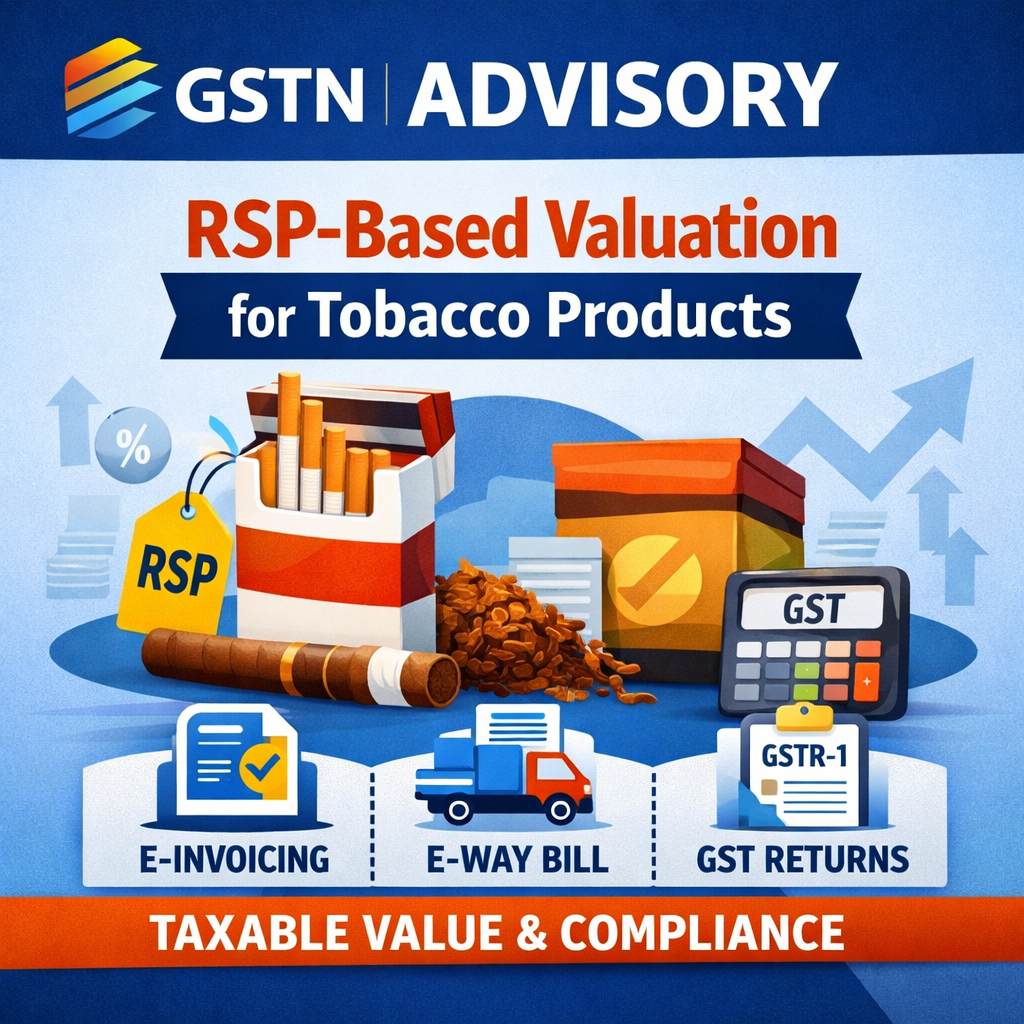
The GST Network (GSTN) has issued an important advisory clarifying the manner of reporting taxable value and tax liability for notified tobacco goods taxed under RSP-based valuation. The clarification covers reporting requirements across e-Invoice, e-Way Bill, and GST returns (GSTR-1 / GSTR-1A / IFF).
This update is critical for manufacturers, wholesalers, distributors, and all taxpayers dealing in tobacco products notified for valuation based on Retail Sale Price (RSP).
1. Background: RSP-Based Valuation under GST
Under GST provisions, certain notified goods—particularly tobacco products—are subject to tax based on the Retail Sale Price (RSP) printed on the package, after allowing the prescribed abatement, rather than the actual transaction value.
In essence:
-
GST is not calculated on invoice value
-
GST is calculated on RSP minus notified abatement
-
This method is mandated under Section 15(4) of the CGST Act, read with relevant notifications
2. Objective of the GSTN Advisory
The advisory has been issued to:
-
Ensure consistent reporting of taxable value under RSP-based valuation
-
Prevent mismatches between reported value and tax liability
-
Align data reported in e-Invoice, e-Way Bill, and GST returns
-
Minimise system-generated notices and scrutiny due to incorrect valuation
3. Key Clarification by GSTN
(A) Taxable Value to be Reported
For notified tobacco goods covered under RSP-based valuation:
-
✅ Taxable value must be the RSP-based value (after abatement)
-
❌ Transaction value or invoice value must not be treated as taxable value
This principle applies uniformly across:
-
e-Invoice
-
e-Way Bill
-
GSTR-1 / GSTR-1A
-
Invoice Furnishing Facility (IFF)
4. Reporting in e-Invoice
While generating e-Invoices for notified tobacco goods:
-
The taxable value field must reflect:
-
RSP
-
Less: notified abatement
-
Resulting assessable value
-
-
GST rate and tax amount must be computed on this RSP-based taxable value
-
A difference between invoice value and taxable value is legally permissible
Common error to avoid:
Reporting transaction value as taxable value in the e-Invoice, leading to incorrect tax calculation.
5. Reporting in e-Way Bill
For e-Way Bill generation:
-
Taxable value must strictly follow RSP-based valuation
-
Auto-populated values from e-Invoice should not be incorrectly modified
-
Discrepancies between e-Invoice and e-Way Bill data may trigger system alerts
6. Reporting in GSTR-1 / GSTR-1A / IFF
In GST returns:
-
Outward supply details must reflect RSP-based taxable value and correct tax liability
-
This ensures accurate reflection in the recipient’s GSTR-2B
-
Prevents mismatch between tax paid and supplies reported
-
IFF filers must also strictly adhere to this valuation method
7. Impact on Taxpayers
This advisory directly affects:
-
Tobacco manufacturers
-
Cigarette traders
-
Wholesalers and distributors of notified tobacco goods
Incorrect reporting may result in:
-
System-generated notices
-
Return mismatches
-
Audit and assessment issues
-
Demand for differential tax along with interest and penalties
8. Recommended Action Points
Taxpayers should immediately:
✔ Review ERP and billing system configurations
✔ Ensure RSP-based valuation logic is correctly implemented
✔ Train accounting and compliance teams
✔ Reconcile taxable value across e-Invoice, e-Way Bill, and GSTR-1 / IFF
✔ Refer to the detailed GSTN advisory for technical guidance
Conclusion
The GSTN advisory dated 23 January 2026 provides crucial clarity on compliance requirements for notified tobacco goods under RSP-based valuation. Accurate reporting of taxable value across all GST systems is essential to avoid disputes and ensure seamless compliance.
Taxpayers are advised to promptly align their invoicing and return-filing processes with this clarification to remain fully GST-compliant.
