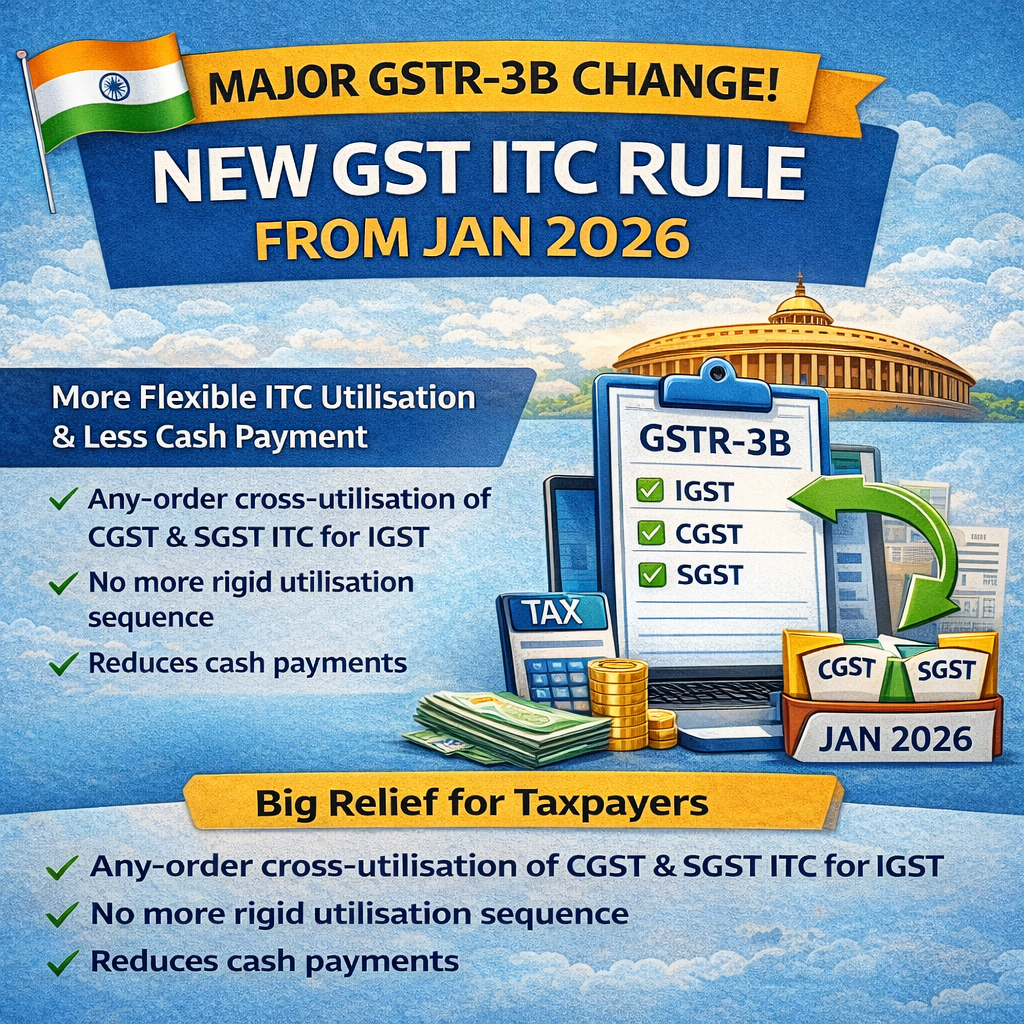
GSTR-3B Changes from Feb 2026: New GST ITC Rules Bring Relief to Taxpayers

To reduce taxpayer hardship, the GST Portal will roll out a major change in ITC utilisation from the January 2026 return period, relaxing the rigid utilisation sequence followed earlier.

1. Earlier ITC Set-Off Rule – Compliance Challenge

Statutory Position (Earlier Framework)

Under the earlier GST law and portal system, Input Tax Credit utilisation was subject to a strict and compulsory sequence:

  • IGST ITC was required to be utilised first:

    • Against IGST liability

    • Then against CGST liability

    • Then against SGST liability

  • CGST ITC could be utilised only:

    • Against CGST liability

    • Then against IGST liability

  • SGST ITC could be utilised only:

    • Against SGST liability

    • Then against IGST liability

Direct cross-utilisation between CGST and SGST was not permitted.

Practical Difficulty for Taxpayers

Because of this rigid utilisation order, taxpayers often had to make cash payments, even when sufficient ITC was available under a different tax head. This resulted in blocked credits and avoidable cash outflow.

Illustration – Earlier Rule (Before January 2026)

Output Tax Liability

  • IGST: ₹1,00,000

  • CGST: ₹40,000

  • SGST: ₹40,000

Available ITC

  • IGST ITC: ₹1,00,000

  • CGST ITC: ₹50,000

  • SGST ITC: ₹50,000

Utilisation as per Earlier Rules

  • IGST ITC of ₹1,00,000 adjusted fully against IGST liability

  • CGST liability of ₹40,000 paid using CGST ITC

  • SGST liability of ₹40,000 paid using SGST ITC

✔ In this scenario, no hardship arose.

Problem Scenario Under Earlier Rules

  • Output IGST Liability: ₹80,000

  • Available ITC:

    • CGST ITC: ₹60,000

    • SGST ITC: ₹20,000

Under the old system:

  • CGST ITC could not be used to pay SGST

  • SGST ITC could not be used to pay CGST

Result:
Despite total ITC being sufficient, cash payment became unavoidable due to utilisation restrictions. This was a common and recurring compliance issue.


2. New ITC Utilisation Rule – Effective from January 2026

What Has Changed?

🔹 System-level modification in Table 6.1 of GSTR-3B

From the January 2026 tax period onwards, once IGST ITC is fully exhausted, the GST Portal will allow utilisation of CGST and SGST ITC for payment of IGST liability in any sequence.

📌 This flexibility is enabled through the GST Portal system, without changing the basic statutory framework.


3. Salient Features of the New Rule

  • Applicable only after full utilisation of IGST ITC

  • CGST and SGST ITC can be used in any order

  • Cross-utilisation permitted only for IGST liability

  • Implemented through automated portal logic in GSTR-3B

  • Reduces cash outflow and accumulation of idle ITC


4. Illustration – New Rule (From January 2026)

Output IGST Liability: ₹80,000

Available ITC

  • IGST ITC: Nil

  • CGST ITC: ₹60,000

  • SGST ITC: ₹20,000

Utilisation under New Rule

  • CGST ITC utilised: ₹60,000

  • SGST ITC utilised: ₹20,000

IGST liability fully discharged through ITC, with no cash payment

✔ Earlier: Cash payment was mandatory
✔ Now: Entire liability settled via ITC


5. Practical Impact on Taxpayers

✅ Significant Relief

  • Eliminates unnecessary cash payments

  • Prevents ITC pile-up under a single tax head

  • Improves liquidity and working capital efficiency

✅ Easier Compliance

  • System-driven utilisation suggestions

  • Reduced chances of manual errors

  • More logical and business-friendly ITC usage


6. Important Points to Remember

  • Direct cross-utilisation between CGST and SGST is still not allowed

  • Flexibility is permitted only for IGST liability

  • Applicable prospectively from January 2026

  • Taxpayers should analyse ITC balances before filing GSTR-3B
Budget 2026 Updates: Major Changes in GST Law

GST Changes Announced in Budget 2026 – Key Amendments Explained

The Finance Bill, 2026 proposes several significant amendments to the Central Goods and Services Tax Act, 2017 (CGST Act) with the intent of simplifying GST compliance, reducing litigation, and strengthening refund and appellate mechanisms.

Unless specifically stated otherwise, these amendments will become effective from a date to be notified, simultaneously with corresponding amendments by the States and Union Territories.


1. Amendment to Section 15(3): Post-Sale Discounts

Earlier Position

Post-sale discounts were allowed to be excluded from the value of supply only if:

  • The discount was agreed upon before or at the time of supply, and

  • The recipient reversed proportionate Input Tax Credit (ITC).

This condition led to frequent disputes where commercial discounts were offered after supply without explicit prior agreements.

Amendment Proposed (Finance Bill, 2026 – Clause 137)

  • The requirement of linking discounts to a pre-existing agreement has been removed.

  • Section 15(3) now allows exclusion of discounts based on issuance of a credit note under Section 34, subject to reversal of corresponding ITC by the recipient.

Impact

✔ Greater commercial flexibility
✔ Reduced valuation-related litigation
✔ Better alignment with real-world business practices


2. Amendment to Section 34: Credit Notes

Earlier Position

Section 34 did not explicitly link credit note provisions with valuation rules under Section 15, resulting in interpretational challenges.

Amendment Proposed (Clause 138)

  • Section 34 is amended to expressly reference Section 15.

Impact

✔ Clear legal linkage between valuation and credit notes
✔ Strengthens validity of post-sale discount adjustments
✔ Reduces objections during audits and assessments


3. Amendment to Section 54(6): Provisional Refund for Inverted Duty Structure

Earlier Position

Provisional refund of 90% was primarily available for zero-rated supplies, while refunds arising from Inverted Duty Structure (IDS) were excluded.

Amendment Proposed (Clause 139)

  • Provisional refund provisions are extended to IDS-related refunds.

Impact

✔ Improved cash flow for manufacturers
✔ Reduced working capital blockage
✔ Major relief for sectors with higher input tax rates


4. Amendment to Section 54(14): Removal of Refund Threshold Limit

Earlier Position

A threshold limit applied for sanctioning refunds, leading to procedural delays—especially for small exporters.

Amendment Proposed (Clause 139)

  • Threshold limit removed for refund claims relating to export of goods with payment of tax.

Impact

✔ Uniform refund processing
✔ Faster refunds for small exporters
✔ Reduced administrative discretion


5. Insertion of Section 101A(1A): Interim National Appellate Mechanism

Earlier Position

Conflicting Advance Ruling decisions were appealable to the National Appellate Authority (NAA), which was never constituted—leaving taxpayers without remedy.

Amendment Proposed (Clause 140)

  • New Section 101A(1A) empowers the Government to notify an existing authority or tribunal to hear such appeals until NAA is constituted.

  • Sub-sections (2) to (13) of Section 101A will not apply in such cases.

  • Explanation clarifies that “existing authority” includes a tribunal.

📌 Effective Date: 1 April 2026

Impact

✔ Resolves long-standing appellate vacuum
✔ Provides certainty in advance ruling disputes
✔ Strengthens GST dispute resolution framework


6. IGST Act Amendment: Place of Supply for Intermediary Services

Earlier Provision

Under Section 13(8)(b) of the IGST Act, intermediary services were deemed supplied at the location of the service provider, making overseas services taxable in India.

Amendment Proposed (Clause 141)

  • Section 13(8)(b) is omitted.

  • Place of supply will now be determined as per Section 13(2)—i.e., location of the recipient.

Impact

✔ Intermediary services to foreign clients qualify as export of services (subject to conditions)
✔ GST generally not applicable on such transactions
✔ Major relief for service exporters and consultants
✔ Long-pending litigation expected to subside


Conclusion

The GST amendments proposed in the Finance Bill, 2026 mark a decisive move toward taxpayer-friendly, litigation-free, and business-aligned GST administration. Key reforms in valuation, refunds, appellate remedies, and cross-border services are expected to significantly improve compliance efficiency and certainty.

Businesses and professionals should closely evaluate these changes and prepare for implementation once notified.