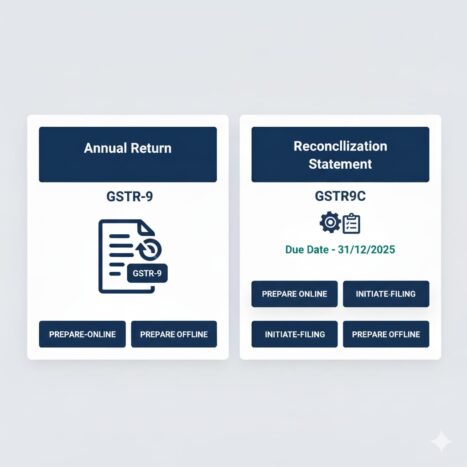
Filing of GSTR-9 and GSTR-9C for FY 2024-25 is now available on the GST Portal

✅ Recent Update

GSTR-9 (Annual Return) and GSTR-9C (Reconciliation Statement) for FY 2024-25 are now available on the GST Portal.

Taxpayers can now file their annual returns and reconciliation statements in line with the updated formats and instructions, which reflect the recent amendments in GST rules and legislation.

The deadline to file both forms, unless an extension is announced, is 31st December 2025.


🆕 GSTR-9 & 9C: Key Modifications for FY 2024-25

The revised forms include multiple updates based on recent amendments and notifications. Let’s go through them step by step:


1️⃣ Enhanced ITC Reporting and Reversal Requirements

  • Taxpayers are now required to submit more detailed information regarding Input Tax Credit (ITC).
  • Reversals must be reported separately as per Rules 37, 37A, 38, 42, and 43.

This is intended to enhance reconciliation accuracy and ensure proper tracking of ITC.
👉 Tip: Before submitting, thoroughly check reversal entries, reclaimed credits, and auto-filled data.


2️⃣ New Fields for Import and Transitional Credit Reporting

  • New fields have been introduced for reporting import-related ITC and transitional credits.
  • This promotes greater transparency for businesses importing goods or transferring credits from previous tax regimes.
    👉 Tip: Match your import details with the ICEGATE system and verify accuracy before submission.

3️⃣ Auto-Population of Data and Mismatch Handling

  • The updated forms automatically fetch data from GSTR-1, GSTR-3B, and GSTR-2B.

Several fields will be prefilled to minimize manual mistakes.
However, taxpayers should carefully verify and reconcile all details, as discrepancies may trigger future audits.

👉 Tip: Ensure sales, ITC, and outward supply figures are fully reconciled before filing.


4️⃣Late Fee and Interest Reporting Standardized

  • The revised guidelines mandate clear disclosure of any late fees or interest due under Section 47(2).
  • All filing delays must be reported transparently in the prescribed form.

👉 Tip: Do not use back-dated entries — ensure the actual delay period and corresponding charges are reported accurately.


5️⃣New Instructions with Relevant Rule References

  • The instructions for both GSTR-9 and GSTR-9C have been revised to enhance clarity and ease of understanding.
  • Table references and compliance logic have been simplified to minimize errors in interpretation

👉 Tip: Review the updated instruction sheet before beginning the filing process.

 

⚠️ Beyond the Investment: What Startup Fundraising Really Costs You

The Real Price of Raising Capital for Startups

Securing capital marks a defining milestone in every startup’s growth path. While attention often gravitates toward the headline valuation and total funds raised, it’s equally important to understand the actual cost of reaching that milestone.

Recognising these expenses isn’t merely about accounting accuracy — it’s about empowering founders to make informed financial and strategic choices.

Each phase of fundraising comes with its own financial commitments, and these must be anticipated well in advance. The reality is that many of these costs are borne by the startup, whether or not the deal eventually materialises. Proper planning helps safeguard liquidity and ensures the company remains financially stable throughout the fundraising journey.


Key Insight

Raising money can be expensive — and if unmanaged, these costs can quietly consume a notable portion of the very funds you aim to secure.

Expenses such as advisory retainers, legal and diligence fees, marketing costs, and months of lost operating focus can add up quickly. Without careful management, these can strain working capital and delay business progress.


Startup Fundraising Expenses

So, what exactly should founders plan and budget for? Let’s break it down.


1. Upfront Advisory Fees and Retainers

The first expense comes from hiring external experts — placement agents, venture advisors, or fundraising consultants. These professionals often charge monthly retainers to structure your raise, prepare materials, and coordinate investor outreach.

As of 2025, retainers generally range between £2,000 and £10,000 per month, lasting up to a year for larger rounds. Additionally, one-time engagement fees of 2%–5% of the fundraising target are often included.

💡 Tip: Always request a clear deliverables list — such as investor meetings or valuation reports — tied directly to any advance payments. Transparency ensures accountability and value.


2. Success Fees or Commissions

Nearly all intermediaries charge a success-based commission, usually between 3%–7% of total funds raised. On a £1 million round, a 5% fee means £50,000 payable upon closing.

Check whether the commission applies to gross commitments or the net received after deductions, and confirm whether it’s due on signing or on fund transfer.


3. Legal & Advisory Costs

Legal counsel is essential for drafting, reviewing, and negotiating term sheets. Expect to spend between £5,000 and £20,000 depending on deal complexity.

In some cases, investors may ask startups to cover a portion of their legal expenses — adding another £10,000 to £30,000. While cutting corners may seem tempting, solid legal advice protects against future liabilities.


4. Due Diligence Expenses

Investors conduct due diligence covering financial audits, IP verification, and compliance checks. While investors lead the process, startups often pay for supporting reports — ranging from £2,000 to £10,000.

Typical reimbursable costs include accounting verification, IP audits, and secure data room setup for document sharing.


5. Marketing & Investor Material Costs

A strong pitch requires professional storytelling. External support for pitch decks, videos, and financial models can cost:

  • Deck design: £1,000–£5,000

  • Investor video: £2,000–£10,000

  • Financial modelling: £1,000–£5,000

Though optional, polished materials can increase investor engagement by 20–30%.


6. Travel & Investor Meetings

Despite digital tools, many investors prefer in-person meetings. Factor in £1,000–£5,000 for travel, accommodation, and event participation.


7. Time & Opportunity Costs

Fundraising can take 3–9 months — time the founder could otherwise spend on customers or product development. This hidden cost often outweighs direct expenses and must be acknowledged in strategic planning.


8. Post-Funding Obligations

Even after funding closes, administrative and investor management costs persist — such as board meetings, statutory filings, and audit requirements. These recurring commitments should be part of your long-term forecast.


Budgeting Smartly for Fundraising

  • List every cost: Treat fundraising as its own project with a detailed budget.

  • Demand transparency: Get written confirmation of all fees and conditions from intermediaries.

  • Negotiate structure: See if retainers can be adjusted against final fees or legal costs capped.

  • Add a buffer: Always include a 10–20% contingency for unforeseen expenses.

Accounting & Finance: Top Q3 2025 Earnings Influencing Market Trends

As companies worldwide unveil their Q3 2025 earnings, traders and investors are getting a clearer picture of the global economy’s momentum — and its weak spots.

From tech giants to retailers, every sector is revealing something about consumer strength, inflation impact, and investor confidence.


Key Takeaway

Quarter three results are shaping global market sentiment. Strong tech earnings are boosting optimism, while consumer and retail sectors show growing caution.

For traders, even one comment in an earnings call can send shockwaves through markets — making this season a critical moment to stay alert.


Tech Takes the Lead

Technology firms are once again driving global optimism.
AI, semiconductor, and cloud companies have delivered solid results, reassuring investors that last year’s growth wasn’t just a one-time surge.

And it’s not just Wall Street reacting — European and Asian markets are following suit, proving that tech continues to anchor global sentiment.


Retail Feels the Pressure

Retailers, however, are facing mounting challenges.
Rising tariffs, inflation, and changing consumer habits are eating into margins. Even companies showing higher revenues are struggling with shrinking profits.

The question remains: can consumer demand hold through the final quarter of 2025?


Financials and Real Estate: A Mixed Bag

Higher interest rates have helped banks with better margins but slowed loan growth.
Real estate firms are still adjusting to new demand dynamics, especially in major cities.

This mix makes financials tricky — one strong result can mask underlying weakness elsewhere.
Traders using flexible tools like CFDs can adapt quickly, hedging against risk while seizing short-term opportunities.


Themes Shaping Market Sentiment

  • Consumer Spending: Retail earnings continue to reflect household confidence (or lack thereof).

  • Interest Rates: Central bank signals can easily overshadow even strong results.

  • Currency Moves: Exchange rate fluctuations remain a key factor in cross-border earnings.

  • Geopolitics: Supply chain shifts and policy uncertainty keep volatility alive.


Sector Snapshot

Sector Trend Outlook
Tech Strong rebound Continued momentum
Retail Margin pressure Depends on consumer demand
Financials Mixed Sensitive to rate decisions
Energy Volatile Benefiting from price swings

Traders Should Ask:

  • Can tech maintain its growth pace into Q4?

  • Will consumers keep spending through higher costs?

  • Could higher rates hurt credit growth?

  • Are commodities still a safe hedge against volatility?


Setting the Tone for the Year-End

Q3 2025 earnings are setting the stage for how markets will close out the year.
Tech’s strength brings confidence, but consumer caution and sectoral divergence keep uncertainty high.

For traders, adaptability is the key — those watching closely and reacting quickly could find opportunity amid volatility.