
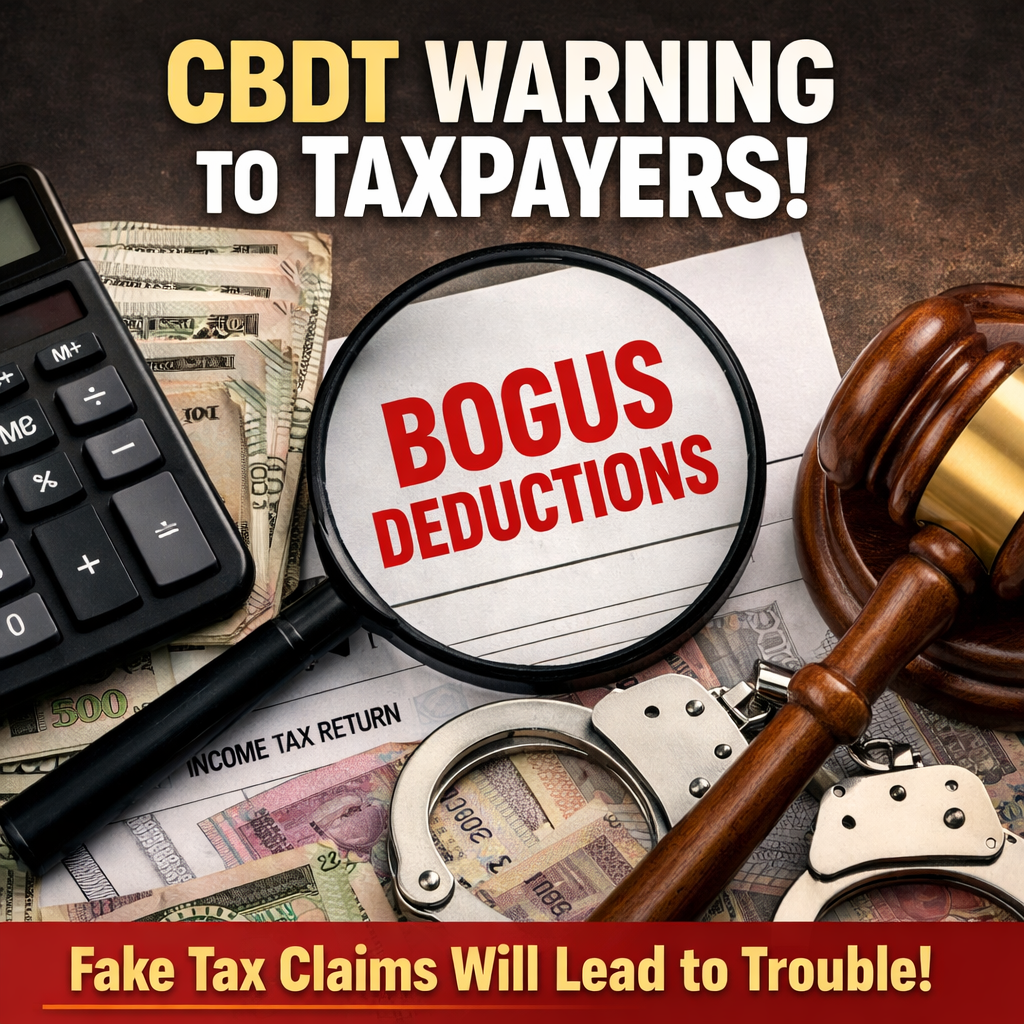

Bogus Claims पर CBDT की बड़ी पहल | करदाताओं को भेजे गए SMS-Email नोटिस
CBDT Flags Surge in Fake Deduction Claims: What Taxpayers Must Know
1. Context of the CBDT Press Release
The Income Tax Department has recently detected a sharp rise in incorrect and fraudulent claims of deductions and exemptions being reported in Income-tax Returns (ITRs). Investigations suggest that many of these claims were routed through intermediaries and agents operating nationwide on a commission-driven model.
In response, the Central Board of Direct Taxes (CBDT) has issued a firm advisory, cautioning taxpayers against such practices and urging them to voluntarily rectify incorrect claims.
2. Meaning of Bogus Deduction Claims
Bogus deduction claims are deductions or exemptions wrongly availed without actual eligibility, solely to reduce tax liability.
As per the CBDT, the most common areas of misuse include:
- Donations made to Registered Unrecognised Political Parties (RUPPs)
- Contributions shown to certain charitable institutions or trusts
- Claims lacking genuine receipts or documentary evidence
- Deductions backed by fabricated or altered documents
In several instances, intermediaries lured taxpayers with promises of inflated refunds in return for commissions.
3. Patterns and Methods Identified by the Department
Through investigation and data analysis, the Department uncovered that:
- Several RUPPs were either inactive or completely non-operational
- Many entities existed only on paper, with fake or unverifiable addresses
- Funds were moved through dummy or layered bank accounts
- Donation receipts were issued without any real charitable or political work
- These entries were later used by individuals and companies to suppress taxable income
Search and survey operations have already been conducted, and substantial incriminating evidence has been seized.
4. Deployment of Data Analytics and AI
The CBDT has upgraded its compliance framework using technology-led tools.
Key developments include:
- Use of advanced data analytics and AI-based risk assessment
- Cross-verification of data from:
- Income-tax returns
- Donation disclosures
- Bank transaction records
- Registration details of recipient entities
- Identification of high-risk behavioural trends among taxpayers
As a result, both genuine mistakes and deliberate misreporting are now easier to detect.
5. Provisions Under Scrutiny
The press release highlights close monitoring of deductions claimed under Section 80G of the Income-tax Act, 1961, which allows tax benefits for donations to approved institutions.
Other donation-related deduction provisions may also be examined if irregularities are noticed.
6. SMS and Email Alerts to Taxpayers
As part of a taxpayer-centric initiative, CBDT has rolled out a Targeted NUDGE Campaign.
Under this campaign:
- Taxpayers suspected of claiming incorrect deductions are receiving
- SMS notifications
- Email advisories
- These alerts are being sent from 12 December 2025 onwards
- Messages are delivered to registered mobile numbers and email addresses
The intent is corrective—not punitive—at this stage.
7. Chance to Rectify Through Revised or Updated Returns
CBDT has clarified that:
- Many taxpayers have already revised their returns for AY 2025–26
- Others have opted to file Updated Returns for earlier assessment years
Taxpayers are being encouraged to:
- Withdraw incorrect deduction claims
- Pay due tax along with applicable interest
- Avoid penalties and prosecution
This reflects the government’s philosophy of “trust first, enforce later.”
8. Risks of Ignoring the Advisory
Failure to act on the advisory may lead to:
- Selection of cases for scrutiny assessments
- Levy of penalties for under-reporting or misreporting income
- Initiation of prosecution in serious or repeat cases
- Action against intermediaries facilitating fraudulent claims
Ignoring the warning can therefore result in severe financial and legal consequences.
9. Immediate Steps for Taxpayers
Taxpayers should promptly:
- Re-examine their ITRs, especially donation-related deductions
- Verify the legitimacy of donee organisations, including approval status
- Ensure possession of valid and authentic receipts
- File a Revised or Updated Return if any error is discovered
- Update correct contact details on the Income Tax Portal
- Steer clear of agents offering “guaranteed refunds”
10. Final Message
The CBDT’s advisory serves both as a warning and an opportunity.
Only claim deductions you are genuinely eligible for.
Temporary gains through fake refunds can invite long-term legal trouble.
With technology-driven monitoring now firmly in place, tax evasion through bogus deductions is no longer hidden or risk-free.