Budget 2026 Income Tax Slab Rates for FY 2026-27 | AY 2027-28

Income Tax Rates as per Budget 2026 – FY 2026-27 (AY 2027-28)

No Change in Old Tax Regime Slab Rates

Union Budget 2026 has not made any changes to the income tax slab rates under the normal (old) tax regime. The slab structure applicable for FY 2026-27 continues to remain identical to FY 2025-26 for individuals, HUFs, companies, firms, and other assessees.

However, the new tax regime under Section 115BAC continues to apply with the revised slab rates introduced earlier, along with an enhanced rebate under Section 87A, making it the default regime for individuals.


1. Income Tax Rates – Individuals, HUF, AOP, BOI & AJP

(Old / Normal Tax Regime)

1.1 Individuals (Below 60 Years)

Net Income Tax Rate
Up to ₹2,50,000 Nil
₹2,50,001 – ₹5,00,000 5%
₹5,00,001 – ₹10,00,000 20%
Above ₹10,00,000 30%

✔ Rates unchanged for AY 2026-27 and AY 2025-26

1.2 Resident Senior Citizens (60–79 Years)

Net Income Tax Rate
Up to ₹3,00,000 Nil
₹3,00,001 – ₹5,00,000 5%
₹5,00,001 – ₹10,00,000 20%
Above ₹10,00,000 30%

1.3 Resident Super Senior Citizens (80 Years & Above)

Net Income Tax Rate
Up to ₹5,00,000 Nil
₹5,00,001 – ₹10,00,000 20%
Above ₹10,00,000 30%

1.4 HUF / AOP / BOI / Artificial Juridical Person

Net Income Tax Rate
Up to ₹2,50,000 Nil
₹2,50,001 – ₹5,00,000 5%
₹5,00,001 – ₹10,00,000 20%
Above ₹10,00,000 30%

2. Surcharge – Individuals, HUF, AOP & BOI

Total Income Surcharge
₹50 lakh – ₹1 crore 10%
₹1 crore – ₹2 crore 15%
₹2 crore – ₹5 crore 25%
Above ₹5 crore 37%

Important Clarifications

  • Higher surcharge not applicable on:

    • Dividend income

    • Capital gains under Sections 111A, 112, 112A & 115AD

  • Surcharge on such income capped at 15%

  • Marginal relief available at each surcharge slab


3. Health & Education Cess

  • Levied at 4% on income tax plus surcharge

  • Not applicable to specified funds under Section 10(4D) (in notified cases)


4. Rebate under Section 87A – Old Regime

  • Available to resident individuals

  • Total income up to ₹5,00,000

  • Maximum rebate: ₹12,500

  • Result: Nil tax liability


5. Alternate Minimum Tax (AMT)

  • Applicable where regular tax is less than 18.5% of adjusted total income

  • AMT rate for IFSC units earning foreign exchange income: 9%


6. New Tax Regime – Section 115BAC

(Default from AY 2024-25)

6.1 Slab Rates – AY 2026-27

Total Income Tax Rate
Up to ₹4,00,000 Nil
₹4,00,001 – ₹8,00,000 5%
₹8,00,001 – ₹12,00,000 10%
₹12,00,001 – ₹16,00,000 15%
₹16,00,001 – ₹20,00,000 20%
₹20,00,001 – ₹24,00,000 25%
Above ₹24,00,000 30%

6.2 Section 87A Rebate – New Regime

  • Available up to ₹12,00,000 income

  • Maximum rebate: ₹60,000

  • Marginal relief available

  • AMT not applicable under the new regime


7. Partnership Firms & LLPs

  • Flat tax rate: 30%

  • Surcharge: 12% if income exceeds ₹1 crore

  • Cess: 4%

  • AMT: 18.5% (9% for IFSC units)


8. Local Authorities

  • Tax rate: 30%

  • Surcharge, cess, and AMT same as partnership firms


9. Domestic Companies – Tax Rates

Category Tax Rate
Turnover ≤ ₹400 crore (FY 2023-24) 25%
Other domestic companies 30%

Special Tax Regimes

  • Section 115BAA: 22%

  • Section 115BAB (Manufacturing): 15%

  • Surcharge: Flat 10%


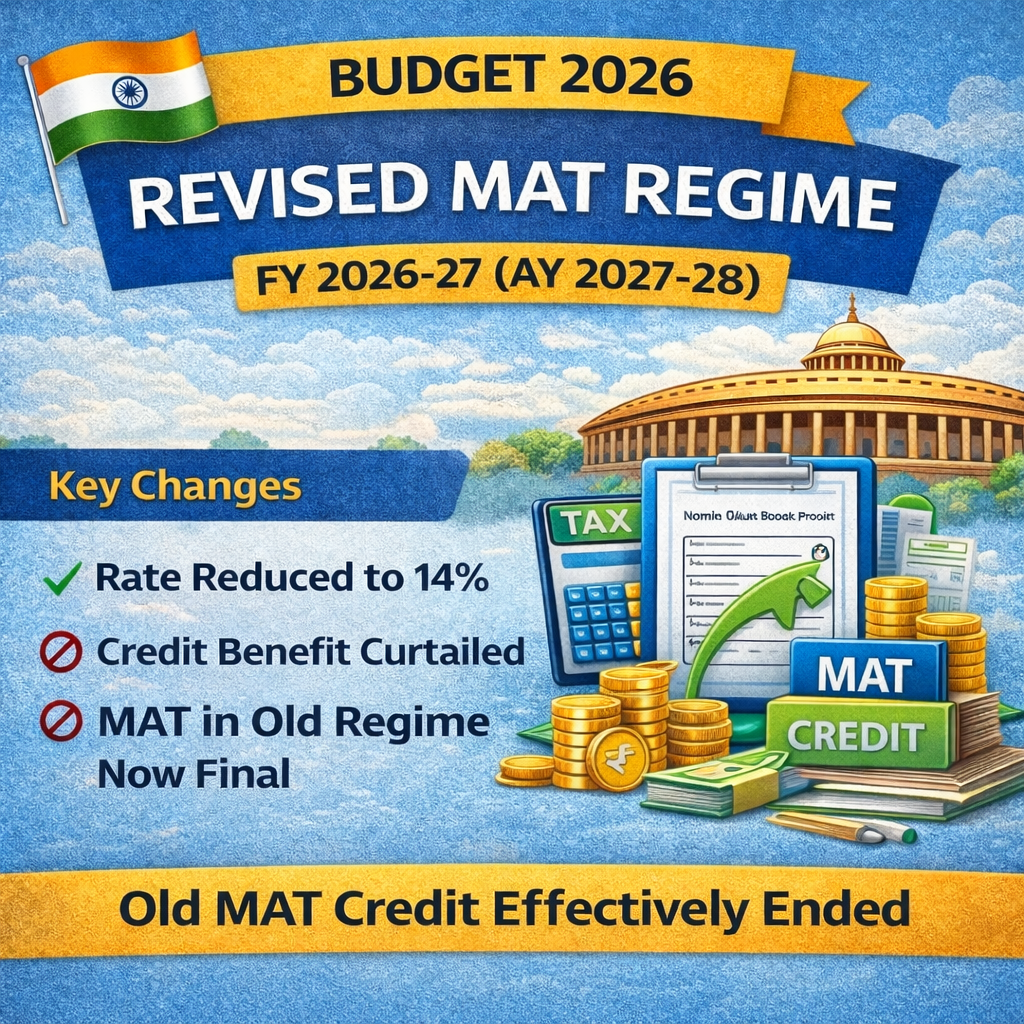
🔴 Major MAT Changes Introduced in Budget 2026

(Applicable from FY 2026-27 / AY 2027-28)

Key Reforms in Minimum Alternate Tax

(A) Reduction in MAT Rate

  • MAT rate reduced from 15% to 14%

  • Applicable to all companies except IFSC units

  • Surcharge and cess continue as applicable

(B) MAT to Become Final Tax under Old Regime

  • MAT paid under old regime will be treated as final tax

  • No fresh MAT credit allowed going forward

(C) Restriction on MAT Credit Set-off

  • Domestic Companies (New Regime):

    • MAT credit set-off limited to 25% of total tax liability

  • Foreign Companies:

    • Set-off allowed only to the extent normal tax exceeds MAT


10. Foreign Companies

Nature of Income Tax Rate
Royalty / FTS (old agreements) 50%
Other income 35%
  • Surcharge: 2% / 5%

  • Cess: 4%

  • MAT applicable unless exempted


11. Co-operative Societies

Normal Rates

Income Tax Rate
Up to ₹10,000 10%
₹10,001 – ₹20,000 20%
Above ₹20,000 30%

Optional Regimes

  • Section 115BAD: 22%

  • Section 115BAE (Manufacturing): 15%

  • AMT not applicable once opted

GSTR-3B Changes from Feb 2026: New GST ITC Rules Bring Relief to Taxpayers

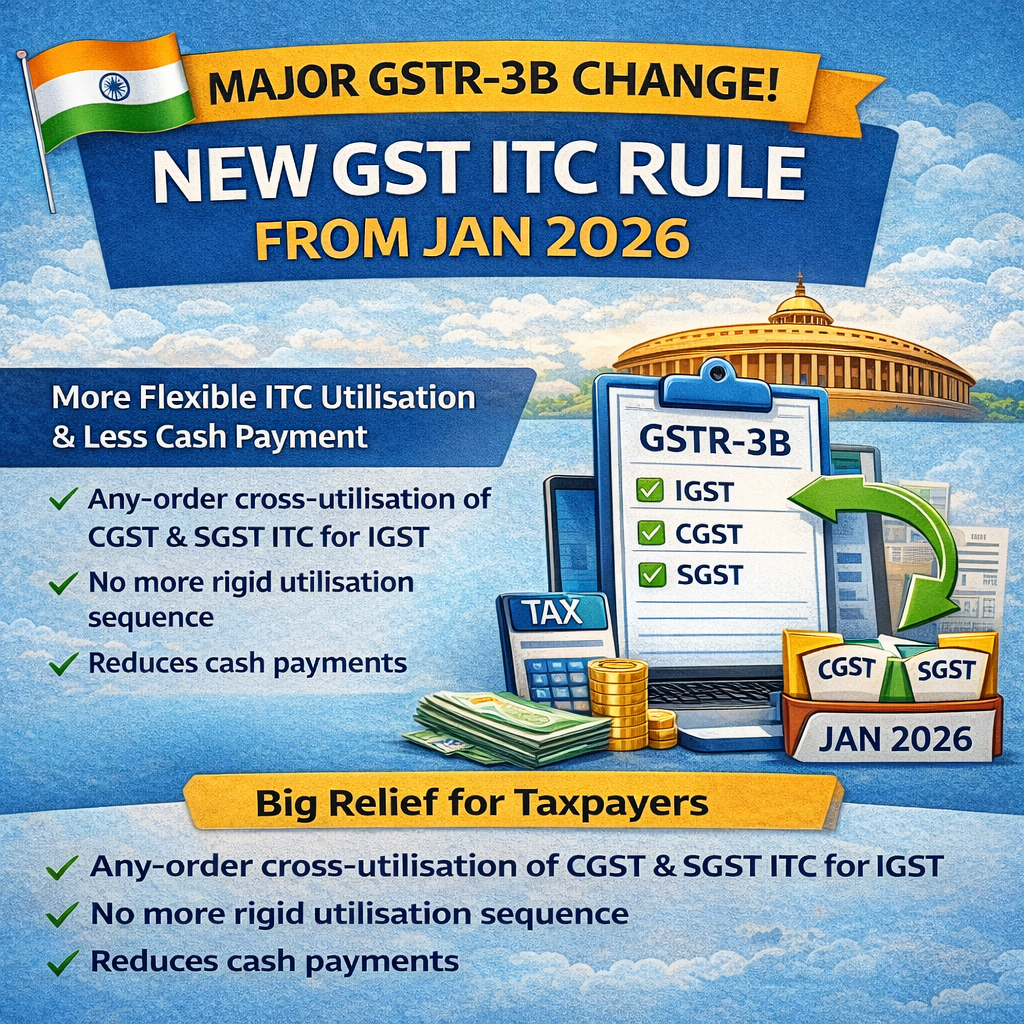
To reduce taxpayer hardship, the GST Portal will roll out a major change in ITC utilisation from the January 2026 return period, relaxing the rigid utilisation sequence followed earlier.

1. Earlier ITC Set-Off Rule – Compliance Challenge

Statutory Position (Earlier Framework)

Under the earlier GST law and portal system, Input Tax Credit utilisation was subject to a strict and compulsory sequence:

  • IGST ITC was required to be utilised first:

    • Against IGST liability

    • Then against CGST liability

    • Then against SGST liability

  • CGST ITC could be utilised only:

    • Against CGST liability

    • Then against IGST liability

  • SGST ITC could be utilised only:

    • Against SGST liability

    • Then against IGST liability

Direct cross-utilisation between CGST and SGST was not permitted.

Practical Difficulty for Taxpayers

Because of this rigid utilisation order, taxpayers often had to make cash payments, even when sufficient ITC was available under a different tax head. This resulted in blocked credits and avoidable cash outflow.

Illustration – Earlier Rule (Before January 2026)

Output Tax Liability

  • IGST: ₹1,00,000

  • CGST: ₹40,000

  • SGST: ₹40,000

Available ITC

  • IGST ITC: ₹1,00,000

  • CGST ITC: ₹50,000

  • SGST ITC: ₹50,000

Utilisation as per Earlier Rules

  • IGST ITC of ₹1,00,000 adjusted fully against IGST liability

  • CGST liability of ₹40,000 paid using CGST ITC

  • SGST liability of ₹40,000 paid using SGST ITC

✔ In this scenario, no hardship arose.

Problem Scenario Under Earlier Rules

  • Output IGST Liability: ₹80,000

  • Available ITC:

    • CGST ITC: ₹60,000

    • SGST ITC: ₹20,000

Under the old system:

  • CGST ITC could not be used to pay SGST

  • SGST ITC could not be used to pay CGST

Result:
Despite total ITC being sufficient, cash payment became unavoidable due to utilisation restrictions. This was a common and recurring compliance issue.


2. New ITC Utilisation Rule – Effective from January 2026

What Has Changed?

🔹 System-level modification in Table 6.1 of GSTR-3B

From the January 2026 tax period onwards, once IGST ITC is fully exhausted, the GST Portal will allow utilisation of CGST and SGST ITC for payment of IGST liability in any sequence.

📌 This flexibility is enabled through the GST Portal system, without changing the basic statutory framework.


3. Salient Features of the New Rule

  • Applicable only after full utilisation of IGST ITC

  • CGST and SGST ITC can be used in any order

  • Cross-utilisation permitted only for IGST liability

  • Implemented through automated portal logic in GSTR-3B

  • Reduces cash outflow and accumulation of idle ITC


4. Illustration – New Rule (From January 2026)

Output IGST Liability: ₹80,000

Available ITC

  • IGST ITC: Nil

  • CGST ITC: ₹60,000

  • SGST ITC: ₹20,000

Utilisation under New Rule

  • CGST ITC utilised: ₹60,000

  • SGST ITC utilised: ₹20,000

IGST liability fully discharged through ITC, with no cash payment

✔ Earlier: Cash payment was mandatory
✔ Now: Entire liability settled via ITC


5. Practical Impact on Taxpayers

✅ Significant Relief

  • Eliminates unnecessary cash payments

  • Prevents ITC pile-up under a single tax head

  • Improves liquidity and working capital efficiency

✅ Easier Compliance

  • System-driven utilisation suggestions

  • Reduced chances of manual errors

  • More logical and business-friendly ITC usage


6. Important Points to Remember

  • Direct cross-utilisation between CGST and SGST is still not allowed

  • Flexibility is permitted only for IGST liability

  • Applicable prospectively from January 2026

  • Taxpayers should analyse ITC balances before filing GSTR-3B

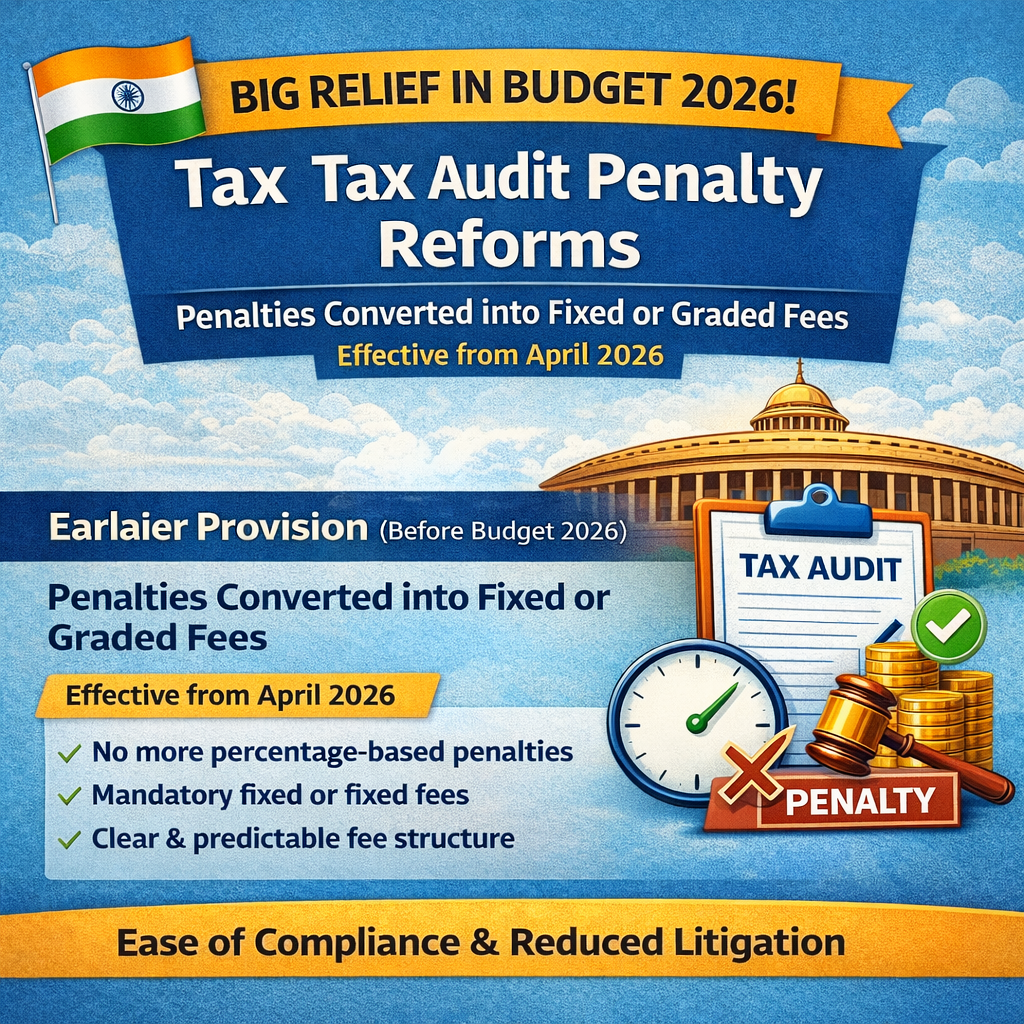
Budget 2026 Relief for Taxpayers: Penalty on Tax Audit Delay Removed from April 2026

Budget 2026 introduces a major compliance relief by replacing penalties with fixed mandatory fees for select procedural and technical lapses under the Income-tax Act.

The Government has recognised that penalties imposed for procedural or technical delays often result in avoidable litigation, even in situations where there is no revenue loss or any mala fide intent. To address this concern and provide greater certainty to taxpayers, Budget 2026 proposes to replace penalties for certain compliance failures with fixed or graded mandatory fees.

These amendments will come into force from 1 April 2026 and will apply from Tax Year 2026-27 onwards.


1. Change in Late Fee for Tax Audit – Section 446

Earlier Provision (Before Budget 2026)

Under Section 446, failure to get accounts audited or to obtain the audit report (without reasonable cause) attracted a discretionary penalty, being the lower of:

  • 0.5% of total sales / turnover / gross receipts, or

  • ₹1,50,000

Since the penalty was discretionary and turnover-linked, it frequently led to litigation, especially in cases involving minor or unintentional delays.

Proposed Amendment – Penalty Converted into Fee

Budget 2026 proposes to:

  • Omit the penalty provision under Section 446, and

  • Introduce a mandatory fee under proposed Section 428(c).

New Graded Fee Structure for Tax Audit Delay

Nature of Default Proposed Fee
Delay up to specified period ₹75,000
Delay beyond specified period ₹1,50,000

📌 The fee is mandatory, non-discretionary, and not linked to turnover or receipts, ensuring certainty in compliance.

Important Note:
While Section 446 has been removed for tax audit defaults, it has been re-purposed to deal with penalties related to failure to furnish or furnishing incorrect information on crypto asset transactions.


2. Change in Penalty for Transfer Pricing Audit Report – Section 447

Earlier Provision

Failure to furnish the accountant’s report under Section 172 (relating to international and specified domestic transactions) attracted a fixed penalty of ₹1,00,000 under Section 447.

Proposed Amendment

Budget 2026 proposes to:

  • Convert the penalty into a fee, and

  • Shift the provision to Section 428(4).

New Graded Fee Structure

Period of Delay Proposed Fee
Shorter delay ₹50,000
Longer delay ₹1,00,000

This change introduces proportionality and fairness, particularly for procedural delays without deliberate non-compliance.


3. Change in Penalty for Statement of Financial Transactions – Section 454(1)

Earlier Provision

Failure to furnish a Statement of Financial Transactions (SFT) or reportable account attracted a penalty of:

  • ₹500 per day for the period of default.

Proposed Amendment

Budget 2026 proposes to:

  • Convert the penalty into a mandatory fee, and

  • Shift the provision to Section 427(3).

This reflects the Government’s intent to treat technical reporting delays as compliance lapses rather than offences.


4. Capping of Penalty under Section 454(2)

Earlier Provision

If SFT was not furnished even after notice, a penalty of:

  • ₹1,000 per day was leviable

  • No maximum limit was prescribed

Proposed Relief

Budget 2026 introduces:

  • An upper cap of ₹1,00,000 on the penalty under Section 454(2)

This ensures certainty and prevents excessive penalties for prolonged but technical defaults.


5. Rationale Behind the Amendments

The Government has clearly stated that:

  • Penalties for technical defaults cause unnecessary litigation

  • Conversion into mandatory fees ensures certainty

  • Non-discretionary fees reduce arbitrary assessments

  • The reforms align with a trust-based, taxpayer-friendly tax administration


6. Effective Date & Applicability

  • Effective from: 1 April 2026

  • Applicable for: Tax Year 2026-27 onwards

  • Defaults relating to earlier tax years will continue under the old provisions


Penalties Converted into Fees – Summary Table

(Effective from 01.04.2026 | Tax Year 2026-27 onwards)

Nature of Default Earlier Penalty New Fee (Budget 2026)
Failure to get accounts audited Lower of 0.5% of turnover / receipts or ₹1,50,000 ₹75,000 / ₹1,50,000 (graded based on delay)
Failure to furnish TP Report (Sec 172) ₹1,00,000 ₹50,000 / ₹1,00,000 (graded fee)
Failure to furnish SFT / reportable account ₹500 per day (no cap) Fee under Section 427(3), capped at ₹1,00,000
Failure to furnish information (Sec 466) ₹1,000 ₹25,000 (fixed fee)