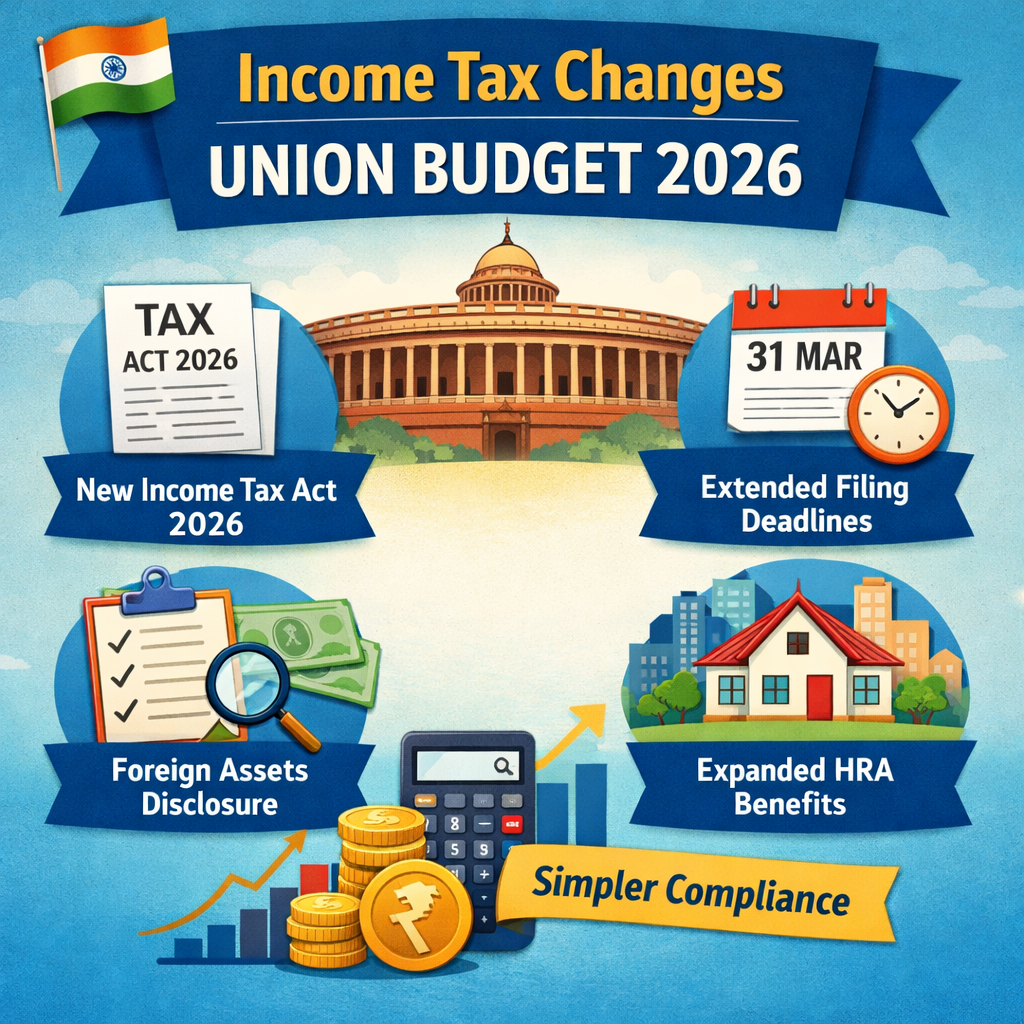
🔹 Income Tax Relief for Individuals There may be further rationalisation of income tax slabs, higher basic exemption limits, or enhancements in standard deduction to boost disposable income.

Union Budget 2026 – Overview and Expectations

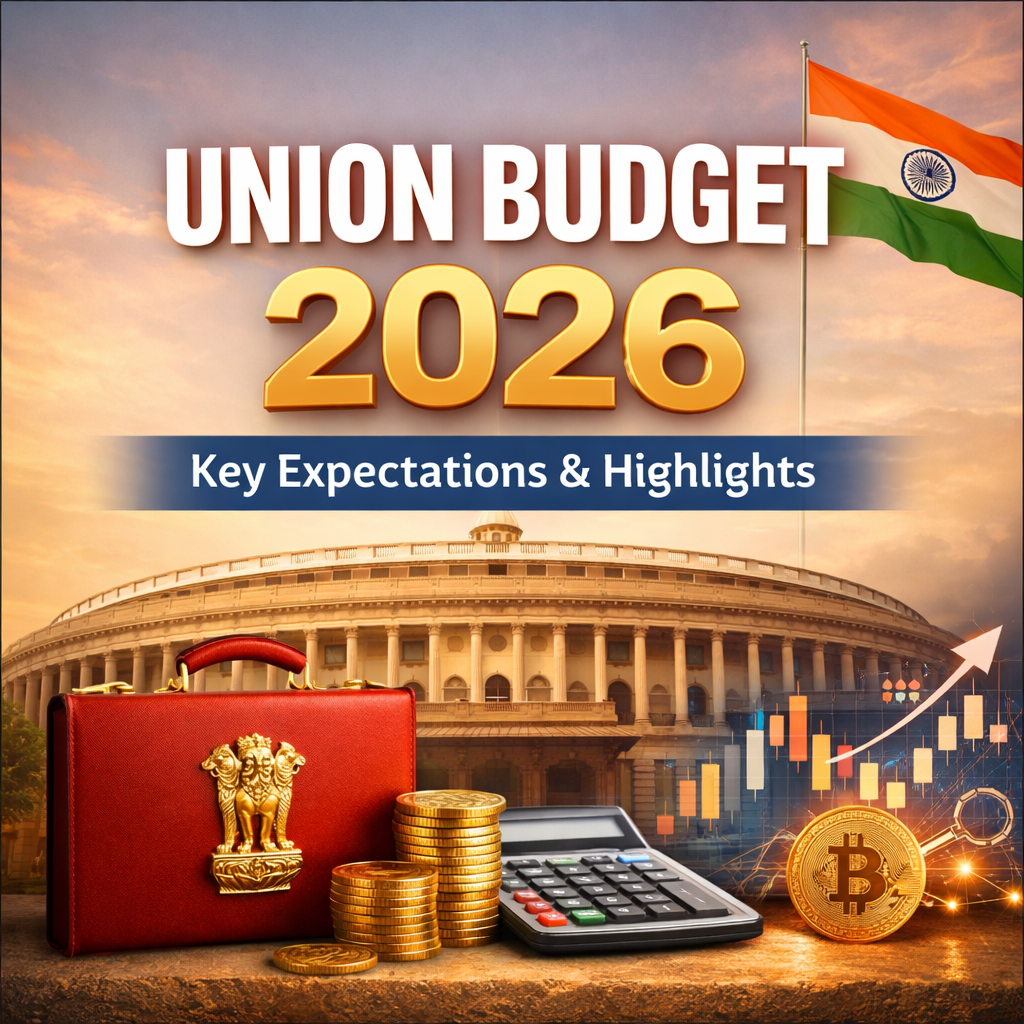
India’s Union Budget 2026 is slated to be presented on 1 February 2026 (Sunday) by the Finance Minister. Although presenting the Budget on a Sunday had earlier triggered discussion, it has now been formally confirmed, and the government is fully prepared for this key fiscal announcement.

This Budget assumes added significance as it follows the introduction of the Income-tax Act, 2025, which focused mainly on simplifying legal language and compliance procedures rather than making major policy changes. As a result, Budget 2026 is expected to carry the primary burden of announcing substantive tax and regulatory reforms.


I. Economic Background & Budget Direction

India’s macroeconomic position remains relatively stable, supported by steady growth, moderated inflation, and sustained investment in infrastructure. Budget 2026 is expected to strike a careful balance between managing fiscal pressures in the short term and driving long-term structural reforms.

The government is likely to continue prioritising capital expenditure, welfare schemes, digital transformation, and regulatory certainty, with focused attention on sectors such as agriculture, healthcare, women empowerment, start-ups, and emerging areas of the new digital economy.


II. Key Expectations from Budget 2026

1. Taxation – Areas of Anticipated Change

Personal Income Tax
Large-scale rate cuts are not widely expected; however, revisions in tax slabs, exemption limits, or thresholds may be introduced to improve household spending power and stimulate consumption.

Capital Gains Tax
Existing capital gains provisions are under review. Rationalisation measures may be announced to improve clarity, simplify compliance, and encourage investment activity.

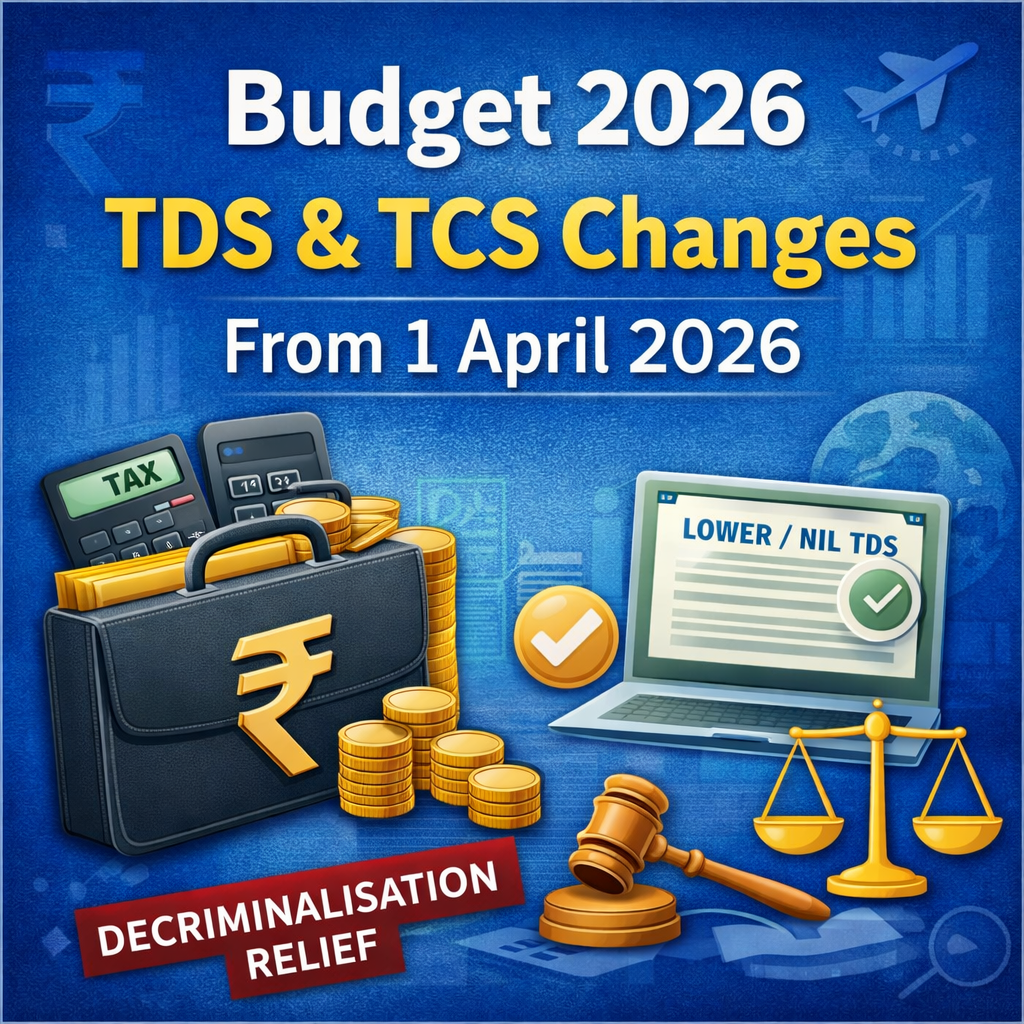
TDS Simplification
The government may streamline TDS provisions to reduce administrative and compliance challenges faced by businesses and taxpayers.

ESOPs and Foreign Tax Credit
Budget 2026 may bring clarity or relief measures related to ESOP taxation, particularly for employees of multinational companies, along with smoother mechanisms for claiming Foreign Tax Credit.


2. Sectoral and Social Priorities

Women-Centric Initiatives
Expect announcements aimed at improving women’s participation in the workforce, access to finance, skill development, and social security.

Agriculture and Rural Economy
Measures may include enhanced credit availability, farm modernisation programs, and targeted income-support mechanisms for farmers and rural households.

Senior Citizens
The government may extend or enhance benefits related to healthcare, savings, and taxation for senior citizens.


III. Virtual Digital Assets (Cryptocurrency) – Emerging Developments

1. Enhanced Monitoring, AML & KYC Framework

In early January 2026, the Financial Intelligence Unit (FIU) introduced tighter AML and KYC norms for crypto exchanges and VDA service providers. These measures aim to align the crypto ecosystem with mainstream financial regulations and improve traceability. Key elements include:

  • Live selfie verification using liveness detection to prevent misuse of static images or deepfakes

  • Geo-location capture, including latitude, longitude, IP address, date, and time for onboarding and transactions

  • Expanded KYC documentation, requiring PAN plus an additional government-issued ID along with OTP verification

  • Bank account authentication through penny-drop verification

  • Periodic KYC updates, with more frequent reviews for high-risk users

  • Continuous transaction monitoring and reporting of suspicious activities

These steps reflect the government’s intent to curb money laundering, terror financing, fraud, and misuse of anonymous crypto transactions, while strengthening investor confidence and systemic oversight.


2. Crypto Taxation – Industry Expectations

Under the current framework:

  • Gains from VDAs are taxed at a flat 30%, without allowing loss set-off

  • A 1% TDS applies on each transaction, which industry participants argue restricts liquidity and pushes traders to overseas platforms

For Budget 2026, crypto stakeholders are seeking:

  • Reduction in TDS (suggested at 0.01%) to improve market liquidity

  • Permission to offset losses against gains, bringing parity with other asset classes

  • More nuanced tax treatment, possibly based on holding period or integration with slab-based taxation

There is also discussion around establishing a clear regulatory authority structure, potentially involving SEBI for exchange oversight and RBI for cross-border monitoring, subject to Budget and post-Budget policy announcements.


IV. Indirect Tax and Regulatory Environment

GST and Customs

  • Industry is likely to seek GST rate rationalisation and faster processing of refunds

  • Customs duty structures may be reworked to support domestic manufacturing, technology adoption, and exports

Regulatory Coordination

Efforts are ongoing to move toward a single, well-defined regulatory framework for VDAs, reducing overlap among regulators and improving compliance clarity.


V. Core Themes Likely to Shape Budget 2026

Area Anticipated Focus
Taxation & Compliance Slab rationalisation, TDS simplification, crypto tax clarity
Digital Assets Stronger oversight, tracking mechanisms, regulatory structure
Women & Social Welfare Financial inclusion, employment, empowerment schemes
Agriculture & Rural Development Farmer support, rural infrastructure
Senior Citizens Health coverage and tax relief
Infrastructure & Capex Continued emphasis on public investment
Technology & Innovation R&D incentives, AI and digital economy push
Indirect Taxes GST simplification and customs duty rationalisation

In essence, Budget 2026 is expected to focus on stability, reform, and future readiness—combining fiscal prudence with growth-oriented policy measures across taxation, technology, and social development.

VI. Conclusion

Budget 2026 is expected to be a transformative fiscal roadmap, aimed at achieving sustainable economic growth, deeper social inclusion, and forward-looking regulatory reforms. In particular, the evolving approach toward the crypto and virtual digital asset ecosystem—marked by stricter KYC/AML requirements and closer regulatory supervision—signals the government’s intent to bring greater transparency, accountability, and investor confidence into the sector.

At the same time, market participants and industry stakeholders are looking toward the Budget for pragmatic tax rationalisation and clearer policy direction that encourages innovation and legitimate participation without diluting compliance standards. Overall, Budget 2026 is likely to reflect a careful balance between risk management and growth facilitation, reinforcing India’s commitment to a stable, inclusive, and future-ready economic framework.

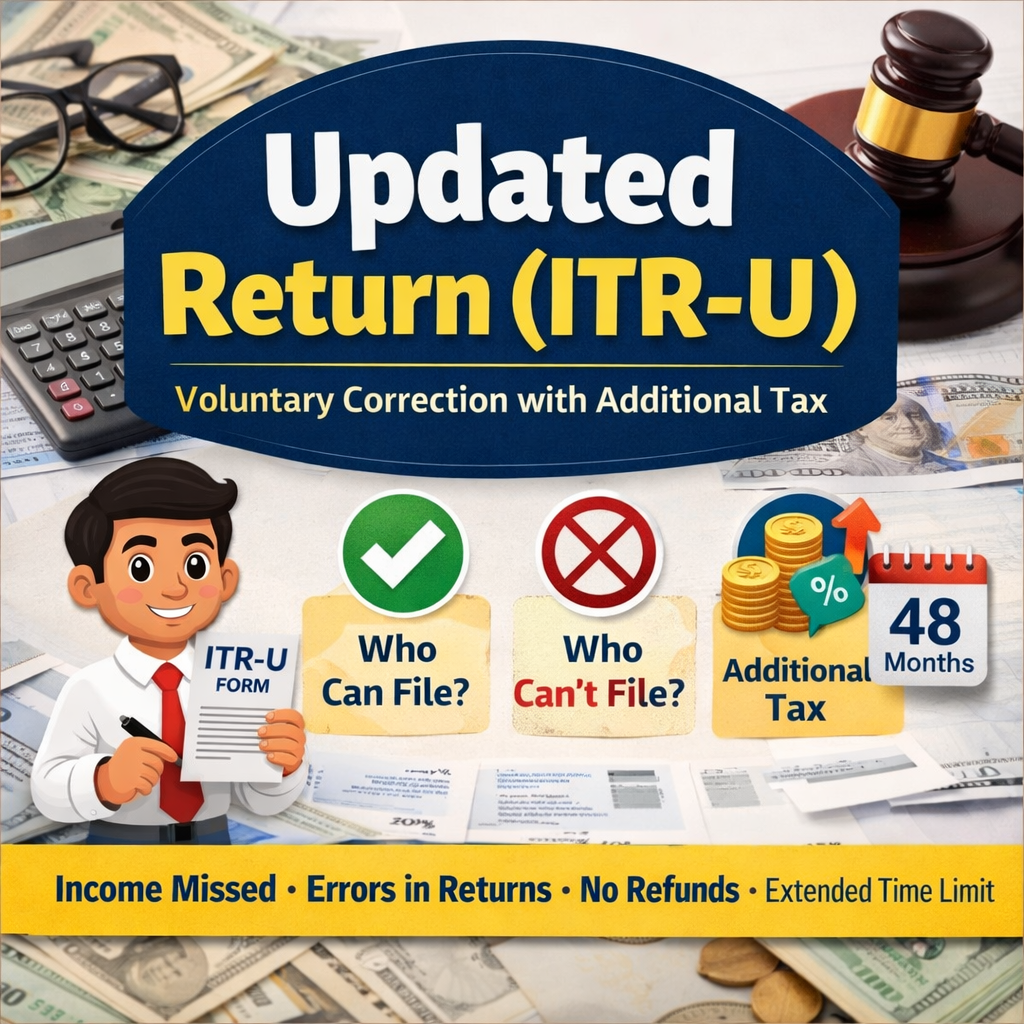
✅ Who is Eligible to File ITR-U? You may file an Updated Return if you need to: Report missed or under-reported income Correct wrong income details Amend an incorrect tax rate Reduce excess loss or depreciation claimed Update wrong deductions or exemptions File a return even if no return was filed earlier

Income-tax law ke andar voluntary compliance ko badhava dene ke liye Updated Return (ITR-U) ka concept laya gaya hai. Iska main objective ye hai ki agar kisi taxpayer se return file karte samay koi income reh gayi ho, galat details report ho gayi ho, ya return file hi nahi hui ho, to wo apni galti khud se sudhaar sake — bas shart ye hai ki uske saath due tax, interest aur additional tax ka payment kiya jaye.

Recent amendments ke baad ITR-U ki time limit aur additional tax structure dono me kaafi bade badlav kiye gaye hain. Is article me updated provisions ko simple language me samjhaya gaya hai.


ITR-U kya hota hai?

ITR-U (Updated Income-tax Return) ek special return hai jo Income-tax Act ke Section 139(8A) ke tahat file ki jaati hai. Ye tab file hoti hai jab:

  • Pehle file ki hui return me koi income disclose nahi hui ho

  • Income ya details galat report hui ho

  • Taxpayer ne pehle koi return file hi nahi ki ho

👉 Lekin dhyaan rahe, ITR-U sirf tab allowed hai jab usse extra tax payable banta ho.


Kaun ITR-U file kar sakta hai?

Neeche diye gaye taxpayers ITR-U file kar sakte hain:

  • Individual

  • HUF

  • Firm

  • Company

  • AOP / BOI

  • Trust ya anya entities

Aap ITR-U file kar sakte hain agar:

  • Aapne pehle original / belated / revised return file ki ho

  • Ya pehle return file nahi ki ho, lekin ab income disclose karne par tax payable ho raha ho

🔔 Important condition:
Updated return file karne ke baad tax liability increase honi chahiye. Agar tax nil ho ya refund ban raha ho, to ITR-U file nahi ki ja sakti.


Kaun ITR-U file nahi kar sakta?

Nimn situations me ITR-U file karna allowed nahi hai:

  • Agar updated return se:

    • Refund mil raha ho, ya

    • Pehle se due refund ki amount badh rahi ho

  • Agar updated return se:

    • Total tax liability kam ho rahi ho

  • Agar us assessment year ke liye:

    • Search u/s 132

    • Survey (specified cases)

    • Requisition u/s 132A
      jaise proceedings start ho chuki ho

  • Agar taxpayer:

    • Carry forward loss ko increase karna chahta ho
      (loss sirf reduce kiya ja sakta hai, badhaya nahi)


ITR-U file karne ki time limit (Updated Provision)

Purana rule:
ITR-U sirf 24 months ke andar file ki ja sakti thi.

Naya rule (1 April 2025 se effective):
Ab ITR-U 48 months (4 saal) tak file ki ja sakti hai, relevant assessment year ke end se.

Example:

  • Assessment Year: 2024-25

  • AY ka end: 31 March 2025

  • ITR-U ki last date: 31 March 2029

👉 Is extension ka purpose ye hai ki taxpayers ko zyada samay mile voluntarily income disclose karne ke liye.


ITR-U par Additional Tax (Section 140B)

ITR-U file karte waqt taxpayer ko ye payments karni hoti hain:

  • Applicable Income Tax

  • Interest (Section 234A / 234B / 234C, jo bhi apply ho)

  • Additional Income-tax

Additional tax ka calculation Tax + Interest ke total amount par hota hai.


Additional Tax Rates – Updated Structure

ITR-U Filing Period Additional Tax
12 months ke andar 25%
12–24 months 50%
24–36 months 60%
36–48 months 70%

Delay jitna zyada, additional tax utna hi zyada — isliye early compliance financially faydemand hai.


Simple Example

Maan lijiye:

  • Additional tax payable: ₹1,00,000

  • Interest: ₹10,000

  • Total (Tax + Interest): ₹1,10,000

12 months ke andar filing:

  • Additional tax @25% = ₹27,500

  • Total payable = ₹1,37,500

3rd year me filing (24–36 months):

  • Additional tax @60% = ₹66,000

  • Total payable = ₹1,76,000


Important Practical Points

  • ITR-U ka use refund claim ke liye nahi ho sakta

  • Ye facility sirf voluntary disclosure ke liye hai

  • Interest calculation me chhoti si galti additional tax ko bhi badha sakti hai

  • Har assessment year ke liye sirf ek baar ITR-U file ki ja sakti hai

  • Hamesha correct ITR-U form aur latest utility ka hi use karein

Updated Income Tax Slabs Applicable for FY 2025–26 (AY 2026–27)

Complete Overview of Income Tax Slabs, Rebate, Standard Deduction, Surcharge & Cess

The Government has retained the New Tax Regime as the default option and further streamlined the income tax slab structure to offer greater relief to middle-income taxpayers. For Financial Year 2025–26 (Assessment Year 2026–27), the revised framework emphasizes higher basic exemption limits, an enhanced rebate, and a standard deduction for salaried individuals, making the regime more taxpayer-friendly.

This article provides a comprehensive explanation of the latest income tax slab rates, along with details on the rebate under Section 87A, standard deduction, health and education cess, applicable surcharge, and the categories of taxpayers to whom these provisions apply.

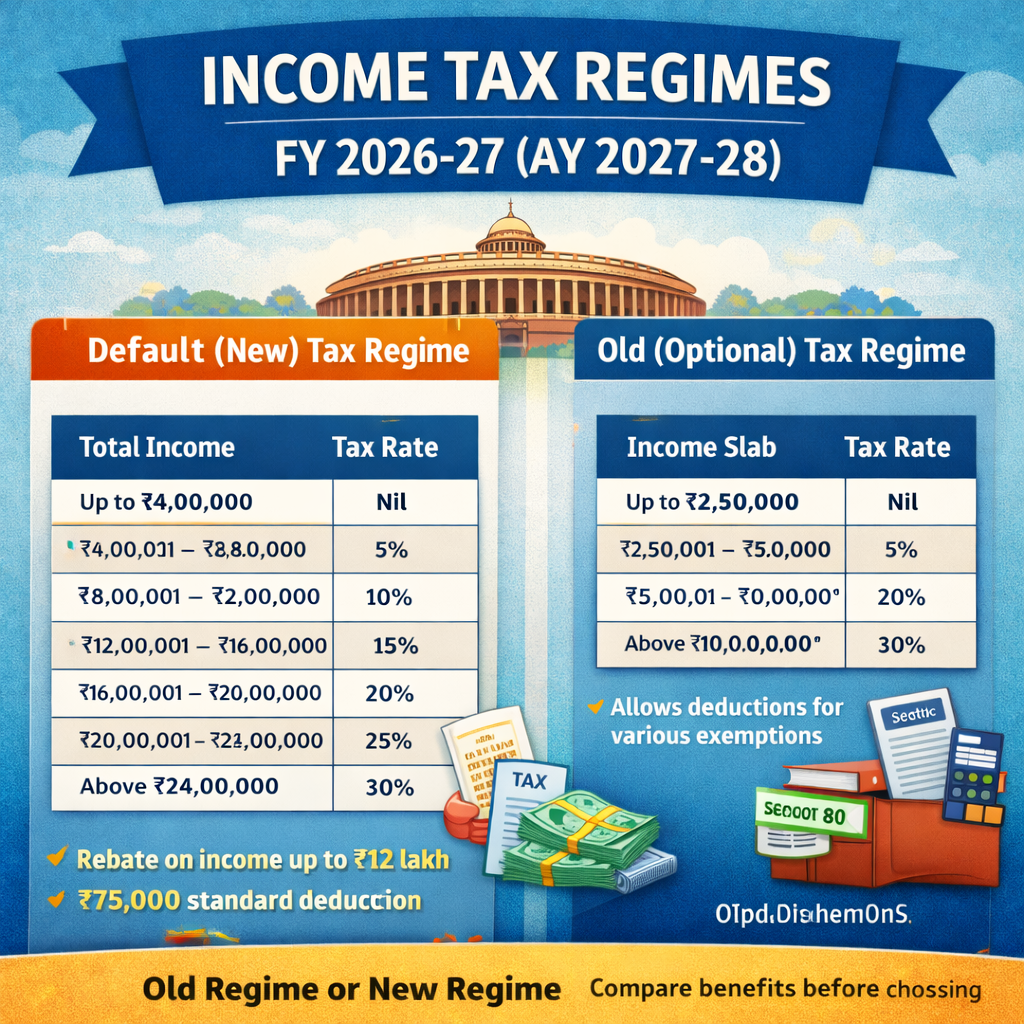
1. New Income Tax Slab Rates – FY 2025–26 (AY 2026–27)

Under the New Tax Regime, income is taxed at progressive slab rates as outlined below:

Total Income Applicable Tax Rate
Up to ₹4,00,000 Nil
₹4,00,001 – ₹8,00,000 5%
₹8,00,001 – ₹12,00,000 10%
₹12,00,001 – ₹16,00,000 15%
₹16,00,001 – ₹20,00,000 20%
₹20,00,001 – ₹24,00,000 25%
Above ₹24,00,000 30%

👉 Note: Income tax is calculated slab-wise, meaning each portion of income is taxed at the applicable rate, not the entire income at one single rate.


2. Income Up to ₹4,00,000 – No Tax Liability

For FY 2025–26, the basic exemption limit under the New Tax Regime stands at ₹4,00,000.
Accordingly, individuals whose total taxable income does not exceed ₹4 lakh are not required to pay any income tax.


3. Rebate Under Section 87A – Significant Relief

Eligibility Criteria

  • Available only to Resident Individual taxpayers

  • Applicable exclusively under the New Tax Regime

Rebate Provisions

  • If taxable income does not exceed ₹12,00,000

  • 100% rebate of tax payable is allowed

  • Maximum rebate amount: ₹60,000

👉 As a result, income up to ₹12 lakh becomes effectively tax-free under the New Regime.

Practical Clarification

  • Tax is first computed as per slab rates

  • If the calculated tax liability is ₹60,000 or less, the rebate completely offsets it

  • Net tax payable becomes Nil


4. Standard Deduction of ₹75,000

Who Can Claim?

  • Salaried employees

  • Pensioners

Deduction Amount

  • A flat standard deduction of ₹75,000 is available under the New Tax Regime

Tax Impact

Due to this deduction:

  • A salaried individual earning up to ₹12,75,000

  • After deducting ₹75,000, taxable income becomes ₹12,00,000

  • 👉 No income tax is payable

This significantly enhances the attractiveness of the New Regime for salaried taxpayers who do not rely heavily on deductions.


5. Health and Education Cess

  • 4% Health and Education Cess

  • Levied on income tax plus surcharge, if any

  • Applicable to all categories of taxpayers without exception


6. Surcharge on Higher Income Levels

Surcharge is levied when total income crosses ₹50 lakh, as per the following structure:

Total Income Surcharge Rate
₹50 lakh – ₹1 crore 10%
₹1 crore – ₹2 crore 15%
₹2 crore – ₹5 crore 25%
Above ₹5 crore 37%

Marginal Relief

Marginal relief is available to ensure that the additional tax payable due to surcharge does not exceed the additional income earned over the threshold limit.


7. Applicability of These Provisions

Applicable To

  • Resident Individuals

  • Salaried taxpayers

  • Pensioners

  • Professionals and business owners opting for the New Tax Regime

Not Applicable / Points of Caution

  • Non-resident individuals (Section 87A rebate not available)

  • Taxpayers with income taxed at special rates (such as lottery winnings or certain capital gains)

  • Individuals who claim substantial deductions under the Old Regime (80C, HRA, housing loan interest, etc.)


8. New Tax Regime vs Old Tax Regime – Practical Comparison

The New Tax Regime is more suitable if:

  • You have minimal deductions

  • You are a salaried taxpayer with a simple salary structure

  • Your annual income is around ₹12–13 lakh

The Old Tax Regime may be preferable if:

  • You claim major deductions under sections 80C, 80D, HRA, or home loan interest

  • You have substantial tax-saving investments

👉 Tip: Always compute tax liability under both regimes before filing your Income Tax Return to choose the most beneficial option.

Smart Reporting and Decision-Making with Easy Smart Shop

Data-driven decisions are critical for business growth. However, many businesses struggle because data is incomplete, inaccurate, or difficult to understand. Easy Smart Shop transforms daily business data into meaningful insights through powerful reports.

Comprehensive Business Reports

Easy Smart Shop provides detailed and easy-to-understand reports covering every area of business.

Reporting Features Include:

  • Sales reports (daily, monthly, yearly)

  • Purchase and expense reports

  • Stock and inventory summaries

  • Customer receivable reports

  • Supplier payable reports

  • Profit & Loss statements

  • Cash book and day book

Easy Analysis for Business Owners

All reports are presented in a structured format, helping business owners quickly identify trends and issues.

Decision-Making Advantages:

  • Identify high-performing products

  • Monitor expenses and control costs

  • Track payment delays

  • Analyze profitability

  • Plan purchases and production better

Accuracy and Transparency

Because all operations are connected—billing, inventory, production, and finance—reports are accurate and reliable. This creates transparency across the business and reduces dependency on manual checks.


Conclusion

Easy Smart Shop is more than an operational tool. It is a business intelligence partner that helps owners understand their business clearly, take timely decisions, and grow with confidence.

Strengthening Customer Relationships and Sales Growth with Easy Smart Shop

In any business, customers are the foundation of success. Managing customer data, tracking sales, following up on payments, and maintaining service quality becomes difficult when records are scattered or manual. Easy Smart Shop helps businesses build stronger customer relationships by organizing everything in one place.

Centralized Customer Management

Easy Smart Shop allows businesses to store complete customer information along with transaction history, outstanding amounts, and follow-up records.

Customer Management Features:

  • Customer profile creation and management

  • Complete sales and payment history

  • Outstanding balance tracking

  • Due payment follow-up reminders

  • Customer-wise reports and summaries

Improved Sales Efficiency

With faster billing, easy quotation creation, and accurate records, businesses can respond quickly to customer requirements.

Sales Support Features:

  • Quick invoice and quotation generation

  • Easy conversion of quotations to invoices

  • Professional documentation

  • Sales summary and performance reports

Business Benefits

  • Faster customer service

  • Improved customer trust

  • Reduced payment delays

  • Better repeat sales

  • Clear visibility of customer behavior

By improving customer handling and communication, Easy Smart Shop helps businesses increase sales and build long-term relationships.

How Easy Smart Shop Improves Inventory, Production, and Financial Control

Inventory, production, and finance are the three pillars of any product-based business. If any one of these is poorly managed, the entire operation can suffer. Easy Smart Shop provides strong control over all three areas in a simple and connected manner.


Smart Inventory Management

Poor inventory control often leads to overstocking, shortages, and losses. Easy Smart Shop ensures that stock data is always accurate and updated.

Inventory Features Include:

  • Real-time stock updates

  • Category and product-wise stock management

  • Low-stock and expiry alerts

  • Purchase and stock adjustment records

  • Inventory summary and detailed reports

Business Impact:

  • Prevents stock shortages

  • Reduces wastage

  • Improves purchase planning

  • Enhances customer satisfaction


Production & Process Management

For manufacturing and processing businesses, managing production efficiently is critical. Easy Smart Shop helps monitor the complete production lifecycle.

Production Features Include:

  • Production order creation

  • Tracking of raw material usage

  • Multi-stage process monitoring

  • Finished goods stock updates

  • Wastage and by-product tracking

  • Complete production history

Business Impact:

  • Better control over resources

  • Reduced production errors

  • Improved delivery timelines

  • Clear visibility of production performance


Financial & Expense Control

Financial discipline is essential for sustainable growth. Easy Smart Shop helps businesses track income, expenses, and dues clearly.

Finance Features Include:

  • Expense entry and category-wise tracking

  • Customer receivable reports

  • Supplier payable reports

  • Due payment follow-up reminders

  • Profit & Loss summaries

  • Cash book and day book reports

Business Impact:

  • Improved cash flow management

  • Timely payment collections

  • Better expense control

  • Clear financial visibility


GST Compliance Made Simple

GST compliance can be complex, but Easy Smart Shop simplifies it with accurate data and reports.

GST Support Includes:

  • GST-ready sales and purchase data

  • GSTR-1 and GSTR-3B compatible reports

  • Easy data export for filing

  • Smooth coordination with CAs

This ensures compliance without stress or confusion.


Conclusion

Easy Smart Shop combines operations, production, inventory, billing, and finance into one smart system. By replacing manual work and disconnected tools, it helps businesses operate smoothly, make informed decisions, and grow confidently.

With Easy Smart Shop, businesses don’t just manage work—they manage it smartly.

Why Easy Smart Shop Is the Perfect All-in-One Software for Modern Businesses

Managing a business today is more complex than ever. Business owners must handle billing, inventory, customers, suppliers, production, expenses, compliance, and reporting—often all at the same time. Using separate tools or manual registers not only increases workload but also creates chances of errors and delays.

Easy Smart Shop by Swanirmit Technologies is designed to solve these challenges by offering a single, integrated business management platform that is easy to use, reliable, and scalable.

What Makes Easy Smart Shop Different?

Easy Smart Shop is built by understanding real business needs. It focuses on automation, accuracy, and simplicity so that business owners can concentrate on growth instead of daily operational stress.

Key Capabilities of Easy Smart Shop

  • Fast and accurate billing system

  • Real-time inventory management

  • Customer and supplier tracking

  • Quotation and job work management

  • Expense control and financial tracking

  • Production and process monitoring

  • Due payment follow-up system

  • GST-ready reports and compliance support

  • Powerful business reports and analytics

  • Multi-user access with role control

Benefits for Business Owners

  • Saves time by automating routine tasks

  • Reduces manual errors and paperwork

  • Improves operational transparency

  • Enhances customer service with faster billing

  • Helps in better financial planning

  • Supports business growth with reliable data

Easy Smart Shop is suitable for retailers, wholesalers, distributors, manufacturers, factories, and service-based businesses. Whether the business is small or growing, the software adapts to changing needs.

In short, Easy Smart Shop is not just software—it is a complete digital backbone for your business.

GST Advisory Explained: Opt-In Declaration for Specified Hotel Premises

GST Advisory: Online Facility for Opt-In Declaration of Specified Premises

(Effective from 1 January 2026)

📅 Overview of the Update

GSTN, through an advisory issued on 4 January 2026, has introduced an online mechanism on the GST Portal for filing Opt-In Declarations for “Specified Premises”, as prescribed under Notification No. 05/2025 – Central Tax (Rate) dated 16 January 2025.

Previously, for FY 2025-26, taxpayers were required to submit these declarations manually to jurisdictional GST officers. With effect from 1 January 2026, the declaration process has been digitised, ensuring better transparency, ease of compliance, and system-based tracking.

This update is especially relevant for hotels and accommodation service providers.


🏨 Meaning of “Specified Premises” under GST

“Specified Premises” refers to hotel accommodation units that choose to be governed by the specific GST rate structure notified for such premises under GST law.

Once a premise is opted in as a specified premise:

  • The declaration applies only to the selected premise

  • The status continues for subsequent financial years

  • It remains valid until an opt-out declaration (Annexure IX) is filed


👥 Eligible & Ineligible Persons

✅ Who Can File

  • Existing regular GST taxpayers (active or suspended) providing hotel accommodation services

  • Applicants for new GST registration intending to declare premises as specified premises

❌ Who Cannot Use This Facility

  • Composition scheme taxpayers

  • GST TDS / TCS registrants

  • SEZ units or SEZ developers

  • Casual taxable persons

  • Taxpayers with cancelled GST registrations

📌 Note: Suspended registrations are permitted; cancelled registrations are not.


📄 Declarations Available on GST Portal

🔹 Annexure VII – For Existing Registrations

  • Applicable to already registered taxpayers

  • Used to opt in for specified premises for the upcoming financial year

🔹 Annexure VIII – For New Registration Applicants

  • Applicable to persons applying for fresh GST registration

  • Becomes effective from the date GST registration is granted

🔔 Annexure IX – Opt-Out Declaration

  • Will be enabled on the portal separately at a later stage


⏰ Filing Timelines

🅰️ Existing Registered Taxpayers (Annexure VII)

  • Can be filed only for the next financial year

  • Filing period: 1 January to 31 March of the preceding year

📌 For FY 2026-27
➡️ Window: 01-01-2026 to 31-03-2026

🅱️ New Registration Applicants (Annexure VIII)

  • Must be filed within 15 days of ARN generation

  • Can be filed even before GSTIN is allotted, provided:

    • Registration application is not rejected

⛔ If the 15-day period expires:

  • Filing will be allowed only through Annexure VII during the prescribed window

  • If registration is rejected, Annexure VIII cannot be filed


🖥️ Procedure to File Opt-In Declaration on GST Portal

  1. Log in to the GST Portal

  2. Navigate to:
    Services → Registration → Declaration for Specified Premises

  3. Select the relevant option:

    • Opt-In Declaration, or

    • Download Filed Annexure

  4. Choose eligible premises

  5. Enter required declaration details

  6. Submit using EVC

  7. ARN is generated upon successful submission


⚠️ Key Practical Points

  • A maximum of 10 premises can be selected in one declaration

  • Each premise generates:

    • A separate reference number

    • A separate downloadable PDF

  • Additional declarations may be filed for remaining premises

  • If a premise is missed, Annexure VII can be re-filed for the same FY during the open window

  • Once opted in, the status continues automatically unless Annexure IX (opt-out) is filed


📥 Downloading Filed Declarations

Declarations can be downloaded from:
Services → Registration → Declaration for Specified Premises → Download

Each declared premise will have an individual downloadable record.


📧 Email & SMS Alerts

After successful filing:

  • Email and SMS notifications are sent to all authorised signatories


🔔 Special Clarifications for FY 2025-26 & FY 2026-27

1️⃣ Manual Filers for FY 2025-26
Taxpayers who submitted declarations manually must re-file Annexure VII online for FY 2026-27 between 01-01-2026 and 31-03-2026.

2️⃣ First-Time Declaration of Specified Premises
Those opting in for the first time must file Annexure VII online within the same window for FY 2026-27.

January 2026: Complete Compliance & Filing Schedule for Businesses

January marks more than just the start of a new calendar year—it is also one of the busiest compliance months for businesses, professionals, and employers. A tight cluster of statutory obligations such as GST returns, TDS filings, PF-ESI contributions, and MCA compliances leaves little room for error. Missing even one due date can trigger late fees, interest, penalties, or system-generated notices.

As we enter January 2026, the compliance environment continues to become more stringent, backed by tighter deadlines, automated checks, and enhanced portal validations. To help businesses, taxpayers, and professionals stay on track, this article provides a comprehensive, date-wise compliance calendar for January 2026, covering GST, Income Tax, TDS/TCS, PF, ESI, and MCA requirements—all consolidated in one place.


GST Compliance

Due Date | Return/Form | Period | Applicability
7 January 2026 | GSTR-7 | December 2025 | GST TDS deductors
7 January 2026 | GSTR-8 | December 2025 | E-commerce operators
11 January 2026 | GSTR-1 | December 2025 | Monthly outward supply filers
20 January 2026 | GSTR-3B | December 2025 | Monthly GST return
22/24 January 2026 | GSTR-3B (QRMP) | Oct–Dec 2025 | Based on state category
20 January 2026 | GSTR-5A | December 2025 | OIDAR service providers

GST Composition Scheme
18 January 2026 | CMP-08 | Oct–Dec 2025


TDS/TCS & Income-Tax Compliances

Monthly TDS/TCS Payment
7 January 2026 – Deposit of TDS/TCS for December 2025
(Generally payable by the 7th of the following month)

Quarterly TDS/TCS Returns
15 January 2026 | Form 27EQ (TCS) | Oct–Dec 2025
31 January 2026 | Forms 24Q, 26Q, 27Q | Oct–Dec 2025

Income-Tax Update
As per CBDT indications, new ITR forms and procedures under the simplified Income-tax framework are expected to be notified by January 2026, ahead of implementation from 1 April 2026.


PF & ESI Compliance

15 January 2026
• EPF contribution payment & return – December 2025
• ESI contribution payment & return – December 2025

(PF and ESI dues are generally payable by the 15th of the subsequent month.)


MCA / ROC Filings

31 January 2026
• Filing of Annual Returns and Financial Statements for FY 2024-25
• Ensure timely submission of AOC-4 and MGT-7 within the extended timeline

LLPs should also verify due dates for Form 11 and other applicable ROC filings based on entity-specific requirements.


Other Important Statutory Compliances

Professional Tax (PT)
Generally payable by 31 January 2026 for December 2025 salary deductions (state-specific rules apply).

Advance Tax
No advance tax installment is due in January; the next installment falls in March 2026.


Consequences of Delayed Compliance – Quick Snapshot

GST: Late fees and interest on net tax liability
TDS/TCS: Interest and penalties for late payment or return filing
PF/ESI: Interest and statutory damages under respective laws


In today’s technology-driven compliance framework, delays rarely go unnoticed. GST filings, TDS payments, PF-ESI contributions, and MCA submissions are closely monitored through integrated systems. Timely compliance is no longer optional—it is essential.

Use this January 2026 Compliance Calendar as a ready reference, plan your filings in advance, and complete all obligations well before due dates. Staying proactive today helps avoid financial exposure, legal complications, and unnecessary stress in the future.

🌟 Invitation to Visit Swanirmit Technologies|Stall G7 | MASSIA Campaign 2026 | Chhatrapati Sambhajinagar

Swanirmit Technologies is proud to invite you to visit our stall at the MASSIA Campaign 2026 (Advantage Maharashtra Expo 2026), one of the largest industrial and business exhibitions in Marathwada.

This expo brings together entrepreneurs, MSMEs, manufacturers, retailers, and technology providers on one platform — and we are excited to showcase our flagship product Easy Smart Shop.


📍 Stall & Event Details

Exhibitor: Swanirmit Technologies
Stall Number: G7

Event: MASSIA Campaign / Advantage Maharashtra Expo 2026

Venue: AURIC Exhibition Ground, Shendra MIDC

City: Chhatrapati Sambhajinagar, Maharashtra

Visitor Registration: https://www.amexpo.in/visitor_registration.php

Google Location: https://maps.app.goo.gl/mfprhHb4LPSe6omB9


💻 Product Overview: Easy Smart Shop

Easy Smart Shop is an all-in-one business management software designed specially for small and medium businesses who want to simplify operations, reduce manual work, and grow efficiently.

At Stall G7, you will get a complete live demonstration of how Easy Smart Shop works in real business scenarios.

🔹 Key Features of Easy Smart Shop

🧾 Smart Billing

  • Fast and simple billing process

  • GST-ready invoices

  • Support for multiple payment modes

  • Error-free and professional bills

📦 Inventory Management

  • Real-time stock tracking

  • Low stock alerts

  • Easy product management

  • Reduced stock loss and confusion

👥 Customer & Supplier Management

  • Maintain customer records easily

  • Track outstanding balances

  • Supplier purchase history at one place

📊 Business Reports

  • Sales, purchase, and profit reports

  • Daily, monthly, and yearly insights

  • Helps in better decision-making

📱 Easy to Use

  • Simple interface

  • No technical knowledge required

  • Quick setup and training

☁️ Secure & Reliable

  • Safe data handling

  • Designed for smooth day-to-day operations


🎯 Who Should Visit Our Stall?

Easy Smart Shop is ideal for:

  • Retail shop owners

  • Supermarkets & kirana stores

  • Distributors & wholesalers

  • Manufacturers & factories

  • Service-based businesses

  • MSMEs looking for digital solutions


🤝 Why Visit Stall G7?

  • Live demo of Easy Smart Shop

  • One-to-one business consultation

  • Understand how software fits your business

  • Practical solutions for real business problems

  • Guidance from our expert team

Whether you are starting your digital journey or upgrading your existing system, Swanirmit Technologies is here to help.


📌 Venue Address

AURIC Exhibition Ground
Shendra MIDC,
Chhatrapati Sambhajinagar,
Maharashtra

📍 Look for Stall Number G7 – Swanirmit Technologies


✨ We Look Forward to Meeting You

We warmly welcome business owners, entrepreneurs, partners, and visitors to connect with us and explore how Easy Smart Shop can make business management easy, smart, and efficient.

👉 Save the stall number: G7
👉 Visit Swanirmit Technologies at MASSIA Campaign 2026