
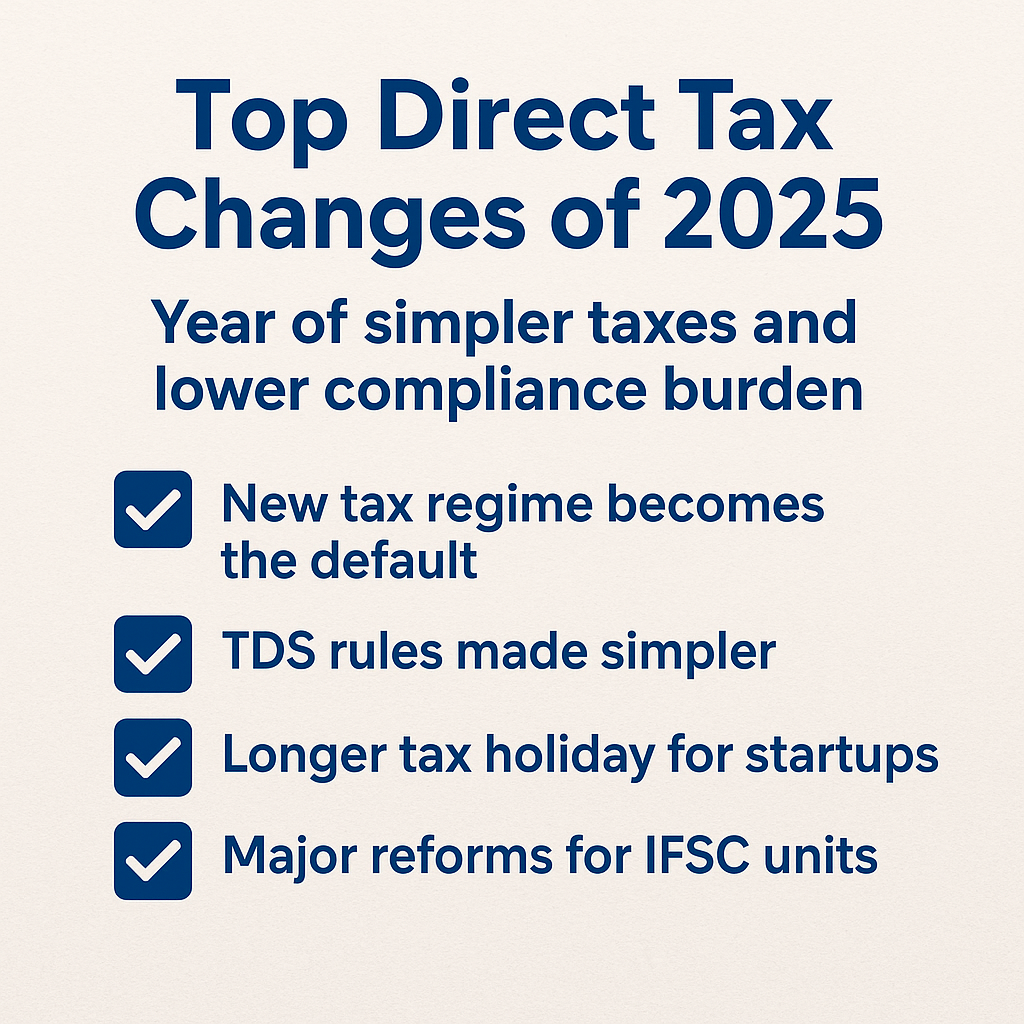

Direct Tax Changes in 2025: Simplification and Reduced Compliance Take Centre Stage
India’s direct tax framework underwent several significant changes in 2025 as the government prioritised tax simplification, eased compliance requirements, and sought to encourage higher consumer spending. The reforms—ranging from an overhauled personal tax regime and simplified TDS provisions to an extended tax holiday for startups and greater clarity on capital gains—have had a wide-ranging impact across the economy.
New tax regime made the default option
The most notable reform was the decision to make the new tax regime under Section 115BAC the default choice for taxpayers. The basic exemption limit was increased to ₹4 lakh, while the rebate under Section 87A was enhanced, effectively making income up to ₹12 lakh tax-free.
Experts say the impact of this shift is already being felt. According to them, the simplified slab structure and higher rebate have raised disposable incomes, providing a clear boost to consumption-driven sectors such as manufacturing and construction.
Simplified TDS framework
Budget 2025 introduced meaningful changes to the Tax Deduction at Source (TDS) provisions under the Income Tax Act, 1961, with the objective of easing compliance for individuals and businesses. TDS rules were streamlined and threshold limits enhanced, significantly lowering the compliance burden for small taxpayers and enterprises. In addition, the turnover limit for presumptive taxation under Section 44AD was increased to ₹3 crore, offering MSMEs greater flexibility and reduced administrative overheads.
Extended tax holiday for startups
The 2025 Budget also prolonged the 100 per cent profit-linked tax deduction for eligible startups, allowing them to claim the benefit for any three years within their first ten years of operation. This incentive has now been extended until April 1, 2030. The extended timeline is expected to support startups in navigating initial loss-making years and improve their ability to attract investment.
Key reforms for IFSC entities
The Finance Act, 2025 rolled out a series of tax incentives for units operating in the International Financial Services Centre (IFSC). Offshore funds and exchange-traded funds (ETFs) are now permitted to relocate to IFSC without triggering adverse tax consequences. Additionally, non-residents trading in offshore or over-the-counter derivatives through IFSC platforms will be eligible for tax exemptions. Tax incentives for IFSC units have also been extended up to March 31, 2030.
A significant amendment was also made to deemed dividend provisions. Inter-company loans will no longer be classified as deemed dividends when the lending entity is a finance company or an IFSC-based finance unit. According to Ananthapadmanabhan, this change has prompted large corporate groups to consider moving treasury operations to India, as the clarity around treasury-related lending removes a key area of concern.
Removal of equalisation levy
Under the Finance Act, 2025, the government abolished the equalisation levy on digital advertising with effect from April 1, 2025. This step has simplified the tax framework for multinational technology companies operating in India.
Taking an overall view, Ananthapadmanabhan said the reforms have strengthened the foundation for sustained, demand-driven economic growth, which is also evident in the sharp rise in GDP growth to 8.2 per cent in the second quarter of FY26.